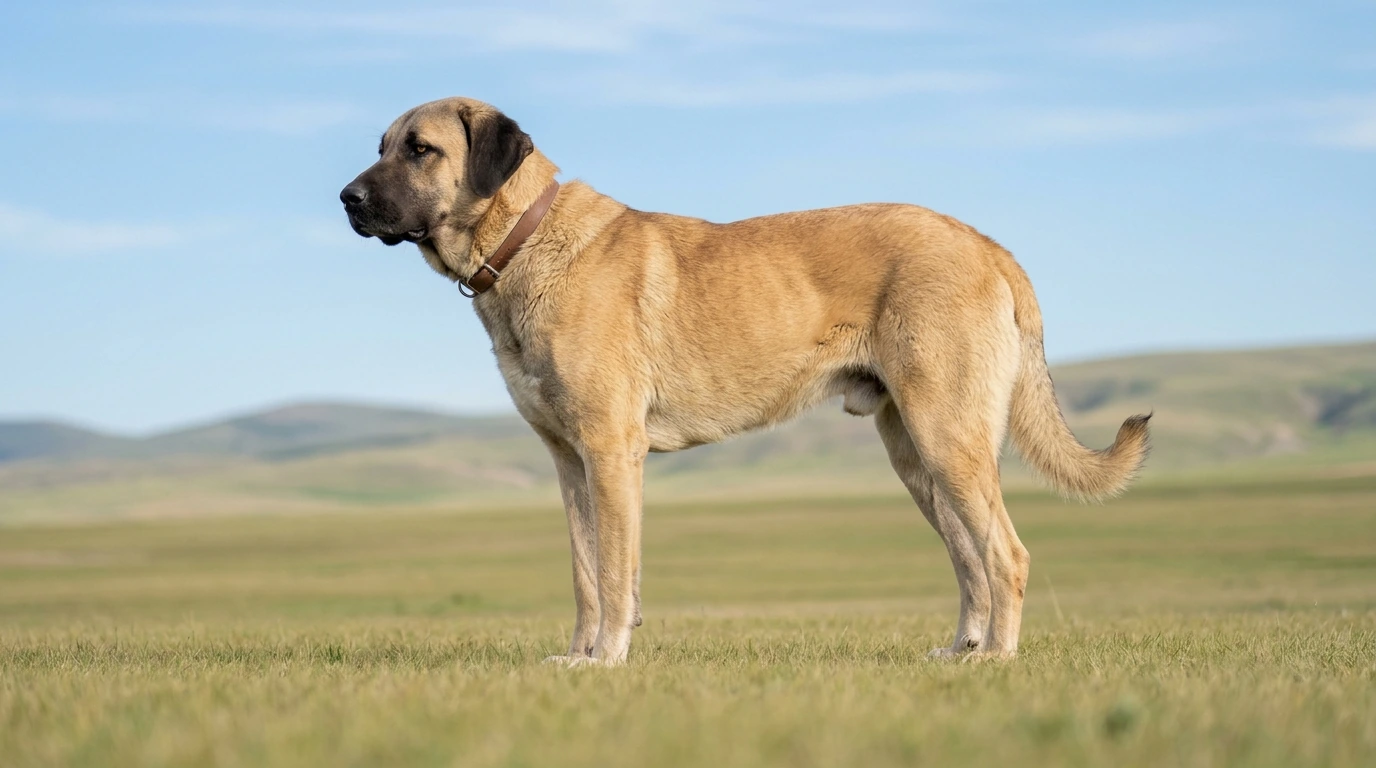
What is an Anatolian Shepherd Dog? It’s a large flock guard from Turkey, recognised by the Royal Kennel Club in its Pastoral group. Its breed standard gives males 74–81cm and 50–64kg, and females 71–79cm and 41–59kg, and describes a steady, bold dog without aggression. It isn’t a banned type in the UK, but it needs a large home, a large garden and more than two hours of exercise a day.
We haven’t owned an Anatolian Shepherd, so this guide draws on the Royal Kennel Club’s breed standard and breed page, Dogs Trust’s UK longevity study, GOV.UK and PDSA’s general advice for dog owners. Where UK sources say nothing about this breed, we’ve said so.
Before you decide: Dogs Trust says claims that a breed has certain traits, such as being good with children, should be treated with caution, because that depends on the individual dog. Get to know the dog itself, not just what’s said about the breed.
TABLE OF CONTENTS
Anatolian Shepherd Dog at a glance
| What to know | Anatolian Shepherd Dog | Source |
|---|---|---|
| Royal Kennel Club group | Pastoral | Royal Kennel Club |
| Size category | Large | Breed page |
| Height | Males 74–81cm, females 71–79cm | Breed standard |
| Weight | Mature males 50–64kg, females 41–59kg | Breed standard |
| Coat | Short and dense, with a thick undercoat | Breed standard |
| Colour | All colours except merle, with or without a black mask and black ears | Breed standard |
| Exercise | More than 2 hours a day | Breed page |
| Home | A large house and large garden; suits the country | Breed page |
| Grooming | More than once a week; the coat sheds | Breed page |
| UK median lifespan | 10.1 years (from a small group of dogs) | Dogs Trust 2024 |
| Breed Watch | Category 1 | Breed page |
| Health test for breeders | Hip scoring (BVA/KC scheme) | Breed page |
| UK legal status | Not a banned type | GOV.UK |
Sources: Royal Kennel Club breed standard (updated April 2025) and breed page; Dogs Trust 2024 UK longevity study; GOV.UK. A breed standard describes the ideal, so an individual dog may be larger or smaller than the sizes given.
Anatolian Shepherd size and weight
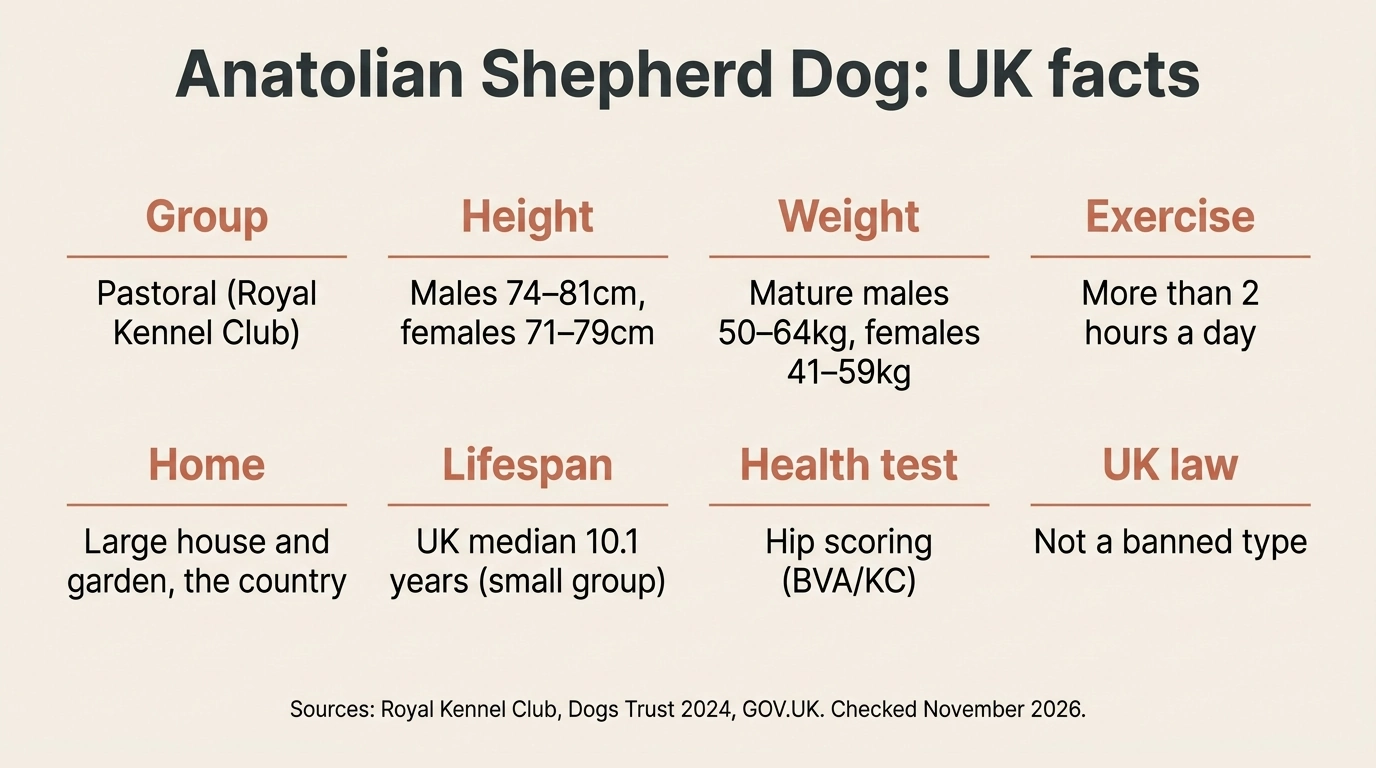
The breed standard asks for males of 74–81cm at the shoulder and females of 71–79cm. It gives a weight too: 50–64kg for mature males and 41–59kg for females. The breed page puts the Anatolian in the Royal Kennel Club’s Large size category, and the standard adds that mature males have a broader head than females.
Those figures describe the ideal dog, not a promise about any one puppy. The Royal Kennel Club’s note for puppy buyers makes the same point: a dog might be larger or smaller than the measurements in its standard. To see how this standard compares with other big breeds, our list of giant dog breeds gives each one’s heights.
Growing up: what UK sources say
No UK source publishes a growth chart or weights by age for Anatolian Shepherd puppies, so we don’t give one. What does apply is general advice for any growing large dog. PDSA says hip dysplasia tends to be worse in medium to large breeds, fast-growing dogs, overweight dogs and dogs over-exercised when young. It advises feeding a food that suits your puppy’s size, breed and age, and asking your vet how to exercise them as they grow. Our guide to large breed puppy food covers the feeding side.
What does an Anatolian Shepherd look like?
The breed standard describes a large, tall, upstanding dog with a broad, heavy head and a short, dense coat, and says it must have size, stamina and speed. The skull is large, broad and flat between the ears, and the muzzle makes up about a third of the head’s length. The nose, lips and eye rims are black, and the eyes are fairly small for the size of the skull, golden to brown in colour.
The ears are medium-sized and triangular with rounded tips, hanging flat against the head and lifting when the dog is alert. The tail is long, reaching at least to the hock. At rest it’s carried low with a slight curl; when the dog is alert, it’s carried high with the end curled over the back, especially in males.
Coat, colour and mask
The coat is short and dense with a thick undercoat. It lies flat and close, is a little longer and thicker at the neck, shoulders and tail, and has no feathering on the ears or legs.
The standard accepts all colours, with or without a black mask and black ears; only merle is unacceptable. The Royal Kennel Club’s breed-standard colours for registration are fawn with mask, grey fawn with mask, red fawn with mask, tricolour, and white with no mask. A fawn dog with a black mask can look a lot like a Turkish Kangal Dog, which is where much of the confusion between the two breeds starts.
Karabash, Akbash and other names
The Royal Kennel Club’s Breeds A to Z lists this breed under one name, the Anatolian Shepherd Dog, often shortened to Anatolian Shepherd.
The Turkish Kangal Dog is a separate breed in the same Pastoral group. Its breed page says it has only recently been recognised in the UK and “was previously included as an Anatolian Shepherd Dog”. Our Anatolian Shepherd vs Kangal guide covers how the two compare.
You may also come across the names Anatolian Karabash, Karabash and Akbash. None of them is a Royal Kennel Club breed name, and no UK source we found explains what they cover. That’s why this guide doesn’t describe an Akbash, or treat any of these names as the same dog as the Anatolian Shepherd.
Anatolian Shepherd temperament in the standard’s words
The breed standard describes the ideal temperament as steady and bold without aggression, naturally independent and very intelligent, as well as proud and confident. It says the breed was originally used to guard sheep, works hard, and can cope with extremes of heat and cold.
The Royal Kennel Club’s breed page explains where that character comes from. It describes a flock guard that lived a nomadic life with its owner, travelling great distances across Turkey’s Central Anatolian Plateau and living outdoors through very hot summers and freezing winters. It calls the breed hardy, agile and loyal, naturally independent and wary of strangers.
Both describe the ideal dog. Neither predicts how any one Anatolian will behave.
Where UK sources go quiet
No UK study measures how Anatolian Shepherds behave, and none of PDSA, Dogs Trust or Blue Cross publishes a guide to the breed. So we can’t tell you how Anatolians tend to get on with children, other dogs or cats. With a breed its own breed page calls wary of strangers, that gap is a good reason to spend time with the individual dog before you decide.
Home, garden, exercise and coat care
The Royal Kennel Club’s breed page sets out what an Anatolian Shepherd needs:
- more than two hours of exercise a day
- a large house with a large garden
- life in the country rather than a town
- grooming more than once a week, as the short coat sheds
The page gives no further detail, and no UK charity has a breed guide to add to it.
Puppy socialisation and training
PDSA’s general advice for any puppy is that the socialisation period runs from about four to 12 weeks old, and that plenty of positive new experiences in that time help a puppy grow into a happy, confident adult. It also recommends consistent, reward-based training throughout a dog’s life. That’s advice for all dogs, not a breed rule, but it matters for an independent dog its breed page calls wary of strangers. Our guide to dog training covers reward-based methods step by step.
Anatolian Shepherd lifespan and health testing
Dogs Trust’s 2024 UK longevity study gives the Anatolian Shepherd a median lifespan of 10.1 years, so a typical dog in the study lived to about 10. The figure comes from a small group of dogs, so treat it as a rough guide. A median describes the middle of the group, not how long your own dog will live.
The breed is in Breed Watch Category 1, which the Royal Kennel Club uses when no points of concern specific to a breed have been identified for judges beyond those its standard already covers. Its good-practice advice for breeders is to prioritise genetic diversity, and its best-practice list adds hip scoring through the BVA/KC Hip Dysplasia Scheme. There’s no breed-specific DNA testing package.
Hip dysplasia is much more common in medium to large pedigree breeds, and if you choose a breed prone to it, you should ask the breeder about hip scores, according to PDSA’s guide to hip dysplasia. Its examples don’t include the Anatolian Shepherd, and we found no RVC VetCompass study of the breed, so we don’t name any health conditions for it.
Questions for the breeder: Ask to see both parents’ hip scores from the BVA/KC scheme. You can check recorded results yourself, along with the inbreeding coefficient for a puppy’s parents, on the Royal Kennel Club’s Health Test Results Finder. If a result isn’t clear, ask your vet what it means.
UK status: recognised, not banned
The Anatolian Shepherd Dog isn’t a banned type in the UK; the Royal Kennel Club recognises it in its Pastoral group. GOV.UK says whether a dog is a banned type depends on what it looks like rather than its breed or name, and our list of banned dog breeds in the UK explains which types the law covers. The law that applies to every dog still applies: it’s against the law to let any dog be dangerously out of control.
An Anatolian Shepherd may be hard to live with if
- you can’t give more than two hours of exercise every day
- you live in a town, or your home or garden is small
- you want a dog that’s openly friendly with everyone, as its breed page calls it wary of strangers
- you’d rather not brush a shedding coat more than once a week
- you want UK breed advice on children, other pets or health, because very little exists for this breed
Anatolian Shepherd Dog: our final thoughts
The Anatolian Shepherd Dog is a big, independent Turkish flock guard with a clear UK breed standard but little else written about it in UK sources. The standard sets out its size, coat and ideal temperament, its breed page says it needs space, exercise and the country, and Dogs Trust’s study gives a rough lifespan of about 10 years.
Beyond that, the honest answer to many questions about the breed is that no UK source has looked. If you’re still drawn to one, ask for the parents’ hip scores, meet the dog, and talk to your vet before you commit.
Frequently Asked Questions
How heavy is a fully grown Anatolian Shepherd?
The breed standard gives 50–64kg for mature males and 41–59kg for females, with heights of 74–81cm and 71–79cm. Those figures describe the ideal, so a healthy adult may weigh a little more or less. No UK source gives weights by age, so ask your vet to check your dog’s body condition as it grows.
What is an Anatolian Karabash?
It’s a name you’ll often see online, but the Royal Kennel Club has no breed called Karabash. It lists the Anatolian Shepherd Dog in its Pastoral group, alongside a separate breed, the Turkish Kangal Dog. We found no UK source that defines a Karabash, so this guide uses the Royal Kennel Club’s own breed names.
What is an Akbash dog?
Akbash is a name used online for a Turkish flock guard, but it isn’t one of the Royal Kennel Club’s 230 breeds, and we found no UK source that describes it. That means we can’t say how an Akbash differs from an Anatolian Shepherd Dog. The Anatolian is the breed with a UK breed standard.
What colours can an Anatolian Shepherd be?
The breed standard accepts all colours, with or without a black mask and black ears, and rules out only merle. The Royal Kennel Club’s breed-standard colours for registration are fawn with mask, grey fawn with mask, red fawn with mask, tricolour, and white with no mask.
Is an Anatolian Shepherd a good dog for a family with children?
No UK source answers this for the breed. There’s no PDSA, Dogs Trust or Blue Cross breed guide, and no UK study of how Anatolian Shepherds behave with children. Dogs Trust says any claim that a breed is good with children should be treated with caution, because it depends on the individual dog.
Does an Anatolian Shepherd need a big garden?
Yes, according to the Royal Kennel Club’s breed page, which suggests a large house with a large garden, more than two hours of exercise a day, and life in the country rather than a town. The breed standard describes a hard-working flock guard that can cope with extremes of heat and cold.
