
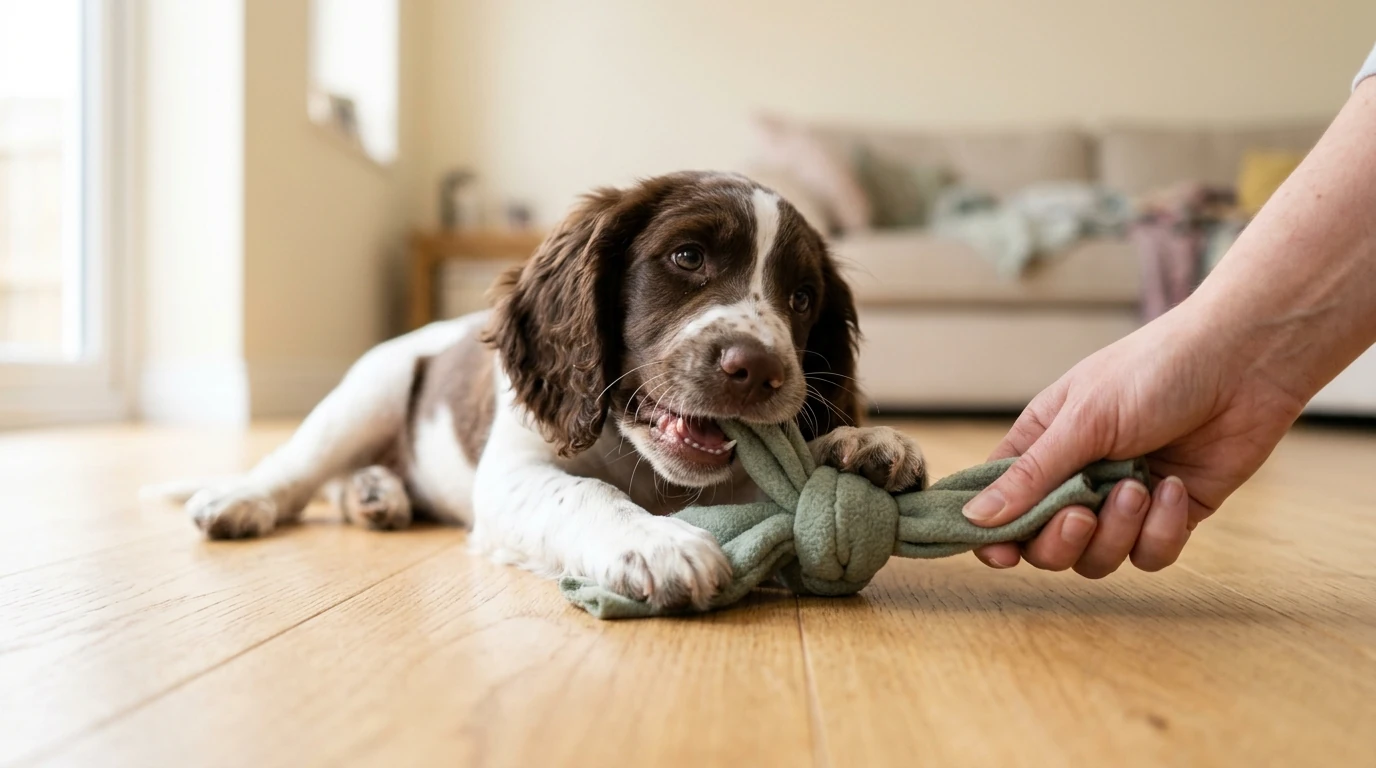
How to stop puppy biting: give your puppy something better to bite, and make sure biting people ends the fun. Keep a toy ready, stay still rather than pulling away, and step away for a moment if the teeth keep coming. Plenty of sleep, regular meals and play help too. Blue Cross says the vast majority outgrow it by three to five months; Dogs Trust says mouthing drops off once teething ends, at around seven months.
Below: why puppies bite, when they stop, what to do and what to avoid, children, and getting help. Our sources are the puppy biting advice from Blue Cross, Dogs Trust and the Royal Kennel Club, PDSA’s guidance on chewing and teething, and Syed’s experience with Dexter, his Cane Corso, who had a nippy phase as a puppy.
TABLE OF CONTENTS
Puppy biting at a glance
| What to know | What UK sources say | Source |
|---|---|---|
| Is it normal? | Yes: puppies explore and play with their mouths | Blue Cross, Dogs Trust, Royal Kennel Club |
| When it eases | Usually by three to five months; mouthing drops a lot once teething ends, at around seven months | Blue Cross; Dogs Trust |
| First thing to do | Offer a toy before the teeth land, and keep your hands still | Blue Cross, Dogs Trust |
| If the teeth keep coming | Turn away, then step away briefly, behind a gate if needed | Dogs Trust, Royal Kennel Club, Blue Cross |
| What makes it worse | Being tired, hungry, bored or overexcited | Blue Cross, Dogs Trust |
| What not to do | Yelping, telling off, pulling away, hand games, the crate as a time-out | Blue Cross, Royal Kennel Club, Dogs Trust |
| Children | Supervise every time, or keep them apart | Blue Cross, Dogs Trust, PDSA |
| When to get help | No improvement, a sudden start, or biting that comes back | Dogs Trust |
Sources: Blue Cross, Dogs Trust, the Royal Kennel Club and PDSA (puppy biting, mouthing, chewing and children and dogs guidance).
Why do puppies bite and mouth?
Puppies find out about the world with their mouths. They also play by mouthing and nipping, which is how they played with their littermates and mum, and Blue Cross describes it as a normal part of learning to get on with other dogs. The Royal Kennel Club adds that puppies find mouthing rewarding, especially while teething, and dogs repeat what they find rewarding.
Dogs Trust lists the usual reasons: teething, overexcitement, play, stress or fear, frustration, pain or illness, habit and wanting attention. Blue Cross notes that some puppies, particularly from working breeds, seem to play bite more or harder, probably because they tend to have more energy.
None of this means your puppy is naughty or trying to be in charge. Dogs Trust is clear that biting isn’t “bad behaviour” or a dog trying to dominate you. It’s usually a feeling your puppy doesn’t yet know how to handle.
Mouthing, play biting or something more?
Most puppy biting is play. According to Dogs Trust, a mouthing puppy doesn’t usually bite down with full pressure, and their body looks loose and wiggly, with regular pauses. Aggressive biting looks different: it’s harder, the dog is stiff and tense, the lips are pulled back to bare the teeth, and there’s often a growl or bark first. A dog biting like that is usually scared and asking for space.
It isn’t always easy to tell in the moment, and Dogs Trust says that’s fine. If the biting worries you, hurts, or is hard to interrupt, go to the section on getting help below.
When do puppies stop biting?
There’s no single age. Blue Cross says the vast majority of puppies grow out of mouthing and play biting once they’re three to five months old. Dogs Trust says there’s no magic age, but that a dog is typically mouthing a lot less once teething has finished, at around seven months.
Either way, it eases with time if you manage it. Dogs Trust says biting doesn’t usually stop on its own without guidance, and Blue Cross says it can take a few weeks of consistent redirection before a puppy learns that toys are more satisfying than people.
Expect good days and bad days along the way. Blue Cross reminds owners that a puppy’s behaviour won’t always be perfect, and a setback doesn’t mean the approach isn’t working.
How teething affects biting
Teething makes gums sore, and that adds to the urge to bite. Blue Cross puts teething between three and seven months of age, when chewing helps the puppy teeth come out and the adult set come through. PDSA says young puppies chew a lot while teething to ease their gums, much as human babies do.
Give your puppy safe things to chew instead of hands. PDSA’s vets suggest chew toys that are designed for chewing, soft enough to dent with a fingernail, too big to fit wholly in your puppy’s mouth, and safe if a piece is swallowed. They advise against bones and rawhide. Most soft toys, tug ropes and tennis balls are for supervised play only.
How to stop puppy biting: what UK charities advise
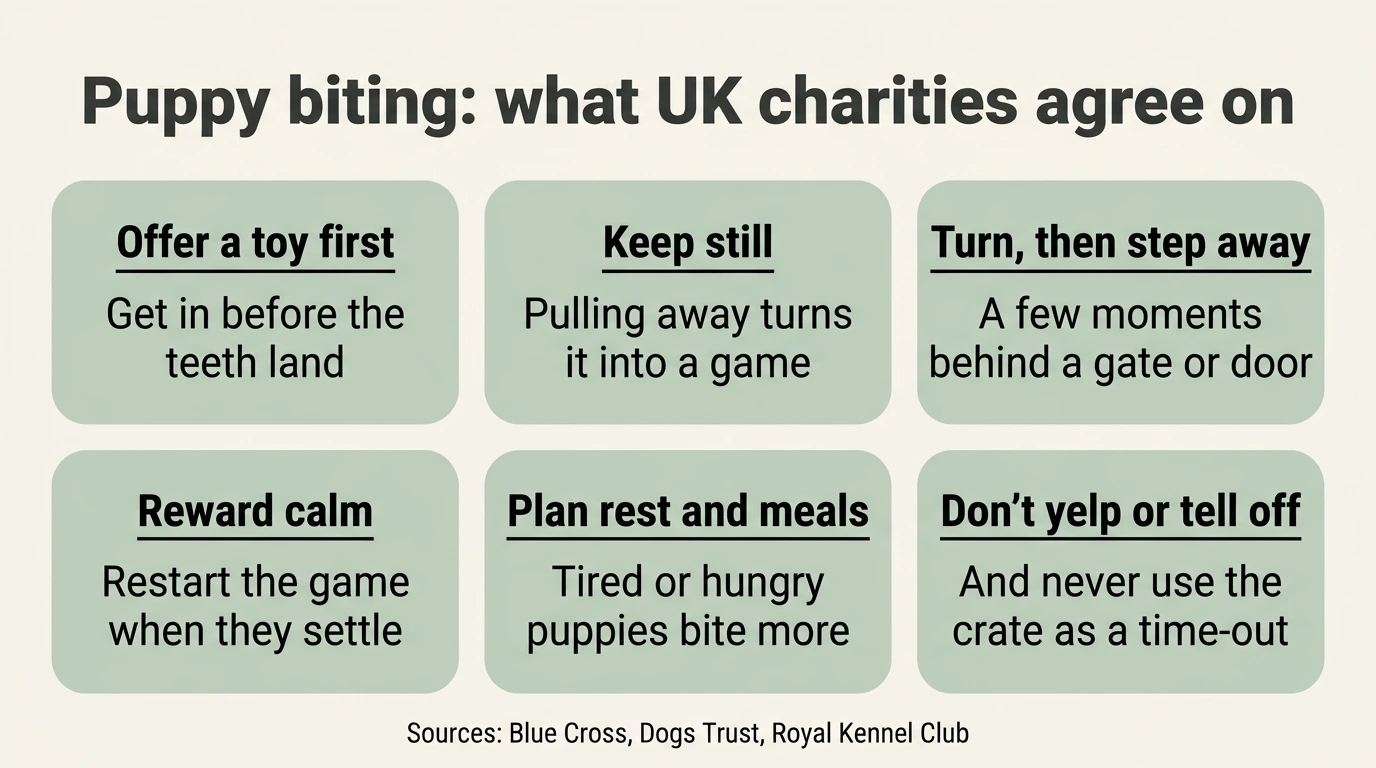
Blue Cross, Dogs Trust and the Royal Kennel Club give much the same method. The aim is to make toys more rewarding than hands, and to make sure that teeth on people always end the game. Dogs Trust’s guide to mouthing, nipping and puppy biting sets out four steps for the moment it happens; here’s how they fit with the other charities’ advice.
- Get in first. Watch for the signs your puppy is winding up to play, such as bouncing, pouncing and batting with their paws, and offer a toy before the teeth arrive. Keep toys in a few places around the house so one is always close.
- Make the toy the fun part. Move it along the floor or shake it, play tug with a large soft toy, and let your puppy win sometimes.
- Stay still if teeth land on you. Pulling your hand away, pushing your puppy off or making a noise feels like a game to them. Keep still, and redirect onto the toy as soon as there’s a pause.
- Turn away if it carries on. Fold your arms and turn your back, and stand up if you were on the floor.
- Step away briefly if it still carries on. Walk away, or go to the other side of a door or stair gate, for a few moments until your puppy has calmed down.
- Come back and reward calm. Restart the game, scatter a few treats to find, or give a gentle fuss.
Ask everyone in the house, and visitors, to follow the same rules. Dogs Trust suggests writing your house rules down and putting them on the fridge, because a puppy who’s allowed to mouth one person will keep trying it with everyone.
If your puppy bites hard and won’t settle, Blue Cross suggests clipping a lightweight house line to their harness before play, so you can calmly lead them to a gated area for a short break without handling a wriggling, mouthy puppy. Let them rejoin you once they’ve settled. Never leave a puppy alone with the line on, and don’t use the crate for this: it should stay a safe place to rest.
From our home: Dexter had a nippy phase as a puppy. We treated it as normal puppy behaviour, but we worked on it every day. If his teeth touched skin during play, the game stopped: I kept my hand still and let it go limp, then stepped away for a short break before starting again with a toy. He picked it up quickly. Food helped too. He learned to wait until I said he could start his meal or take a treat from my hand, and that patience carried over into gentler play.
Biting hands, feet and clothes
Hands, ankles and trouser legs are favourite targets because they move. Dogs Trust and the Royal Kennel Club both say to keep still rather than snatching a hand or foot away or tugging your clothes back, which only feels like tug of war to a puppy.
What you wear makes a difference too. Blue Cross points out that loose clothes, fluffy slippers and a flapping dressing-gown belt are hard for a puppy to resist. Dogs Trust suggests thicker clothes so you’re less tempted to pull away, taking off the item your puppy has grabbed to end the game, and wellies to protect children’s feet and ankles while you redirect.
Hand games are the other habit to drop. Letting a puppy chew your fingers, or wrestling with your hands or feet, teaches them that teeth on skin is part of play. Dogs Trust says puppies need the same message every time, before they grow into bigger dogs with adult teeth.
Overtired, hungry or bored: common triggers
A lot of puppy biting has a cause you can plan for. Dogs Trust says puppies need 18 to 20 hours of sleep a day, and an overtired puppy often gets the zoomies and mouths more, which can look as if they need more exercise. If your puppy has eaten, been to the toilet and had a busy day, they probably need a nap.
Blue Cross adds hunger, since puppies have small stomachs and need several meals a day, and boredom. Balance play and short training games with rest, without over-exercising your puppy for their age. Blue Cross also suggests noting down when the biting happens, so you can have a toy, a chew or some quiet time ready before it starts.
After walks and excitement, Dogs Trust suggests calming activities such as sniffing, licking and chewing: a stuffed feeder, a lick mat or a long-lasting chew. Our guide to dog enrichment toys covers how to choose safe ones.
Mouthing during handling and grooming
Being brushed, checked or held is a common time for mouthing. The Royal Kennel Club suggests keeping handling and grooming sessions short while your puppy gets used to them, giving them something to hold in their mouth such as a small stuffed toy, and picking a quieter time of day, just before a nap. A second person can keep the head end busy while you brush.
What not to do when your puppy bites
Some popular advice, much of it from overseas, goes against what UK charities recommend. Avoid:
- Yelping or squealing. Blue Cross says a high-pitched squeal tends to excite a puppy and can encourage more biting, and the Royal Kennel Club says yelping makes a puppy more likely to think the game is on.
- Telling off, shouting or smacking. Blue Cross says it can frighten your puppy and cost you their trust, and Dogs Trust says punishment can make biting worse in the long run.
- Pushing your puppy away or pulling your hands back fast. To a puppy, it’s part of the game.
- Using the crate as a time-out. Blue Cross says the crate should stay a safe, comfortable place to rest.
- Encouraging play biting with fingers or feet, however cute it looks while your puppy is small.
- Ignoring a toy your puppy brings you. Dogs Trust says your puppy could learn that mouthing gets your attention faster than a toy does.
The same thinking applies to all training: rewards work and punishment backfires. Our dog training guide explains reward-based training and what to teach first.
Puppies, children and biting
Puppy teeth are sharp, and it’s hard for children to stay calm when they’re nipped. Blue Cross says their reactions can even make a puppy mouth more, so children shouldn’t be expected to manage play biting on their own.
Children and puppies: Supervise every time children and your puppy are together, and keep them apart when you can’t watch, with a stair gate or a separate room. Blue Cross, Dogs Trust and PDSA all give this advice. Dogs Trust also suggests asking children not to run and shout near your puppy, so it doesn’t get overexcited.
When to get help with puppy biting
Most puppy biting fades with time and the steps above. Dogs Trust advises getting help if:
- the biting isn’t improving, or you think it comes from fear or frustration
- your puppy has suddenly started mouthing or biting, or is doing it more (see your vet first)
- the biting improved and then started again, which can be a sign of illness or discomfort (see your vet)
- a bite seems aggressive, causes an injury, or is hard to interrupt
Getting help: Dogs Trust runs a free Behaviour Support Line on 0303 003 6666 for owners worried about mouthing, nipping or biting. If a bite breaks the skin, get medical advice, Dogs Trust says. Your vet can check for pain or illness first, and a qualified behaviourist can help after that.
Final thoughts on puppy biting
Puppy biting is normal, it’s temporary, and it’s easier to live with when you plan for it. Knowing how to stop puppy biting mostly comes down to getting in first with a toy, keeping still when the teeth land, stepping away for a moment when they won’t stop, and making sure your puppy gets enough sleep, food and play. Skip the yelps, the telling off and the crate time-outs. If it isn’t improving, or it changes suddenly, talk to your vet or Dogs Trust’s behaviour team.
Frequently Asked Questions About Puppy Biting
Is puppy biting normal?
Yes. Puppies explore and play with their mouths, and Blue Cross, Dogs Trust and the Royal Kennel Club all describe mouthing and play biting as normal. It still needs guidance: Dogs Trust says puppies need help learning to be gentle with people, and that it’s never too early to start.
Should I yelp when my puppy bites me?
No. You’ll often read this tip, but Blue Cross says a high-pitched squeal tends to excite puppies and can encourage more biting, and the Royal Kennel Club says yelping makes a puppy more likely to think the game is on. Keep still, then turn or step away instead.
Why does my puppy bite more in the evening?
Often because they’re overtired. Dogs Trust says puppies need 18 to 20 hours of sleep a day, and a puppy short of sleep tends to get the zoomies and mouth more. If your puppy has eaten, been to the toilet and had a busy day, try a nap in a quiet space rather than more play.
Is my puppy being aggressive when it bites?
Usually not. Dogs Trust says playful mouthing comes with loose, wiggly body language and regular pauses. Aggressive biting is harder, with a stiff, tense body and bared teeth, often after a growl. If the biting worries you, causes an injury or is hard to interrupt, call Dogs Trust’s free Behaviour Support Line.
Should I put my puppy in its crate when it bites?
No. Blue Cross says not to use the crate for this, because it should stay a safe, comfortable place to rest. If your puppy bites hard, step away, or guide them to a gated area for a short break, and let them back once they’ve calmed down.
Will my puppy grow out of biting on its own?
Partly. Blue Cross says most puppies grow out of play biting by three to five months, and Dogs Trust says mouthing drops a lot once teething ends, at around seven months. But Dogs Trust adds that biting doesn’t usually stop on its own without guidance, so keep teaching gentle play.
