There’s no official list of giant dog breeds, and no agreed height or weight that makes a breed “giant”. The closest thing the UK has is a 2026 Royal Veterinary College study of dogs seen by UK vets, which named 29 giant breeds using a list drawn up with help from the Royal Kennel Club. Below are those breeds, the height each breed standard gives, and the three the Royal Kennel Club itself calls “extra large”.
This guide uses the Royal Veterinary College’s 2026 study of giant breeds in UK vet records, the Royal Kennel Club’s breed pages and breed standards, PDSA and Dogs Trust for living with a big dog, and GOV.UK for the law. We haven’t measured any of these dogs ourselves, and we don’t rank breeds by size, because no UK source does.
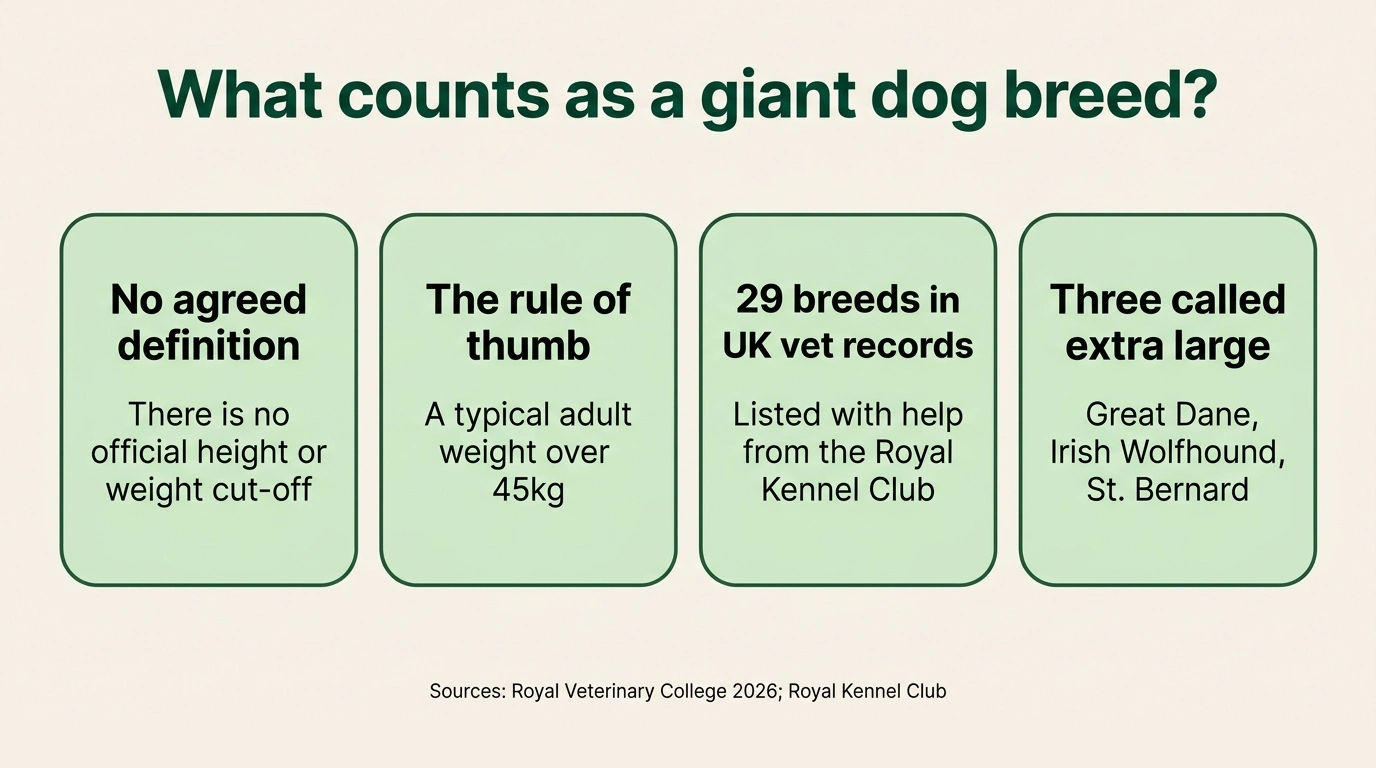
TABLE OF CONTENTS
What counts as a giant dog breed?
There’s no universally agreed height or weight that makes a breed giant, the Royal Veterinary College study says. The usual rule of thumb is a breed whose typical adult weight is over 45kg. The researchers drew up their list of 29 breeds with the Royal Kennel Club’s help, and found these dogs made up about 1 in 80 of the dogs seen by UK vets in 2019.
The list is by breed, not by each dog’s weight. That’s why a few slimmer breeds sit on it, such as the sighthounds and the Giant Schnauzer, alongside the heavy mastiff types.
The Royal Kennel Club gives every breed on its Breeds A to Z list a size label, from Small to Extra large. All the Royal Kennel Club breeds on this page are labelled Large or Extra large.
Good to know: The Royal Kennel Club says a breed standard describes the ideal for the breed. A dog may be larger or smaller than the sizes it gives, so treat the heights below as a guide, not a promise.
Is there a biggest dog breed?
No UK body ranks dog breeds by size, so we don’t either. Lists of big dog breeds online usually rank them by a weight taken from overseas sources, and some include dogs that are banned in the UK.
The three breeds the Royal Kennel Club calls extra large
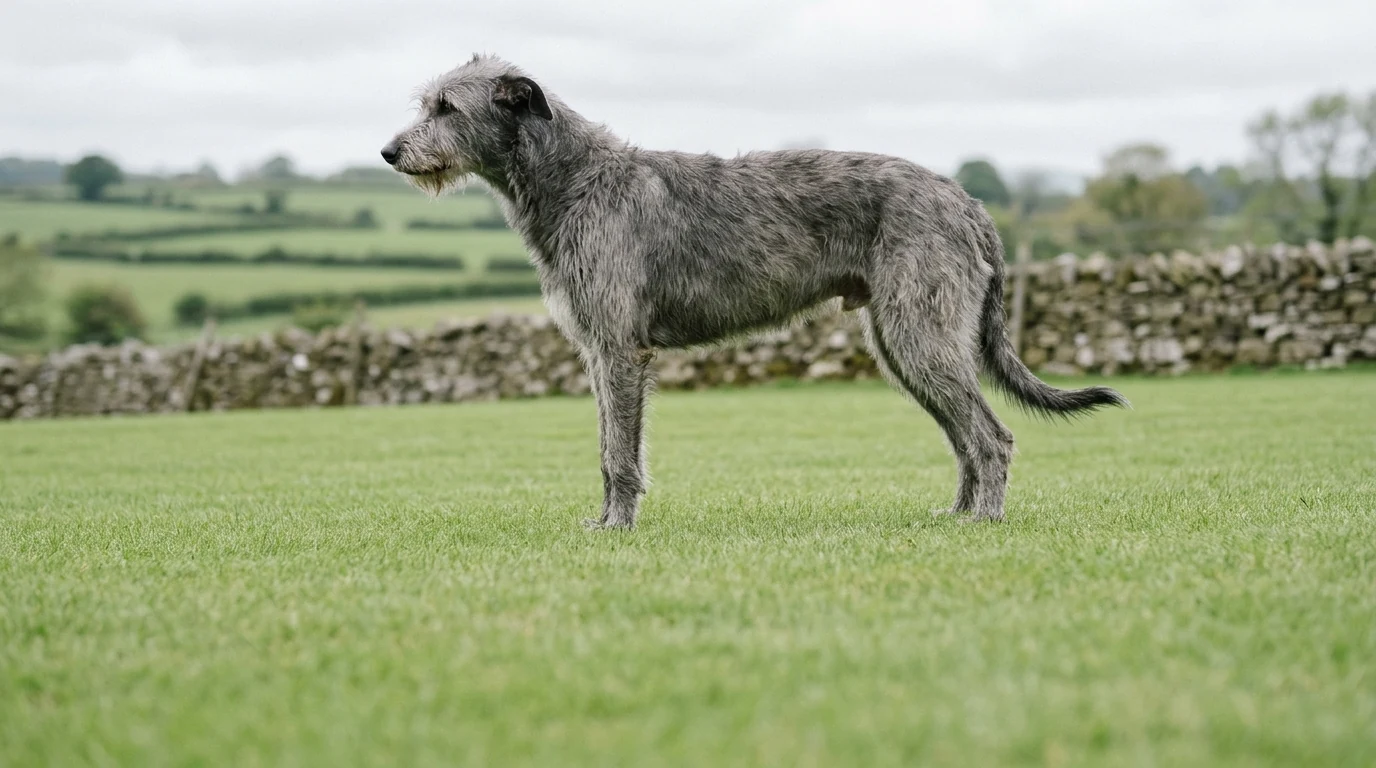
Of the 230 breeds on the Royal Kennel Club’s Breeds A to Z list, three carry its “Extra large” size label: the Great Dane, the Irish Wolfhound and the St. Bernard. Their breed standards give minimum heights rather than ranges: males at least 76cm, 79cm and 75cm, and females at least 71cm, 71cm and 70cm, in that order. The Mastiff, often listed online as the biggest breed, is labelled Large, and its standard gives no height at all. Our English Mastiff vs Great Dane guide compares those two side by side.
Giant dog breeds at a glance
| Breed | Royal Kennel Club group | Royal Kennel Club size | Height in the breed standard (males / females) |
|---|---|---|---|
| Akita | Utility | Large | 66–71cm / 61–66cm |
| Alaskan Malamute | Working | Large | Preferred: 64cm / 58cm |
| Anatolian Shepherd Dog | Pastoral | Large | 74–81cm / 71–79cm |
| Bernese Mountain Dog | Working | Large | 64–70cm / 58–66cm |
| Bloodhound | Hound | Large | 66cm / 61cm (usually 63–69cm / 58–63cm) |
| Borzoi | Hound | Large | Minimum: 74cm / 68cm |
| Bullmastiff | Working | Large | 64–69cm / 61–66cm |
| Deerhound | Hound | Large | Minimum desirable: 76cm / 71cm |
| Dogue de Bordeaux | Working | Large | Ideal: 60–68cm / 58–66cm |
| Estrela Mountain Dog | Pastoral | Large | 65–72cm / 62–68cm |
| Giant Schnauzer | Working | Large | 65–70cm / 60–65cm |
| Great Dane | Working | Extra large | Minimum: 76cm / 71cm |
| Great Swiss Mountain Dog | Working | Large | 65–72cm / 60–68cm |
| Hungarian Kuvasz | Pastoral | Large | 71–75cm / 66–70cm |
| Irish Wolfhound | Hound | Extra large | Minimum: 79cm / 71cm |
| Komondor | Pastoral | Large | Average: 80cm / 70cm |
| Leonberger | Working | Large | 72–80cm / 65–75cm |
| Mallorquin Mastiff | Not on the Royal Kennel Club’s list | No label | No UK breed standard |
| Mastiff | Working | Large | Not given in the breed standard |
| Neapolitan Mastiff | Working | Large | 65–75cm (not split by sex) |
| Newfoundland | Working | Large | Average: 71cm / 66cm |
| Otterhound | Hound | Large | Approximate: 69cm / 61cm |
| Pyrenean Mastiff | Working | Large | Minimum: 77cm / 72cm |
| Pyrenean Mountain Dog | Pastoral | Large | Minimum: 70cm / 65cm |
| Russian Black Terrier | Working | Large | 68–77cm / 66–72cm |
| St. Bernard | Working | Extra large | Minimum: 75cm / 70cm |
| Tibetan Mastiff | Working | Large | Minimum desirable: 66cm / 61cm |
| Turkish Kangal Dog | Pastoral | Large | 74–81cm / 71–79cm |
Sources: Royal Kennel Club breed standards and Breeds A to Z (read November 2026); the list of breeds is the Royal Veterinary College’s 2026 study. The study recorded “Akita” and “American Akita” as two names; the Royal Kennel Club lists one Akita, so it appears once here.
Giant dog breeds in the Working group
1. Alaskan Malamute
The Royal Kennel Club puts the Malamute in its Working group with a Large size label. Its standard gives preferred heights of 64cm for males and 58cm for females, and describes a heavily boned dog that should never look short in the leg. Our Malamute vs Husky guide covers the breed in more detail.
2. Bernese Mountain Dog
A Working breed labelled Large. The breed standard gives 64–70cm for males and 58–66cm for females, and describes a sturdy, active, alert working dog of striking colour.
3. Bullmastiff
A Working breed labelled Large. Its standard sets 64–69cm for males and 61–66cm for females, and asks for a symmetrical dog that is sound and active rather than cumbersome.
4. Dogue de Bordeaux
A Working breed labelled Large, and the most common giant breed in the study’s vet records. The standard’s ideal height is 60–68cm for males and 58–66cm for females. It describes a harmonious outline that should look neither leggy nor too low to the ground.
5. Giant Schnauzer
A Working breed labelled Large. Its standard gives 65–70cm for males and 60–65cm for females and calls variations outside those limits undesirable. It describes a robust dog that looks almost square, with a keen expression.
6. Great Dane
One of the Royal Kennel Club’s three Extra large breeds. The standard sets minimum heights for dogs over 18 months: 76cm for males and 71cm for females. It describes an elegant outline, with the head and neck carried high. Our English Mastiff vs Great Dane guide has the breed’s UK figures.
7. Great Swiss Mountain Dog
A Working breed labelled Large. The standard gives 65–72cm for males and 60–68cm for females. It describes a distinctively marked tri-colour dog, sturdy and agile, with a clear difference between males and females.
8. Leonberger
A Working breed labelled Large. Its standard gives 72–80cm for males and 65–75cm for females, and describes a large, muscular yet elegant dog that is confident, calm and lively.
9. Mastiff
A Working breed labelled Large. Its standard gives no height or weight. It says size is desirable only when it comes with quality and complete soundness, and describes a square-looking head and a broad, deep body. Our English Mastiff vs Great Dane guide explains what UK vet records show instead.
10. Neapolitan Mastiff
A Working breed labelled Large. The standard gives one height range, 65–75cm, and says females are somewhat smaller. It describes a large, well-boned dog, slightly longer in the body than it is tall.
11. Newfoundland
A Working breed labelled Large. Its standard gives average heights of 71cm for males and 66cm for females. It describes a large, deep-bodied dog with a double coat that shouldn’t look heavy or inactive.
12. Pyrenean Mastiff
A Working breed on the Royal Kennel Club’s imported register, labelled Large. Its standard sets minimums of 77cm for males and 72cm for females, with no upper limit. It says the coat shouldn’t be exaggerated in length and the dog shouldn’t look slow.
13. Russian Black Terrier
A Working breed labelled Large, despite the “terrier” in its name. The standard gives 68–77cm for males and 66–72cm for females. It describes an almost square body and a weatherproof coat that is trimmed.
14. St. Bernard
One of the Royal Kennel Club’s three Extra large breeds. Its standard gives minimum heights of 75cm for males and 70cm for females. It says size is desirable only when combined with quality, balance and soundness.
15. Tibetan Mastiff
A Working breed labelled Large. Its standard gives desirable minimums of 66cm for males and 61cm for females, adding that type should never be sacrificed for size. It describes a mane, more pronounced in males, and a well-feathered tail carried over the back.
Giant dog breeds in the Pastoral group
16. Anatolian Shepherd Dog
A Pastoral breed labelled Large. Its standard gives 74–81cm for males and 71–79cm for females, and describes a tall dog with a broad head and a short, dense coat. Our Anatolian Shepherd vs Kangal guide explains how the two breeds relate.
17. Estrela Mountain Dog
A Pastoral breed labelled Large. The standard gives 65–72cm for males and 62–68cm for females, with a tolerance of 4cm above. It describes a sturdy dog of mastiff type, never cumbersome, with small ears that fold backwards and a hook at the end of the tail.
18. Hungarian Kuvasz
A Pastoral breed on the imported register, labelled Large. Its standard gives 71–75cm for males and 66–70cm for females. It describes a large, well-balanced, sturdily built dog.
19. Komondor
A Pastoral breed labelled Large. Its standard gives average heights of 80cm for males and 70cm for females, with minimums of 65cm and 60cm and no maximum. It describes a large dog with a corded coat.
20. Pyrenean Mountain Dog
A Pastoral breed labelled Large. Its standard sets minimums of 70cm for males and 65cm for females, and says most dogs will be well above them. It describes a dog of great size that is well balanced and not cumbersome.
21. Turkish Kangal Dog
A Pastoral breed labelled Large. The standard gives 74–81cm for males and 71–79cm for females. It describes a short, dense double coat from cream to grey, a black or dark mask and ears, and a tail carried in a curl over the back when alert. See our Anatolian Shepherd vs Kangal guide for how the breeds differ.
Giant dog breeds in the Hound group
22. Bloodhound
A Hound breed labelled Large. Its standard gives 66cm for males and 61cm for females, with males usually 63–69cm and females 58–63cm. It describes a noble, dignified expression.
23. Borzoi
A Hound breed labelled Large. The standard sets minimum heights of 74cm for males and 68cm for females, and describes a graceful, elegant dog.
24. Deerhound
A Hound breed labelled Large, listed as the Scottish Deerhound in the study. Its standard gives desirable minimums of 76cm for males and 71cm for females, and says the breed resembles a rough-coated greyhound of larger size and bone.
25. Irish Wolfhound
One of the Royal Kennel Club’s three Extra large breeds. Its standard sets minimum heights of 79cm for males and 71cm for females, and says the aim is for males to average 81–86cm. It describes a rough, harsh coat and a long, slightly curved tail.
26. Otterhound
A Hound breed labelled Large. Its standard gives approximate heights of 69cm for males and 61cm for females. It describes a rough double coat, large feet and a long, striding action.
The Akita, from the Utility group
27. Akita
A Utility breed labelled Large. Its standard gives 66–71cm for males and 61–66cm for females, and describes a large, alert, heavy-boned dog. The Royal Kennel Club also lists the Japanese Akita Inu as a separate breed; the two were separated in 2006, and the Japanese Akita Inu isn’t on this list. Our Akita vs Shiba Inu guide covers the Akita in more detail.
A giant breed the Royal Kennel Club doesn’t list
28. Mallorquin Mastiff
The Mallorquin Mastiff was one of the 29 breeds in the study, from a small group of dogs. It isn’t on the Royal Kennel Club’s Breeds A to Z list and has no UK breed standard, so there’s no UK height to give.
How heavy are giant dogs?
In the Royal Veterinary College study, the typical adult giant dog weighed just under 49kg. Males were heavier than females, at about 52kg against about 45kg.
Weights varied a lot. About 1 in 4 adult giant dogs weighed under 40kg, and about 1 in 5 weighed 60kg or more. The mastiff-type breeds were heavier on average than the rest.
We don’t give a weight for each breed on this page. Where FlexK9 has a guide to a breed, such as the Great Dane, Mastiff, Malamute or Anatolian Shepherd, that guide sets out the UK figures.
Living with a giant breed: what UK sources say
Giant breeds take longer to grow up. As a general rule, PDSA says large and giant breeds need puppy food until around 18 months, and larger breeds can take 18 months to two years to reach their full size. The Royal Kennel Club notes that giant breeds may not mature physically until nearly two. Our guides to large breed puppy food and large breed dog food cover feeding.
They live shorter lives on average. In the Royal Veterinary College study, giant dogs died at a median age of about 8.9 years, about three years less than dogs overall in UK vet records. Females lived a little longer than males. Our guide to which dogs live longest covers lifespan in more detail.
Ear infections and being overweight were among the problems vets recorded most often in giant dogs, each in about 1 in 12 of the dogs whose records were checked.
Bloat in deep-chested dogs
Bloat, or GDV, is when the stomach fills with gas and then twists. PDSA describes it as a painful, life-threatening condition that mostly affects large, deep-chested dogs, and it often needs an operation.
When to see your vet: Contact your vet straight away if your dog keeps retching, is restless (panting and pacing), drools a lot, has a swollen tummy, has pale gums, struggles to breathe or collapses. PDSA lists these as signs of GDV, which is an emergency.
Space, the car and choosing a dog
The Royal Kennel Club’s breed pages suggest a large house for the Great Dane, the Irish Wolfhound and the St. Bernard. A big dog also needs help in and out of a high car boot as it gets older; our guides to dog ramps for the car and dog steps for the bed and sofa compare the options.
Size isn’t the whole picture. Dogs Trust says claims that a breed is good with children should be treated with caution, because it depends on the individual dog, so meet the dog first, and its mother if it’s a puppy. PDSA advises making sure a puppy’s parents have had the relevant health screening for their breed. Our guide to common health problems in dog breeds explains how to check.
Big breeds that aren’t on this list
Some breeds people expect to see here weren’t in the study. The Cane Corso isn’t on the Royal Kennel Club’s list and wasn’t one of the 29; our Cane Corso size guide covers how big it gets. The same goes for the Central Asian Shepherd Dog, or Alabai, covered in our Central Asian Shepherd Dog size guide.
The Rottweiler is a Large breed on the Royal Kennel Club’s list but wasn’t counted as giant in the study. Our Rottweiler weight chart has its UK figures.
Some types of dog are banned in the UK whatever their size; our list of banned dog breeds in the UK names all five. GOV.UK says whether a dog is a banned type depends on what it looks like, not its breed or name; our Dangerous Dogs Act guide explains the law.
Final thoughts: is a giant breed right for you?
- If you’re drawn to a giant breed, choose it for the dog’s needs and temperament as well as its size, and meet the dog first.
- If you have limited space or a small car, check the breed’s size label and think about how you’ll lift or help an older dog.
- If you’re planning a budget, allow for a dog that eats puppy food for longer, and for vet care through a shorter life.
- If you’re buying a puppy, ask about the parents’ health screening, or consider a rescue dog whose adult size you can see.
- If you want a dog for many years, remember that giant breeds live around three years less on average.
Giant dog breeds FAQs
Which dog breed is the tallest?
No UK source ranks breeds by height. The Royal Kennel Club labels three breeds extra large: the Great Dane, the Irish Wolfhound and the St. Bernard. Breed standards also set heights in different ways, some as ranges and some as minimums or averages, so they can’t be lined up into a league table.
How long do giant dog breeds live?
About nine years on average, roughly three years less than dogs overall. In a 2026 Royal Veterinary College study of UK vet records, giant dogs died at a median age of about 8.9 years, and females lived a little longer than males. A median describes the middle of the group, not how long your own dog will live.
When is a giant breed fully grown?
Usually somewhere between 18 months and two years. PDSA says larger breeds can take 18 months to two years to reach full size and, as a general rule, need puppy food until around 18 months. The Royal Kennel Club notes giant breeds may not mature physically until nearly two.
Is a Bernese Mountain Dog a giant breed?
It was one of the 29 giant breeds in the 2026 Royal Veterinary College study. The Royal Kennel Club puts it in its Working group with a Large size label, and its breed standard gives heights of 64–70cm for males and 58–66cm for females.
Are giant dog breeds good family dogs?
No UK source rates giant breeds as better or worse with families. Dogs Trust says claims that a breed is good with children should be treated with caution, because it depends on the individual dog. Meet the dog first, and its mother if it’s a puppy, and think about whether your home has room for a very big dog.
