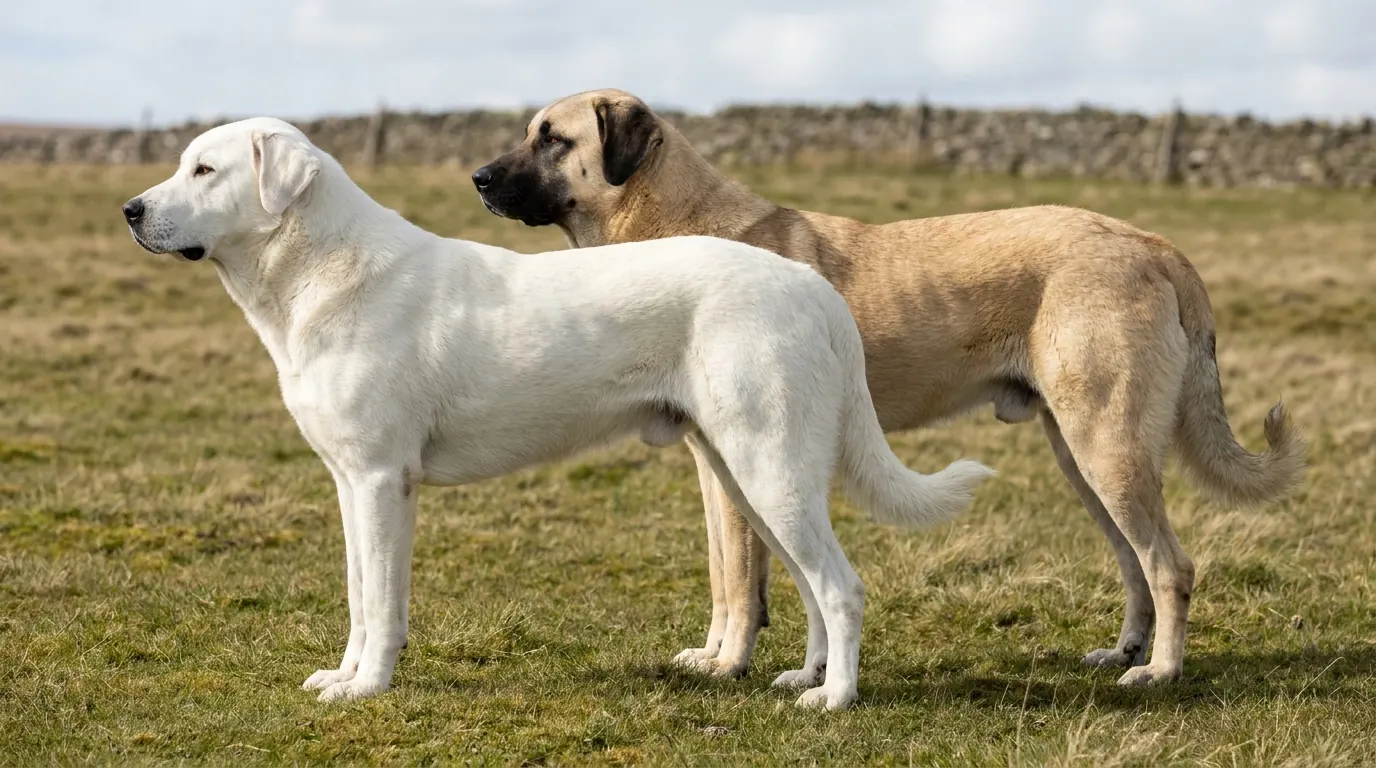
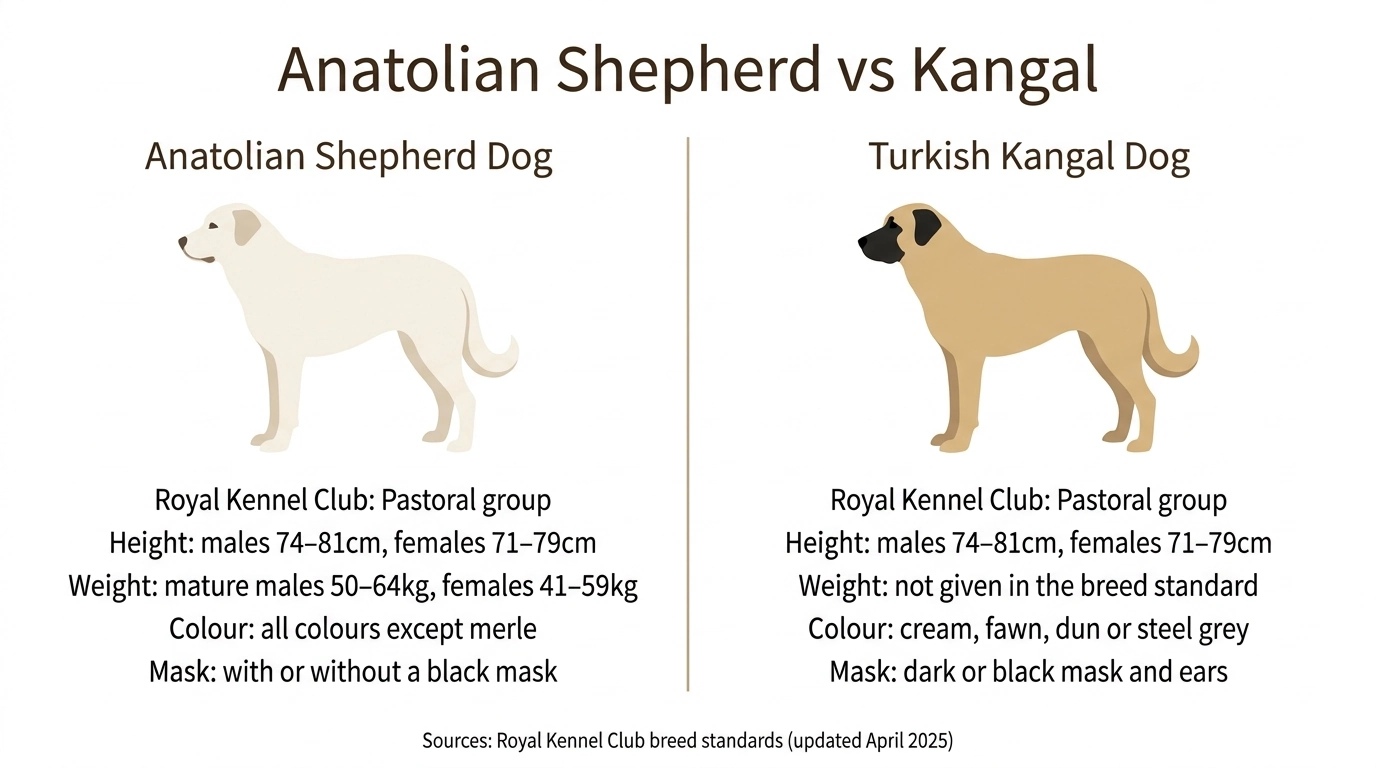
Anatolian Shepherd vs Kangal comes down to colour and mask. The Royal Kennel Club lists them as two separate Pastoral breeds, and both standards give the same height ranges. A Kangal must be cream, fawn, dun or steel grey with a dark mask and ears; an Anatolian Shepherd can be any colour except merle, with or without a mask.
We haven’t owned either breed, so this comparison draws on the Royal Kennel Club breed standards and breed pages, and Dogs Trust’s UK longevity study.
TABLE OF CONTENTS
One breed or two: what the Royal Kennel Club says
It’s an easy mix-up. The Royal Kennel Club’s Turkish Kangal Dog breed page says the Kangal has only recently been recognised in the UK and “was previously included as an Anatolian Shepherd Dog”. Today its Breeds A to Z list has two separate entries in the Pastoral group, the Anatolian Shepherd Dog and the Turkish Kangal Dog, and each has its own breed standard.
Kennel clubs in other countries have grouped and named these dogs in different ways over the years. We stick to how the Royal Kennel Club lists them today, which is as two breeds.
You may also see the names Karabash or Akbash. None of the Royal Kennel Club’s 230 breeds carries either name, and we found no UK source that sets out what they mean, so we don’t describe them here.
The Kangal is often compared with the Alabai, or Central Asian Shepherd Dog, too. We cover that pairing in our Alabai vs Kangal comparison.
Anatolian Shepherd vs Kangal at a glance
| Feature | Anatolian Shepherd Dog | Turkish Kangal Dog |
|---|---|---|
| Royal Kennel Club group | Pastoral | Pastoral |
| RKC size category | Large | Large |
| Height (breed standard) | Males 74–81cm, females 71–79cm | Males 74–81cm, females 71–79cm |
| Weight (breed standard) | Mature males 50–64kg, females 41–59kg | Not given in the breed standard |
| Colour | All colours except merle | Cream through fawn to dun or steel grey |
| Mask and ears | With or without a black mask and black ears | Dark or black mask and ears |
| Coat | Short and dense, with a thick undercoat | Short, dense and weatherproof, with a thick undercoat |
| Ears | Medium, triangular, hanging flat | Medium, triangular, hanging flat |
| Exercise (RKC) | More than 2 hours a day | More than 2 hours a day |
| Grooming (RKC) | More than once a week | More than once a week |
| Breed Watch (RKC) | Category 1 | Category 1 |
| UK median lifespan | 10.1 years (a small group of dogs) | No UK data |
| UK legal status | Not a banned type | Not a banned type |
Sources: Royal Kennel Club breed standards (both updated April 2025) and breed pages; Dogs Trust 2024 UK longevity study. Breed standards describe the ideal for each breed, so an individual dog may be larger or smaller than the sizes given.
How to tell an Anatolian Shepherd from a Kangal
Colour and mask: the clearest difference
Colour is where the two standards really part company. The Kangal standard describes a whole-coloured dog, ranging from cream through fawn to dun or steel grey, with dark ears and a dark or black mask, which the standard calls the breed’s hallmark. A little white on the chest, toes and chin is tolerated, brindle is undesirable, and other colours aren’t accepted.
The Anatolian Shepherd standard is far broader. It accepts all colours, with or without a black mask and black ears, and rules out only merle. The Royal Kennel Club’s registration colours for the breed include white with no mask, tricolour and several shades of fawn with a mask.
That makes colour a one-way test. A white, unmasked or tricolour dog doesn’t have Kangal colouring, but a fawn dog with a black mask could be either breed, so colour alone can’t confirm a Kangal.
Head, eyes and build
The differences in head and build are real but subtle. The Anatolian Shepherd standard asks for a large, upstanding, powerfully built dog with a broad, heavy head, a muzzle about a third of the head’s length and relatively small eyes.
The Kangal standard asks for a large, well-muscled dog of balanced proportions, with a slightly rounded skull, almond to oval eyes and a body slightly longer than it is tall. Side by side, these points may help an experienced eye, but they aren’t an easy way to tell one dog from the other.
What the two standards share
Much of what people describe as a difference between the breeds isn’t one on paper. Both standards give exactly the same heights, as the table shows. Both describe medium, triangular ears with rounded tips that hang flat and lift when the dog is alert. Both describe a long tail, reaching at least to the hock, that hangs low with a slight curl at rest and curls over the back when the dog is alert, especially in males.
Both standards also ask for a short, dense coat with a thick undercoat and no feathering on the ears or legs, and the Royal Kennel Club’s breed pages give identical guidance on size, exercise and grooming. So size, ears, tail and coat won’t tell you which breed you’re looking at.
Where each breed comes from
The Royal Kennel Club describes the Anatolian Shepherd as a native of Turkey, developed as a flock guard that travelled great distances with its owner across the Central Anatolian Plateau and lived outdoors through very hot summers and freezing winters. Its breed standard describes an active breed originally used to guard sheep, able to cope with extremes of heat and cold.
The Kangal’s story, as the Royal Kennel Club tells it, is much the same: a flock guard that lives a nomadic life outside in all weathers. Its standard adds that the breed guards the flock rather than herding it, and is capable of hard work in extreme temperatures.
Temperament: what the breed standards say
Both standards describe a steady, bold, naturally independent and very intelligent dog that is proud and confident. Where they differ is in emphasis. The Anatolian Shepherd standard adds that the breed is bold without aggression, and the Royal Kennel Club’s breed page describes it as loyal and wary of strangers.
The Kangal standard says the breed is not aggressive by nature but can be dominant and territorial, and that it can be aloof with strangers while staying loyal to its owner.
These are descriptions of the ideal dog, not predictions about any one dog. No UK study compares how the two breeds behave, so we don’t rank them.
Exercise, home and grooming
The Royal Kennel Club gives both breeds exactly the same guidance. Each is a large dog that needs more than two hours of exercise a day, suits a large house with a large garden and is better suited to the country than a town. Both have short coats that shed, and both need grooming more than once a week.
Neither PDSA nor Dogs Trust publishes a breed guide for either dog, so we haven’t found any further UK care advice to add. If you’re planning for a large breed, our guides to large breed puppy food and the best dog beds for large dogs cover the kit side.
Lifespan and health: what UK sources cover
Anatolian Shepherd vs Kangal lifespan in the UK
Dogs Trust’s 2024 UK longevity study gives the Anatolian Shepherd a median lifespan of 10.1 years, so a typical dog in the study lived to about ten. That figure comes from a small group of dogs, so treat it as a rough guide. A median describes the middle of the group, not how long your own dog will live.
The study has no figures for the Kangal, and we found no other UK lifespan data for the breed, so the two can’t be compared. The Royal Kennel Club’s breed pages put both breeds in its “over 10 years” lifespan band.
Health testing and Breed Watch
Both breeds are in Breed Watch Category 1, which the Royal Kennel Club uses when no breed-specific points of concern have been identified for show judges beyond those its breed standard already covers.
For both breeds, the Royal Kennel Club’s good-practice advice is to prioritise genetic diversity when breeding. For the Anatolian Shepherd, its best-practice list adds hip scoring through the BVA/KC Hip Dysplasia Scheme; for the Kangal, it lists no specific tests. It offers no breed-specific DNA testing package for either breed.
PDSA has no breed guide for either dog, and we found no single-breed RVC VetCompass study for either, so we don’t name any health conditions for these breeds.
Before you buy: The Royal Kennel Club’s Health Test Results Finder shows the screening results recorded for dogs on its Breed and Activity Registers, and lets you check the inbreeding coefficient for a puppy’s parents. For Anatolian Shepherds, its best-practice advice is hip scoring through the BVA/KC Hip Dysplasia Scheme; for Kangals, it asks breeders to prioritise genetic diversity. Ask your vet to explain what any results mean.
Which breed suits which owner
On paper, the two breeds ask for the same kind of home: a large house and garden, more than two hours of exercise a day and, ideally, life in the country. Both standards describe working flock guards with an independent streak, and both breeds come with reserve towards strangers: the Anatolian’s breed page calls it wary, the Kangal’s standard aloof.
We found no UK source with advice on living with children or other pets for either breed, so we can’t add any. That leaves the choice to the breed standards themselves, including the colour and look you’re drawn to, rather than any sense that one breed is better than the other.
Neither breed is a banned type in the UK; our list of banned dog breeds in the UK explains which types are. For more pairings, browse our breed guides.
Frequently Asked Questions
Is a Kangal just an Anatolian Shepherd with a different name?
No, not in the UK. The Royal Kennel Club lists the Anatolian Shepherd Dog and the Turkish Kangal Dog as two separate breeds, each with its own standard. It says the Kangal was previously included as an Anatolian Shepherd Dog, before the breed was recognised in its own right.
Which is bigger, an Anatolian Shepherd or a Kangal?
On paper, neither. Both breed standards give the same heights: 74–81cm for males and 71–79cm for females. Only the Anatolian Shepherd’s standard gives a weight, 50–64kg for mature males and 41–59kg for females, so the standards can’t tell you which breed is heavier.
Can an Anatolian Shepherd have a black mask?
Yes. The Anatolian Shepherd’s breed standard accepts all colours except merle, with or without a black mask and black ears. That means a fawn Anatolian with a black mask can look a lot like a Kangal. A white or unmasked dog, though, doesn’t match the Kangal’s standard colouring.
How long do Anatolian Shepherds and Kangals live in the UK?
A typical Anatolian Shepherd in Dogs Trust’s UK longevity study lived to about ten years, though the figure comes from a small group of dogs. The study has no figures for Kangals, and we found no other UK data, so there’s no reliable way to compare the two breeds.
Are Kangals or Anatolian Shepherds banned in the UK?
No. Neither breed is a banned type in the UK, and the Royal Kennel Club recognises both in its Pastoral group. The usual law still applies, though: it’s against the law to let any dog be dangerously out of control, whatever its breed.
