
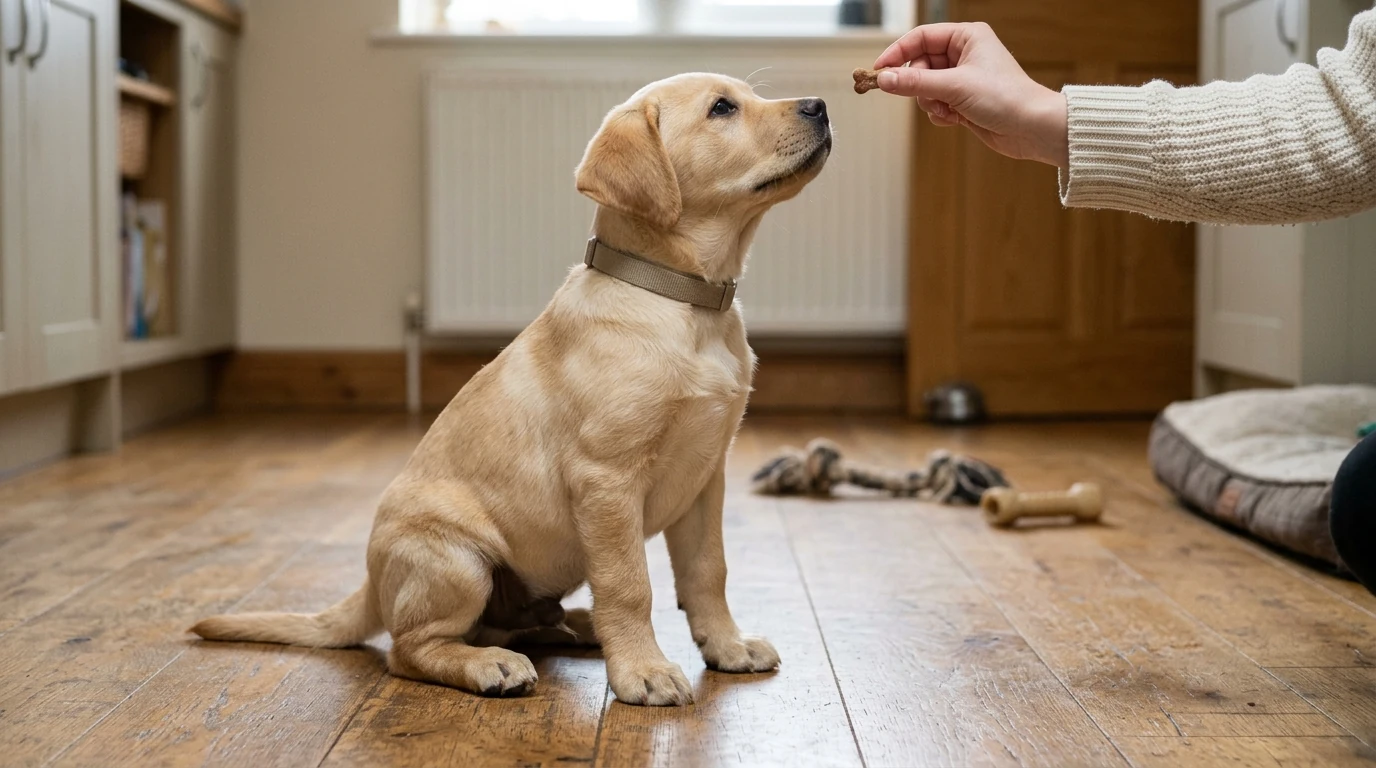
How do you train a dog? With rewards. PDSA, Dogs Trust and Blue Cross all recommend reward-based training: you give your dog something they love the moment they do what you ask, so they want to do it again. Start as soon as your puppy comes home, keep sessions short, and never punish mistakes.
This dog training guide covers how reward-based training works, what to teach first, recall, lead walking, puppy biting, classes and when to get help. It draws on the training guides of those three UK charities, plus Syed’s experience of training Dexter, his Cane Corso, since he was a puppy. Where the charities say nothing, we say so.
TABLE OF CONTENTS
Dog training at a glance
| What to know | What UK charities advise | Source |
|---|---|---|
| Method | Reward the behaviour you want; never punish | PDSA, Dogs Trust, Blue Cross |
| When to start | As soon as your puppy comes home | Dogs Trust |
| Session length | About two to five minutes; five to 10 minutes | Blue Cross; Dogs Trust |
| Classes | Once your puppy has had their vaccinations, and only reward-based ones | PDSA |
| Puppy biting | Most puppies grow out of it by three to five months | Blue Cross |
| Getting help | Your vet first, then an accredited trainer or certified behaviourist | PDSA |
What is reward-based dog training?
Reward-based training, also called positive reinforcement, means giving your dog something they want when they do something you like. Dogs learn by association, so a behaviour that earns a reward is more likely to happen again. PDSA’s guide to reward-based training calls it the kindest and most effective method, and adds that training keeps a dog’s mind active and helps you bond.
A reward can be food, a toy, a game or simply your attention. Dogs Trust suggests saving soft, smelly treats such as cheese, sausage or chicken, chopped pea-sized, for harder tasks and busy places, and plainer biscuits for easy ones. Training treats count towards the day’s food, so cut meals down a little on training days.
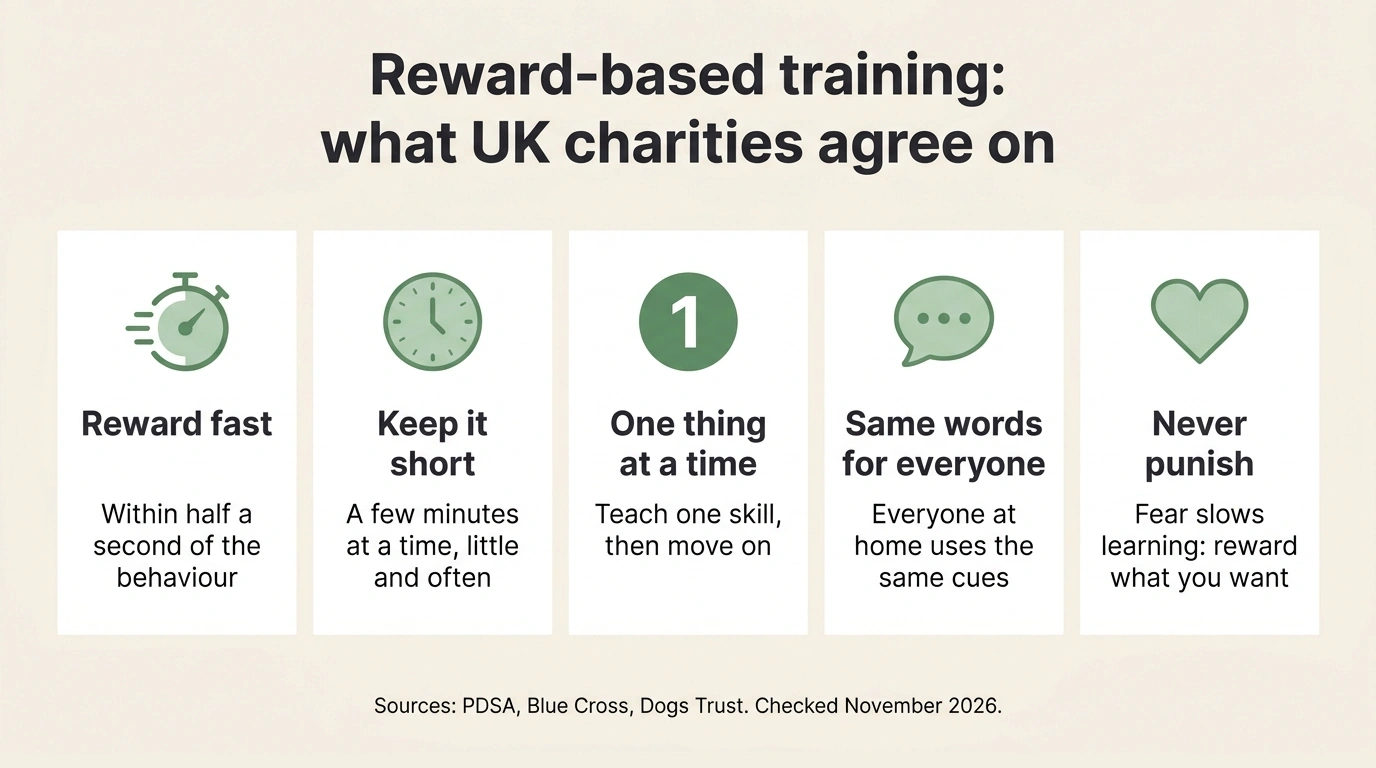
Timing matters. Reward during the behaviour or within half a second of it. Many owners use a marker, a word such as “yes” or a clicker, to tell their dog the exact moment they got it right. Pair the marker with a treat about 20 times before you use it in training, Blue Cross suggests.
Why punishment and “alpha” methods backfire
You may still read that a dog needs to see you as its “alpha”. That dominance theory is outdated and debunked, according to Dogs Trust: it came from studying unrelated wolves kept in captivity, while wild wolves live in cooperative family groups. Dogs are a different species again.
Methods built on that idea, such as pushing a dog into position, holding it down, choke chains, shock collars, shouting and smacking, can leave a dog anxious and fearful and may make its behaviour worse, the charity says. Punishment causes anxiety and fear, which make animals learn more slowly, PDSA adds, and it teaches a dog that people can’t be trusted.
When to start training a puppy
Training starts the day your puppy comes home and carries on into adolescence, adulthood and beyond, according to Dogs Trust. Two things begin straight away: learning their name and toilet training. Go at your puppy’s pace and keep it fun.
The first weeks matter for socialisation too. A puppy’s socialisation period runs from about 4 to 12 weeks old, PDSA explains, and positive new experiences then help them grow into a confident adult. Until your vet says your puppy is protected by their vaccinations, you can still train at home and in your own garden, as long as unvaccinated dogs don’t use it, and carry your puppy out to meet people.
Toilet training and crate training are skills in their own right, with step-by-step guides from both PDSA and Blue Cross. Dogs Trust says a crate should always be introduced slowly.
From our home: Dexter’s training started when he was a couple of months old. Rewards did most of the work: a treat for sitting, waiting, coming back and leaving things, and for good behaviour around the house. He’s very food driven, which made that easier. He also had a routine and was only allowed in certain rooms at first, and he went to group classes from a young age.
Puppy biting and mouthing
Nipping hands, sleeves and slippers is normal. Puppies explore with their mouths and play this way with their littermates, and Blue Cross says most grow out of it once they’re three to five months old. Teething can make it worse, so keep chew toys to hand. Our guide to puppy biting covers when it stops and what to do, step by step.
Blue Cross and Dogs Trust give much the same advice:
- Redirect your puppy onto a toy rather than snatching your hands away, which turns it into a game.
- Don’t squeal, shout or tell them off. It either excites a puppy or frightens them.
- Watch for triggers. Tired, hungry or overexcited puppies mouth more, so plan rest, regular meals and calm activities such as a chew or a lick mat.
- If they bite hard, calmly step away or give a short break behind a baby gate, then come back with a toy.
- Supervise children closely, and keep your puppy and children apart when you can’t.
The first things to teach your dog
Start each new skill somewhere quiet with few distractions. Once your dog has got it, practise in the garden, on walks and at the kerb. These are the basics UK charities cover first.
Sit
Hold a treat just above your dog’s nose and move it slowly back over their head. As their head tips up, their bottom goes down. Reward the moment it touches the floor, and don’t push their bottom down, PDSA says. Once your dog sits reliably for the treat, add the word “sit”, then phase out the lure.
Down, wait and stay
From a sit, lower a treat from under your dog’s chin to the floor, then draw it slowly forward, and they’ll follow it into a down. For wait or stay, ask for a sit or a down, pause for a few seconds before the reward, and build the time up gradually, Blue Cross suggests.
Leave it
Puppies use their noses and mouths to explore, which is why Dogs Trust calls “leave” an essential skill for anything they shouldn’t pick up. If your dog already has something in their mouth, don’t pull it out: PDSA warns this can turn into a game of tug, or even a snap. Offer something better in exchange, then praise them when they let go.
Four paws on the floor
Jumping up is often rewarded by accident. Dogs Trust points out that saying “No, get down” while looking at and pushing a dog still gives them the attention they wanted. Ask for a sit instead, and let the greeting be the reward. For jumping on furniture or counters, PDSA suggests removing the temptation, luring your dog down, rewarding them once all four paws are on the ground and then adding the word “off”.
Teaching your dog to come back when called
A reliable recall keeps your dog safe if you let them off the lead, drop the lead or someone leaves a door open. Start early, but it’s never too late.
- Choose one cue, such as “come”, “here” or a whistle, and make sure everyone at home uses it.
- Start indoors or in the garden, close to your dog, with no distractions. Say their name, then the cue, and step back.
- When they reach you, praise them, hold their collar gently and give several tasty treats. Holding the collar is part of the exercise, because you’ll need it to clip the lead on.
- Practise little and often, then add distance and small distractions.
- Move on to quiet walks, on the lead or on a long training line attached to a harness, well away from roads.
Those steps come from Blue Cross’s recall guide. Dogs Trust adds two tips: give your dog at least five seconds before calling again, and don’t call if you think they won’t come, as that teaches them coming back is optional.
Never tell your dog off when they do come back, however long they took, or they’ll learn to avoid you. Don’t only call them to end their fun, either: call them for a game or a treat during the walk too. If a young dog’s recall seems to vanish, it may be adolescence, which Blue Cross says usually starts at five to six months and ends at around 18 months to two years. Go back to quieter places for a while.
Lead walking: loose lead and heel
Most dogs pull because it works: every step forward rewards it. Teaching a loose lead can be a very long process, PDSA says, so expect it to take many walks.
First, decide which side your dog walks on and how far ahead they may go, Blue Cross advises. That side becomes your “heel”.
- Practise at home or in the garden first, rewarding your dog for standing or walking beside you. Dogs Trust suggests starting without the lead.
- Ask for a sit before you clip the lead on, so the walk starts calmly.
- Walk slowly and reward your dog often for staying by your side.
- The moment the lead goes tight, stop. Don’t pull back. When there’s slack again, reward and carry on.
- Give a good play or run beforehand, and let your dog sniff on the walk.
Use comfortable equipment. For dogs that pull, PDSA recommends a harness, and nothing that causes pain or restricts movement, such as a choke collar. For really strong dogs, Blue Cross suggests a headcollar at first, introduced slowly at home, but never as a long-term fix.
From our home: I taught Dexter to heel on my left. He now walks on my left naturally, and if he drifts he’s easy to bring back to heel. He learned recall as a puppy too, but he’s always on a lead in public; his off-lead runs happen in secure dog fields we book. For a dog his size, that makes him much easier to manage.
For where the law says your dog must be on a lead, see our guide to UK dog lead laws.
Tips that make dog training stick
- Keep sessions short and frequent. Blue Cross suggests about two to five minutes at a time, and Dogs Trust five to 10.
- Teach one thing at a time, and end on a success or a game.
- Use the same words and signals as everyone else in your home.
- Train when your dog has eaten and been to the toilet, somewhere calm.
- Show your dog what you want rather than forcing them into position.
- Once a skill is reliable, reward every other time, then mix food with praise so your dog stays keen.
- Ignore mistakes and reward the next success.
- Count training treats in the day’s food.
Most of those tips appear in Dogs Trust’s top ten, and PDSA’s golden rules say the same. Training doesn’t stop once your puppy has the basics: PDSA notes that good manners can slip over time, so keep practising throughout your dog’s life. If an older dog starts forgetting what they knew, PDSA suggests gently re-teaching the basics with rewards, and our guide to the signs of dementia in dogs explains more. Short sessions count as brain work too, and our dog enrichment toys guide has more games to play at home.
Puppy classes and dog training classes
Puppies can start training classes as soon as they’ve had their vaccinations, PDSA says, and it’s never too late for an older dog. Check which vaccines your puppy needs before the first class, and ask whether your vet practice runs puppy socialisation groups.
Choose a class that only uses reward-based methods. The charity advises avoiding any class that uses water pistols, rattle cans or similar gadgets, or that bases its training on the idea that dogs need to be dominant. Members of the Association of Pet Dog Trainers use reward-based methods only.
Choosing a dog as well? Our guide to the breeds PDSA rates easiest to train explains what its ratings mean.
When to get help from your vet or a behaviourist
Some problems need more than training at home. PDSA lists common worries such as pulling on the lead, jumping up, barking at other dogs, recall problems, fear of noises, separation anxiety and aggression, and advises dealing with them early, before they become habits.
Start with your vet, because illness and pain can change how a dog behaves. For extra help with training, PDSA recommends classes or private sessions with an accredited trainer who uses reward-based methods. For more complex problems, your vet may refer you to a certified behaviourist. Plenty of people advertise as trainers or behaviourists, so look for one on a register that meets the Animal Behaviour and Training Council’s standards.
If your dog is biting aggressively or hurting people, Dogs Trust says to get expert help straight away, and to get medical advice for anyone who’s injured.
When to see your vet: If your dog’s behaviour changes suddenly, or a problem doesn’t improve with training at home, book a vet check first. Illness and pain can easily cause changes in behaviour, PDSA says, and your vet can refer you to a certified behaviourist if you need one.
Final thoughts on dog training
- If you’ve just brought a puppy home, start with their name, toilet training and short, fun sessions.
- If your puppy nips, redirect them to a toy and expect it to pass by three to five months for most puppies.
- If your dog pulls, stop when the lead goes tight and reward slack, on every walk.
- If recall slips in adolescence, go back to quiet places and higher-value rewards.
- If a problem appears suddenly or worries you, see your vet first.
Frequently Asked Questions
How long does it take to train a dog?
There’s no set time, and no UK charity gives one. Dogs Trust says training starts the day your puppy comes home and continues through adolescence and adulthood, and PDSA warns that stopping a dog pulling can be a very long process. Short, regular sessions and consistency matter more than the calendar.
How old should a puppy be before you start training?
Start as soon as your puppy comes home, often at around eight weeks old. Dogs Trust says learning their name and toilet training begin naturally from day one. You can train at home and in the garden before vaccinations are complete, and start classes once your vet says your puppy is protected.
Will I always need treats to train my dog?
No. Reward every success while your dog is learning. Once they do it reliably, reward every other time, then every third, and mix treats with praise or a fuss, Dogs Trust advises. Keeping some food rewards in the mix still helps, especially for recall in busy places.
Should I use a clicker to train my dog?
You can, but you don’t have to. A clicker is a marker: it tells your dog the exact moment they got something right. Blue Cross says a word such as “yes” works the same way, and a thumbs-up suits a deaf dog. Whatever you use, always follow it with a reward.
Is it OK to tell my dog off?
It rarely helps. PDSA says a dog told off after the event won’t understand what it’s for, and that punishment causes fear, which slows learning. Reward the behaviour you want instead, ignore mistakes where it’s safe to, and give your dog something better to do.
Why does my dog come back at home but not at the park?
Outside, smells, other dogs and people all compete with you. Practise in quiet places first, add distractions slowly and use a reward that beats the park, such as chicken or a game. Blue Cross notes that some dogs, such as terriers and hounds, are naturally more drawn to sounds and smells.
