
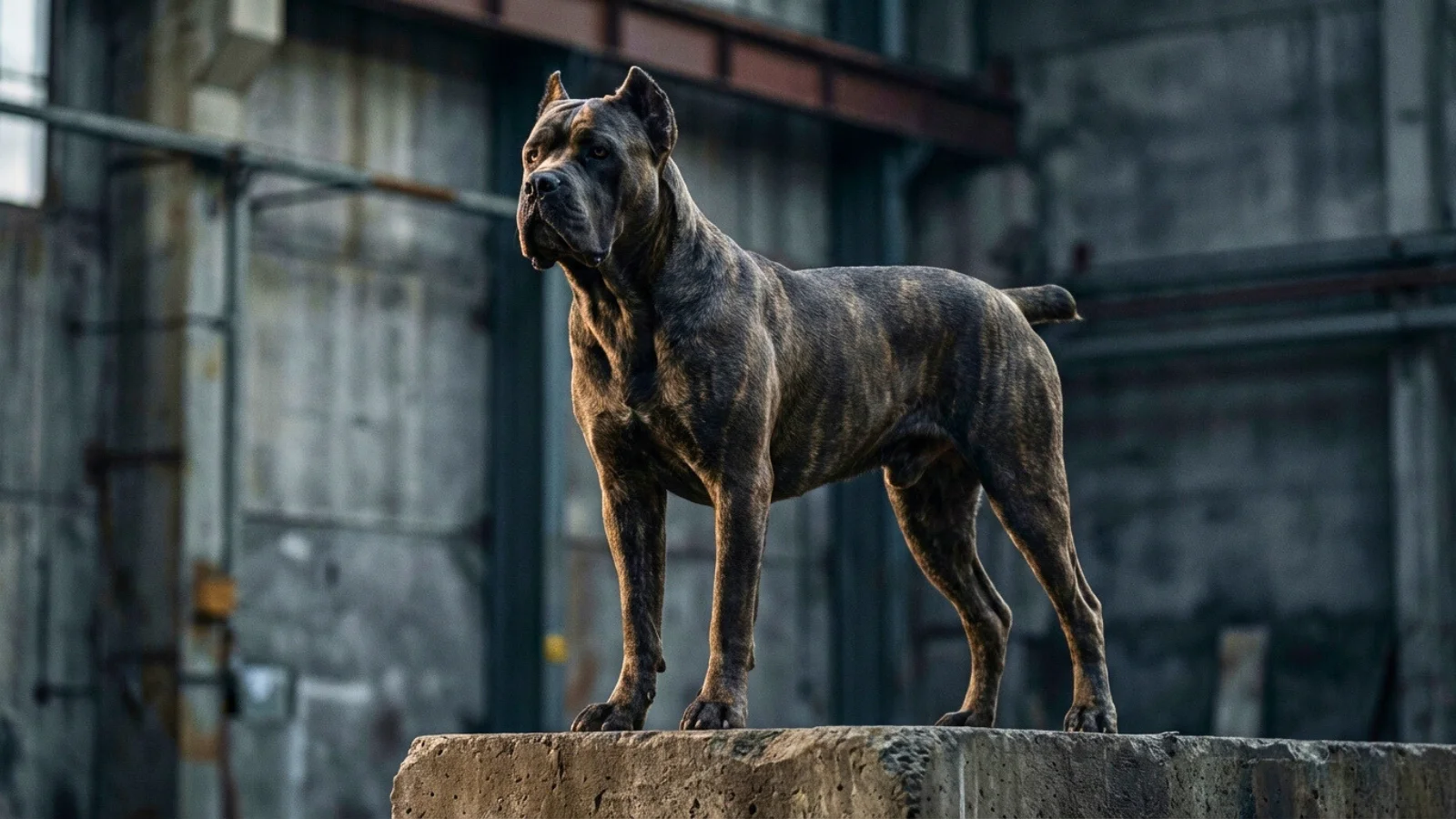
Bringing a Cane Corso into your life is a massive commitment, quite literally. Known as the Italian Mastiff, this magnificent breed commands respect through its sheer physical presence, deep loyalty, and unwavering protective instincts. But most Cane Corso size charts online repeat the same unsourced numbers from one site to the next — nobody says where the figures actually came from, and nobody shows you a real dog against them.
We can’t fix the second problem for every breed, but we can for this one. Dexter, my own Cane Corso, is 4.5 years old and currently sits at 43–46kg. His growth wasn’t a perfect textbook curve, and his vet has specific feedback on where he sits relative to the breed that most owners never hear. This guide gives you the standard growth data — clearly labelled by source, not presented as unquestionable fact — plus Dexter’s real trajectory alongside it, so you’ve got both the reference points and a genuine example of how one dog actually tracked.
At FlexK9, we believe in prioritising canine health, structural integrity, and proven data over social media hype. Understanding the true trajectory of your dog’s development is crucial for their long-term well-being. This comprehensive guide breaks down the factual expectations for a Cane Corso size, detailing their height, their ideal weight, and what a healthy growth timeline actually looks like. By following a structured and realistic Cane Corso size chart, you can ensure your dog develops into a structurally sound, powerful, and healthy adult.
TABLE OF CONTENTS
Understanding the True Cane Corso Size and Weight
To accurately assess your dog’s development, we must first strip away the myths and look closely at the biological realities and established breed standards of the Cane Corso.
Breed Standards vs. The “King” and “XL Corso” Myth
Search “Cane Corso size” for five minutes, and you’ll find breeders and owners boasting about dogs supposedly weighing 130, 140, even 150 pounds (59–68kg+), often marketed under invented labels like “King Corso” or “XL Corso.” These aren’t recognised classifications — no kennel club, breed authority, or the FCI itself acknowledges a “King” or “XL” variant of the Cane Corso. They’re marketing terms, full stop, usually attached to dogs that are simply overweight or have been deliberately bred oversized by crossing in other mastiff-type breeds.
Because the breed is not yet officially recognised by the UK Kennel Club, ethical UK breeders and experts adhere to the official global breed standard set by the Fédération Cynologique Internationale (FCI). That standard puts a healthy adult male at 64–70cm (25–27.5 inches) at the withers, with proportionate weight, while females are naturally smaller — typically 40–45kg (85–99 lbs) and 60–66cm (23.5–26 inches) tall.
Here’s the part the “King Corso” marketing conveniently skips: pushing a dog beyond these genetic limits doesn’t make them a better guardian or a more impressive animal. It makes them structurally overloaded. Extra mass a Cane Corso’s skeleton wasn’t built to carry translates directly into accelerated joint wear, a higher bloat risk, and a shortened working life. A correctly-proportioned, standard-sized Corso is not a “smaller” or lesser version of the breed — it’s the version that’s actually built to last.
Male vs. Female Cane Corso Dimensions
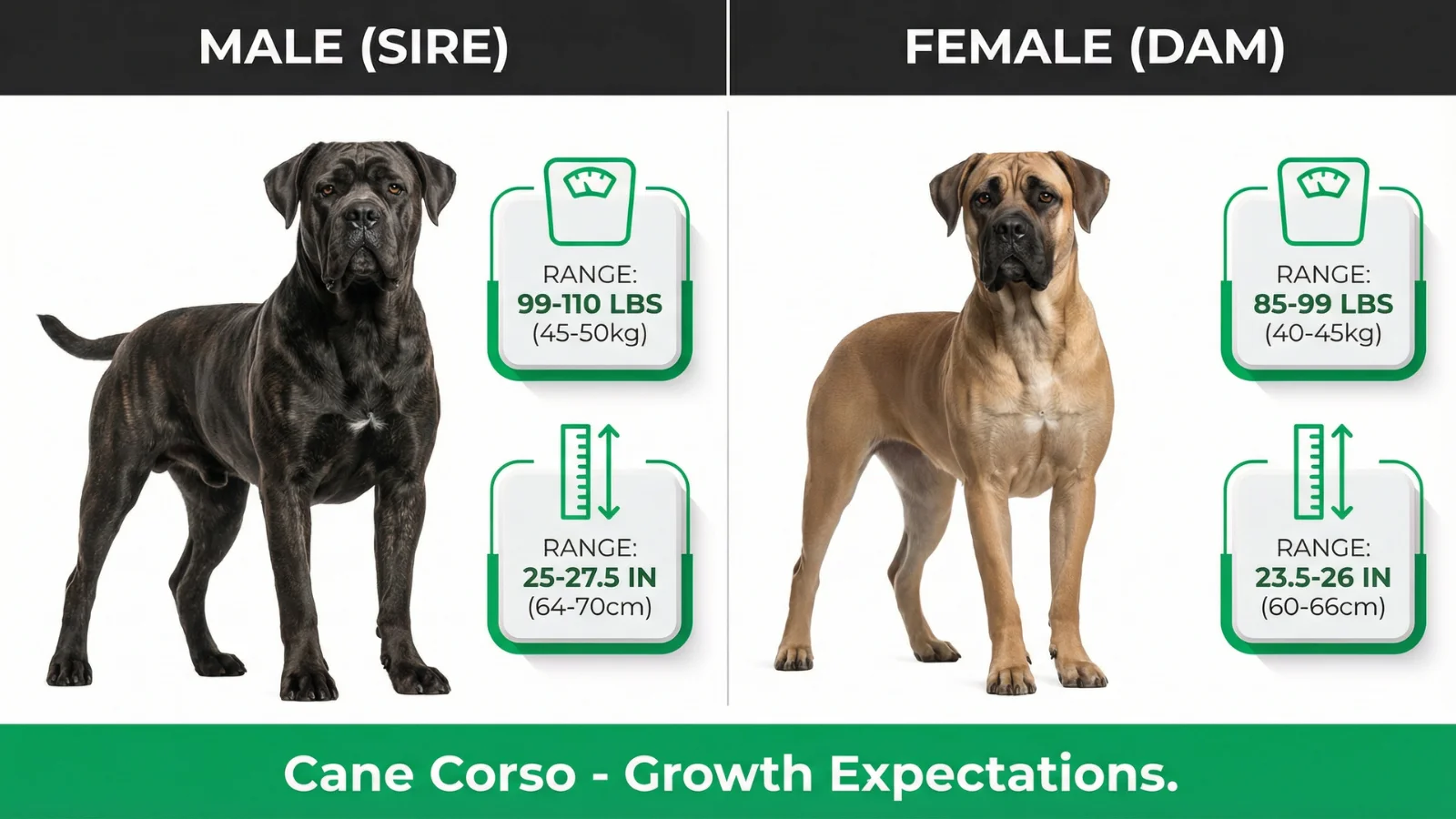
Sexual dimorphism is pronounced in this breed. Males carry a significantly broader skull, a thicker neck, and a more robust skeletal frame designed to support denser muscle mass. Females, while still powerful, have a comparatively refined bone structure and a lighter overall footprint. This isn’t just cosmetic — it means females typically plateau in weight gain earlier than males, and trying to push a female toward male-sized dimensions works against her natural development rather than with it.
The Cane Corso Size Chart — And Where These Numbers Actually Come From
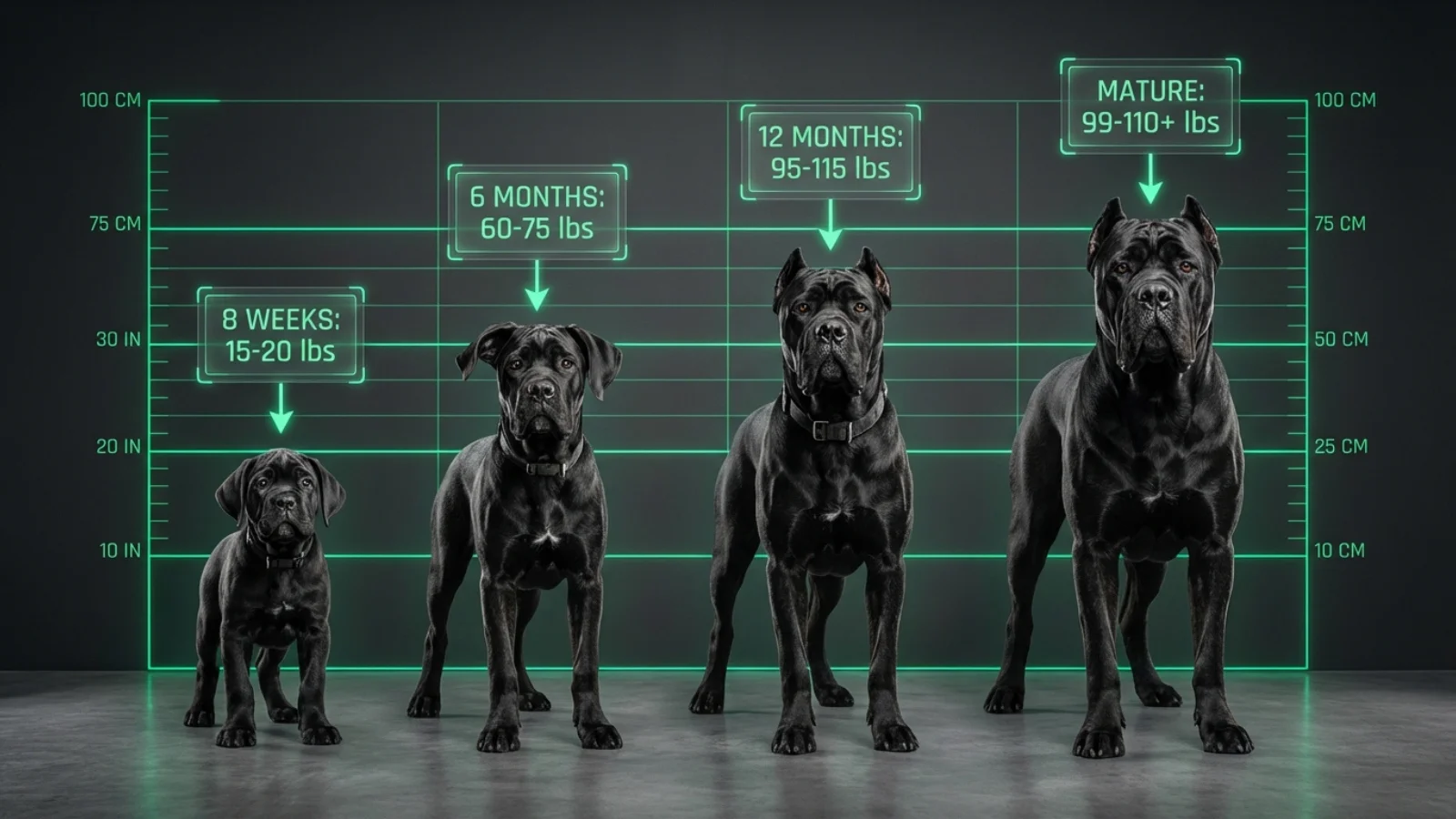
Most Cane Corso growth charts online present month-by-month figures as if they’re clinical fact. They aren’t. Here’s an honest breakdown of what’s actually behind the numbers in this guide:
- Adult height and weight ranges (the 45–50kg male / 40–45kg female figures) come directly from the FCI breed standard — this is the closest thing to an authoritative source for the breed in the UK, given the Cane Corso isn’t yet Kennel Club recognised.
- Month-by-month puppy and adolescent figures below are aggregated averages drawn from typical breed growth patterns, not a single clinical dataset. Treat them as a guide for spotting a dog that’s wildly off-track, not as a target your puppy needs to hit exactly.
Tracking your puppy’s growth involves two separate metrics — upward height growth and lateral mass (muscle and bone density) — and they rarely progress in lockstep.
Tracking Height Progression
A Cane Corso typically experiences rapid vertical growth during their first eight to ten months, often looking leggy, gangly, and slightly disproportionate during this phase. That’s completely normal. Measure at the withers — the highest point of the shoulder blades, just behind the base of the neck — rather than the top of the head, for an accurate reading.
Tracking Weight Progression
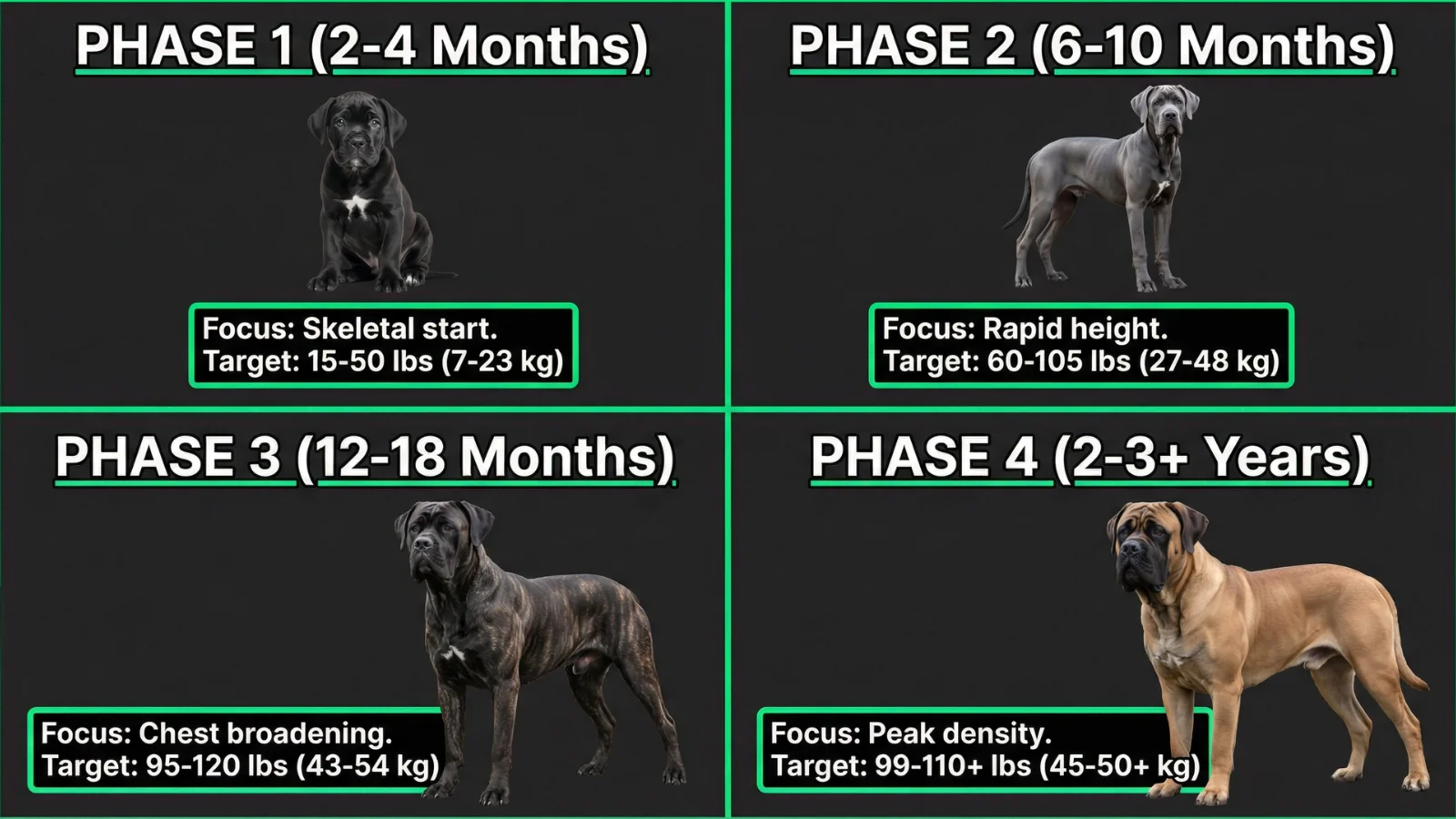
Filling out with muscle and bone density takes considerably longer than gaining height. A full Cane Corso weight timeline spans several years. The stages below are aggregated estimates (see the sourcing note above) to help you gauge the general shape of the journey.
1 Month Old
Around 2.2–4.5kg (5–10 lbs). Still heavily dependent on their mother, just beginning the transition to solid food.
2 Months Old
6.8–9kg (15–20 lbs) — the standard age a puppy goes to their new home. Highly active, clumsy, and visibly growing by the week.
3 Months Old
11.3–15.8kg (25–35 lbs). Rapid skeletal growth underway, with a noticeably increasing appetite.
4 Months Old
18.1–22.6kg (40–50 lbs). Teething is often in full swing and the jaw begins widening into its characteristic square shape.
5 Months Old
22.6–29.4kg (50–65 lbs). Height typically outpaces lateral muscle development here, giving a leggy appearance.
6 Months Old
27.2–34kg (60–75 lbs). Entering canine adolescence — a good point to lock in a strict, consistent feeding schedule.
7 Months Old
29.4–38.5kg (65–85 lbs). Early signs of mature muscle definition start appearing across the shoulders and hindquarters.
8 Months Old
31.7–43kg (70–95 lbs). Vertical height growth begins slowing noticeably as the body shifts energy toward mass.
9 Months Old
36.2–45.3kg (80–100 lbs). The chest cavity visibly drops and broadens, giving a more adult-like silhouette.
10 Months Old
38.5–47.6kg (85–105 lbs). Close to final adult height, but still well short of final adult weight and muscle density.
11 Months Old
40.8–49.8kg (90–110 lbs). Dietary discipline remains important while the skeletal frame is still setting.
12 Months Old
43–52.1kg (95–115 lbs). Physically, a one-year-old Corso is still very much a teenager in development terms, regardless of legal “adult” status.
18 Months Old
45.3–54.4kg (100–120 lbs). Neck thickening, skull broadening, and chest deepening are the dominant changes at this stage.
2 Years Old
Approaching true physical maturity, with weight stabilising around the FCI standard range. Muscle tone should be dense and proportional to the skeletal frame.
3 Years Old and Beyond
It can take a full three years for a Cane Corso to completely fill out. Adult weight is fully locked in by this stage — significant weight gained after this point is excess fat, not structural growth.
Dexter’s Growth: Chunky Puppy to Lean, Standard-Compliant Adult
Charts are useful for spotting a dog wildly off-track. What they can’t tell you is what a real Cane Corso’s growth actually looks and feels like as an owner living through it — so here’s Dexter’s.
As a puppy, Dexter grew quickly and, frankly, chunkily. His paws were noticeably oversized even by Corso puppy standards, and it wasn’t unusual for passers-by to stop and comment that he was clearly going to be a big dog. Beyond that, his puppyhood was fairly standard for the breed — no dramatic deviation from the general shape of the chart above, just a puppy who was visibly going to end up on the larger side of it.
From around two years old onwards, Dexter leaned out considerably as he matured, and that trend has continued into adulthood. Now, at 4.5 years old, he’s stable at 43–46kg, fluctuating within that range depending on activity and season rather than trending up or down.
The part worth passing on: at a routine check-up, our vet specifically praised Dexter’s weight — not because he’s small, but because he’s lean at a large frame. Their comment, in substance, was that most mastiff-type dogs they see clinically run overweight, and that carrying extra weight on that frame is what drives the joint problems this breed is prone to. Dexter being on the bigger side of standard and lean simultaneously was flagged as exactly the right combination — proof, in other words, that “big” and “healthy” aren’t in tension with each other, but “heavy” and “healthy” often are. That’s the practical version of the FCI-standard-vs-“King Corso” argument made in the section above: it’s not about breeding or feeding for the smallest possible dog, it’s about a large dog carrying the right amount of him.
Health, Care, and Managing Your Mastiff’s Growth
Knowing the numbers is only half the battle. Actively managing your dog’s environment, diet, and daily routine is what guarantees those numbers reflect a healthy, thriving animal rather than a medical liability.
Why Overfeeding is Dangerous (Bloat & Joint Dysplasia)
The desire to have the biggest dog on the block leads many owners to drastically overfeed their puppies. This is a catastrophic mistake. Pushing a large breed puppy to grow too quickly places immense, unnatural stress on their developing joints, leading directly to hip and elbow dysplasia. Carrying excess weight also significantly increases the risk of gastric dilatation-volvulus, commonly known as bloat — a sudden, fatal condition where the stomach twists on itself. Keep your dog lean; you should be able to easily feel their ribs without applying deep pressure.
The Role of Joint Supplements for Large Breeds
Because these mastiffs carry so much dense mass, their joints endure heavy wear and tear daily. Introducing the best dog joint supplements early in adult life can be a game-changer. Key ingredients like glucosamine and chondroitin help maintain cartilage health, promote natural joint lubrication, and can delay the onset of osteoarthritis in senior years. Proactive joint care is infinitely better than reactive pain management.
Dietary Needs for Steady, Healthy Growth
A standard all-life-stages kibble is rarely suitable for a giant breed puppy. They need specifically formulated large breed dog food that strictly controls calcium and phosphorus ratios to prevent explosive, unstable bone growth — mineral levels that are too high trigger bone growth the surrounding muscles and tendons can’t support. Learning how to feed a Cane Corso for controlled, steady growth is the real secret to raising a structurally sound mastiff.
Using Enrichment Toys to Prevent Rapid Eating
Due to their size and intense drive, many of these dogs inhale their meals in seconds — a primary trigger for bloat. Heavy-duty dog enrichment toys and feeding accessories that force the dog to work for their food slow intake drastically, protecting the digestive tract while also providing mental stimulation.
Exercise Guidelines for Growing Puppies
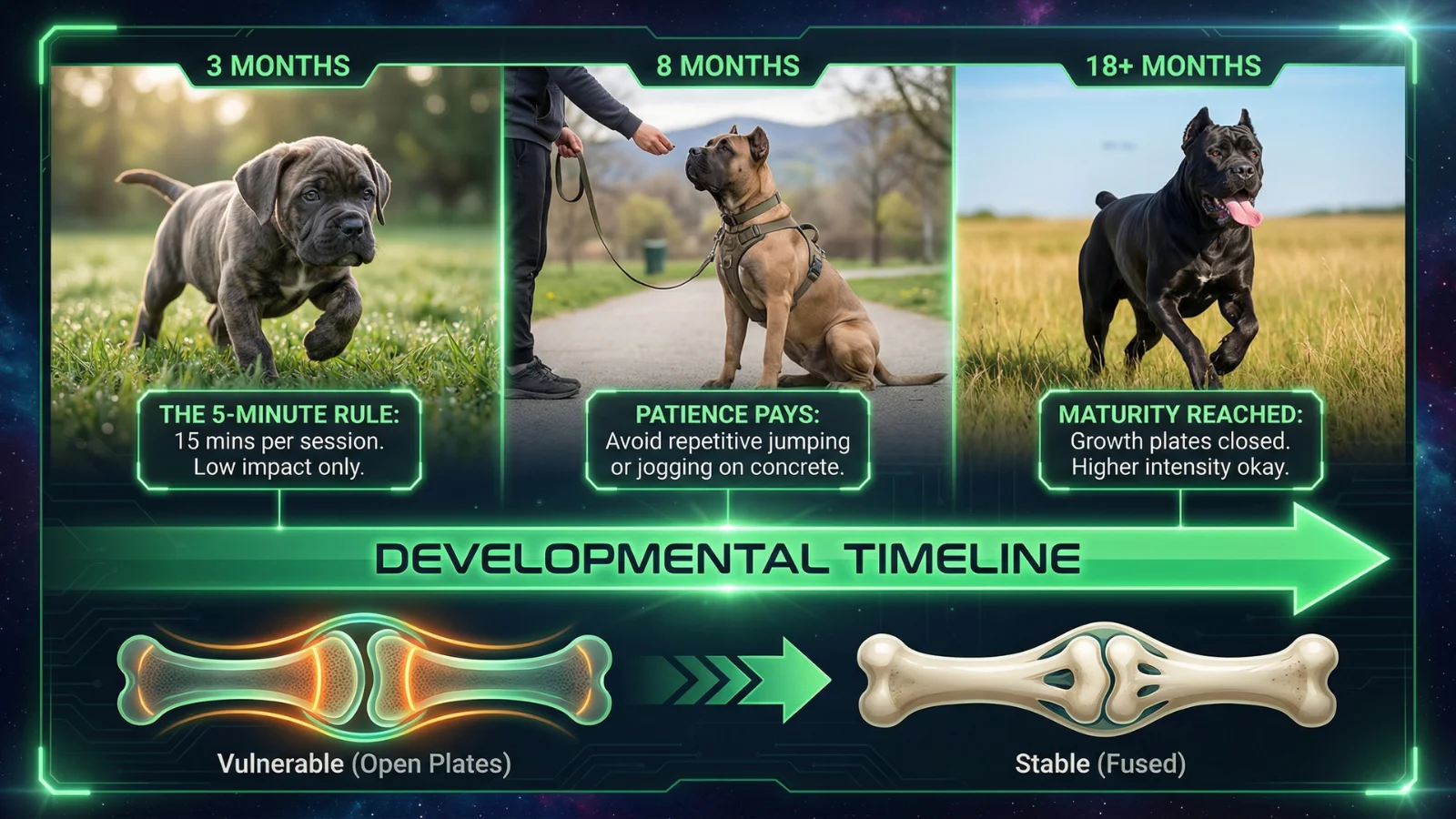
Forced exercise is highly detrimental to unformed growth plates. A widely accepted rule of thumb is five minutes of structured exercise per month of age, twice a day. Until your dog is at least eighteen months old and growth plates have fully closed, avoid high-impact activities like repetitive jumping, forced jogging on concrete, or pulling heavy weights.
Gear Choices: Collar vs Harness for a Powerful Dog
Managing a dog that can easily weigh over 45kg requires thoughtful equipment. Standard neckwear concentrates all corrective pressure directly onto the trachea and cervical spine. When weighing up a dog harness vs collar for a heavily muscled mastiff, a quality harness distributes pulling force across the chest, giving better mechanical control while protecting the airway.
Genetics and Environmental Factors
Never underestimate genetics. If a puppy’s parents were structurally smaller and leaner, the puppy will likely follow that blueprint — no amount of premium food or specialised care overrides genetic code. Environmental factors like daily stress, sleep quality, and early-life trauma also quietly influence how well the body uses nutrition to grow.
Keeping up with routine grooming using the best brush for a Cane Corso is also a useful, low-effort way to regularly check body condition and feel for proper muscle tone under the coat.
Final Thoughts on Your Cane Corso’s Size
Raising a Cane Corso is an incredibly rewarding journey that requires patience, discipline, and a focus on long-term health rather than sheer scale. Remember that the ultimate goal is not to breed or raise the heaviest dog possible, but to cultivate a structurally sound, athletic guardian that exhibits the stable, confident corso personality and temperament this breed is famous for.
Additionally, keeping up with routine grooming using the best brush for a Cane Corso allows you to regularly check their body condition and feel for proper muscle tone underneath their coat.
Ignore the online hype, stick to the biological facts, and enjoy the steady, magnificent growth of your canine companion.
Frequently Asked Questions
What is the maximum healthy weight for a Cane Corso?
The maximum healthy weight for an adult male Cane Corso is typically between 99 and 110 lbs (45 to 50 kg). Females naturally peak between 85 and 99 lbs (40 to 45 kg). Dogs heavily exceeding these breed standard weights are often dangerously overweight, increasing their risk of joint dysplasia and bloat.
At what age is a Cane Corso fully grown?
A Cane Corso reaches its full height around 12 to 14 months of age, but they are not fully grown at this stage. They will continue to build muscle density, broaden their chest, and fill out their skull until they reach true physical maturity between 2 and 3 years old.
How tall does a Cane Corso get?
According to official FCI breed standards, a male Cane Corso stands between 25 and 27.5 inches (64 to 70 cm) tall at the withers (shoulder). A female Cane Corso is slightly shorter and more refined, standing between 23.5 and 26 inches (60 to 66 cm) at the withers.
How much should my 6-month-old Cane Corso weigh?
At 6 months old, a healthy Cane Corso puppy should weigh between 60 and 75 lbs (27 to 34 kg). During this specific adolescent phase, they will often look tall and lanky because their rapid vertical height growth temporarily outpaces their lateral muscle development.
Are “King” or “XL” Cane Corsos recognised breeds?
No. Terms like “King,” “XL,” or “Giant” Cane Corso are marketing labels, not recognised classifications — no kennel club or the FCI acknowledges them. Dogs sold under these labels fall outside the breed standard and frequently carry excess weight their frame wasn’t built to support, leading to structural issues, orthopaedic pain, and shortened lifespans. Our own Dexter sits toward the larger end of the standard range at 43–46kg and was specifically praised by our vet for being lean at that size — proof that “big” within standard and “oversized” are not the same thing.
How can I tell if my Cane Corso is overweight?
You can tell your Cane Corso is at a healthy weight by checking their body condition score. You should be able to easily feel their ribs without applying deep pressure. Furthermore, they should have a visible abdominal tuck when viewed from the side and a clearly defined waistline when viewed from above.
Why is my Cane Corso smaller than the size chart says?
Your Cane Corso’s ultimate size is primarily dictated by their genetics. If their specific bloodline (sire and dam) leans smaller, your dog will naturally be smaller. As long as your mastiff is proportional, eating well, and cleared by a veterinarian, a leaner, smaller frame is perfectly healthy and often better for their joints.
