
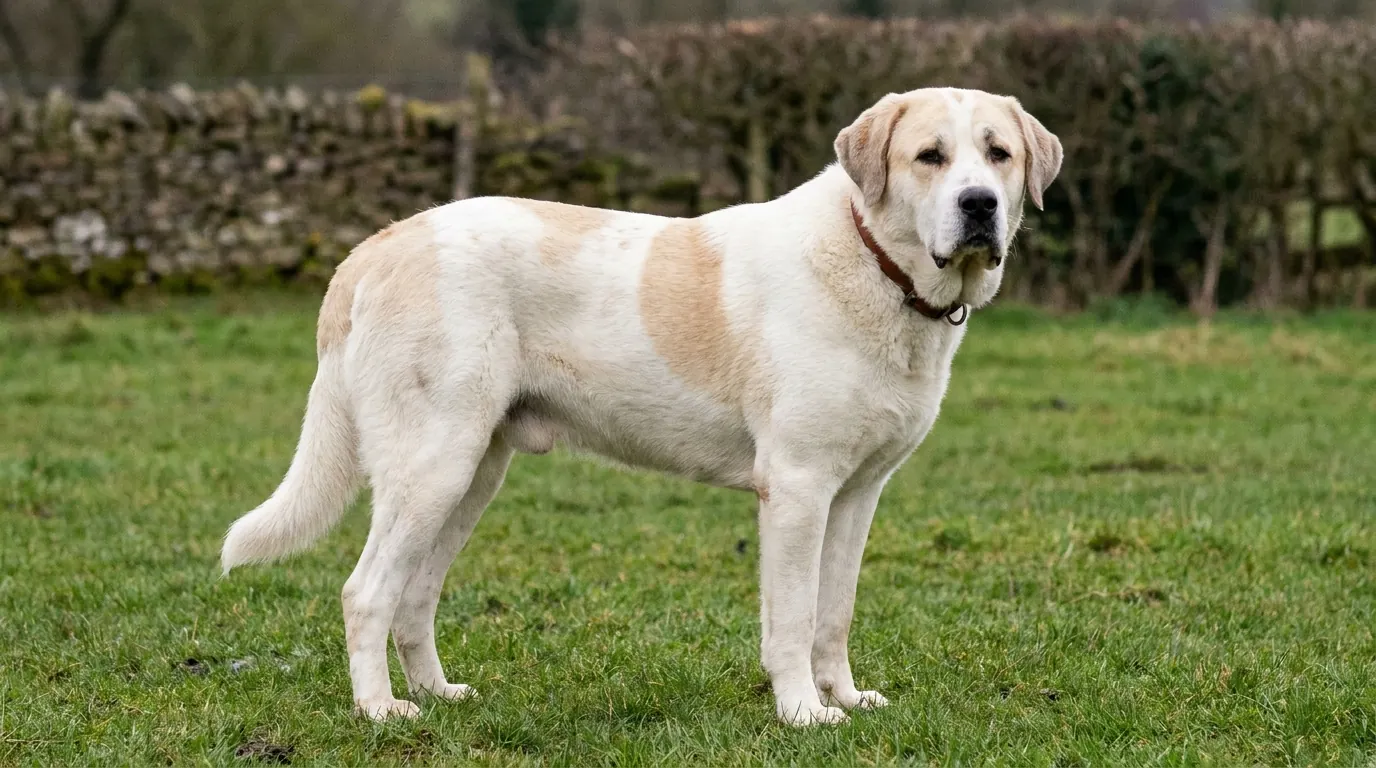
How big is a Central Asian Shepherd Dog? No UK source gives its size. The breed, often called the Alabai, isn’t recognised by the Royal Kennel Club, and no UK charity or vet study covers it. The international (FCI) breed standard describes a large dog, sets a minimum height and weight with males bigger than females, and says it isn’t fully mature until about three.
This guide uses the FCI standard for the Central Asian Shepherd Dog, the Royal Kennel Club’s Breeds A to Z list, GOV.UK and PDSA’s general advice for dog owners. We haven’t owned the breed, and there’s no PDSA, Dogs Trust or Blue Cross breed guide for it. Where UK sources say nothing, we’ve said so.
TABLE OF CONTENTS
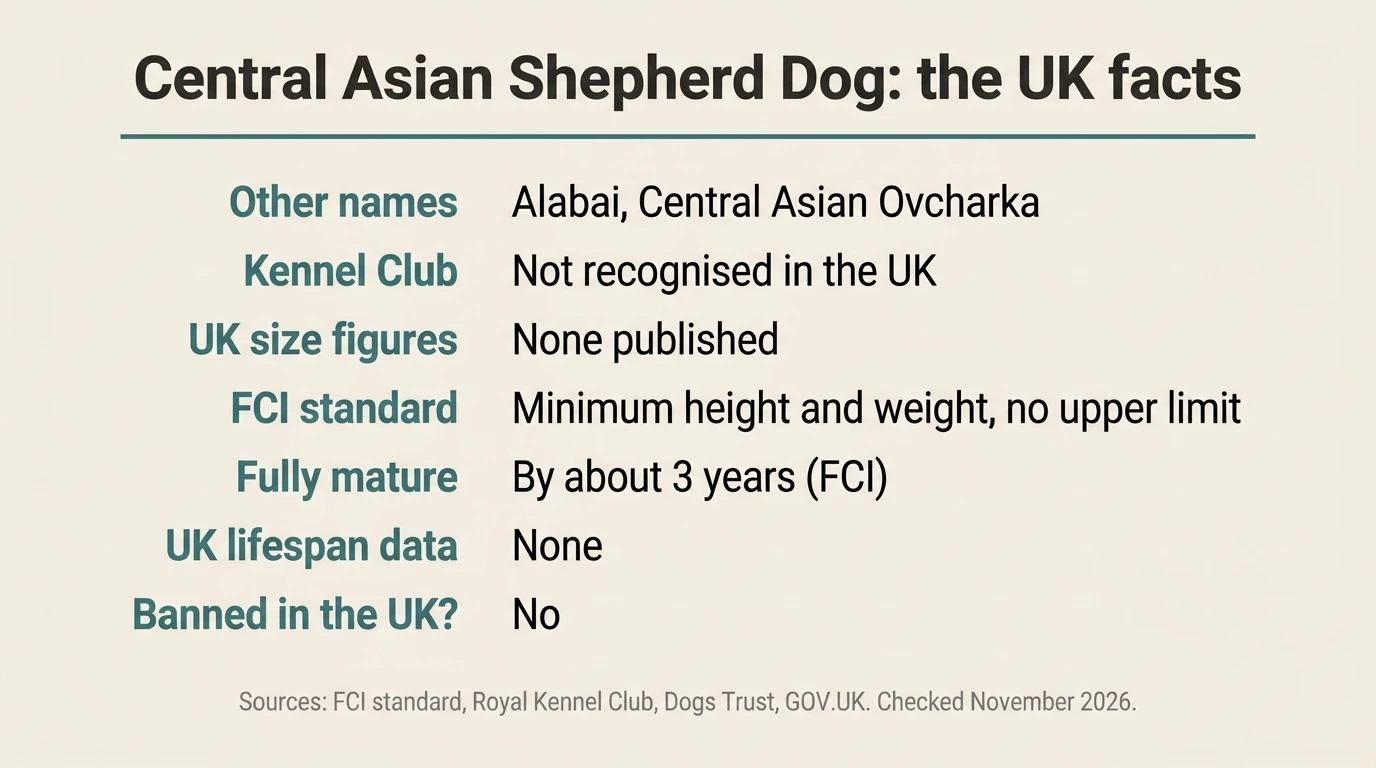
Central Asian Shepherd Dog at a glance
| What to know | Central Asian Shepherd Dog | Source |
|---|---|---|
| Other names | Alabai (or Alabay), Central Asian Ovcharka; the FCI’s official name is Sredneasiatskaya Ovtcharka | FCI standard |
| Royal Kennel Club | Not recognised; no UK breed standard | Royal Kennel Club Breeds A to Z |
| Size | Large; no UK figures | FCI standard |
| Height and weight | Minimums only, lower for females than males; no upper limit | FCI standard |
| Fully mature | By about three years old | FCI standard |
| UK lifespan data | None | Dogs Trust 2024 study (no named row for the breed) |
| UK breed health data | None | No PDSA breed guide or UK vet study found |
| Original job | Guard and watch dog; protected herds | FCI standard |
| Banned in the UK? | No; type is judged by looks, not breed | GOV.UK |
A breed standard describes the ideal dog, not every individual.
How big does a Central Asian Shepherd Dog get?
Big, but no UK source puts a number on it. The breed isn’t on the Royal Kennel Club’s list, no UK charity has a breed guide for it, and the Royal Veterinary College’s 2026 study of giant breeds seen by UK vets didn’t include it. So there are no UK average heights or weights to give you.
Large stature, with clear differences between the sexes, is how the FCI standard describes the breed: males are more massive than females, with a larger head. It sets a minimum height at the shoulder and a minimum weight, a little lower for females than for males. It gives no upper limit and says a larger dog is desirable, as long as it stays in proportion.
That means the standard tells you how small a Central Asian Shepherd Dog shouldn’t be, not how big a typical one is. Individual dogs vary, and size figures quoted online without a source can’t be checked against any UK data.
How long does a Central Asian Shepherd take to grow?
The breed reaches full maturity by about three years old, according to the FCI standard. Larger breeds in general can take 18 months to two years to reach full size, PDSA says, and too much high-impact exercise while a puppy is growing can damage its joints and bones. Its advice is to avoid long walks, running and hiking until a big dog is fully grown.
For feeding a growing big puppy, see our guide to the best large breed puppy food.
Why there’s no UK size chart for the breed
We don’t give a growth chart or a weight-by-age table, because no UK source has one for the Central Asian Shepherd Dog. Instead, check your dog’s shape as well as its weight, as PDSA suggests: you should be able to feel the ribs with a light touch and see a waist from above. Your vet can weigh your dog and tell you how much it should be eating.
Alabai, Ovcharka or Central Asian Shepherd: one breed, several names
They’re the same breed. Its official FCI name is Sredneasiatskaya Ovtcharka, which the English version of the standard translates as Central Asia Shepherd Dog. Alabai (sometimes spelled Alabay) and Central Asian Ovcharka are other names people use for it.
The standard gives the breed’s origin as the regions of Central Asia in the former USSR, with Russia as its patron country. It says the dogs were shaped by natural selection across a huge area, from the Caspian Sea to China and from the southern Urals to Afghanistan, mainly to protect herds, and that work on the breed began in the USSR in the 1930s.
It’s a different breed from the Turkish Kangal Dog, which the Royal Kennel Club recognises in its Pastoral group. Our Alabai vs Kangal comparison sets the two side by side, and our guide to Kangal temperament covers the Kangal on its own.
The Central Asian Shepherd’s status in the UK
Kennel Club and FCI recognition
The Central Asian Shepherd Dog isn’t recognised by the Royal Kennel Club. It isn’t among the 230 breeds on its Breeds A to Z list, which includes the breeds on its imported breed register. So there’s no UK breed standard, group or Breed Watch category for it, and no health test records to check.
Internationally, the breed has been recognised on a definitive basis since 1989 by the FCI, the federation of national kennel clubs. It sits in Group 2 as a Molossoid breed of the mountain type, and its current standard dates from 2010.
Is it a banned type?
No. The Central Asian Shepherd Dog isn’t one of the five types in our list of banned dog breeds in the UK. Whether a dog is a banned type depends on what it looks like, rather than its breed or name, according to GOV.UK, and the law on dogs that are dangerously out of control applies to every breed. Our guide to the Dangerous Dogs Act 1991 explains what each section of the law says.
What is a Central Asian Shepherd Dog like to live with?
Self-assured, balanced, quiet, proud and independent, with a natural instinct of territory: that’s how the FCI standard describes the breed. It treats aggressive or overly shy dogs as disqualified, and a highly strung temperament as a severe fault. A breed standard describes the ideal dog, though, not every individual.
No UK study looks at how Central Asian Shepherds behave at home, with children or with other dogs, and no UK charity gives breed advice on their training or exercise. So no UK source can tell you whether one would suit your family.
For any puppy, the socialisation period runs from about 4 to 12 weeks old, PDSA says, and lots of positive new experiences then help it grow into a happy, confident adult. The same guide recommends keeping up consistent, reward-based training throughout a dog’s life. Our guide to puppy and dog training explains how it works.
Central Asian Shepherd health: the gaps in UK data
There’s no UK health or lifespan data for the Central Asian Shepherd Dog: no PDSA breed guide, no VetCompass study that we could find, and no named row in Dogs Trust’s 2024 lifespan study. For how lifespan varies with size across UK breeds, see our guide to dogs with the longest lifespan.
Two conditions that matter for big dogs are covered in PDSA’s general advice. Hip dysplasia most commonly affects medium to large pedigree dogs and is mostly inherited, so it suggests asking the breeder about hip scores. GDV, where the stomach bloats and twists, is most common in giant and deep-chested breeds and is an emergency. Neither is a finding about this breed.
For conditions UK vets record across many breeds, see our guide to dog breed health problems.
When to see your vet: Contact your vet straight away if your dog is retching, restless or has a swollen belly. These can be signs of GDV, which is life-threatening, PDSA says. If anything else about your dog’s health worries you, book an appointment rather than waiting.
Thinking of getting a Central Asian Shepherd in the UK?
Thinking carefully before you buy or rescue any pedigree breed, and doing as much research as you can first, is what PDSA recommends. With this breed, that research is harder, because there’s no UK breed standard or breed health data to check a puppy against. Its guide to choosing a healthier pedigree pet covers the questions to ask.
Its general advice, before you commit, is to:
- Make sure the puppy’s parents have been health tested, and ask the breeder about hip scores.
- Use the free Puppy Contract when you buy a puppy.
- Check you can afford vet fees and pet insurance, which can cost more for some breeds.
- Budget for a large dog: the minimum lifetime cost of a large breed is about £8,200 to £18,800.
- Feed a growing puppy food that suits its size and age, and keep its exercise gentle until it’s fully grown.
- Consider a rescue dog, including from a breed-specific rescue centre.
Before you buy: Talk to your vet before you commit to a Central Asian Shepherd puppy or rescue dog. With no UK breed health data to go on, your vet can help you decide which health checks to ask for.
Final thoughts on the Central Asian Shepherd Dog
The Central Asian Shepherd Dog is a large breed that UK sources barely cover. What you can rely on is the FCI standard’s description and PDSA’s general advice for any dog.
- If you want size figures, the FCI standard gives minimums only, and no UK source gives averages.
- If you’re comparing it with the Kangal, our Alabai vs Kangal comparison sets them side by side.
- If you’re buying a puppy, ask to see the parents’ health results and use the Puppy Contract.
- If anything about your dog’s health worries you, talk to your vet.
Frequently Asked Questions About the Central Asian Shepherd Dog
How much does a Central Asian Shepherd weigh?
No UK source gives an average weight. The international (FCI) breed standard sets a minimum weight for males and a slightly lower one for females, with no upper limit, and says a larger dog is desirable if it stays in proportion. Individual dogs vary, so ask your vet to check your dog’s weight and shape.
Is the Alabai the biggest dog breed?
No UK source says so. There’s no UK data on the Central Asian Shepherd Dog’s size, and the Royal Veterinary College’s 2026 study of giant breeds seen by UK vets didn’t include it. The FCI standard describes a large dog but sets minimums only, so UK sources can’t rank it against other breeds.
How long do Central Asian Shepherds live?
There’s no UK figure. Dogs Trust’s 2024 study of UK dog lifespans has no row named for the breed, and we found no UK vet study that covers it. Lifespans quoted online for the Alabai can’t be checked against UK data, so your vet is the best person to ask about your own dog’s health.
Is a Central Asian Shepherd a good family dog?
UK sources can’t say. No UK study or charity guide covers the breed’s behaviour with children or other pets. The FCI standard describes a self-assured, independent dog with a natural territorial instinct. If you’re considering one, PDSA advises researching the breed carefully and speaking to your vet before you choose a new dog.
Can you get a Kennel Club registered Central Asian Shepherd?
Not as a Royal Kennel Club breed. The Central Asian Shepherd Dog isn’t on the Royal Kennel Club’s Breeds A to Z list, so there’s no UK breed standard and no Kennel Club health test record to check a puppy against. Ask the seller for the parents’ health test results, including hip scores.
Is ear cropping legal in the UK?
No. Ear cropping is illegal in the UK, as PDSA notes in its breed advice. The FCI standard says traditional ear cropping and tail docking are still practised where the law allows, which is why many photos show cropped dogs. A Central Asian Shepherd’s natural ears are medium-sized, triangular and hang down.
