
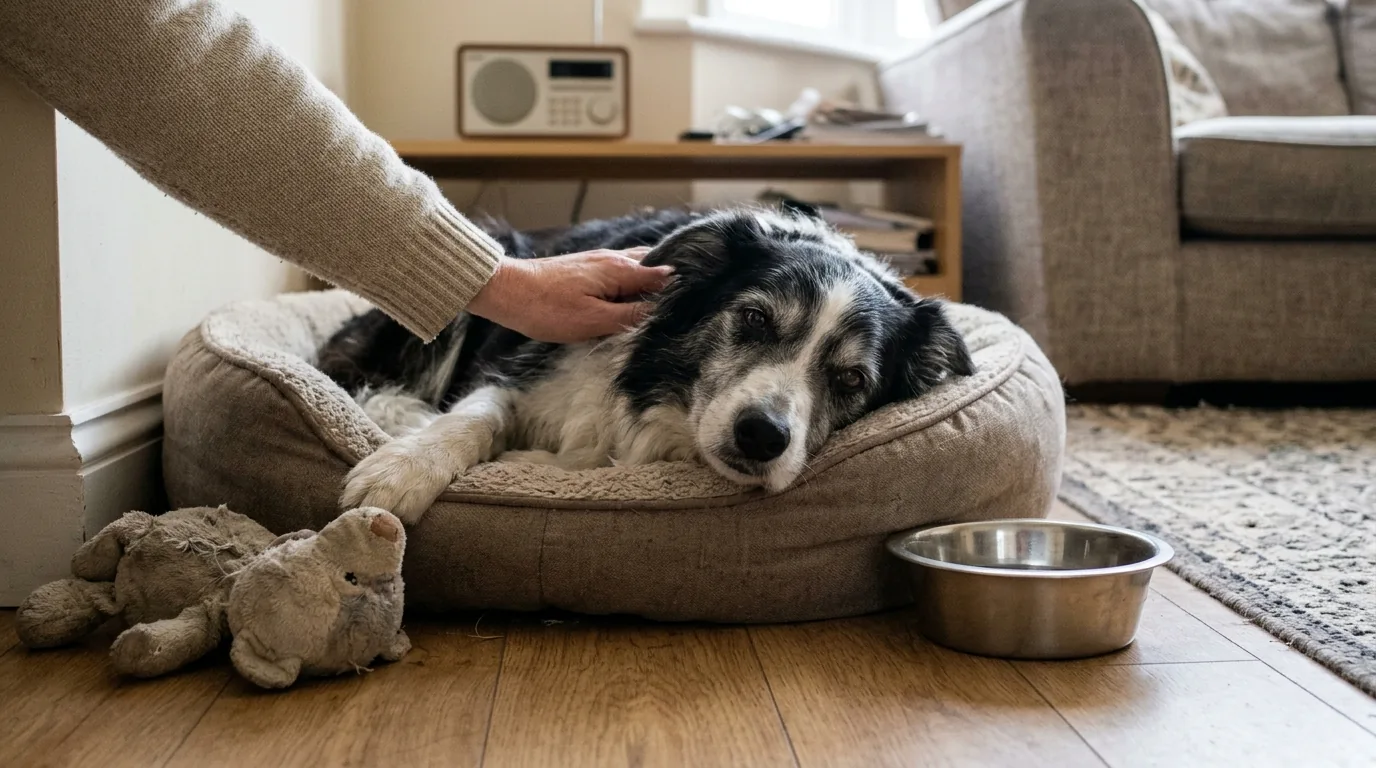
Yes, dogs can get dementia. Dog dementia, which vets call cognitive dysfunction, can develop as a dog’s brain ages and causes behaviour changes, such as confusion, waking at night and accidents in the house, that tend to get worse over time. There’s no cure, but treatment and simple changes at home help many dogs keep a good quality of life for some time, PDSA says.
This guide uses advice from three UK vet charities: PDSA, Blue Cross and Dogs Trust. We haven’t cared for a dog with dementia; our own dog, Dexter, is a Cane Corso coming up to five. Where UK sources say nothing, such as how long a dog lives with dementia or the age it starts, we say so. This guide is general information, not veterinary advice.
| What to know | What UK vet charities say | Source |
|---|---|---|
| What it is | A condition of the ageing brain that affects memory, learning and behaviour, similar in some ways to Alzheimer’s in people | PDSA |
| Common signs | Confusion, waking at night, accidents indoors, forgetting training, pacing, staring into space and barking more | PDSA, Blue Cross |
| Which dogs get it | More common in older dogs; young dogs are unlikely to get it | PDSA |
| Can it be cured? | No, and it tends to get slowly worse | PDSA, Blue Cross |
| Treatment | Your vet may suggest medicine, a special diet, supplements or pheromone products | PDSA |
| Help at home | A steady routine, a familiar layout, gentle walks on a lead and simple games | PDSA, Blue Cross |
| When to see a vet | At the first sign of a change in behaviour | Dogs Trust |
| Saying goodbye | A decision you make with your vet, based on quality of life | PDSA, Blue Cross, Dogs Trust |
TABLE OF CONTENTS
What is dog dementia?
Dog dementia is the everyday name for cognitive dysfunction, a condition that can develop in some dogs as their brain ages. It affects memory, makes it hard to learn anything new and changes behaviour and personality, much like Alzheimer’s in people. The cause isn’t fully understood, though a build-up of a harmful protein in the brain and poor blood flow are known to make it worse. That’s how PDSA describes dementia in dogs, and Blue Cross’s guide to older dogs gives the same picture.
So can dogs get dementia? Not in exactly the way people do, PDSA’s guide to dementia in pets explains, but what they get is similar in many ways. It’s more common in older dogs, and young dogs are unlikely to get it. Dogs Trust counts dogs over seven as senior, and our guide to dog years to human years explains when a dog counts as senior by size.
Signs of dementia in dogs
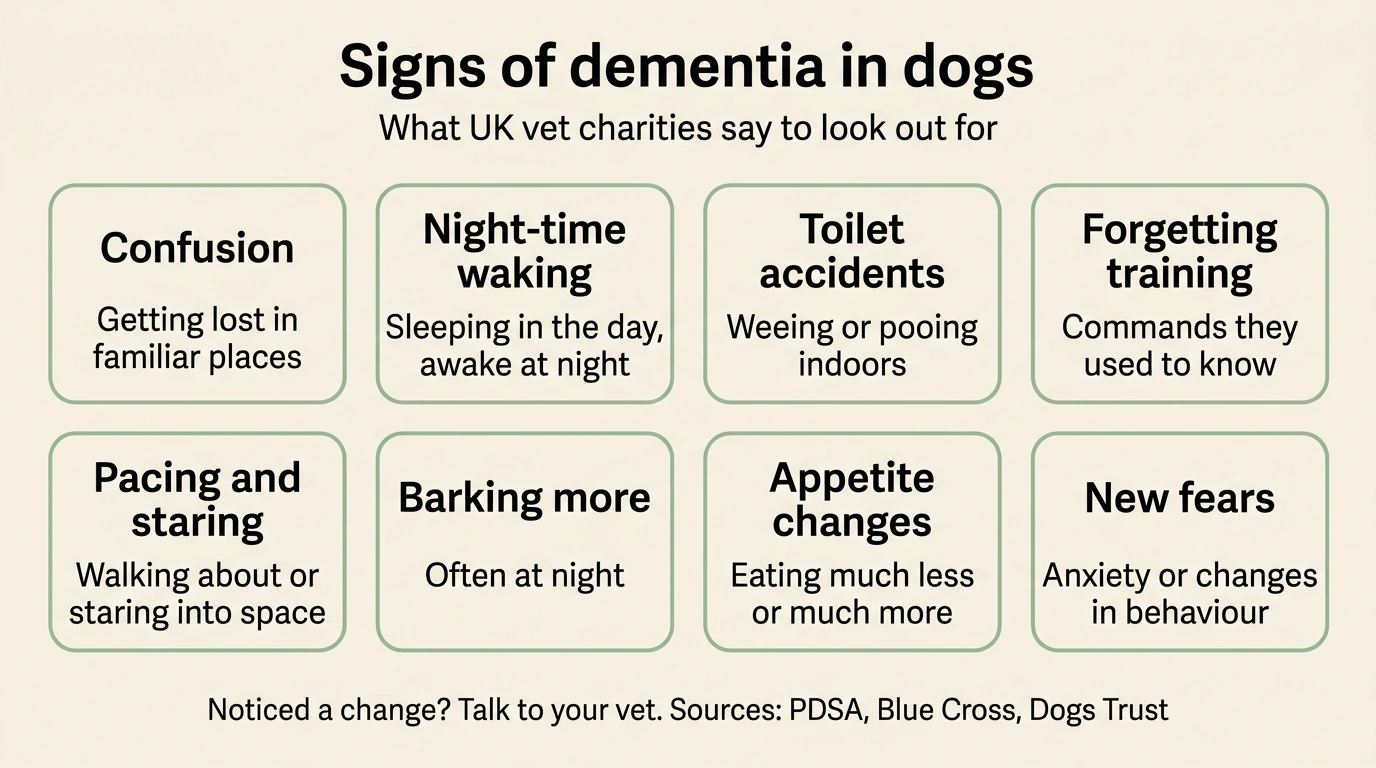
The signs often start small. At first you may only notice your dog acting slightly differently, and the changes tend to become more obvious over time. Between them, the UK vet charities list these signs:
- Confusion, such as getting lost in familiar places or stuck in a room they can’t find their way out of
- Sleeping more in the day and being awake or restless at night
- Weeing or pooing in the house, even though they’re toilet trained
- Forgetting commands and training, and finding it hard to learn new things
- Pacing, or staring into space
- Barking or howling more, often at night
- Eating much less, or much more if they forget they’ve already eaten
- Seeming withdrawn or low, or forgetting family members and other pets
- New fears, anxiety or changes in behaviour, including aggression
- New compulsive behaviours
Most of these come from PDSA’s two dementia guides. Blue Cross lists the same core signs in its older-dog advice, and Dogs Trust names new compulsive behaviours as a sign of senility.
Restless at night: what some owners call sundowning
Some owners call night-time restlessness “sundowning”, a word borrowed from human dementia care. The UK vet charities don’t use the term, but PDSA and Blue Cross both describe the pattern: sleeping more in the day, being awake at night and barking or howling more in the night. A steady routine helps. PDSA suggests feeding and walking your dog at the same times each day, and encouraging them to stay awake for some of the day if they’re restless at night. If nights are getting hard for either of you, tell your vet.
Other problems that can look like dementia
Not every change in an older dog is dementia. Slowing down with age is normal, but changes in behaviour can be a sign of pain or illness, Blue Cross warns, and hearing loss can confuse a dog too.
A dog that barks more may be troubled by something or going deaf, according to Dogs Trust. Walking round in a circle is one of the signs PDSA lists for loss of balance, which is often caused by vestibular disease, a problem deep in the ear that older dogs are more likely to get. That’s why the next step is always your vet.
When to see a vet about dementia
Talk to your vet as soon as you notice a change in your dog’s behaviour. Dogs Trust advises contacting your vet at the first sign of behavioural changes in an older dog, and the earlier a dog with cognitive dysfunction gets treatment, the better their outlook, PDSA says. Your vet will need to see your dog to diagnose it.
We couldn’t find a UK vet charity that offers a home test or checklist score for dementia, so there isn’t one on this page. Before the appointment, it helps to note what you’ve seen and when, such as nights your dog was awake or accidents indoors.
When to see your vet: Book an appointment if your older dog seems confused, is awake at night, starts having accidents indoors or behaves differently. Dogs Trust advises telling your vet at the first sign of a change rather than putting it down to age. If your dog suddenly loses their balance, PDSA’s advice is to contact your vet.
From our home: Dexter is coming up to five, so he isn’t a senior dog yet and we haven’t lived with dementia. He’s calmer than he was as a youngster but still runs and plays hard, and he sees the vet once a year. Dogs Trust advises twice-yearly check-ups once a dog is older, and telling your vet about any change in behaviour rather than putting it down to age. That’s what we plan to do as he gets older.
Can dog dementia be treated?
There’s no cure, and no way to prevent it, but your vet may still be able to help. Vets usually recommend a combination of treatments, according to PDSA:
- Medicine: a few medicines may help with the signs and slow the condition down.
- Diet and supplements: special diets and antioxidant supplements are designed to support brain function; talk to your vet about which would suit your dog.
- Pheromone products: these can help if your dog is anxious.
- Behaviour support: your vet may refer you to an accredited behaviourist, especially if the signs are severe or your dog develops new fears.
Blue Cross also says there may be medicines that help and to ask your vet what’s suitable. We haven’t named any medicines, diets or supplements, because the right choice depends on your dog and only your vet can make it. We couldn’t find a UK vet charity that recommends a supplement for dementia without a vet’s advice.
How to help a dog with dementia at home
Small changes at home can make a real difference. These come from PDSA’s and Blue Cross’s advice:
- A daily routine, with meals and walks at the same times
- A safe den that stays the same, with their bed, food, water and favourite toys in one place
- Furniture left where it is; if something has to change, change one room at a time
- Clues to help them find their way, such as a radio playing in one room or a textured rug in another
- Short, gentle walks in familiar places, on a lead or in an enclosed field, with time to sniff
- Simple games and a few simple commands
- Plenty of chances to go to the toilet, even if they don’t ask, and puppy pads indoors if needed
- An up-to-date ID tag and microchip details, in case they get lost
- Time together every day: a game, a short training session or a quiet cuddle
If your dog forgets something they used to know, don’t get angry or punish them; both charities stress this. PDSA suggests gently re-teaching basic training with positive, reward-based methods, and our dog training guide explains how reward-based training works. For simple games that use food, a towel or a cardboard box, see our guide to dog enrichment toys.
Keeping everyone safe
Dogs with cognitive dysfunction can act unpredictably, and PDSA warns this can include aggression, even in a dog that has always been friendly. If your dog seems nervous in certain places or around certain people, move them away from the situation, and never force them into something that scares or confuses them. Children should never be left alone with a dog with dementia. A confused dog that runs after something on a walk may not find its way back to you, Blue Cross adds, so a lead keeps them safe.
How long can a dog live with dementia?
No UK source gives a figure. Most dogs can have a good quality of life for some time after diagnosis, especially if they respond well to treatment and the condition is managed well at home, PDSA says. It tends to get slowly worse, though, and in some dogs it becomes severe.
You may read that dog dementia has mild, moderate and severe stages, each with its own timeline. The UK vet charities don’t set out stages, so we don’t either; your vet is the best person to say how your dog is doing. For how long dogs live in general and by breed, see our guide to how long dogs live.
When to put a dog with dementia to sleep
This is one of the hardest decisions an owner faces, and it’s one you make with your vet. It might be kindest to consider putting a dog to sleep if their symptoms become very severe, they have more bad days than good, their quality of life has significantly deteriorated or they become a danger to themselves, PDSA says. The same applies if you’re finding it impossible to manage them, or they’re suffering.
To judge quality of life, the charities suggest asking questions like these, and asking them regularly:
- Are they in pain, restless or unable to get comfortable?
- Have they lost interest in food, even their favourite treats?
- Do they struggle to get up, or can they no longer manage even a gentle walk?
- Are they weeing or pooing where they rest?
- Have they stopped enjoying the things they used to love?
- Do they seem confused in normal situations, or no longer interested in what’s going on around them?
- Are they having more bad days than good?
- Are you finding it hard to cope with caring for them?
If the answer to many of these is yes, your dog is struggling, PDSA says. A falling quality of life doesn’t always mean it’s time, though: there may be other treatments to try, and a vet only recommends euthanasia as a last resort. Dogs Trust suggests listing the things your dog loved doing at their healthiest and comparing that with how they are now, and PDSA suggests keeping a diary to track changes over weeks or months.
Preparing to say goodbye
Your vet can talk you through what happens and answer your questions, including whether it can be done at home or at a quiet time at the surgery. Dogs Trust suggests taking someone with you so you don’t drive home alone, and thinking about any other dogs at home, who may grieve too. Feeling guilty or doubting the decision afterwards is normal, Blue Cross says, and its Pet Bereavement Support Service on 0800 096 6606 offers confidential support if you need to talk.
Final thoughts: living with a dog with dementia
- If your older dog is confused, restless at night or forgetting their training, see your vet rather than putting it down to age.
- If your vet diagnoses dementia, ask about treatment early: the sooner it starts, the better the outlook.
- If you’re caring for them at home, keep the routine and the layout steady, keep walks short and on a lead, and be patient.
- If nights or accidents are wearing you down, tell your vet, because how you’re coping matters too.
- If you’re wondering whether it’s time, look at their quality of life with your vet; you don’t have to decide alone.
Frequently Asked Questions
At what age do dogs get dementia?
No UK vet charity gives an age. PDSA says dementia is more common in older dogs and young dogs are unlikely to get it. Dogs Trust counts dogs over seven as senior, and Blue Cross says larger breeds can slow down as early as six, so mention any changes from middle age to your vet.
Can a dog with dementia still have a good life?
Yes, for a time. PDSA says most dogs can have a good quality of life for some time after diagnosis, especially if they respond well to treatment and the condition is managed at home. A steady routine, gentle walks and simple games help, but it tends to get slowly worse, so watch how your dog copes.
Why does my old dog pace and stare at the wall?
Pacing and staring into space are both on PDSA’s list of dementia signs, but they aren’t proof of it. Changes in an older dog’s behaviour can also be a sign of pain or illness, Blue Cross says, so book a vet appointment and describe what you’ve seen and when it happens.
Do dogs with dementia forget their owners?
Some seem to. PDSA lists forgetting family members and other pets among the signs. Its advice is to keep time together positive, even if your dog seems to have forgotten you, and to spend a little quality time with them each day, which can help them stay confident and respond to you.
Can young dogs get dementia?
It’s unlikely. PDSA says dementia is more common in older pets and that young pets are unlikely to get it. If a young or middle-aged dog becomes confused, forgets their training or starts behaving differently, something else is more likely to be the cause, so see your vet.
Is there a test for dog dementia?
No UK vet charity offers a home test. Your vet needs to see your dog to diagnose it, PDSA says. Before the appointment, write down the changes you’ve noticed and when they happen, such as waking at night or accidents indoors, so your vet has the full picture.
