
How old is your dog in human years? There’s no UK-agreed answer. We found no formula for turning dog years to human years from any UK vet charity, the Royal Kennel Club or VetCompass, and the popular charts online come from US research. What UK data does give is how long dogs of each size typically live and when they count as senior. Our calculator uses those figures to show how far through a typical life your dog is.
This guide draws on Dogs Trust, Blue Cross, PDSA, the Royal Veterinary College’s VetCompass research and the Office for National Statistics, plus what I’ve seen with Dexter, my Cane Corso. Where UK sources say nothing, I’ve said so.
TABLE OF CONTENTS
Dog years to human years: is there a formula?
No UK source gives one. The old rule that one dog year equals seven human years has nothing UK-based behind it, and it falls apart at the very start of a dog’s life. Puppies grow up fast: PDSA says small dogs usually move off puppy food at around a year old, and large or giant breeds at around 18 months. A one-year-old dog is close to adult, which a seven-year-old child is not.
You’ll find plenty of size-based dog years to human years charts online. The ones we checked trace back to US vets and US research, not to any UK charity, the Royal Kennel Club or UK vet records. So rather than copy a US chart, this page uses the UK figures that do exist: typical lifespans by size, and the ages UK charities use for “senior”.
Dog age calculator
FlexK9 dog age calculator (UK figures)
A rough guide built from UK lifespan figures (Dogs Trust, RVC VetCompass and ONS), not a vet’s assessment.
Enter your dog’s age and choose the size group closest to your dog. The calculator tells you which life stage UK charities would put your dog in and how far through a typical life for that size your dog is. From the age of three, it also gives a human comparison.
How the calculator works
There’s no UK formula for dog years to human years, so the calculator takes the typical lifespan for your dog’s size group and works out how much of it your dog has lived. It then applies the same share to an average UK human life. Here are the figures it uses:
- Small, medium and large dogs: median lifespans of 12.7, 12.5 and 11.9 years, from a 2024 Dogs Trust study of UK dogs.
- Giant dogs: a median of about 8.9 years, from a separate 2026 RVC VetCompass study of giant breeds.
- People: about 81 years, the midpoint of the Office for National Statistics’ UK life expectancy at birth for 2021 to 2023 (78.8 for men and 82.8 for women).
- Life stages: senior over seven and geriatric over 12 (Dogs Trust), and senior food at about seven for small dogs and about five for larger dogs (PDSA).
The human comparison only starts at three because dogs grow up far faster than children do. A two-year-old dog is an adult, but the same share of a human life would make it look like a child. The calculator can’t account for your dog’s breed, health or individual history, so treat the result as a rough guide, not a vet’s assessment.
How long do dogs live in the UK?
The typical UK dog lives about 12 and a half years. In a 2024 study of more than half a million UK dogs, Dogs Trust found a median lifespan of 12.5 years, with females living slightly longer than males (12.7 years against 12.4). Size made a clear difference: large breeds were about a fifth more likely to have a shorter life than small breeds.
Giant breeds live shorter lives again. In a 2026 study of giant breeds such as Great Danes, Irish Wolfhounds and Saint Bernards, RVC VetCompass found they died at a median age of about 8.9 years, compared with about 12 years for dogs overall. Females lived a little longer than males, at about 9.3 years against 8.5, and the RVC linked the shorter lives to other research showing that faster growth in giant dogs leads to faster ageing.
| Size group | Typical lifespan | Source |
|---|---|---|
| Small breeds | 12.7 years | Dogs Trust (2024) |
| Medium breeds | 12.5 years | Dogs Trust (2024) |
| Large breeds | 11.9 years | Dogs Trust (2024) |
| Giant breeds | about 8.9 years | RVC VetCompass (2026) |
| All dogs | 12.5 years | Dogs Trust (2024) |
You may also see a figure of 11.2 years. That comes from RVC VetCompass life tables built from vet records of dogs that died in 2016, and it measures average life expectancy at birth, so it isn’t the same measure as the medians above. For a single breed’s lifespan, our dog breed health problems guide points to each breed’s UK figures.
When is a dog a senior?
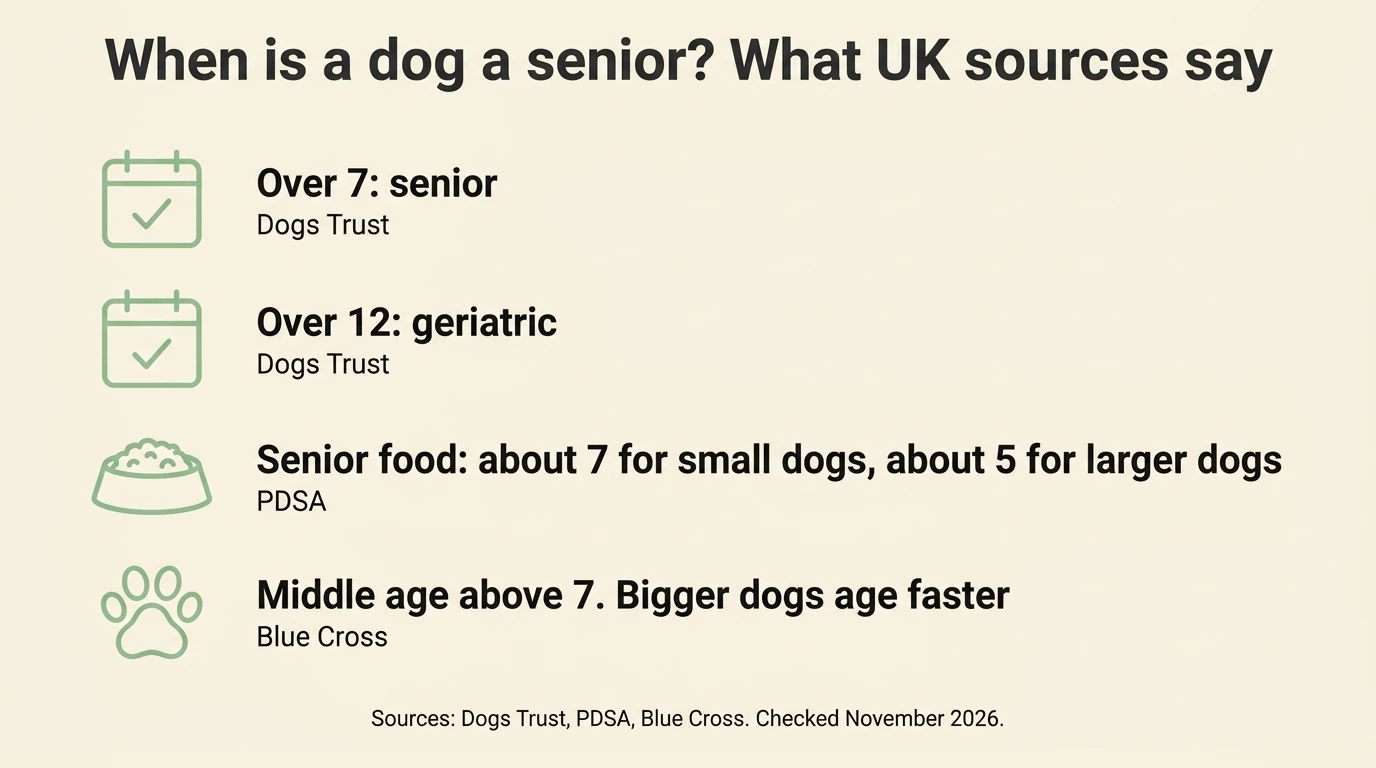
Most UK guidance puts it at around seven. Dogs Trust says dogs over seven can be considered senior, meaning older but still generally healthy, and dogs over 12 can be considered geriatric, with a greater risk of health problems. Its guide also notes that smaller breeds tend to live longer and that the age when age-related problems appear differs by breed.
Middle age for most dogs starts above seven, according to Blue Cross, with an important caveat: bigger dogs age faster, and size varies a lot even within a breed. That’s why food advice comes earlier for big dogs. For food, PDSA suggests moving to a senior food at about half a dog’s life expectancy, which it puts at around seven for small dogs and around five for larger dogs. Our large breed dog food guide covers senior picks for bigger dogs.
From our home: Dexter turns five in January. He was very boisterous until about three and has been much calmer since, but he still runs fast and jumps around when he plays, so I wouldn’t say old age has kicked in. His vet hasn’t talked about when he’ll count as a senior. He has a check-up once a year. Our Cane Corso vs Presa Canario guide covers the breed’s UK lifespan figures.
Signs your dog is getting older
Ageing creeps in gradually. Between them, Dogs Trust and Blue Cross list these changes to look out for:
- Sleeping more and having less energy
- Joint stiffness after strenuous exercise
- Cloudy eyes, which Dogs Trust says could mean cataracts
- Struggling to see or hear, or barking more than before
- A coat that loses its shine, and white hairs appearing
- Putting on weight as they become less active
- Becoming less tolerant or grumpier, or wanting more time with you
- Confusion or new compulsive behaviours
Dogs Trust advises telling your vet at the first sign of any behaviour change, rather than putting it down to age. If getting in and out of the car is becoming harder, the charity also suggests a ramp for an older dog, and our guide to the dog ramp for car travel compares the options.
FlexK9 Health Disclaimer: This guide doesn’t replace your vet. If your dog’s energy, weight, appetite, toileting, movement or behaviour changes, book a check-up rather than assuming it’s just age. Many changes in older dogs have a treatable cause.
How to tell a rescue dog’s age
If you’re asking “how old is my dog in human years?” about a rescue dog with no known birthday, start with your vet. We found no UK charity guide to estimating a dog’s age from its teeth, eyes or coat, so we haven’t given one here. Your vet can examine your dog and may be able to give an estimated age, which you can then use in the calculator above.
Caring for an older dog
Older dogs need more vet checks, not fewer: twice-yearly check-ups are essential for an ageing dog, Dogs Trust says. Day to day, its advice is to let your dog set the pace on walks, go for frequent short walks rather than one long one, and keep an eye on teeth and nail length. Our guide on how often to clip dog nails covers older dogs’ nails.
Weight matters more as dogs slow down. Blue Cross suggests weighing your dog every one to two months, keeping daily exercise steady at about 20 to 30 minutes two or three times a day, and considering a senior diet because these are lower in calories. Smaller meals two or three times a day can also help keep weight healthy, Dogs Trust adds. Some breeds carry their own health risks as they age, and the breed health guide linked above covers what UK vet records show.
Final thoughts: dog years to human years
There’s no UK formula for dog years to human years, but UK data still answers the question most owners are really asking: how far through life is my dog?
- If your dog is over seven, Dogs Trust would call them senior, and twice-yearly vet checks are worth booking.
- If you have a large or giant dog, PDSA’s senior food point comes earlier, at around five.
- If your dog’s behaviour or energy changes, tell your vet rather than putting it down to age.
- If you don’t know your dog’s age, ask your vet for an estimate first.
- If you want a number, our calculator gives one built from UK figures, with every source shown.
Frequently Asked Questions
Is one dog year really seven human years?
No. The seven-year rule has no UK source behind it, and it doesn’t fit how dogs grow. PDSA says small dogs usually move off puppy food at around a year old and larger breeds at around 18 months, so a one-year-old dog is close to adult. How fast a dog ages after that depends a lot on its size.
How old is a 5-year-old dog in human years?
It depends on size. Using UK lifespan figures, a five-year-old small, medium or large dog has lived about 40% of a typical life, which matches a person of about 32 to 34. A five-year-old giant breed has lived more than half of its typical lifespan, closer to a person of about 46. For larger dogs, PDSA suggests thinking about a senior food at around five.
How old is a 12-year-old dog in human years?
A 12-year-old small or medium dog is close to the end of a typical UK lifespan, roughly like a person in their late 70s. A large dog of 12 has just passed the typical lifespan for its size. A giant breed of 12 has outlived it by about three years. Dogs Trust calls dogs over 12 geriatric, with a greater risk of health problems.
Do bigger dogs age faster?
Yes, on average. Blue Cross says bigger dogs age faster. A 2024 Dogs Trust study found large breeds were about a fifth more likely than small breeds to have a shorter life, and an RVC VetCompass study found giant breeds died at a median age of about 8.9 years, against about 12 for dogs overall.
How often should an older dog see the vet?
Twice a year. Dogs Trust calls twice-yearly check-ups essential for an ageing dog, and advises telling your vet at the first sign of any behaviour change. Between visits, Blue Cross suggests weighing your dog every one to two months so weight changes are caught early.
When is a dog an adult?
Usually between about one year and 18 months, depending on size. PDSA’s general rule is that small dogs stay on puppy food until around a year old, while large or giant breeds stay on it until around 18 months. Your vet can tell you when your own dog is ready to switch.
