
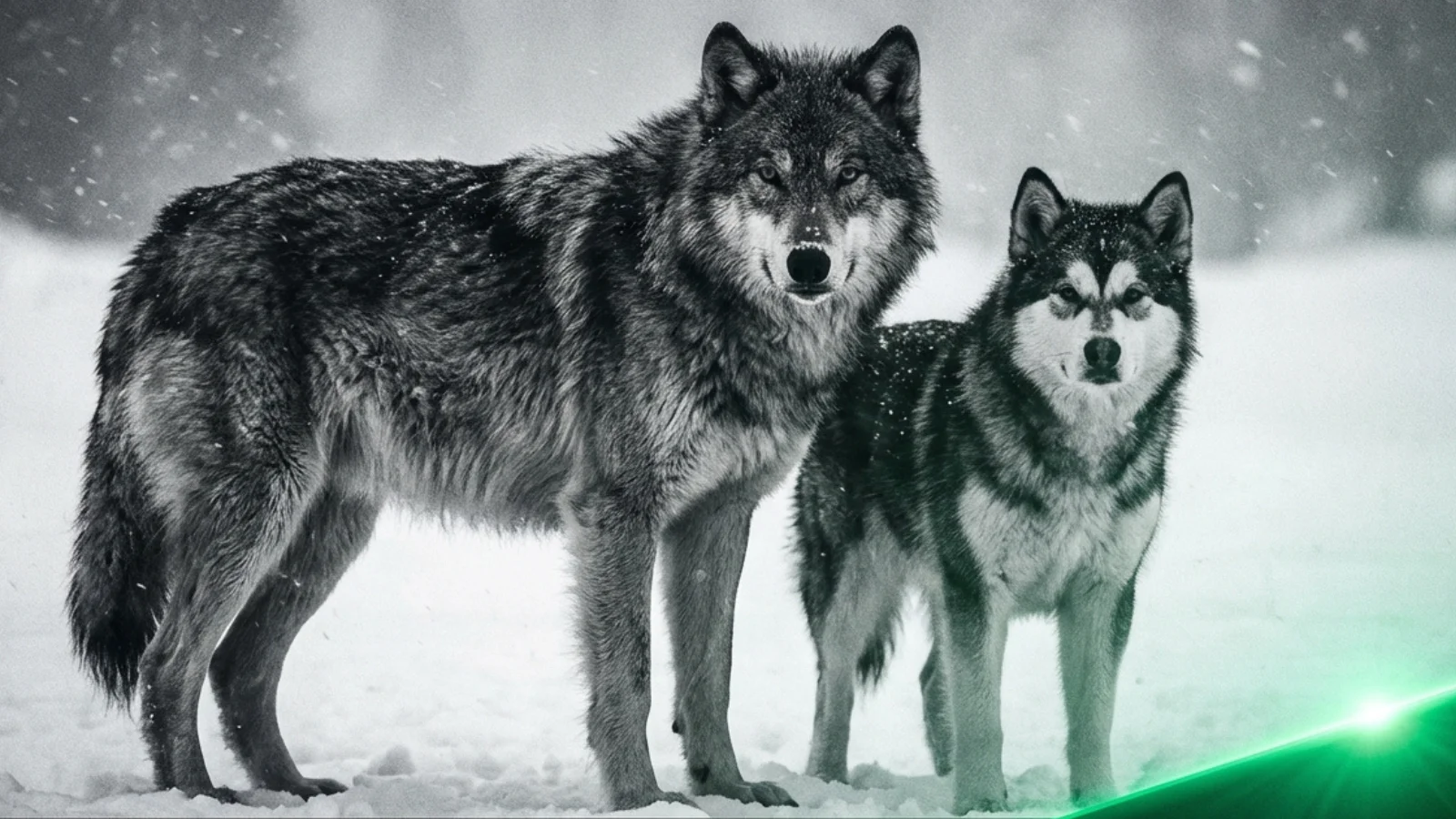
For many passionate dog owners, gazing into the eyes of a Siberian Husky or an Alaskan Malamute can feel like looking directly into the wild. The ancestral link between our domestic companions and their wild forebears is a source of endless fascination. However, while they share an undeniable genetic lineage, a true wolf vs dog comparison reveals startling evolutionary differences, particularly when it comes to their physical dimensions.
At FlexK9, our mission is to provide you with honest, data-driven, and expert insights into all things canine. While we are an online-only platform and not a veterinary practice, we rely on canine behavioural science and biology to bring you the facts. Many people assume that large domestic dogs have surpassed their wild ancestors in size, but the reality is far more complex.
- 1. Shoulder height: Grey wolves typically stand taller than huskies and many working breeds.
- 2. Body weight: Wolves usually carry more lean mass than similarly tall domestic dogs.
- 3. Bone density: Wolves have denser, heavier skeletons built for survival and hunting.
- 4. Chest structure: Wolves have narrower, deeper chests and a more efficient endurance build.
- 5. Paw size: Wolf paws are significantly larger and act like natural snowshoes.
- 6. Stride length: Wolves have longer legs and a more energy-efficient gait over rough terrain.
- 7. Function and build: Domestic dogs may outweigh wolves, but they are usually bred for different jobs and body proportions.
These 7 differences are explained in more detail below, with supporting structural data and a breed comparison chart.
If you have ever wondered how a wild predator physically stacks up against the dog sleeping on your sofa, you are in the right place. If you have ever wondered how a wild predator physically stacks up against the dog sleeping on your sofa, this guide breaks down the 7 most important wolf vs dog size differences, from height and weight to bone density, paw size, stride length, and overall build.
TABLE OF CONTENTS
The Evolutionary Journey: Wolf vs Dog
To truly understand the differences in size, we must first look at the evolutionary journey that separated the grey wolf (Canis lupus) from the domestic dog (Canis lupus familiaris). The domestication of dogs began tens of thousands of years ago. Early humans did not selectively breed for size right away; they bred for temperament, selecting the least aggressive and most cooperative wolves to help with hunting and camp security.
Over millennia, this process led to a phenomenon scientists refer to as domestication syndrome. As early dogs became tamer, their physiological and morphological traits began to dramatically shift. Their muzzles shortened, their teeth became smaller, and their overall brain size decreased compared to wild wolves. While wolves continued to face the brutal reality of natural selection—where only the largest, strongest, and most efficient hunters survived the harsh winters, domestic dogs were shielded by human intervention.
Just as we see when examining a coyote vs dog comparison, a wild canine’s physical traits are strictly dictated by survival, while a domestic dog’s are shaped by human intervention.
Today, the size of a domestic dog is dictated entirely by human breeding programmes. We have manipulated canine genetics to create breeds as tiny as the Chihuahua and as massive as the English Mastiff. In contrast, the size of a wild wolf is dictated by its environment, diet, and the sheer necessity of survival. This fundamental difference in their evolutionary paths is the primary reason a wolf vs dog comparison is so physically striking.
Physical Traits: Breaking Down the Wolf vs Dog Size Comparison
When we look at a wolf vs dog size comparison, it is not just about placing two animals side-by-side and measuring to the shoulder. The way their mass is distributed, the density of their bones, and the structure of their limbs are entirely different. To illustrate this, we must compare the average grey wolf to domestic dogs of similar height and build.
Height and Weight Differences
The grey wolf is among the largest wild members of the canine family. According to official data from the U.S. Fish & Wildlife Service, an adult male grey wolf (and it is important to note the distinct size variations between male vs female dogs and wolves) typically stands between 26 and 32 inches (66 to 81 cm) at the shoulder and weighs anywhere from 70 to 150 pounds (32 to 68 kg), depending on the geographic region. Wolves found in the northern territories of Canada and Alaska are generally larger than those found in the southern United States or parts of Europe.
By comparison, a Siberian Husky—often mistaken for a wolf due to its coat and markings—is significantly smaller. A male Husky stands about 21 to 24 inches (53 to 61 cm) tall and weighs a mere 45 to 60 pounds (20 to 27 kg). Even the formidable Alaskan Malamute, a heavy-duty freighting dog, maxes out around 85 pounds (38 kg). While there are certainly domestic giant breeds that weigh more than a wolf, a common debate when looking at the English Mastiff vs Great Dane, these dogs lack the agile, predatory proportions of a wild canine.
Bone Structure and Muscle Mass
One of the most defining factors in the wolf vs dog size debate is bone density and chest shape. Wolves possess narrow, deep chests that are aerodynamically designed for long-distance travel through deep snow and dense forests. Their front legs are positioned closer together than a domestic dog’s, allowing their hind paws to fall precisely into the tracks of their front paws. This energy-saving gait is a hallmark of wild survival.
Domestic dogs, on the other hand, tend to have barrel-shaped chests and a wider stance. Even if a domestic dog matches a wolf in weight, the dog will often carry more body fat and less lean, fast-twitch muscle. A wolf’s skeleton is notably heavier and denser, built to withstand the immense physical trauma of taking down prey that is often ten times its size, such as elk or moose.
Paw Size and Stride Length
If you compare a wolf track with that of a large domestic dog, the difference in paw size is immediately noticeable. A grey wolf’s paw can easily measure 4.5 to 5 inches (11 to 13 cm) long and 4 inches (10 cm) wide. These massive paws act as natural snowshoes, distributing the wolf’s weight evenly so they can sprint across the top of snowdrifts without sinking.
Furthermore, a wolf’s stride is incredibly long. They have elongated legs compared to their body length, giving them a lanky, almost imposing appearance. A domestic dog of the same weight will have significantly smaller paws and a shorter, more compact leg structure, making them far less efficient at traversing wild, untamed terrain.
Wolf vs Dog Size Comparison Chart
To give you a clear, authoritative visual representation, we have compiled the wolf vs dog size chart below. This dataset compares the average adult male measurements of a Grey Wolf against popular domestic breeds.
| Species / Breed | Average Height (Shoulder) | Average Weight | Paw Width | Primary Function |
| Grey Wolf | 26 – 32 inches (66-81 cm) | 70 – 150 lbs (32-68 kg) | 4.0 inches (10 cm) | Apex Predator |
| Siberian Husky | 21 – 24 inches (53-61 cm) | 45 – 60 lbs (20-27 kg) | 2.5 inches (6 cm) | Light Sledding |
| Alaskan Malamute | 25 – 28 inches (64-71 cm) | 75 – 85 lbs (34-38 kg) | 3.0 inches (7.5 cm) | Heavy Freighting |
| German Shepherd | 24 – 26 inches (61-66 cm) | 65 – 90 lbs (29-41 kg) | 2.5 inches (6 cm) | Herding / Guarding |
| English Mastiff | 30+ inches (76+ cm) | 150 – 230 lbs (68-104 kg) | 3.5 inches (9 cm) | Guarding / Estate |
Why Do Some Domestic Dogs Look Like Wolves? – Differences between Wolves and Dogs
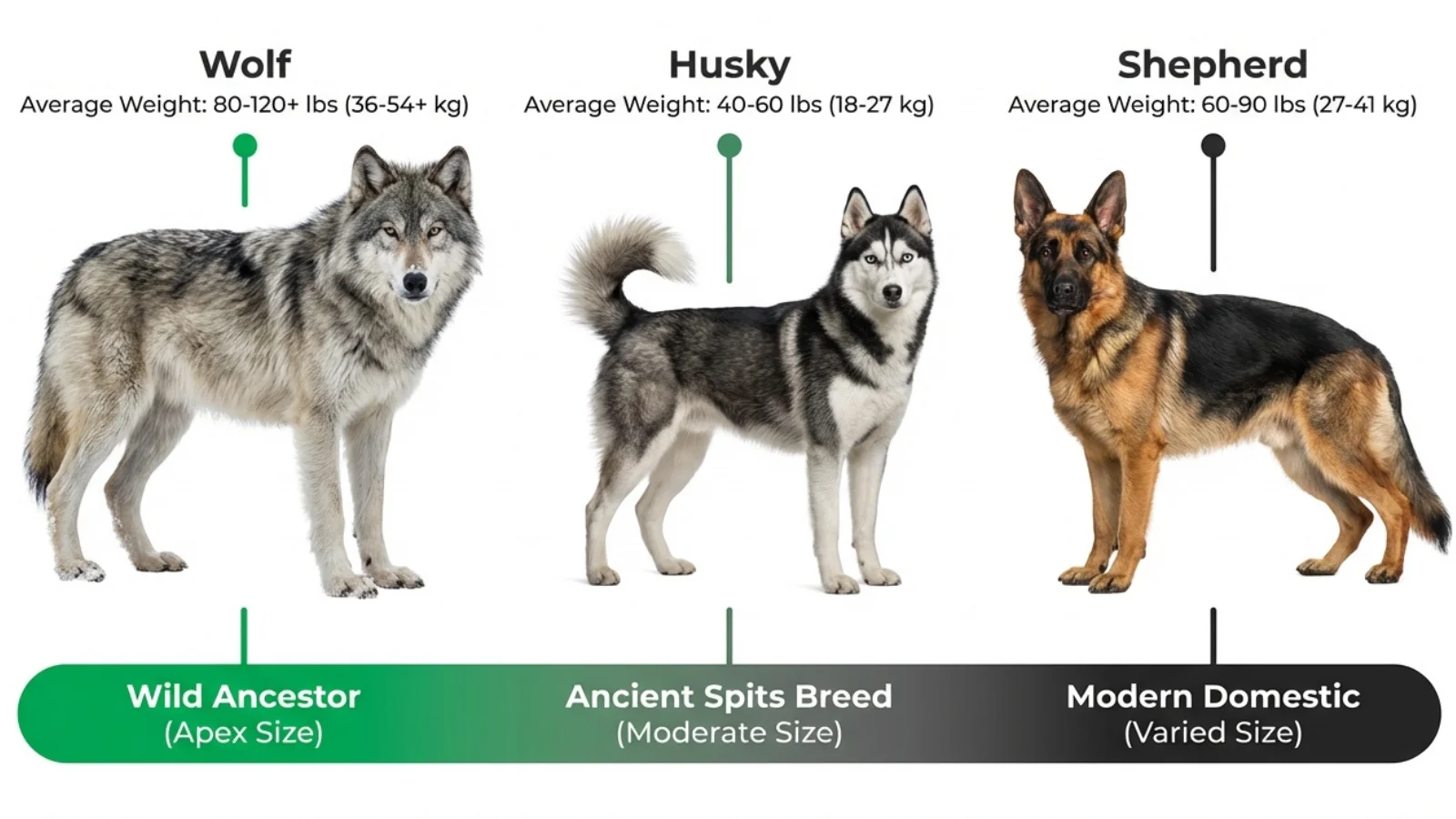
Given the vast differences in the wolf vs dog size comparison, it is natural to wonder why certain breeds look so remarkably wolf-like. When comparing breeds such as the Malamute vs Husky, you will notice they share striking physical characteristics with wolves, including erect ears, dense double coats, and a wild gaze.
This similarity is primarily due to a combination of ancient genetics and convergent evolution. Spitz-type dogs (the family to which Huskies and Malamutes belong) are some of the oldest dog breeds in the world, meaning their genetic makeup is slightly closer to their ancient ancestors than a modern breed like a Golden Retriever. Furthermore, these dogs were bred in the same harsh Arctic environments as wolves. To survive sub-zero temperatures, they naturally developed the same dense, insulating undercoats, furry paws, and bushy tails that wild wolves use to cover their noses when sleeping in the snow.
If you are curious about your own dog’s ancestral lineage and how close they are to wild canines, using one of the best dog DNA test kits can reveal exactly how much ancient Spitz DNA they carry.
However, looks can be deceiving. While a Northern Inuit Dog might be bred specifically to mimic the appearance of a wolf (famously used as the “Direwolves” in Game of Thrones), they do not possess the biological size, bone density, or predatory instincts of a true wild canine.
The Reality of Wolfdogs: Size, Temperament, and Care
As dog experts at FlexK9, we believe in honest, practical guidance. The fascination with wolves often leads people to seek out “wolfdogs” (a hybrid cross between a domestic dog and a wild wolf) as pets. It is crucial to address this with absolute candour: wolfdogs are not standard domestic pets, and their size and temperament make them unsuitable for the vast majority of homes. Many prospective owners confuse purebred wolf-like dogs with actual hybrids, which is why understanding the critical differences between a Husky vs wolf dog is essential before bringing one home.
When you mix a wild predator with a domestic dog, the resulting size and behaviour are highly unpredictable. A high-content wolfdog can grow to the full size of a grey wolf, inheriting the immense jaw strength, high prey drive, and intense need to roam. Unlike domestic dogs, which have been bred to look to humans for guidance and affection, a wolfdog retains a wild independence. Because of these unpredictable and intense behaviours, leading UK veterinary charities like the PDSA strongly advise against keeping wolfdog hybrids as family pets, noting that first-generation crosses require a strict licence under the Dangerous Wild Animals Act 1976.
They require specialised, heavily reinforced enclosures, specific raw diets, and handlers with extensive experience in exotic animal behaviour. When evaluating a standard dog harness vs collar, neither will suffice for the sheer strength and unpredictable flight risk of a high-content wolfdog.
For anyone enamoured by the size and majesty of a wolf, we strongly advise admiring them in the wild or in reputable sanctuaries, and choosing a domestic breed that suits your lifestyle for your own home.
Nutrition and Growth: Fueling Your Large Breed Dog
While you might not have a wild wolf roaming your hallway, managing the growth and size of a large domestic breed requires serious attention. Whether you own an 80-pound Malamute or a 150-pound Mastiff, their nutritional needs during the puppy and adolescent phases are vastly different from small breeds.
Wild wolves regulate their growth naturally through a highly varied, protein-rich diet dictated by the seasons. For large domestic dogs, rapid growth spurts can lead to severe orthopaedic issues, such as hip dysplasia or osteochondritis dissecans (OCD). It is essential to feed the best large breed puppy food to tightly control calcium and phosphorus ratios and ensure slow, steady bone development.
As your dog reaches maturity, transitioning them to a high-quality large breed dog food focused on lean proteins is vital, incorporating the best dog joint supplements (like glucosamine and chondroitin), and keeping them at a lean, healthy weight.
A lean dog is a healthy dog, and carrying excess weight places unnecessary strain on their joints. Additionally, providing a highly supportive place to rest, such as one of the best dog beds for large dogs in the UK, will take the pressure off their heavier frames and protect their joints over time.
Be sure to check out our other online guides for honest reviews on the best large-breed harnesses and nutritional strategies to keep your domestic giant thriving.
Frequently Asked Questions
How much bigger is a wolf than a Husky?
A wild grey wolf is significantly larger than a Siberian Husky. While a male Husky typically weighs between 45 to 60 pounds and stands up to 24 inches tall, a male grey wolf weighs between 70 to 150 pounds and can stand up to 32 inches tall at the shoulder. A wolf is generally twice the weight and notably taller, with a much larger head and paws.
Can a domestic dog be larger than a wild wolf?
Yes, in terms of sheer weight and sometimes height, certain domestic breeds are larger than wolves. Giant breeds like the English Mastiff, Saint Bernard, and Great Dane can weigh well over 150 to 200 pounds, surpassing the maximum weight of a grey wolf. However, these dogs lack the wild, athletic muscle mass and bone density of a wolf.
What is the bite force of a wolf vs dog?
A grey wolf has a crushing bite force estimated to be around 400 to 600 PSI, depending on methodology, allowing them to crack the femurs of large ungulates. Most large domestic dogs, such as German Shepherds or Pitbulls, have a bite force of approximately 230 to 250 PSI, making the wolf’s bite significantly more powerful.
Why do wolves have bigger paws than dogs?
Wolves have evolved massive paws—often up to 5 inches long—to act as natural snowshoes. This biological adaptation allows their heavy bodies to walk and run across deep snow without sinking, which is critical for hunting and winter survival. Domestic dogs, even large ones, do not have this evolutionary necessity, resulting in much smaller, more compact paws.
Is a wolfdog bigger than a purebred wolf?
Typically, a wolfdog is not bigger than a purebred grey wolf. A wolfdog’s size depends entirely on the domestic breed used in the cross (such as a Malamute or German Shepherd) and the percentage of wolf genetics. While they can be very large, the introduction of domestic dog genetics usually results in an animal that is slightly smaller or roughly equal in size to a purebred wolf.
How tall does a grey wolf get when standing on its hind legs?
When standing fully upright on its hind legs, a large adult grey wolf can reach roughly 6 feet (about 1.8 metres), although shoulder height is the more useful measurement for real size comparisons.
