Which are the most intelligent dog breeds? No UK vet charity or the Royal Kennel Club ranks dog breeds by intelligence, and the numbered “top 10” lists online trace back to a survey of North American obedience judges. What UK sources do tell you is how easy each breed usually is to train: PDSA’s breed guides put 12 breeds at the top of their scale, including the Border Collie, Labrador and Poodle.
This guide uses the Royal Kennel Club’s breed standards, PDSA’s breed guides and training advice, and Syed’s own experience training Dexter, his Cane Corso. Where UK sources say nothing, we’ve said so.
TABLE OF CONTENTS
Is there a UK ranking of the most intelligent dog breeds?
No. No UK vet charity, the Royal Kennel Club or the RVC’s VetCompass vet-records project publishes a ranking of dog breeds by intelligence. The numbered lists of smartest dog breeds that fill search results come from a survey of obedience judges in North America, not from UK research.
What the Royal Kennel Club does publish is a breed standard for each breed it recognises, describing the ideal character. We read all 226 in November 2026: 105 describe the breed as intelligent, and 14 go further with “highly”, “very” or “extremely” intelligent.
The word isn’t a ranking of the most intelligent dog breeds, though. The standards for the Poodle, German Shepherd and Rottweiler, all near the top of online lists, don’t use it at all; they say “good-tempered”, “tractable” and “biddable” instead. The Basenji, often near the bottom of those lists, is “an intelligent, independent, but affectionate and alert breed”.
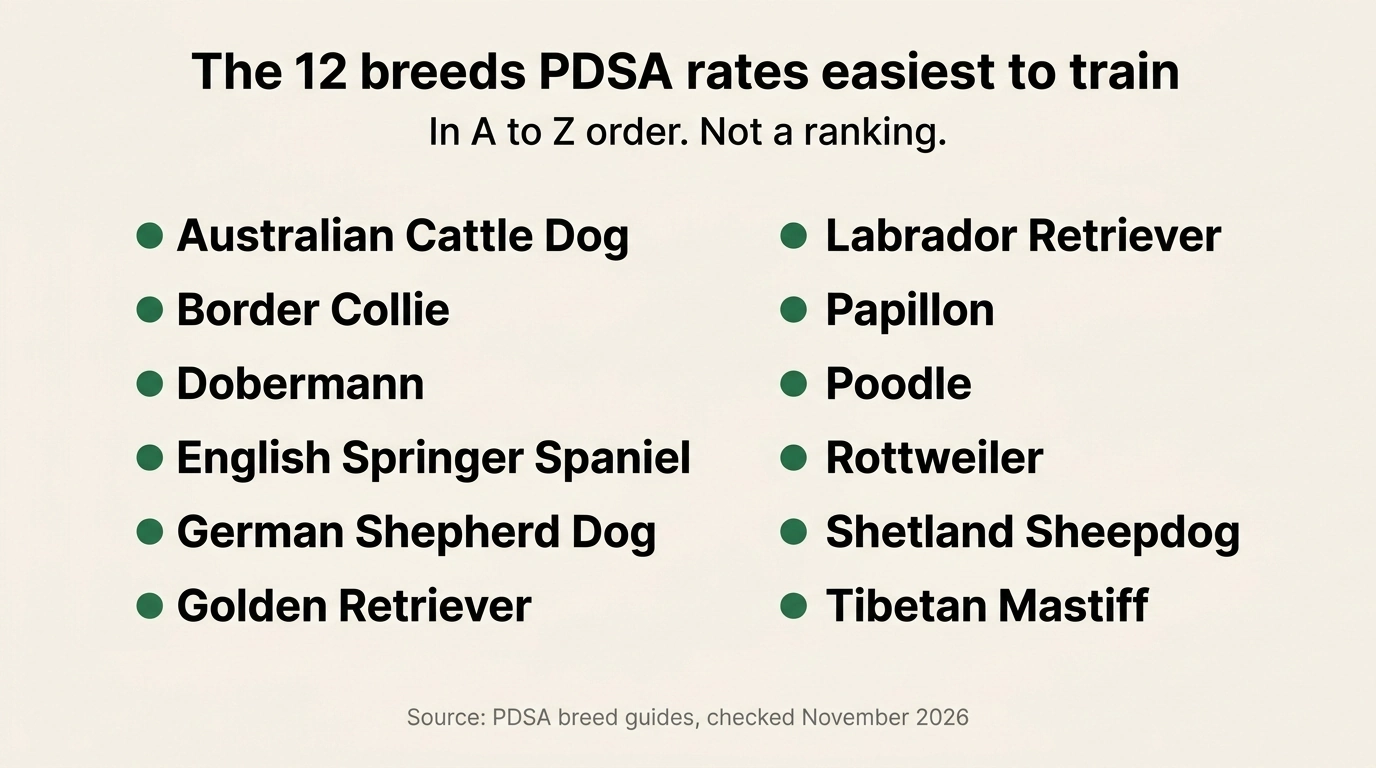
The 12 breeds PDSA rates easiest to train
PDSA, the UK vet charity, publishes a guide for more than 100 breeds, and each one has an “Easy to train” bar. We checked all 103 in November 2026: 13 breeds sit at the top of the bar, most sit in the middle and three sit at the bottom. It’s a guide to how easy a breed usually is to train, not an intelligence test, and every dog is an individual.
The bar also puts the Giant Schnauzer at the top, but its own guide says training “may take more effort than some other breeds”, so we’ve left it out. That leaves these 12, in A to Z order.
| Breed | What its breed standard says | PDSA’s daily exercise |
|---|---|---|
| Australian Cattle Dog | “Alert, intelligent, watchful” | At least 2 hours |
| Border Collie | “Keen, alert, responsive and intelligent” | At least 2 hours |
| Dobermann | “Intelligent and firm of character” | At least 2 hours |
| English Springer Spaniel | “Friendly, happy disposition, biddable” | At least 2 hours |
| German Shepherd Dog | “Loyal, self-assured, courageous and tractable” | At least 2 hours |
| Golden Retriever | “Biddable, intelligent” | At least 2 hours |
| Labrador Retriever | “Intelligent, keen and biddable” | A lot of exercise every day, no set minimum |
| Papillon | “Lively, intelligent, friendly” | At least 30 minutes |
| Poodle | “Gay-spirited and good-tempered” | Around an hour |
| Rottweiler | “Courageous, biddable” | At least 2 hours |
| Shetland Sheepdog | “Alert, gentle, intelligent” | Around an hour |
| Tibetan Mastiff | “Calm and patient” | At least 1 hour |
Breed standard wording from the Royal Kennel Club; daily exercise from each breed’s PDSA guide.
Australian Cattle Dog
The breed standard describes a dog that is “alert, intelligent, watchful, courageous, trustworthy, devoted to its work”. PDSA calls Cattle Dogs highly intelligent, needing a lot of physical and mental activity, and suggests sports such as agility or flyball. Their herding instinct means they may nip at the heels of running children, which early training and socialisation can help with, its guide adds. Our Australian Shepherd vs Australian Cattle Dog guide covers the breed in more detail.
Border Collie
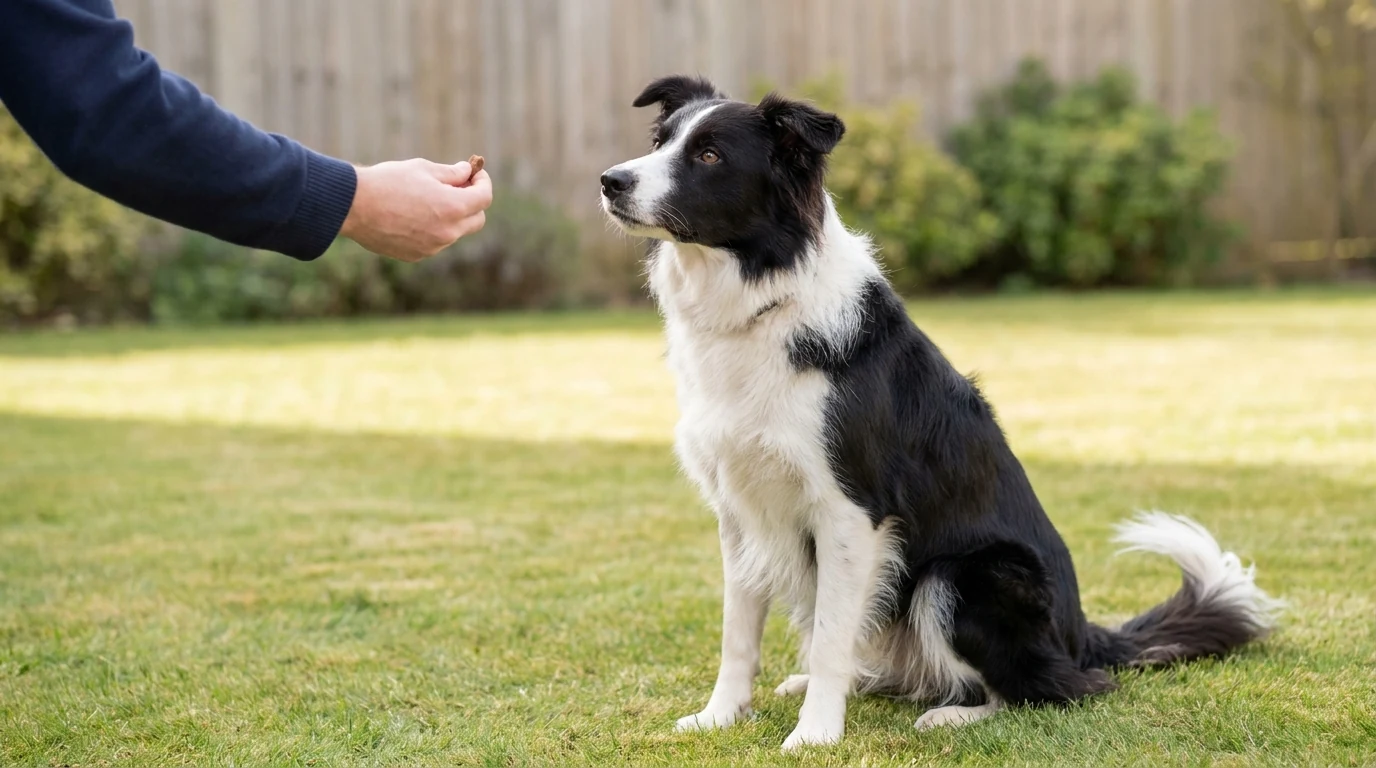
“Keen, alert, responsive and intelligent” is how the breed standard puts it, and PDSA says Border Collies are believed to be one of the most intelligent breeds in the world. They can be easy to train for experienced owners but might not be the best first dog. They ideally need someone around all the time to keep them active, reward-based training that carries on for life and at least two hours’ exercise a day. In the charity’s own words, “A bored Collie is very bad news indeed!”
Dobermann
The breed standard describes the Dobermann as “intelligent and firm of character, loyal and obedient”. PDSA calls the breed loyal, intelligent and keen to learn, needing plenty of mental and physical exercise so they don’t get bored. Dobermanns fit well into family life with an experienced owner, its guide says, but probably aren’t the best breed for families with young children or for first-time owners.
English Springer Spaniel
The breed standard asks for a “friendly, happy disposition” and a biddable dog, one that’s willing to do as it’s asked. Springers are obedient and keen to learn, so training should be relatively easy, according to PDSA, and they often enjoy the mental stimulation it gives them. The same guide sets at least two hours of exercise a day.
German Shepherd Dog
Rather than calling the breed intelligent, the breed standard describes a German Shepherd as “loyal, self-assured, courageous and tractable”, meaning easy to manage. PDSA calls them very loyal, intelligent dogs that love being active, so they can be easy to train. They suit owners with plenty of experience and time, because they can get bored easily, and consistency is key. Our Belgian Malinois vs German Shepherd guide compares the breed with the Malinois.
Golden Retriever
The breed standard calls the Golden Retriever “biddable, intelligent and possessing natural working ability”. Goldens thrive on training, can be easy to train and can make good first dogs, as long as you’re ready for a larger breed, according to PDSA. Because they’re intelligent, they can get bored easily, so their brains need to be kept as active as their bodies. Our Golden Retriever vs Labrador guide compares the two retrievers.
Labrador Retriever
The Labrador’s breed standard describes an “intelligent, keen and biddable” dog “with a strong will to please”. PDSA says Labradors are obedient, quick to learn and eager to please, and that their training should always be reward-based. Its guide gives no single exercise figure, but says they need a lot of exercise and mental enrichment every day, and that dogs from working lines need training to fulfil their desire to work and retrieve.
Papillon
The breed standard asks for a dog that is “lively, intelligent, friendly, with no aggression; always alert”. Papillons are very obedient and respond well to training, says PDSA, and training and socialisation matter from a young age. They don’t need a large amount of exercise: the guide gives 30 minutes a day as the minimum.
Poodle
All three of the Royal Kennel Club’s Poodle standards (Standard, Miniature and Toy) describe the breed as gay-spirited and good-tempered, with no mention of intelligence. PDSA says Poodles are very obedient and respond well to training, and that training and socialisation at a young age help them grow up confident and sociable. Its guide suggests around an hour of exercise a day, and says Poodles love to run, swim and retrieve.
Rottweiler
The breed standard describes a good-natured, courageous and biddable dog. PDSA calls Rottweilers intelligent and active, needing plenty to keep them busy in body and mind. They thrive with someone who understands the breed and recognises the need for early socialisation and consistent, reward-based training, the charity says. Our guide to whether a Rottweiler is a good family dog covers home life in more detail.
Shetland Sheepdog
The Sheltie’s breed standard asks for an “alert, gentle, intelligent” dog that is “responsive to his owner”. Shelties are intelligent and respond well to training, PDSA says, and training and socialisation are very important when they’re young. They need around an hour of exercise a day and enjoy playing games.
Tibetan Mastiff
The breed standard describes the Tibetan Mastiff as “calm and patient” but also “independently minded”, and slow to mature. PDSA calls the breed very intelligent and responsive to positive training, though it can be very strong-willed. Tibetan Mastiffs don’t really suit first-time owners, its guide says, but can be great with experienced owners who understand the breed.
What a clever dog needs from you
Read the guides side by side and a pattern stands out: PDSA often adds a condition to “easy to train”, such as “with experienced owners”, “in the right hands” or for owners with time. Several guides also warn that an intelligent dog can get bored easily, and that boredom tends to show as chewing, barking or mischief around the home. Our guide to dog enrichment toys covers free brain games and toys that give a clever dog something to do.
Before choosing one of these breeds, check you can offer:
- mental exercise as well as walks, every day
- training that carries on through your dog’s life, not just puppy classes
- short training sessions that end on a success
- company: PDSA says you should never leave any dog alone for more than four hours
- experience, or help from an accredited trainer, for the breeds PDSA says suit experienced owners
- healthy training treats, with a smaller main meal on training days
How to train a clever dog
The advice is the same for every breed: use reward-based training. PDSA says training keeps a dog’s mind active and helps you bond, and that rewarding the behaviour you want is the kindest and most effective way to teach it. Its golden rules, in short:
- Find a reward your dog will work for: food, praise or a favourite toy.
- Reward during the behaviour, or within half a second of it.
- Keep sessions short and end on a high.
- Teach one command at a time.
- Use short, clear commands.
- Keep rewarding, as it can take lots of repetition.
- Ignore mistakes and reward the next success.
- Never punish, because punishment causes anxiety and fear, which make dogs learn slower.
- Make sure everyone uses the same commands.
You may read that a clever dog needs a firm “pack leader”. That’s a myth, according to PDSA: your dog doesn’t need to see you as dominant, but they do need to trust you and understand your commands. The charity advises avoiding any class built on dominance, or on gadgets such as water pistols and rattle cans.
Classes can start once your puppy has had their vaccinations, and it’s never too late, because old dogs can learn new tricks too. Choose a class that uses reward-based methods. For a step-by-step guide to the basics, from sit to recall, see our dog training guide.
From our home: I started training Dexter, my Cane Corso, when he was a couple of months old. He had a routine, he was only allowed in certain areas, and I rewarded him for good behaviour and for basics like sit, wait, coming back and leave. He’s very food driven, which helped. He went to group training sessions from a young age, and teaching him to heel on my left means he now walks on my left naturally. It’s still rewarding, because it makes him much easier to manage.
Which breeds are harder to train?
No UK source describes any breed as unintelligent, so we don’t list “least intelligent” breeds. Three breeds do sit at the bottom of PDSA’s training bar, and their guides explain it by character rather than brains:
- The Alaskan Malamute enjoys being challenged so it can use its intelligence, needs ongoing reward-based training and can be destructive when bored.
- The Basset Hound can be very independent, especially when it comes to training.
- The Bull Terrier can be strong-willed; its breed standard says “amenable to discipline”, but also “obstinate”.
Independent isn’t the same as unintelligent. The Royal Kennel Club describes the Basenji as “intelligent, independent”, and PDSA says the breed can be strong-willed, which “sometimes makes training a challenge”. It describes Siberian Huskies the same way: very intelligent, but independent thinkers who need consistent, reward-based training throughout their lives.
Final thoughts
- If you want a dog that’s easier to train, the 12 breeds above are where PDSA’s guides point, but read each one’s note on experience and exercise.
- If you’re a first-time owner, PDSA says Golden Retrievers can make good first dogs and Jack Russells are a popular choice, while Border Collies might not be the best first dog. Our guide to the best family dogs in the UK compares ten breeds on UK data.
- If you’re out for long stretches, remember PDSA’s limit of four hours alone for any dog.
- If your dog is one of the independent breeds, patience, rewards and an accredited trainer will help more than any “clever breed” label.
Frequently Asked Questions
Which dog breed is the smartest?
No UK body names a single smartest breed. PDSA says the Border Collie is believed to be one of the most intelligent breeds in the world, and puts it among the 12 breeds at the top of its “easy to train” scale. The numbered rankings online come from a North American survey, not UK research.
What’s the easiest dog to train for a first-time owner?
PDSA says Golden Retrievers can make good first dogs, as long as you’re ready for a larger breed, and calls Jack Russells a popular choice for first-time owners. It says Border Collies might not be the best first dog. Whichever breed you choose, a reward-based training class will help.
Are German Shepherds intelligent?
Yes. PDSA calls them very loyal, intelligent dogs that love being active, and puts them at the top of its training scale. Their breed standard calls them “tractable”, meaning easy to manage, rather than intelligent. PDSA says they suit owners with plenty of experience and time, as they can get bored easily.
Do intelligent dogs need more exercise?
Not always. Seven of PDSA’s 12 easiest-to-train breeds need at least two hours a day, plus mental exercise. But the Papillon needs 30 minutes and the Poodle and Sheltie around an hour, so a breed’s energy, not its intelligence, decides how much exercise it needs.
Can older dogs learn new tricks?
Yes. PDSA says it’s best to start training while a dog is young, but it’s never too late, and old dogs can learn new tricks too. Keep sessions short, use a reward your dog really likes, and end each session on a success.
Do I need to be the pack leader to train my dog?
No. PDSA calls the idea that you need to be the leader of the pack a myth. Your dog doesn’t need to see you as dominant; they need to trust you and understand your commands. The charity advises avoiding training classes built on dominance.
