
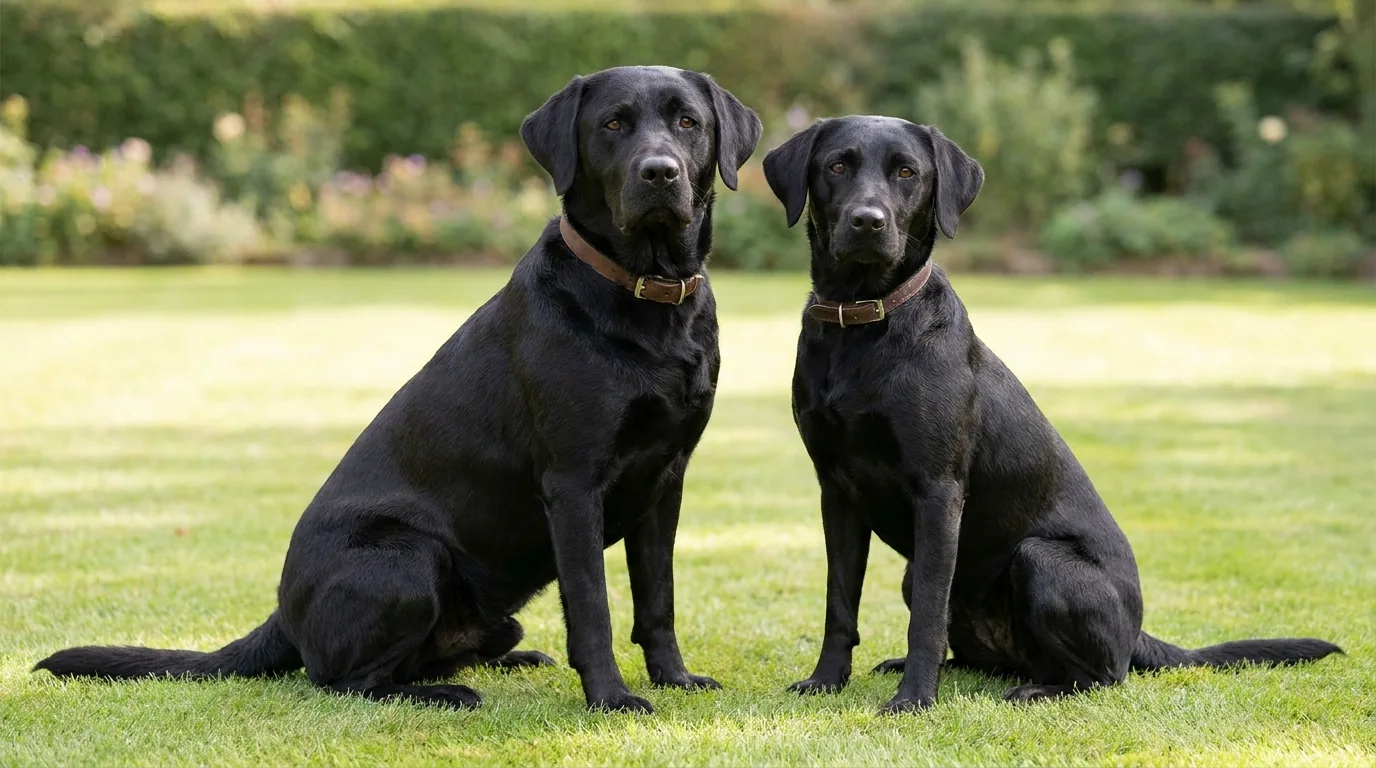
Male or female dog: which is better? On UK evidence, neither. UK vet records show small average differences, such as females living a few months longer and some conditions being recorded more often in one sex. The biggest practical differences are seasons and neutering. No UK charity or vet source we found says one sex makes a better pet.
I’ve only ever owned a male: Dexter, my Cane Corso, who isn’t neutered. So this guide draws on Royal Veterinary College (RVC) VetCompass research, Dogs Trust, PDSA and the Royal Kennel Club rather than a side-by-side comparison of my own. Where a source gives advice, we’ve said whose advice it is.
TABLE OF CONTENTS
The main differences between male and female dogs
Here’s what UK sources say differs between males and females. These are averages across many dogs, so they don’t tell you how any one dog will turn out.
| What differs | Males | Females | Source |
|---|---|---|---|
| Size | Breed standards often give males a taller height range, but not in every breed | Often a shorter range | Royal Kennel Club breed standards |
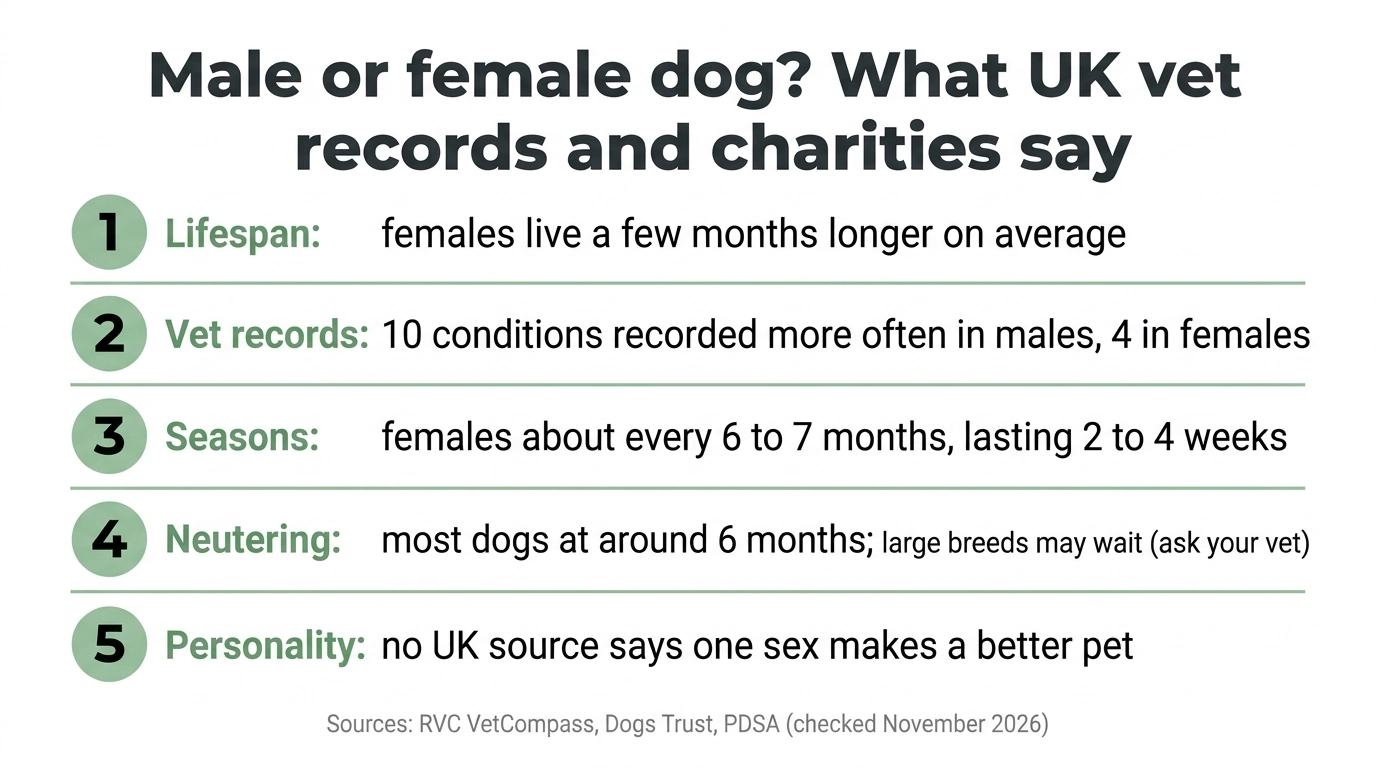
| Typical lifespan (UK median) | 12.4 years | 12.7 years | Dogs Trust (2024) |
| Conditions recorded more often by vets | 10, including ear infections, aggression and arthritis | 4, including urinary incontinence and mammary lumps | RVC VetCompass (2016 records) |
| Seasons | None | About every 6 to 7 months, each lasting 2 to 4 weeks | PDSA |
| If not neutered, watch for | Penis or testicle problems, especially later in life | Pyometra (a womb infection), false pregnancy and mammary lumps | PDSA |
| Neutering operation | Castration | Spay | PDSA |
A median is the middle value: half of the dogs lived longer and half lived shorter.
What are male and female dogs called?
A male dog is called a dog, and a female dog is called a bitch. Those are the terms the Royal Kennel Club’s breed standards use: the Labrador standard, for example, gives one height range for dogs and another for bitches. Because “bitch” is also used as an insult in everyday English, this guide sticks to “male” and “female”.
Is there a personality difference between male and female dogs?
We couldn’t find any UK charity or vet source that says one sex is calmer, more affectionate, more loyal or easier to train. Those claims fill the search results, but they come from blogs, forums and pet brands rather than UK research.
UK vet records do show one behaviour difference. In a Royal Veterinary College study of dogs seen by UK vets in 2016, aggression was one of 10 conditions recorded more often in males than in females. That’s what vets noted across a large group of dogs, not a prediction for any one dog.
Neutering isn’t a fix for it. PDSA says neutering doesn’t prevent aggression and in some cases can make it worse, so if your dog shows signs of aggression, speak to your vet and an ABTC-accredited behaviourist as soon as you can.
Before you decide: Dogs Trust says traits such as being good with children depend on the individual dog. Whatever sex you’re leaning towards, meet the dog you’re considering before you decide.
Male or female dog with children
No UK charity or vet source we found says males or females are better with children. What matters is the individual dog, so start with the breed and the dog in front of you rather than its sex.
If you’re choosing with children in mind, our guide to the best family dogs in the UK compares breeds using UK data, including what PDSA and Dogs Trust say about each one around children.
Health and lifespan in male and female dogs
Conditions recorded more often in one sex
The RVC’s VetCompass programme studies anonymised records from UK vet practices. In its study of dogs seen in 2016, males had a higher risk than females for 10 conditions: ear infections, aggression, coughing, seizures, foreign bodies (such as grass seeds or swallowed objects), reactions to medicines, moist dermatitis (a sore, weepy skin condition), wounds, cuts and arthritis.
Females had a higher risk for four: urinary incontinence, urinary tract infections, mammary (breast) lumps and overgrown nails.
The RVC’s advice is to be alert to the conditions your dog is more at risk of for its age and sex. None of this means a male will get an ear infection or a female will get a urinary infection. It tells you which problems are worth keeping an eye out for.
Lifespan by sex in UK dogs
Females live a little longer on average. RVC VetCompass life tables for UK dogs put a female’s life expectancy at birth about four months longer than a male’s: around 11.4 years against 11.1. A 2024 Dogs Trust study found the same direction, with a median lifespan of 12.7 years for females and 12.4 for males.
The two studies measure lifespan in different ways, which is why their figures differ, but both point the same way. And the gap is small next to the differences between breeds: our breed comparisons, linked in the section on choosing within a breed below, give UK lifespan data breed by breed.
Seasons and neutering
This is where males and females really differ day to day, especially if your dog isn’t neutered.
Seasons in female dogs
A season (or heat) is the part of a female’s cycle when she can get pregnant. PDSA says most dogs have their first season at around six months, though large dogs can be later, some as late as two and a half years. After that, seasons usually come every six to seven months, about twice a year.
Each season lasts about two to four weeks, and she’ll usually bleed for around a week to 10 days. PDSA’s advice is to keep her away from all unneutered males while she’s in season. Spaying stops seasons altogether.
If she isn’t spayed, PDSA also advises watching for signs of pyometra (a serious womb infection) and false pregnancy after each season, and checking her mammary glands regularly for lumps.
Living with an entire male dog
Males don’t have seasons, but an unneutered (entire) male needs managing too. PDSA says to keep him away from unneutered females in season, to be careful around other entire males because aggression is slightly more likely, and to watch for problems with his penis or testicles, especially as he gets older.
When to neuter, and why large breeds may wait
Neutering means removing a male’s testicles (castration) or a female’s ovaries and womb (spaying). PDSA vets recommend that all dogs are neutered unless your vet advises against it, and say most dogs can be neutered at around six months old, with the timing agreed with your vet.
Size is one of the things that changes the timing. PDSA’s guide to neutering dogs says your vet may advise waiting for a large or giant breed, because these dogs take longer to reach adult size and their growth plates take a few months longer to close. It adds that there’s some evidence neutering large and giant breeds at four to six months can lead to joint problems later in life.
From our home: Dexter isn’t neutered. His vets advised us not to neuter him unless it was causing an issue, and one mentioned that it could cause problems later on for a large breed, including with his joints. That was advice for Dexter, not a rule for every dog, so talk the timing through with your own vet.
For a female who has already had a season, PDSA advises waiting about three months after it before spaying. Neutered dogs need around 30% fewer calories, so their portions usually need to come down. PDSA also says there’s no evidence that having a litter is of any benefit to a female dog.
The same VetCompass life tables found that neutered dogs had a longer life expectancy than entire dogs. The authors note this may partly reflect more responsible owners and better care, rather than neutering alone.
Ask your vet: PDSA says neutering can improve some unwanted behaviours but occasionally makes others, such as nervousness, a bit worse. If behaviour is your reason for neutering, talk to your vet and an ABTC-accredited behaviourist first.
Two dogs at home: mixing males and females
If you already have a dog, its sex matters most when either dog isn’t neutered. PDSA says that with an unneutered male and female in the same home, it’s a good idea to neuter one or both. Otherwise you’ll need to keep them completely apart for two to four weeks every time she’s in season, which is hard work: they’ll both want to get to each other.
Two entire males need care too, as PDSA notes that aggression between entire males is slightly more likely. Beyond that, we found no UK guidance saying one pairing of sexes always works best, so judge it on the two dogs’ personalities, and ask an ABTC-accredited behaviourist if you’re unsure.
Male or female within a breed
Within many breeds, the Royal Kennel Club’s breed standards give males a taller height range than females. Not all do: the Beagle’s standard gives one range for males and females alike. The RKC also points out that a standard describes the ideal, so an individual dog may be larger or smaller than its figures.
We keep each breed’s figures on its own page, taken from the breed standard and UK vet data. See Beagle vs Labrador, Golden Retriever vs Labrador and Rottweiler vs German Shepherd.
UK research by sex within one breed is rare. One example: a Royal Veterinary College study of Rottweilers seen by UK vets in 2013 found aggression was the most commonly recorded problem, and that it was recorded more often in males than females. The authors also cautioned that negative media stories may unfairly lead people to see the breed as excessively aggressive. Our guide to whether Rottweilers are good family dogs puts that finding in context.
Choosing your dog: what matters more than sex
If you’re weighing up a male or a female, these are the things UK sources point to:
- Meet the individual dog, whatever its sex.
- Decide early whether you plan to neuter, and agree the timing with your vet, especially for a large breed.
- If you’ll keep a female entire, plan for a season about twice a year, each lasting two to four weeks.
- If you’ll keep a male entire, plan to keep him away from females in season.
- If you already have a dog, check whether either dog will be entire before you choose.
- Choose the breed first: lifespans, for example, differ far more between breeds than between males and females.
Final thoughts: male or female?
Male or female dog? Choose the dog, not the sex. UK evidence shows small average differences, but the bigger questions are practical:
- If you won’t be spaying a female, be ready for seasons about twice a year.
- If you won’t be neutering a male, be ready to keep him away from females in season.
- If you have a large breed, ask your vet about the right time to neuter.
- If you already have a dog, plan around whether either dog is entire.
Frequently Asked Questions
Which gender is better with children?
Neither, as far as UK sources show. We found no UK charity or vet research saying males or females are better with children. Dogs Trust says traits like being good with children depend on the individual dog, so meet the dog with your family before you decide, whatever its sex.
Is there a difference in lifespan between male and female dogs?
Yes, but it’s small. Females live a few months longer on average: UK vet records put the gap at about four months, and a 2024 Dogs Trust study found median lifespans of 12.7 years for females and 12.4 for males. Breed and size make a far bigger difference.
Are male dogs more aggressive than females?
In UK vet records, aggression was recorded more often in males than in females. That’s an average across many dogs, not a prediction for yours. PDSA says neutering doesn’t prevent aggression and can sometimes make it worse, so speak to your vet and an accredited behaviourist early if you’re worried.
Does neutering calm a dog down?
Not reliably. PDSA says a confident, well-socialised dog is unlikely to change after neutering, and that it can make an under-confident or fearful dog more nervous. It may help an over-confident dog or one that urine marks indoors, but talk it through with your vet and a behaviourist first.
How often do female dogs come into season?
Usually about twice a year. PDSA says most dogs have their first season at around six months, later in some large breeds, and then one every six to seven months. Each season lasts about two to four weeks, and seasons stop once a female is spayed.
What is a male dog called?
A male dog is simply called a dog. The Royal Kennel Club’s breed standards use “dogs” for males and “bitches” for females, for example when they give height ranges. In everyday use, most owners just say male and female, as this guide does.
