
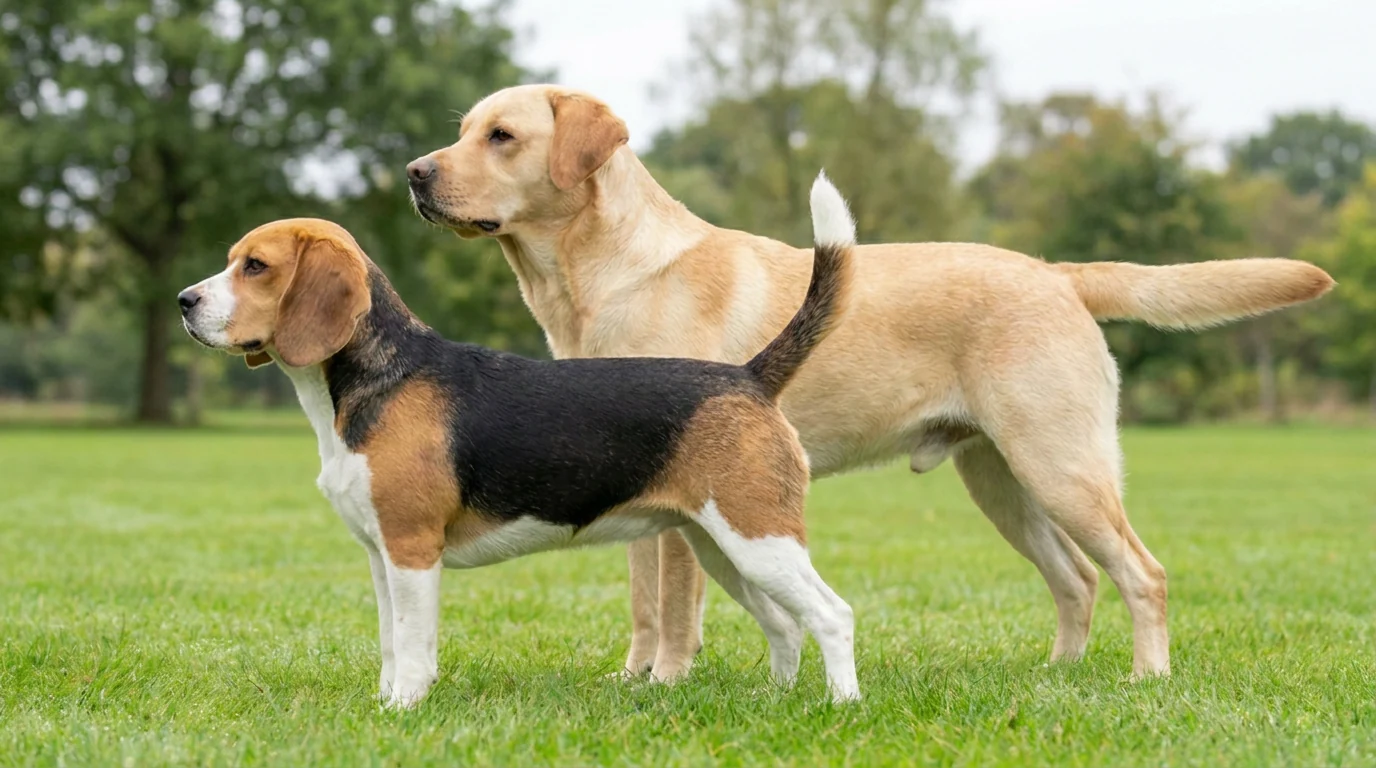
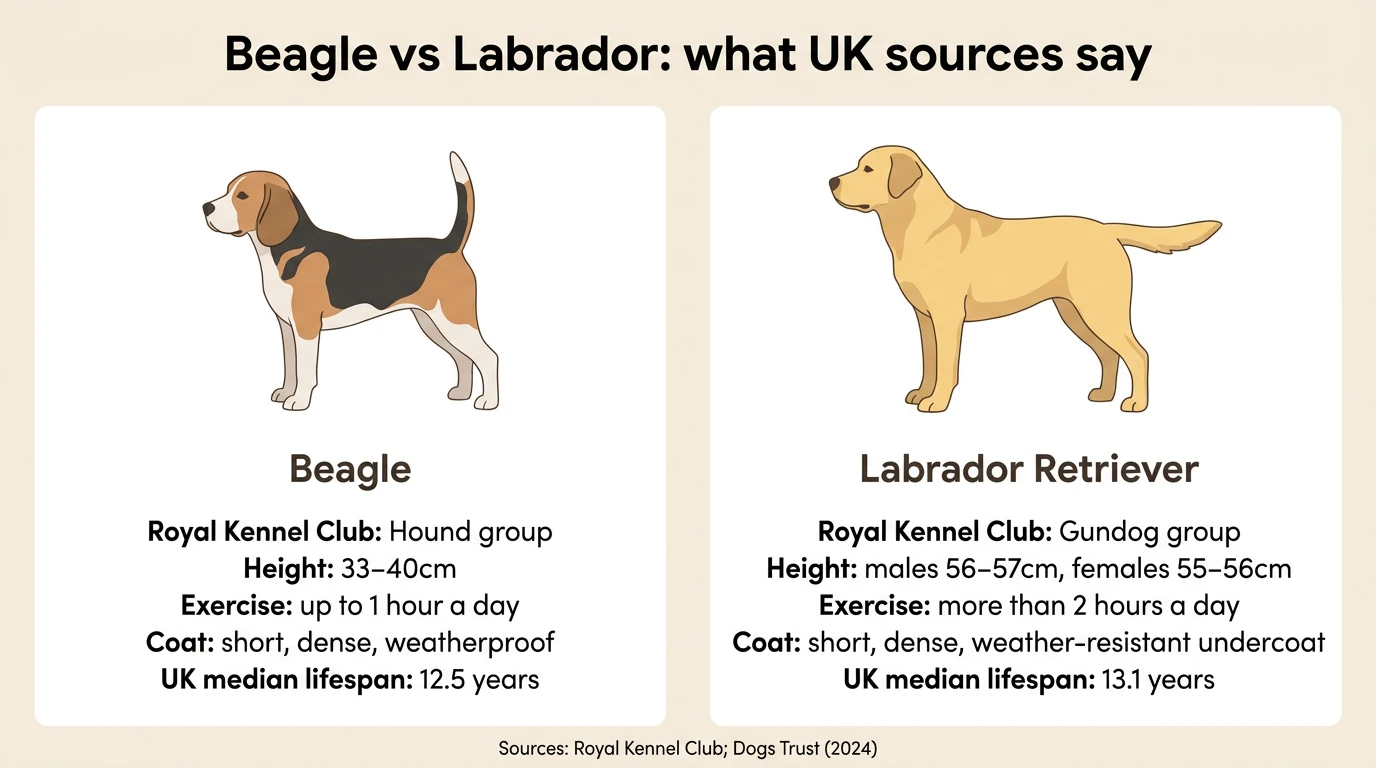
Beagle vs Labrador for a UK home: the Beagle suits a smaller house and garden, up to an hour’s exercise a day and an owner ready for a scent-led hound; the Labrador suits a larger house and garden and more than two hours a day. Both shed, and UK data gives Labradors a slightly longer median lifespan.
We haven’t owned either breed, so this comparison draws on the Royal Kennel Club breed standards, Dogs Trust’s UK longevity study, the Royal Veterinary College’s VetCompass research and PDSA’s breed guides.
TABLE OF CONTENTS
Beagle vs Labrador at a glance
| Beagle | Labrador Retriever | |
|---|---|---|
| Royal Kennel Club group | Hound | Gundog |
| Bred to | Hunt, primarily hare, by following a scent | Retrieve as a working gundog, with a soft mouth and a love of water |
| Size (Royal Kennel Club) | Small | Large |
| Height (breed standard) | 33–40cm (one range for males and females) | Males 56–57cm, females 55–56cm |
| Weight | Not given in the breed standard | Not given in the breed standard |
| Exercise | Up to 1 hour a day | More than 2 hours a day |
| Home and garden | Small house; small or medium garden | Large house; large garden |
| Coat | Short, dense and weatherproof | Short and dense, with a weather-resistant undercoat |
| Colours | Tricolour and nine other combinations in the standard, including lemon and white and red and white | Wholly black, yellow (light cream to fox red) or liver/chocolate |
| Grooming | Once a week | Once a week |
| Sheds | Yes | Yes |
| UK median lifespan | 12.5 years (95% CI 12.3–12.7; n = 4,678) | 13.1 years (95% CI 13.0–13.1; n = 43,428) |
| UK legal status | Not a banned type | Not a banned type |
Sources: Royal Kennel Club breed pages and breed standards (updated 1 April 2025); Dogs Trust’s UK longevity study (2024). Breed standards describe the ideal, so an individual dog may be larger or smaller.
Hound and gundog: what each breed was bred to do
The Beagle: a British pack hound
The Royal Kennel Club describes the Beagle as the smallest of the British pack hounds. It was bred to hunt small game and to be followed on foot, which made it popular with people who couldn’t keep up with the larger scenthounds on horseback. The breed was established in England by the 15th century and has long been valued for its stamina, its voice and its scenting ability. The breed standard sums up its job plainly: it hunts, primarily hare, by following a scent.
That history still shows today. The Royal Kennel Club notes that a Beagle benefits from secure surroundings, because its nose can lead it off after an interesting scent.
The Labrador: a retriever from Newfoundland
The Labrador Retriever comes from Newfoundland, where, according to the Royal Kennel Club, dogs helped fishermen retrieve nets and lost lines and pulled carts loaded with fish. A smaller type was known as the St John’s dog. Crossed with hunting dogs that English traders and fishermen brought over, these dogs formed the basis of the modern Labrador. Some were taken back to England, where sporting owners noticed their retrieving skills; an early patron, the Earl of Malmesbury, gave the breed its name, and the first breed club was founded in 1916.
The Royal Kennel Club now calls the Labrador the most popular of all pedigree breeds, valued as a family companion, service dog, guide dog and working gundog. Its standard describes an excellent nose, a soft mouth and a keen love of water.
Size and build
The two breeds sit at opposite ends of the Royal Kennel Club’s size scale: the Beagle is listed as small and the Labrador as large.
The Beagle standard gives one height range for males and females, from a minimum of 33cm to a maximum of 40cm at the withers. The Labrador standard gives an ideal height of 56–57cm for males and 55–56cm for females. Neither standard gives a weight, and because breed standards describe the ideal, an individual dog may be taller or shorter.
The standards describe different builds, too. The Beagle should be “a sturdy, compactly built hound” with quality but no coarseness. The Labrador is strongly built, short-coupled and very active, broad through the skull, chest and loins, and its standard adds that this agility rules out excessive body weight.
Ears, tail and coat
Beagle ears are long, with a rounded tip, and the standard says they reach nearly to the end of the nose when drawn out. They are set low and hang close to the cheeks. A Labrador’s ears are not large or heavy; they hang close to the head and are set rather far back.
The tails differ as well. The Beagle’s tail is sturdy and moderately long, set on high and carried gaily but not curled over the back, and the standard asks for a white tip. The Labrador has the breed’s distinctive “otter” tail: very thick at the base, tapering towards the tip, with no feathering and a rounded look from its thick, short coat.
Both breeds have short coats. The Beagle’s is dense and weatherproof, and the standard allows tricolour (black, tan and white) and nine other combinations, such as lemon and white or red and white. The Labrador’s coat is short and dense with a weather-resistant undercoat, and the only correct colours are wholly black, yellow (from light cream to fox red) and liver or chocolate.
Temperament: what the breed standards say
Both breed standards ask for a friendly, even-tempered dog. The Beagle standard calls for a hound that is “amiable and alert”, showing neither aggression nor timidity, and describes a merry, bold and determined hunter with plenty of activity and stamina. The Labrador standard describes a dog that is “intelligent, keen and biddable”, with a strong will to please, a kindly nature and no trace of aggression or undue shyness.
The Royal Kennel Club’s breed pages add some context. The Beagle was developed to work in packs, and the Club describes it as sociable and generally good-tempered, a breed that thrives on company. The Labrador’s popularity, it says, comes from its versatility as a companion, service dog, guide dog and working gundog.
PDSA’s breed guides fill in the day-to-day detail. Beagles can be more vocal than other dogs when they’re left alone, PDSA says, so they suit homes where someone is usually around; it advises against leaving any dog alone for more than four hours and says even that may be too long for a Beagle.
A Beagle’s recall can also fade when it catches an interesting scent, so PDSA suggests keeping it on a lead unless the area is secure, and supervising it around smaller pets.
Labradors, according to PDSA, are devoted and affectionate, quick to learn and eager to please, and those from working lines need training that gives an outlet to their urge to work and retrieve. PDSA recommends positive, reward-based training for both breeds.
No UK study compares how easy the two breeds are to train or how much they bark, so we haven’t ranked them on either.
Exercise, space and grooming
Daily exercise is the clearest practical difference between the two. The Royal Kennel Club suggests up to an hour a day for a Beagle and more than two hours for a Labrador. It lists the Beagle for a small house with a small or medium garden and the Labrador for a large house with a large garden, and rates both as suiting town or country life.
PDSA suggests that a Labrador’s day can mix walking, running, retrieving, play, sniffing and searching games and swimming, tailored to the individual dog. For Beagles, it recommends scent games and free time in a secure garden, noting that they are good escape artists who love to climb and dig.
Grooming is light for both breeds. The Royal Kennel Club suggests grooming each once a week, and both shed. PDSA adds that a Beagle’s ears should be kept clean and dry to help prevent ear infections. If you’re choosing a brush for a Beagle’s coat, our guide to the best dog brush for Beagles compares the options.
Lifespan and health: what UK data shows
Beagle vs Labrador: lifespan in the UK
Dogs Trust’s 2024 study of more than half a million UK dogs gives a median life expectancy of 13.1 years for the Labrador Retriever (95% confidence interval 13.0–13.1; 43,428 dogs, 16,155 of them deceased) and 12.5 years for the Beagle (12.3–12.7; 4,678 dogs, 1,552 deceased). The ranges don’t overlap, so in this UK data the Labrador’s median is the longer of the two, by about seven months.
The Royal Kennel Club’s breed pages put lifespan at over 12 years for the Beagle and over 10 years for the Labrador. A median is a midpoint, so plenty of dogs of both breeds live shorter or longer lives.
Beagle health
The largest UK study of pet Beagles, from the Royal Veterinary College’s VetCompass programme, covered 19,906 Beagles under veterinary care in 2019. In a random sample of 3,729 of them, the most common diagnoses that year were obesity (24.27%), periodontal (dental) disease (17.78%), overgrown nails (11.61%), ear infection (11.18%) and anal sac impaction (10.59%). The authors concluded that the Beagle shouldn’t be seen as a breed with extreme conformation, but that owners should pay particular attention to weight control and dental care.
Among the 322 Beagles in the study that died, the median age at death was 11.28 years. That is a different measure from Dogs Trust’s median life expectancy, so the two figures shouldn’t be compared directly.
PDSA lists epilepsy, meningitis, hypothyroidism, certain cancers, intervertebral disc disease, some eye conditions (including cherry eye) and ear infections among the conditions Beagles can develop. It also names four inherited conditions that a puppy’s mother should be checked for (see the box below).
Labrador health
A VetCompass study compared 1,462 Labrador Retrievers with 20,786 other dogs under UK veterinary care in 2016. Labradors had higher odds of 12 of the 35 common disorders studied and lower odds of 7. Osteoarthritis carried the highest odds, at almost three times those of other dogs; patellar luxation (a slipping kneecap) carried the lowest.
PDSA lists hip and elbow dysplasia, a tendency to obesity, and progressive retinal atrophy, an inherited eye condition that can lead to blindness, among the problems Labradors are prone to. Screening for some inherited conditions is available through the British Veterinary Association and Kennel Club Canine Health Schemes.
Weight is a shared theme: obesity was the most common diagnosis in the Beagle study, and PDSA lists it for Labradors too. For how health problems vary between breeds, see our guide to common health problems across dog breeds.
Before you buy: For a Labrador, PDSA recommends checking that the puppy’s parents have been screened under the British Veterinary Association and Kennel Club Canine Health Schemes, which let breeders screen for a range of inherited conditions. For a Beagle, PDSA and the Kennel Club advise checking that the mother has been tested for four inherited conditions: Factor VII deficiency, Imerslund-Gräsbeck syndrome, Musladin-Lueke syndrome and neonatal cerebellar cortical degeneration. Ask your vet which checks make sense for the puppy you’re considering.
Which breed suits which owner?
Neither breed is the better choice; it depends on your home and how your days are spent.
A Beagle may suit you if you have a smaller house with a small or medium garden that you can make secure, you can give up to an hour’s exercise a day plus scent games, and someone is usually at home. Be ready for a hound that follows its nose, may be vocal when left alone and needs supervising around smaller pets.
A Labrador may suit you if you have a larger house and garden, can give more than two hours of exercise a day, and enjoy walks with room for retrieving or swimming. Labradors from working lines in particular need training that gives them a job to do.
With either breed, plan for weekly grooming and shedding, and keep a close eye on weight. PDSA says both breeds can suit family life when well socialised, and advises always supervising a Beagle with children; the same care makes sense with any dog.
If you’re also weighing up the Labrador against its fellow retriever, see Golden Retriever vs Labrador. For other breeds that suit family life, see our guide to the best family dogs in the UK, and browse more comparisons in our breed guides.
Frequently Asked Questions
Which is bigger, a Beagle or a Labrador?
The Labrador is much bigger. The Royal Kennel Club standard gives an ideal height of 56–57cm for males and 55–56cm for females, while the Beagle standard sets a range of 33–40cm for both. Neither standard gives a weight, and individual dogs can be larger or smaller than the ideal.
Do Beagles or Labradors live longer?
In UK data, Labradors live slightly longer. Dogs Trust’s 2024 study gives a median life expectancy of 13.1 years for the Labrador Retriever (43,428 dogs) and 12.5 years for the Beagle (4,678 dogs), and the confidence ranges don’t overlap. Individual dogs of either breed can live shorter or longer lives.
Which needs more exercise, a Beagle or a Labrador?
The Labrador. The Royal Kennel Club suggests more than two hours of exercise a day for a Labrador and up to an hour for a Beagle. Beagles also enjoy scent games, and PDSA advises keeping them on a lead unless the area is secure, because a scent can override their recall.
Do Beagles and Labradors shed?
Yes, both shed. Each has a short coat that the Royal Kennel Club suggests grooming once a week. The Beagle’s coat is short, dense and weatherproof; the Labrador’s is short and dense with a weather-resistant undercoat. PDSA says a weekly brush is usually enough to keep either coat in good condition.
Are Beagles and Labradors good with children?
Both can suit family life if they’re well socialised from a young age, according to PDSA. It describes Labradors as devoted and affectionate and Beagles as loving and tolerant, but advises always supervising a Beagle with children in case play gets too boisterous. The same supervision makes sense with any dog.
