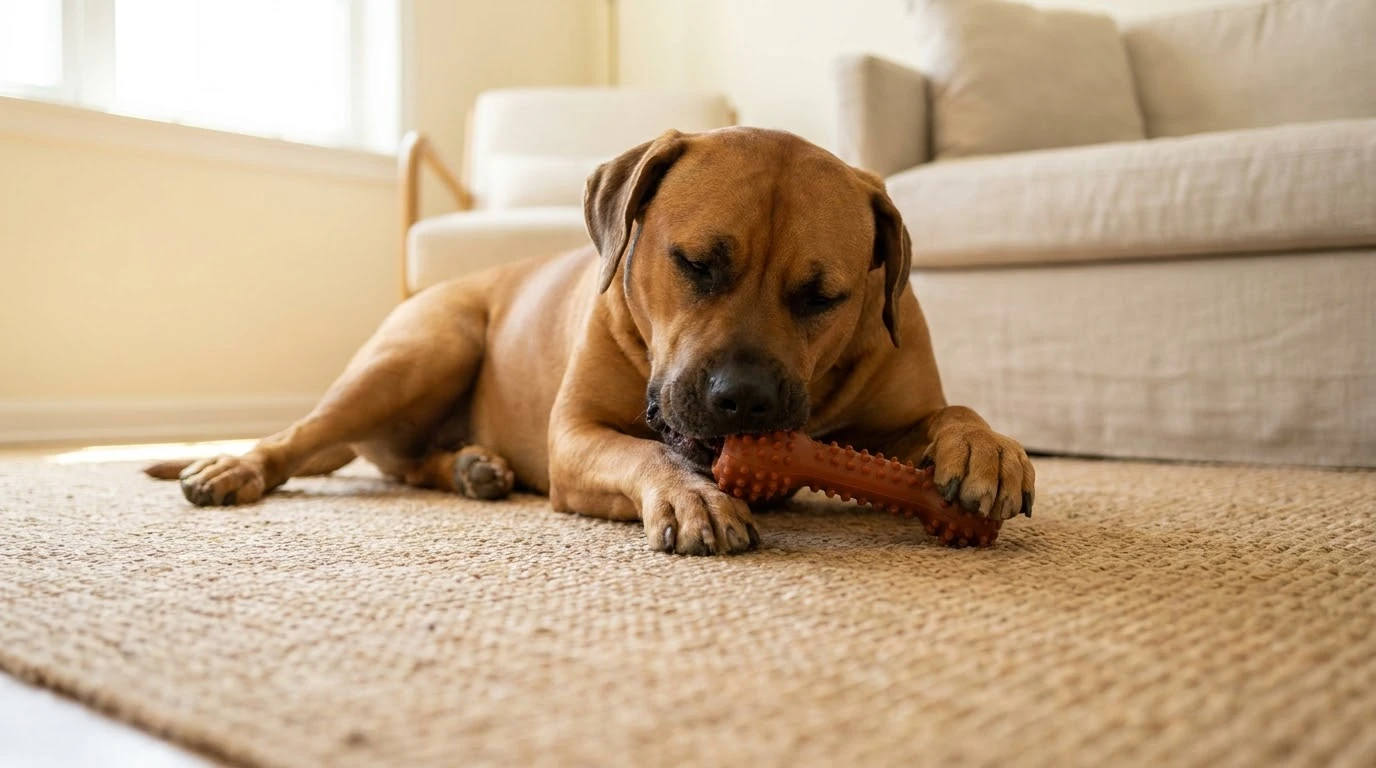
What’s the best plaque remover for dogs? A dog toothbrush and dog toothpaste, used every day. PDSA, Blue Cross and Dogs Trust all put daily brushing first, because it clears plaque before it hardens into tartar. Powders, dental chews and water additives come next. Blue Cross says products that claim to reduce plaque “may help to some degree”, so they work best alongside brushing, or as a back-up for a dog who won’t be brushed yet.
Below are 12 picks across toothpaste, seaweed powders, dental chews, a water additive and the two rubber chew toys that Dexter, our Cane Corso, actually uses. The advice comes from the three UK charities; what each product does is in its maker’s words and marked as theirs. There are no ratings or prices on this page: costs are shown as £ to £££ bands. Where UK sources say nothing, I’ve said so.
Quick Picks:
Best overall: Virbac C.E.T. Enzymatic Toothpaste Kit, paste, toothbrush and finger brush in one box for starting daily brushing.
Best if you can’t brush yet: Logic Oral Hygiene Gel, which the maker says works with or without a brush.
Best Plaque Off powder: ProDen PlaqueOff Powder 180g, the original seaweed powder, with a big-dog amount on the maker’s UK page.
Best budget powder: Leo’s Plaque Off Powder 200g, one ingredient and a clear feeding guide.
Best dental chew for big dogs: Whimzees Variety Box XL, made for dogs over 27kg.
Used on Dexter: atopo Rubber Bone Chew Toy, one of his two after-meal chews.
TABLE OF CONTENTS
What does a plaque remover for dogs actually do?
Plaque is a sticky layer of saliva, food and bacteria that builds up on your dog’s teeth every day. Left alone, it hardens into brown tartar near the gum line, which can lead to painful gum disease, infections and lost teeth, PDSA explains. Dental disease also heads the list of the conditions UK vets record most often, ahead of ear infections and obesity.
A plaque remover for dogs is anything that clears that soft layer or slows it building up. The charity’s vets are clear about the order: brushing every day with a dog toothbrush and dog-safe toothpaste is the best way to remove it, and occasional brushing won’t shift a build-up. Blue Cross and Dogs Trust say the same.
Dental chews, dental diets, water additives and powders are extras. Your vet may recommend them alongside brushing, and Dogs Trust asks you to check with your vet before you use any of them.
FlexK9 Health Disclaimer: This guide is general information, not veterinary advice. See your vet if your dog has red, swollen or bleeding gums, bad breath that doesn’t go away, loose or broken teeth, or struggles to eat. If your dog has a health condition, including a thyroid problem, ask your vet before starting any dental product. PDSA’s guide to dental disease in dogs explains the signs and treatment.
Plaque or tartar: when it’s a job for your vet
Once plaque has hardened into tartar, brushing alone is unlikely to be enough, and your vet can tell you whether your dog needs treatment. That can range from a scale and polish to removing loose, infected or broken teeth, and PDSA says the only safe way to do it is under a general anaesthetic. No powder, chew or gel on this page replaces that.
Signs that your dog’s mouth needs a vet check, from PDSA and Dogs Trust:
- Bad breath
- Red, swollen or bleeding gums
- Brown tartar at the gum line, or discoloured teeth
- Drooling, sometimes with blood
- Pawing at the mouth or face
- Chewing on one side, dropping food or preferring soft food
- Loose, broken or missing teeth
- Swelling on the face
Many dogs keep eating despite dental pain, so a good appetite doesn’t rule out a problem. Many practices also offer nurse dental checks, Dogs Trust adds.
How to start brushing your dog’s teeth
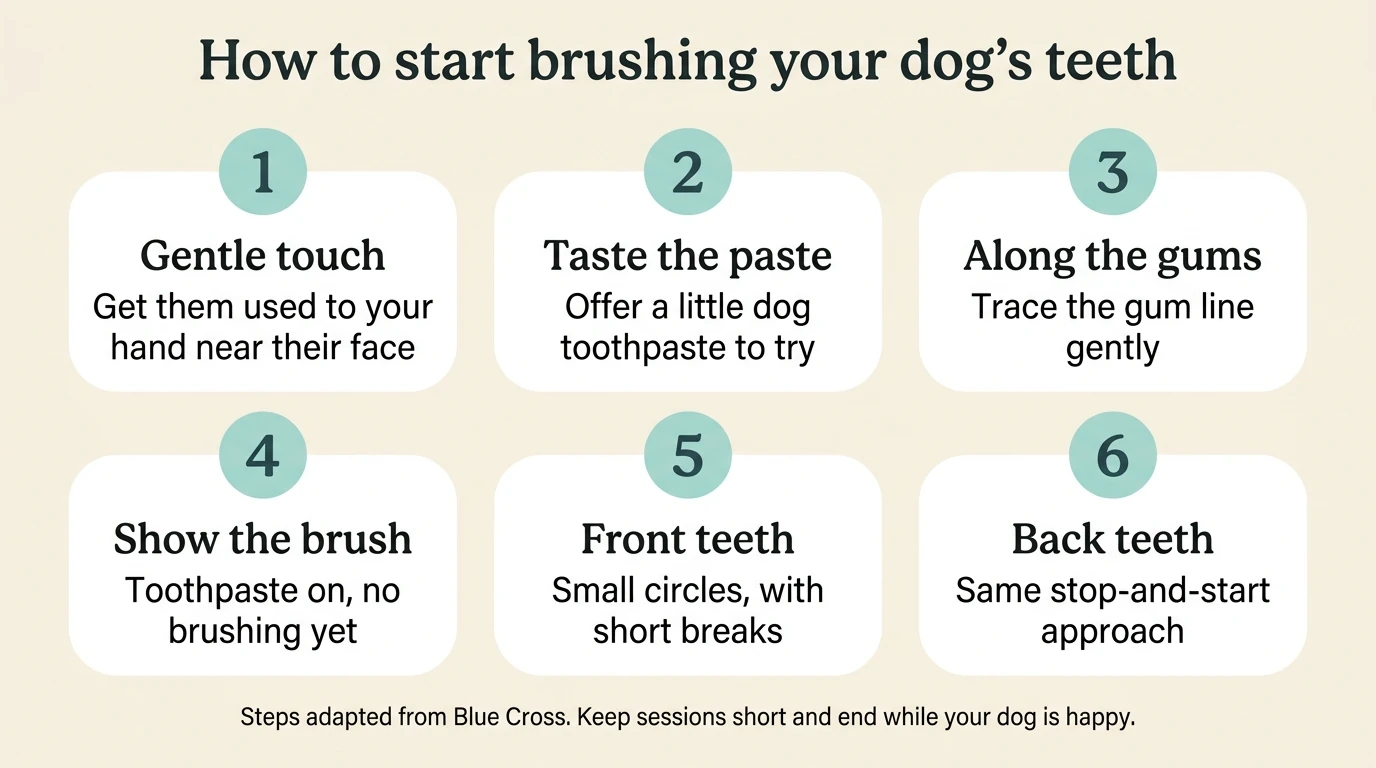
Brush every day with a dog toothbrush or a rubber thimble (a finger brush) and a dog toothpaste, Blue Cross advises, building up slowly with short sessions that end while your dog is still happy. Its steps, spread over a couple of weeks:
- Gently stroke your dog’s cheek so they get used to your hand near their mouth.
- Put a dab of dog toothpaste on your finger and let them sniff and lick it off.
- Run your finger along the gum line inside their mouth.
- Bring in the toothbrush with toothpaste on it, without putting it in their mouth straight away.
- Brush the front teeth and canines in small circles, stopping often to let them lick the brush.
- Move on to the back teeth the same way.
Older dogs can take longer, but they can still learn. If your dog’s mouth already looks sore or inflamed, ask your vet before you start.
Use a dog toothpaste, never your own. Dogs Trust recommends an enzymatic dog toothpaste, which helps break down plaque and comes in flavours such as chicken or liver, and warns that human toothpaste can be toxic to dogs. If your dog pulls away, stop and take a break, then go back a step next time.
From our home: I’ve never got into brushing Dexter’s teeth. I tried a finger brush a couple of times, but it didn’t become a habit. What I do after every meal is wipe round his mouth and gums with a tissue and an unscented damp dog wipe to clear any bits of kibble or food. The charities still put daily brushing first, so treat a wipe as an extra rather than a swap.
Does a plaque remover for dogs like Plaque Off work?
Plaque Off powders are seaweed that you sprinkle on your dog’s food once a day. Most use one seaweed, Ascophyllum nodosum, a kelp, and ProDen PlaqueOff is the original. None of the three UK charities mentions seaweed powders, so there’s no UK vet charity verdict on whether they work.
Swedencare, which makes PlaqueOff, says its powder is accepted by the VOHC, a US veterinary oral health council, and that results usually show within three to eight weeks of daily use. The maker’s own description on UK retailer pages also says the powder is not a substitute for tooth brushing. Read those claims as the makers’, not as independent UK advice.
Seaweed is naturally high in iodine, and ProDen’s UK page doesn’t recommend its powder for dogs with thyroid problems. Leo’s listing says the same for its powder and adds that it isn’t for pregnant or nursing dogs. If your dog has a thyroid condition or any other health problem, ask your vet before you give a seaweed product.
Not every dental powder is seaweed only: Protexin’s PlaqEase adds vitamin C, a prebiotic and a postbiotic to kelp, with a chicken flavour. No UK source compares one powder with another, so the picks below are chosen on what’s in them, how the maker says to use them for a big dog, and UK stock.
Dental chews, chew toys and water additives
Some chew toys and dental treats may help with plaque and bad breath, PDSA says, but chewing mainly works on the back teeth, so it won’t clean the front ones. Dental chews also count towards your dog’s daily food. Treats and chews shouldn’t make up more than 10% of the daily allowance, so cut their meals a little to keep them at a healthy weight.
Blue Cross adds three safety points. Choose a chew that’s the right size for your dog, because one that’s too small can be a choking risk. Hard chews can fracture or wear teeth. And many dental chews are high in calories. For a big dog, that means checking the weight band on the pack: on this page the Whimzees XL is made for dogs over 27kg and the Dentastix Large for dogs of 25kg and over.
Very hard chews such as antlers aren’t on this list for that reason, and any new chew is worth supervising. For food toys and choosing a safe toy size, see our guide to dog enrichment toys.
Water additives are the easiest extra of all. A special dog-safe mouthwash can be added to your dog’s drinking water to help keep their mouth clean, but human mouthwash should never be used, according to PDSA.
How we chose each plaque remover for dogs
I started from the old version of this guide and Amazon UK’s dental range, read more than 40 listings, and checked each one against four things:
- Sold without a prescription: nothing here is a licensed veterinary medicine.
- The maker’s directions for a big dog: a daily amount or a size line for larger dogs, on the listing or the maker’s UK page.
- What’s in it: ingredients or material shown on the listing or the maker’s page, and no listing text that contradicts how the product is used.
- UK stock: in stock with a UK seller when I checked.
The two rubber chew toys are marked Used on Dexter because he uses them. Everything else was chosen on its specifications, ingredients and makers’ information. Dexter hasn’t used any toothpaste, powder, dental chew or water additive on this page.
Best toothpaste and brushing kits for dogs
Best Enzymatic Toothpaste Kit
1. Virbac C.E.T. Enzymatic Toothpaste Kit
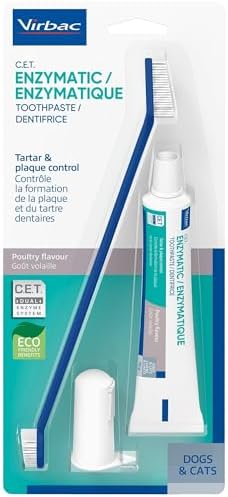
- In the box: C.E.T. enzymatic toothpaste, a dual-ended toothbrush and a finger brush.
- Enzymes: Virbac’s dual-enzyme system is designed to help control the bacteria behind plaque.
- No rinsing: the maker says the paste has no harsh foaming agents and can be swallowed.
- Use: brush daily, starting with the finger brush if your dog is new to it.
Why it’s a top pick: If you’re starting brushing from scratch, this kit puts everything in one box: Virbac’s C.E.T. enzymatic toothpaste, a dual-ended toothbrush and a finger brush. The finger brush suits the early steps, while your dog gets used to a finger in their mouth, and the long brush takes over once they’re settled. Virbac says the paste uses two enzymes, glucose oxidase and lactoperoxidase, to help control the bacteria behind plaque, and that it has no harsh foaming agents, so it can be swallowed without rinsing.
Specifications:
- Type: Enzymatic toothpaste kit
- Pack size or size: Toothpaste, dual-ended toothbrush and finger brush
- How you use it (maker): Brush daily
- Main ingredient or material (maker): C.E.T. dual-enzyme system (glucose oxidase and lactoperoxidase)
- Dog size (maker): Dogs and cats of all ages
- Best for: Owners starting daily brushing
✅ Reasons to Buy:
- Everything to start brushing: paste, a long brush and a finger brush in one kit.
- No rinsing: Virbac says the paste can be swallowed.
- Two brush heads: the dual-ended brush has heads for different tooth sizes, the maker says.
💡 Good to know before you buy:
- Start with the finger brush: it fits Blue Cross’s early steps, before a full brush goes in.
- Tell your vet you use it: Virbac’s UK page asks you to let your vet know your dog uses its toothpaste if a new medication is prescribed.
❌ Reasons to Avoid:
- Brushing takes daily training; it isn’t a quick fix for a dog who won’t have their mouth handled.
- The listing doesn’t name the paste’s flavour.
- Dearer than the paste alone if you already have a brush.
📝 Mini Verdict: The best place to start if you’re willing to brush. Skip it if you already own a dog toothbrush and only need more paste.
Best Gel for Dogs That Won’t Be Brushed
2. Logic Oral Hygiene Gel

- With or without a brush: Ceva says the gel can be brushed on or applied straight onto the teeth.
- Amount: about 5cm a day for dogs over 20kg, after the last meal.
- In the box: a 70g tube and a finger brush.
- Age: suitable for puppies from three months, the maker says.
Why it’s a top pick: Logic is the gel to reach for while your dog is still learning to accept a brush. Ceva, the maker, says it works with or without brushing: you can brush it on, or apply it straight onto the teeth, and a surfactant keeps the enzymes in contact with the teeth and gums. It’s used once a day after the last meal, the tube comes with a finger brush, and the listing gives an amount for big dogs, about 5cm of gel a day for dogs over 20kg. It’s also suitable for puppies from three months, the maker says.
Specifications:
- Type: Enzymatic oral gel (toothpaste)
- Pack size or size: 70g tube with a finger brush
- How you use it (maker): Once a day after the last meal, brushed on or applied straight onto the teeth
- Main ingredient or material (maker): Multi-enzyme system
- Dog size (maker): About 5cm a day for dogs over 20kg; puppies from 3 months
- Best for: Dogs who won’t accept a brush yet
✅ Reasons to Buy:
- Works without a brush: the maker says it can be applied straight onto the teeth.
- Big-dog amount on the listing: 5cm a day for dogs over 20kg.
- Finger brush in the box: for when your dog is ready to be brushed.
💡 Good to know before you buy:
- Brushing still comes first: Ceva’s own listing says brushing every day is the most effective way to get plaque off teeth.
- Use it last thing: the maker’s directions are once a day, after the last meal.
❌ Reasons to Avoid:
- Applied without a brush, nothing scrubs the teeth; the gel does the work on its own.
- At 5cm a day, a big dog gets through a 70g tube much faster than a small dog.
- The listing names the enzyme system but gives no full ingredient list.
📝 Mini Verdict: The best gel for a dog who won’t be brushed yet, and a good paste once they will. Skip it if you’re happy to brush daily with the Virbac kit.
Best plaque remover powders for dogs
Best Plaque Off Powder
3. ProDen PlaqueOff Powder 180g
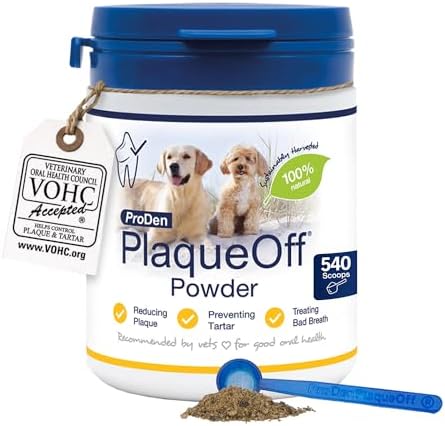
- Ingredient: 100% Ascophyllum nodosum seaweed, sprinkled on food once a day.
- Big dogs: three scoops a day for dogs over 25kg, on the maker’s UK page.
- How long it lasts: about six months for a dog over 25kg at that amount.
- Caution: the maker doesn’t recommend it for dogs with thyroid problems.
Why it’s a top pick: ProDen PlaqueOff is the powder most people mean by “Plaque Off”: 100% Ascophyllum nodosum seaweed, sprinkled on wet or dry food once a day. Swedencare’s UK page gives a big-dog amount, three scoops a day for dogs over 25kg, and says each scoop holds 330mg. At that amount the 180g pot lasts a big dog around six months, which makes it better value for a large breed than the 60g pot. The maker says the powder is VOHC accepted and that results usually show in three to eight weeks.
Specifications:
- Type: Seaweed powder
- Pack size or size: 180g pot with a scoop
- How you use it (maker): Sprinkled on wet or dry food once a day
- Main ingredient or material (maker): Ascophyllum nodosum seaweed (natural iodine 0.08%)
- Dog size (maker): 3 scoops a day for dogs over 25kg
- Best for: Owners who want the original Plaque Off powder
✅ Reasons to Buy:
- One ingredient: the listing names a single seaweed and nothing else.
- A big-dog amount from the maker: three scoops a day for dogs over 25kg.
- A long-lasting pot: about six months for a big dog at the maker’s amount.
💡 Good to know before you buy:
- The “18-month supply” is for a small dog: for a dog over 25kg at three scoops a day, the 180g pot lasts about six months.
- Not for dogs with thyroid problems: seaweed is high in iodine, and the maker doesn’t recommend it for them.
❌ Reasons to Avoid:
- No UK vet charity has a view on seaweed powders.
- Not suitable for dogs with a thyroid condition.
- A dearer pot to buy than the budget powders, though it lasts longer.
📝 Mini Verdict: The best-known plaque remover for dogs in powder form, with a clear big-dog amount. Skip it if your dog has a thyroid problem.
Best Chicken-Flavoured Dental Powder
4. Protexin Veterinary PlaqEase

- Formula: kelp with vitamin C, a prebiotic and a postbiotic.
- Flavour: chicken, for dogs who won’t eat plain seaweed.
- Use: sprinkled on or mixed into food once a day, long term.
- Pack: a 75g pot with a scoop.
Why it’s a top pick: PlaqEase is a different take on a dental powder from Protexin, a UK maker of pet supplements. Instead of seaweed alone, it combines kelp with vitamin C, a prebiotic and a postbiotic, and it has a chicken flavour that the maker says pets enjoy. It’s sprinkled on top of or mixed into food once a day, and the maker says it’s meant for daily, long-term use. A UK retailer’s copy of the label gives four measures a day for dogs over 30kg.
Specifications:
- Type: Dental powder
- Pack size or size: 75g pot with a scoop
- How you use it (maker): Sprinkled on or mixed into food once a day
- Main ingredient or material (maker): Kelp, vitamin C, a prebiotic and a postbiotic
- Dog size (maker): 4 measures a day for dogs over 30kg (UK retailer’s copy of the label)
- Best for: Dogs who turn their nose up at plain seaweed
✅ Reasons to Buy:
- Chicken flavour: made for dogs who won’t eat a plain powder.
- More than seaweed: kelp plus vitamin C, a prebiotic and a postbiotic.
- Water can be added: the directions say it can be mixed in with a little water.
💡 Good to know before you buy:
- It’s a long-term product: the directions say to use it daily on a long-term basis.
- It contains kelp: if your dog has a thyroid condition, ask your vet first.
❌ Reasons to Avoid:
- A 75g pot lasts a big dog only about a month at the label’s amount.
- Costs more per day than ProDen or Leo’s at the makers’ amounts.
- The Amazon listing gives no daily amounts; they come from the label.
📝 Mini Verdict: The pick for a fussy eater who leaves plain seaweed. Skip it if cost per day matters more than flavour.
Best Budget Seaweed Powder
5. Leo’s Plaque Off Powder 200g

- Ingredient: dried Irish seaweed meal, sold as a complementary feed.
- Feeding guide: two teaspoons a day for dogs over 15kg; one teaspoon is 2g.
- Not for: pregnant or nursing dogs, or dogs with a thyroid condition.
- Age: for dogs over eight weeks old.
Why it’s a top pick: Leo’s is a single-ingredient powder of dried Irish seaweed meal, sold as a complementary feed, and it costs the least per pot of the powders here. The listing’s feeding guide is the clearest of the three: half a teaspoon a day for dogs up to 7kg, one teaspoon for 7–15kg and two teaspoons for dogs over 15kg, with one teaspoon equal to 2g. At that amount a 200g pot lasts a big dog about 50 days.
Specifications:
- Type: Seaweed powder
- Pack size or size: 200g
- How you use it (maker): Sprinkled over your dog’s food once a day
- Main ingredient or material (maker): Dried Irish seaweed meal
- Dog size (maker): 2 teaspoons a day for dogs over 15kg
- Best for: Owners who want a seaweed powder on a budget
✅ Reasons to Buy:
- The lowest-priced powder here: the cheapest pot of the three.
- A clear feeding guide: three weight bands and a teaspoon-to-gram conversion.
- One ingredient: seaweed meal with no added preservatives, the maker says.
💡 Good to know before you buy:
- Not for every dog: the listing says it isn’t for pregnant or nursing dogs, or dogs with an overactive or underactive thyroid, and it’s for dogs over eight weeks old.
- Go by the feeding guide: the listing’s safety box uses toothpaste-style wording, so follow the directions in its description and on the pack.
❌ Reasons to Avoid:
- The listing doesn’t name the type of seaweed.
- Not suitable for dogs with a thyroid condition.
- At two teaspoons a day, a big dog uses it faster than ProDen’s three small scoops.
📝 Mini Verdict: The budget way to try a seaweed powder. Skip it if you’d rather have the named seaweed and the maker’s VOHC claim that come with ProDen.
Best dental chews for plaque
Best Seaweed Dental Chew
6. ProDen PlaqueOff Dental Care Bones, Chicken & Pumpkin

- What it is: a chew with ProDen’s seaweed, for dogs who won’t eat a powder.
- Amount: one bone a day for dogs over 14kg; half a bone for smaller dogs.
- Pack: 13 bones in a chicken and pumpkin flavour.
- Calories: about 107 per bone, the maker says.
Why it’s a top pick: These bones put ProDen’s seaweed into a chew, for dogs who won’t eat a powder on their food. The maker says they work two ways: the seaweed, plus the bone’s shape and texture as your dog chews. The listing gives one bone a day for dogs over 14kg and half a bone for smaller dogs. On UK retailer pages, the maker lists dried potatoes, vegetable glycerine, water, gelatine, chicken and dried kelp among the ingredients, and Swedencare puts each bone at about 107 calories.
Specifications:
- Type: Dental chew with seaweed
- Pack size or size: 13 bones
- How you use it (maker): One bone a day for dogs over 14kg; half a bone for smaller dogs
- Main ingredient or material (maker): Dried potatoes, chicken and kelp
- Dog size (maker): Medium and large dogs
- Best for: Dogs who won’t eat a powder
✅ Reasons to Buy:
- Seaweed in a chew: the same seaweed as ProDen’s powder.
- Two ways to clean: seaweed plus the bone’s shape and texture, the maker says.
- A simple amount: one bone a day for dogs over 14kg.
💡 Good to know before you buy:
- Count the calories: about 107 per bone, the maker says, which counts towards PDSA’s 10% treat limit.
- Same iodine caution: it contains seaweed, so the thyroid advice for the powder applies.
❌ Reasons to Avoid:
- The dearest pick per day: 13 bones last under two weeks at one a day.
- The Amazon listing’s ingredient field only says “Organic Seaweed”; the full list is on the maker’s pages.
- The listing doesn’t say what the gelatine is made from.
📝 Mini Verdict: A good way to get seaweed into a dog who refuses powder. Skip it if you’re watching cost per day.
Best Dental Chew for Large Dogs
7. Whimzees Variety Box XL

- Size: XL chews for dogs over 27kg.
- Recipe: vegetarian and grain-free, built on potato starch.
- Shape: ridges and grooves designed to reach between teeth.
- Pack: 14 chews in mixed shapes, one a day.
Why it’s a top pick: Whimzees XL are made for dogs over 27kg, which matters for big dogs because Blue Cross warns that a chew that’s too small can be a choking risk. The chews are vegetarian and grain-free, built on potato starch with six primary ingredients, the maker says. Their ridges and grooves are designed to work into the spaces between teeth, and the maker says they take three times longer to chew than competitors’ treats. The box mixes several shapes.
Specifications:
- Type: Vegetarian dental chew
- Pack size or size: 14 XL chews in mixed shapes
- How you use it (maker): One chew a day
- Main ingredient or material (maker): Potato starch
- Dog size (maker): XL, dogs over 27kg
- Best for: Big dogs who need a big chew
✅ Reasons to Buy:
- Sized for big dogs: XL is for dogs over 27kg.
- Vegetarian and grain-free: a short ingredient list, the maker says.
- Ridges and grooves: designed to reach between teeth.
💡 Good to know before you buy:
- Choose by weight: the L size is for 18–27kg, so check the band before you swap sizes.
- Watch the calories: the L listing gives 178 calories a piece; the XL listing gives none, so allow for it in the 10%.
❌ Reasons to Avoid:
- The XL listing gives no calorie figure.
- A mixed box, so not every chew is the toothbrush shape.
- Dearer per day than Dentastix.
📝 Mini Verdict: The pick for a big dog who needs a chew of the right size. Skip it if a cheap daily stick will do.
Best Everyday Dental Stick
8. Pedigree Dentastix Large

- Size: for dogs of 25kg and over.
- Pack: 112 sticks, one a day.
- Maker’s claim: Pedigree says daily sticks reduce tartar build-up by up to 80%.
- Recipe: low in fat, with no added sugar or artificial colours and flavours.
Why it’s a top pick: Dentastix are the dental sticks most owners know, and the Large size is for dogs of 25kg and over. The 112-stick box lasts nearly four months at one stick a day, so it’s cheap per day. Pedigree says the sticks are scientifically proven to reduce tartar build-up by up to 80% when fed daily, that the texture and active ingredients do the work, and that they were developed with vets and nutritionists at the Waltham Centre for Pet Nutrition. The listing names sodium tripolyphosphate among the minerals.
Specifications:
- Type: Dental stick
- Pack size or size: 112 sticks
- How you use it (maker): One stick a day
- Main ingredient or material (maker): Cereals, meat and animal derivatives, minerals (including sodium tripolyphosphate)
- Dog size (maker): Large, 25kg and over
- Best for: An everyday chew at a low cost per day
✅ Reasons to Buy:
- Low cost per day: 112 sticks last nearly four months.
- Sized for big dogs: Large is for dogs of 25kg and over.
- Low in fat: no added sugar or artificial colours and flavours, the maker says.
💡 Good to know before you buy:
- The 80% figure is Pedigree’s: it’s the maker’s claim for daily use, not an independent UK finding.
- Keep water down: the directions say to always provide a bowl of fresh water.
❌ Reasons to Avoid:
- The ingredients use category names (“cereals”, “meat and animal derivatives”), so you can’t tell exactly what’s in them.
- Not one for a dog on a single-protein diet.
📝 Mini Verdict: The cheapest daily dental chew here for a big dog. Skip it if you need to know every ingredient.
Best Plant-Based Dental Stick
9. Forthglade Natural Dental Sticks

- Recipe: plant-based and grain-free, with mint, parsley and fennel.
- Ingredients: dried potato, tapioca and sweet potato, with a little seaweed.
- Age: for dogs aged one year and over.
- Storage: use within 10–15 days of opening.
Why it’s a top pick: Forthglade’s sticks are plant-based and grain-free, made from dried potato, tapioca and sweet potato with mint, parsley and fennel. Unusually for a stick, the ingredient list includes a little Ascophyllum nodosum seaweed (0.2%) alongside sodium hexametaphosphate (0.6%). The maker says the sticks were developed by vets to help remove plaque and tartar and freshen breath, and that they’re for dogs aged one year and over.
Specifications:
- Type: Plant-based dental stick
- Pack size or size: 20 sticks
- How you use it (maker): As a daily treat (no daily amount on the listing)
- Main ingredient or material (maker): Dried potato, tapioca starch and sweet potato
- Dog size (maker): Not given; for dogs aged 1 year and over
- Best for: Dogs on meat-free or grain-free treats
✅ Reasons to Buy:
- Plant-based and grain-free: no meat or grains in the recipe.
- A full ingredient list: every ingredient named, with percentages for the key ones.
- The lowest-priced pack here: the cheapest dental chew to try.
💡 Good to know before you buy:
- Use within 10–15 days of opening: the maker’s storage advice.
- For dogs aged one and over: not for puppies.
❌ Reasons to Avoid:
- No size or weight guide, so it’s hard to judge for a big dog.
- No daily amount on the listing.
- One listing bullet describes the bigger 10-bag box, so check the pack size before you buy.
📝 Mini Verdict: The pick for a meat-free, grain-free dental chew. Skip it if you want a weight band on the pack.
Best water additive for dogs’ teeth
10. TropiClean Fresh Breath Water Additive

- Use: one capful per 473ml of water each time you refill the bowl.
- Taste: tasteless and odourless, the maker says.
- Ingredients: include cetylpyridinium chloride, zinc gluconate and green tea leaf extract.
- Age: for dogs from 12 weeks.
Why it’s a top pick: A water additive is the easiest dental extra there is, and it fits PDSA’s line on dog-safe mouthwash in drinking water. TropiClean’s is tasteless and odourless, the maker says, and goes in at one capful per 473ml of water each time you refill the bowl, or eight capfuls for a 4-litre bowl. The listing names cetylpyridinium chloride, zinc gluconate and green tea leaf extract among the ingredients, and it’s for dogs from 12 weeks.
Specifications:
- Type: Water additive
- Pack size or size: 473ml
- How you use it (maker): One capful per 473ml of water at each refill
- Main ingredient or material (maker): Cetylpyridinium chloride, zinc gluconate, green tea leaf extract
- Dog size (maker): All sizes, from 12 weeks
- Best for: Dogs who won’t accept brushing, powders or chews
✅ Reasons to Buy:
- No effort: it goes in the water bowl.
- Tasteless and odourless: the maker says dogs won’t notice it.
- Big-bowl directions: eight capfuls for a 4-litre bowl.
💡 Good to know before you buy:
- Never human mouthwash: PDSA warns against it; use a dog product only.
- Refill the dose with the water: the directions are a capful every time you refill.
❌ Reasons to Avoid:
- The maker’s main promise is fresher breath; plaque is a secondary claim.
- Nothing touches the teeth, so it’s the weakest option here on its own.
- How long a bottle lasts depends on how often you refill.
📝 Mini Verdict: A low-effort extra on top of brushing, powder or chews. Skip it as your only plaque remover.
Best rubber chew toys for after meals
These two aren’t dental products in the way a powder or toothpaste is. They’re the rubber chew toys Dexter uses after his meals, and both makers say they help clean teeth, a claim that’s theirs.
11. atopo Rubber Bone Chew Toy

- Size: a 13-inch bone with a handle at each end.
- Material: TPR (thermoplastic rubber), the maker says.
- Grooves: raised nubs with gaps that hold small treats.
- Colour: green.
🐾 Used on Dexter: This green atopo bone is one of the two chew toys Dexter, our Cane Corso, uses regularly. I press a few treats into the grooves after his meals, and he settles down to chew them out.
Why it’s a top pick: A long bone shape suits a big dog: it’s 13 inches (about 33cm) with a handle at each end and raised nubs along its length. The grooves between the nubs hold small treats, which is how it gets used in our house. The maker says it’s made from non-toxic TPR, a thermoplastic rubber, and that the convex design helps clean teeth and control plaque and tartar.
Specifications:
- Type: Rubber chew toy
- Pack size or size: 13 inches (about 33cm), green
- How you use it (maker): Given to chew; treats can go in the grooves
- Main ingredient or material (maker): TPR (thermoplastic rubber)
- Dog size (maker): Small, medium and large dogs
- Best for: Big dogs who like a long chew after meals
✅ Reasons to Buy:
- Long enough for a big dog: 13 inches, with a handle at each end.
- Grooves for treats: small treats press into the gaps.
- Rubber, not hard nylon: made from TPR, the maker says.
💡 Good to know before you buy:
- Treats count: anything you press into the grooves is part of the 10% treat allowance.
- Check it after use: replace it if pieces start to come off.
❌ Reasons to Avoid:
- The maker’s “aggressive chewers” wording doesn’t mean it can’t be damaged.
- Rubber chew toys aren’t a substitute for brushing.
📝 Mini Verdict: A long rubber chew that gives a big dog something to work at after meals. Skip it if your dog breaks up rubber toys.
12. M.C.works Pineapple Rubber Chew Toy, XL

- Size: XL, about 18cm tall, for medium and large dogs.
- Design: hollow, so it can be stuffed with food.
- Surface: textured grooves that hold treats.
- Maker’s note: no toy is indestructible; replace it if it gets chewed up.
🐾 Used on Dexter: This yellow pineapple is the other chew toy Dexter uses regularly. Like the atopo bone, it goes to him after meals with treats pushed into the grooves.
Why it’s a top pick: The XL pineapple is a hollow rubber chew, 7.1 inches (about 18cm) tall, with a textured surface and grooves that hold treats. Because it’s hollow, it can also be stuffed with food. The maker says it’s made from tough rubber, weighs up to 300g and helps clean teeth. It comes in smaller sizes too, so choose the XL for a big dog.
Specifications:
- Type: Rubber chew toy
- Pack size or size: XL, 7.1 inches (about 18cm), yellow
- How you use it (maker): Given to chew, or stuffed with food
- Main ingredient or material (maker): Rubber
- Dog size (maker): Medium and large dogs
- Best for: Food-motivated dogs
✅ Reasons to Buy:
- Stuffable: hollow, so it doubles as a food toy.
- Textured grooves: treats can go in the grooves too.
- Sizes from small to XL: the XL suits a big dog.
💡 Good to know before you buy:
- The maker’s own warning: no toy is indestructible; if your dog chews it up, stop and replace it.
- Treats count: food in the toy is part of the daily allowance.
❌ Reasons to Avoid:
- Heavy for a small dog, which is why the smaller sizes exist.
- Rubber chew toys aren’t a substitute for brushing.
📝 Mini Verdict: A stuffable rubber chew for a big, food-driven dog. Skip it if you only want a dental product.
Plaque remover for dogs: cost compared
Bands compare the 12 picks on this page: £ is lower, ££ middle and £££ higher. Daily cost uses each maker’s amount for a big dog, over 25kg (over 30kg for PlaqEase).
| Product | Type | Pack | Maker’s daily amount for a big dog | Pack price | Daily cost |
|---|---|---|---|---|---|
| Virbac C.E.T. Kit | Toothpaste kit | Paste, toothbrush, finger brush | Brush daily | ££ | Not worked out |
| Logic Oral Hygiene Gel | Gel | 70g | About 5cm (over 20kg) | £ | Not worked out |
| ProDen PlaqueOff Powder | Seaweed powder | 180g | 3 scoops (over 25kg) | £££ | £ |
| Protexin PlaqEase | Dental powder | 75g | 4 measures (over 30kg) | ££ | ££ |
| Leo’s Plaque Off Powder | Seaweed powder | 200g | 2 teaspoons (over 15kg) | £ | £ |
| ProDen Dental Care Bones | Seaweed chew | 13 bones | 1 bone (over 14kg) | ££ | £££ |
| Whimzees Variety Box XL | Dental chew | 14 chews | 1 chew (over 27kg) | £££ | £££ |
| Pedigree Dentastix Large | Dental stick | 112 sticks | 1 stick (25kg and over) | £££ | £ |
| Forthglade Dental Sticks | Dental stick | 20 sticks | Not given | £ | Not worked out |
| TropiClean Water Additive | Water additive | 473ml | 1 capful per 473ml at each refill | ££ | Not worked out |
| atopo Rubber Bone | Chew toy | 1 toy | Not daily | ££ | Not daily |
| M.C.works Pineapple XL | Chew toy | 1 toy | Not daily | ££ | Not daily |
Final Thoughts: Which Plaque Remover for Dogs Should You Buy?
Start with brushing if you can, then add the extras that suit your dog.
- If you’re starting daily brushing: the Virbac C.E.T. Enzymatic Toothpaste Kit has everything in one box.
- If your dog won’t be brushed yet: Logic Oral Hygiene Gel can go straight onto the teeth.
- If you want a powder: ProDen PlaqueOff Powder for the original, Leo’s on a budget, or PlaqEase for a fussy eater.
- If your dog won’t eat a powder: ProDen’s Dental Care Bones put the seaweed in a chew.
- If you want a daily dental chew for a big dog: Whimzees XL for size, Dentastix Large for cost.
- If you want the lowest effort: TropiClean in the water bowl, on top of something else.
- If your dog loves to chew after meals: the two rubber toys Dexter uses, with treats in the grooves.
Whatever you choose, dental disease is common enough to make checking your dog’s mouth a habit. Our guide to the conditions UK vets record most often explains why teeth, ears and weight top the list.
Frequently Asked Questions About Plaque Removers for Dogs
Does Plaque Off work for dogs?
There’s no independent UK verdict. None of PDSA, Blue Cross or Dogs Trust mentions seaweed powders. The maker, Swedencare, says ProDen PlaqueOff is accepted by the VOHC, a US veterinary oral health council, and that results usually show in three to eight weeks, and it says the powder isn’t a substitute for brushing. The charities all put daily brushing first.
Is Plaque Off safe for dogs?
It’s sold as a food supplement, not a medicine, but it isn’t for every dog. Seaweed is naturally high in iodine, and ProDen’s UK page doesn’t recommend its powder for dogs with thyroid problems. If your dog has a thyroid condition, is pregnant or has any other health problem, ask your vet before you use a seaweed product.
How do I get plaque off my dog’s teeth without brushing?
You can slow plaque down without brushing, but not as well. Dental chews, dental diets, water additives and gels you apply straight to the teeth may all help, and your vet can suggest which suits your dog. The UK vet charities still say daily brushing is the best way to remove plaque, so it’s worth training your dog to accept it slowly.
Can I use human toothpaste on my dog?
No. Blue Cross and Dogs Trust both warn that human toothpaste can be toxic to dogs. Use a toothpaste made for dogs, such as an enzymatic dog toothpaste, which comes in flavours like chicken or liver.
Do dental chews work for dogs?
They may help, but they don’t replace brushing. PDSA says some dental treats may help with plaque and bad breath, but chewing mainly cleans the back teeth, not the front ones. Choose the right size for your dog and count chews in their daily food, because many are high in calories.
Can I remove tartar from my dog’s teeth at home?
No, tartar needs your vet. Once plaque has hardened into tartar, brushing alone is unlikely to shift it. PDSA says dental cleaning, from a scale and polish to removing damaged teeth, is only safe under a general anaesthetic, so book a vet or nurse dental check.
