
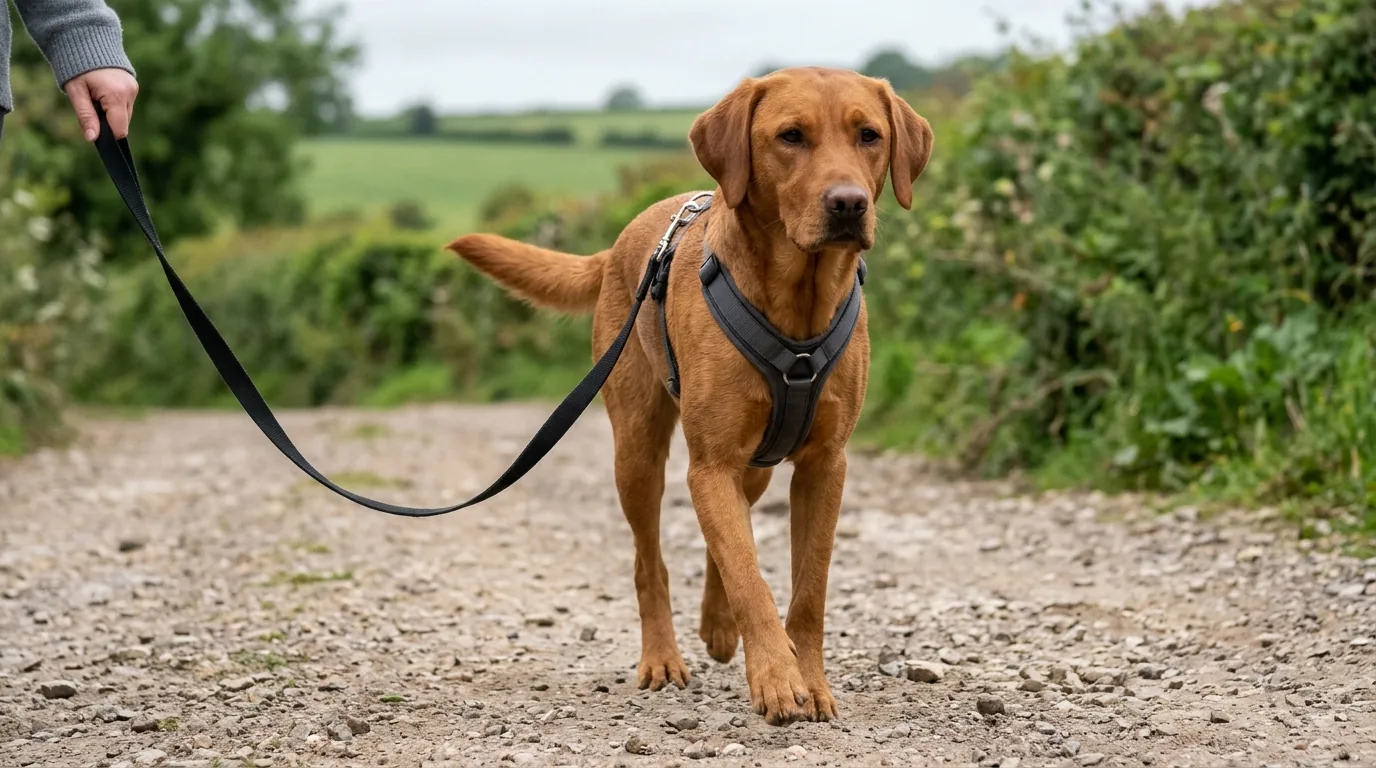
What’s the best dog harness? For most dogs, it’s one whose straps form a Y at the front, that doesn’t tighten when your dog pulls, and that matches your dog’s chest measurement on the maker’s own size chart. Our overall pick is the Ruffwear Front Range, and the Halti Walking Harness is the budget pick.
This guide draws on advice from Dogs Trust and PDSA, the makers’ own size charts and Amazon UK listings. I walk my own Cane Corso, Dexter, in a harness, but these five weren’t tried on him: they were chosen on their design, sizes and availability. Where UK sources say nothing, I’ve said so.
Quick Picks:
Best overall: Ruffwear Front Range: a padded Y-front harness with front and back lead points, sized from 33 to 107cm.
Best budget: Halti Walking Harness: two lead rings, a handle and five points of adjustment for less.
Best for head-shy dogs: DOG Copenhagen Comfort Walk Air 3.0: the neck strap opens, so it doesn’t go over your dog’s head.
Best escape-resistant: Ruffwear Web Master: a three-strap harness with a handle, for dogs that back out of two-strap styles.
Best for puppies and small dogs: EzyDog Chest Plate: a step-in harness with sizes from a 24cm girth.
TABLE OF CONTENTS
What to look for in a dog harness
PDSA recommends walking a dog that pulls on a harness rather than a collar, because it helps stop them hurting their neck. A harness won’t teach your dog to walk nicely on its own, though, and Dogs Trust says the lead walking still needs training. Three things decide whether a dog harness suits your dog.
A Y shape at the front
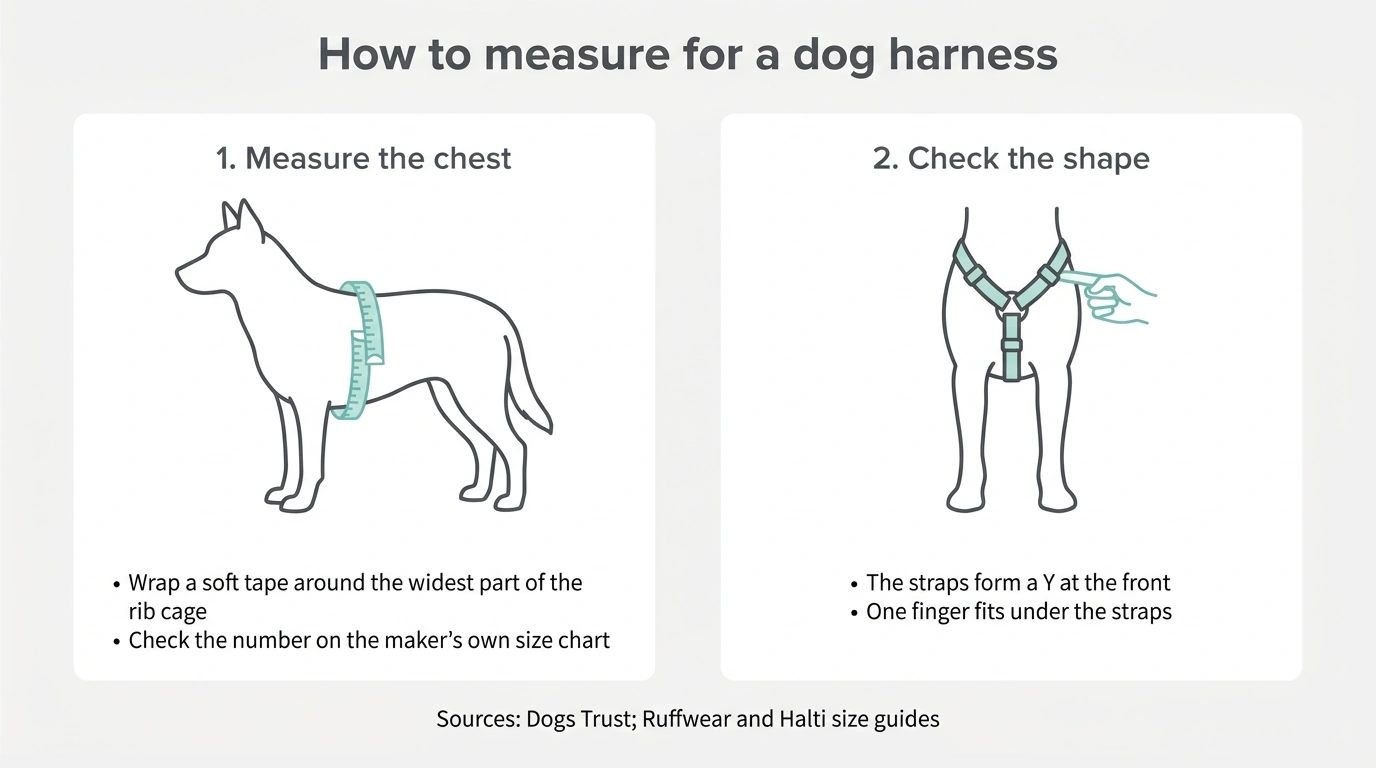
Dogs Trust advises avoiding harnesses that cross directly in front of the shoulders, because they stop the front legs moving naturally. Look at the front of the harness in the maker’s photos: the straps should come down from the neck and meet between the front legs in a Y, rather than running straight across the chest. Vest styles with a wide panel across the chest don’t pass this check, so none are listed here.
Nothing that tightens
The charity also says to avoid harnesses that tighten around the neck or middle, and warns that equipment promising to “cure” pulling can cause pain or discomfort. Every pick on this page stays the same size when the lead goes tight.
A harness that fits
The fit check is simple: you should be able to slide a finger comfortably between the straps and your dog’s body, the harness shouldn’t shift as your dog moves, and your dog shouldn’t be able to slip out of it. For dogs that wriggle free, Dogs Trust says some need a three-strap harness, with an extra strap around the body. Its guide to walking nicely on a lead covers both points.
Before you buy: A harness doesn’t replace the collar and ID tag. Dogs Trust reminds owners that in public your dog still needs a collar with an identity tag, even when you walk them in a harness. Our harness vs collar guide explains what the tag needs to show, and our dog collar picks cover the collar itself.
How to measure your dog for a harness
No UK charity publishes a harness measuring method, so this part comes from the makers. Ruffwear measures around the widest part of the rib cage. Halti’s guide says to place the tape snug around the deepest part of the chest. Both mean a soft tape measure around your dog’s chest at its biggest point.
Sizes don’t match from brand to brand. A 66cm chest is a Small on Ruffwear’s chart, a Medium or Large on Halti’s, and a Medium or Large on DOG Copenhagen’s. So measure first, then check each maker’s own chart rather than buying the size your dog wore in another brand.
If your dog sits between two sizes, follow the maker. Ruffwear says to choose the larger size for the Front Range but the smaller size for the Web Master. EzyDog’s chart lists neck and girth ranges together, so check both measurements for its harness.
Dog harness size calculator
Type your dog’s chest measurement in centimetres and the matching size for four of our picks appears straight away. The sizes come from each maker’s chart as shown on 29 November 2026, so check the chart on the listing before you buy, because makers can change them. The EzyDog Chest Plate isn’t included, because its chart sizes by neck, girth and weight together.
Front rings and dogs that pull
Most of our picks have two places to clip the lead: a ring on the back and one on the chest. The makers describe the back ring for everyday walks and the chest ring for training or for dogs that pull. DOG Copenhagen, for example, describes its chest ring as being “for training purposes”.
A front ring isn’t a fix on its own. Dogs Trust explains that dogs pull because pulling has worked for them before, so the answer is training: stop walking when the lead goes tight, and reward your dog for walking beside you. PDSA’s advice is the same, with treats and patience. Our dog training guide has the full loose lead method.
From our home: Dexter, my Cane Corso, walked on a collar and lead at first, but he pulled, so I moved him to a harness. Now his lead clips to both the front and back rings. The harness goes on for walks and car trips and comes off at home, and he wears a collar with his ID tag on walks.
Puppies, big dogs and Golden Retrievers
Choosing a harness for a puppy
PDSA suggests getting a puppy used to wearing a harness around the house before the first walks. Dogs Trust’s step-by-step method starts with the harness on the floor and a few treats scattered around it, then builds up slowly to doing it up. Puppies grow quickly, so choose a harness with plenty of adjustment and measure again as your puppy grows. The EzyDog Chest Plate starts at a 24cm girth and the Halti Walking Harness at 25cm, according to their charts.
Sizes for large and giant dogs
For a big dog, check the top of each chart first. According to the makers’ charts, EzyDog’s largest Chest Plate fits a girth up to 134cm, DOG Copenhagen’s Comfort Walk Air 3.0 goes up to 115cm, both Ruffwear harnesses to 107cm, and the Halti Walking Harness to 90cm. If your dog’s chest is beyond a maker’s largest size, that harness won’t fit, whatever the listing calls it.
Golden Retriever harness size
PDSA gives an average adult weight of 25 to 34kg for Golden Retrievers, but harness makers size by chest, not by breed or weight, so two Goldens can need different sizes. Measure your own dog and use the calculator above.
How we chose
We looked at the harnesses on the old version of this page, the brands that come up most in UK harness searches, and the makers’ own size charts. Each pick had to pass four checks:
- A Y at the front: judged from each maker’s own photos of a dog wearing the harness. Vest styles and straps straight across the shoulders were left out, following Dogs Trust’s advice.
- Nothing that tightens: no harness that tightens around the neck or body when the lead goes tight.
- Sizes and adjustment: a published size chart, a range that covers most dogs, and straps that adjust at the neck and chest, all from the makers.
- On Amazon UK and in stock: each pick was in stock on Amazon UK when we checked, sold by Amazon or the maker’s own UK seller where possible.
These harnesses haven’t been tested on Dexter. The picks are based on their design, the makers’ specifications and UK availability.
Everyday picks
These two suit most dogs on most walks: one padded, one simpler and cheaper.
Best dog harness overall
1. Ruffwear Front Range

- Y-front design: The straps meet between the front legs, leaving the shoulders free.
- Two lead points: An aluminium V-ring on the back and a webbing loop on the chest.
- Close fit: Four points of adjustment around the neck and body.
- Padded: Foam-padded panels for longer walks.
- Sizes: XXS to L/XL, for chests from 33 to 107cm on Ruffwear’s chart.
Why it’s a top pick: The Front Range does what the charity advice asks for in a simple everyday design. The straps meet in a Y at the chest, nothing tightens, and Ruffwear gives it four points of adjustment for a close fit around the neck and body. You get two places to clip the lead: an aluminium V-ring on the back and a reinforced webbing loop on the chest. Sizes run from XXS to L/XL, covering chests from 33 to 107cm on Ruffwear’s chart, so it suits most dogs.
Specifications:
- Type: Over-the-head, Y-front, foam padded
- Lead points (maker): Back V-ring and chest webbing loop
- Chest sizes (maker): XXS to L/XL, 33–107cm
- Adjustment (maker): Four points
- Best for: Everyday walks for most dogs
✅ Reasons to Buy:
- Two lead points: a back ring for everyday walks and a chest loop for training.
- Close fit: four points of adjustment, according to Ruffwear.
- Padded: foam-padded construction for longer walks, the maker says.
- Seen after dark: reflective trim, plus a loop for a clip-on light.
💡 Good to know before you buy:
- Between sizes: Ruffwear says to choose the larger size for the Front Range.
- Hand wash only: the maker’s care advice is to hand wash in mild detergent and air dry.
❌ Reasons to Avoid:
- No handle on the back, unlike the Web Master.
- Costs more than the budget picks.
📝 Mini Verdict: The one to buy if you want a single, well-made harness for everyday walks. Skip it if your dog backs out of harnesses (the Web Master suits that better) or if you’d rather spend less.
Best budget dog harness
2. Halti Walking Harness

- Y-front design: The straps run down the chest between the front legs.
- Two rings: Clip the lead to the chest or the back.
- Five adjustment points: For a close fit on most dogs.
- Handle: A close-control handle on the back.
- Sizes: XS to L, for chests from 25 to 90cm on Halti’s chart.
Why it’s a top pick: The Halti Walking Harness gives you most of what the Front Range does for a lower price. Its straps form a Y down the chest, it has two lead clip rings, on the chest and the back, and Halti lists five points of adjustment. There’s also a close-control handle on the back for moments when you need your dog right beside you, and 3M Scotchlite reflective strips. Halti calls it lightweight, so it suits owners who prefer a strap harness to a padded one.
Specifications:
- Type: Y-front strap harness
- Lead points (maker): Chest ring and back ring
- Chest sizes (maker): XS to L, 25–90cm
- Adjustment (maker): Five points
- Best for: Everyday walks on a budget
✅ Reasons to Buy:
- Lower price: one of the two lowest-priced harnesses here.
- Two rings: one on the chest and one on the back.
- Handle: a close-control handle on the back.
- Reflective: 3M Scotchlite strips, according to Halti.
💡 Good to know before you buy:
- Largest size: Halti’s Large fits chests up to 90cm, so check the chart before buying for a big dog.
- Sizes overlap: a chest between 48 and 50cm falls in both Small and Medium, so check the fit with the one-finger test when it arrives.
❌ Reasons to Avoid:
- No size for chests above 90cm.
- Fewer extras than the dearer picks: no ID tag point or light loop listed.
📝 Mini Verdict: The sensible choice if you want two rings and a handle without spending much. Look elsewhere if your dog is very large or you’d like padding.
Picks for specific needs
These three solve particular problems: head-shy dogs, dogs that slip out, and puppies or small dogs.
Best harness for head-shy dogs
3. DOG Copenhagen Comfort Walk Air 3.0

- Opens at the neck: An aluminium fitting means it doesn’t go over your dog’s head.
- Two lead points: A back ring for walks and a chest ring for training.
- Four adjustment points: For a close fit.
- ID tag point: A separate ring for a tag, with 3M reflective trim.
- Sizes: XS to XL, for chests from 34 to 115cm on DOG Copenhagen’s chart.
Why it’s a top pick: Dogs Trust notes that harnesses which clip around the neck and body can suit dogs that are a little head-shy. The Comfort Walk Air 3.0 has an aluminium fitting that opens the neck strap, so the harness doesn’t have to go over your dog’s head. The front is Y-shaped, with four points of adjustment, a back ring for everyday walks and a chest ring for training. DOG Copenhagen adds a separate point for an ID tag and 3M reflective trim.
Specifications:
- Type: Clip-open neck, Y-front, padded
- Lead points (maker): Back ring and chest ring
- Chest sizes (maker): XS to XL, 34–115cm
- Adjustment (maker): Four points
- Best for: Dogs that dislike a harness going over the head
✅ Reasons to Buy:
- No over-the-head fit: the neck strap opens with an aluminium fitting.
- Big-dog sizes: the XL goes up to a 115cm chest, on DOG Copenhagen’s chart.
- Easy care: stain and water-repellent materials, the maker says.
- Visible: 3M reflective trim.
💡 Good to know before you buy:
- Washing: DOG Copenhagen says to hand wash it, or machine wash at 30°C in a laundry bag.
- The tag point is a bonus, not a swap: the law still asks for the ID tag on a collar in public, as our harness vs collar guide explains.
❌ Reasons to Avoid:
- Costs more than the budget picks.
- Sizes overlap at the edges (Medium 54–68cm, Large 66–82cm), so a dog near a boundary can fall between two.
📝 Mini Verdict: The pick for a dog that ducks away when a harness comes near its head. If your dog doesn’t mind, the Front Range or Halti do the same job.
Best escape-resistant harness
4. Ruffwear Web Master

- Three straps: An extra strap around the body makes it harder to back out.
- Neck buckle: No pulling it over your dog’s head.
- Padded handle: For steadying your dog when you need to.
- Three lead points: Two on the back and one on the chest.
- Sizes: XXS to L/XL, for chests from 33 to 107cm on Ruffwear’s chart.
Why it’s a top pick: Dogs Trust says some dogs need a three-strap harness, because the extra strap around the body makes it harder for them to wriggle out. The Web Master is exactly that, and Ruffwear calls it “great for houdini dogs”. A neck buckle means it doesn’t have to go over your dog’s head, a padded handle helps when you need to steady your dog, and there are three lead points, including a chest loop. It shares Ruffwear’s 33 to 107cm size range.
Specifications:
- Type: Three-strap, neck buckle, padded
- Lead points (maker): Back V-ring and webbing loop, chest loop
- Chest sizes (maker): XXS to L/XL, 33–107cm
- Adjustment (maker): Four points
- Best for: Dogs that back out of a harness
✅ Reasons to Buy:
- Three straps: an extra strap around the body makes it harder to slip out.
- Neck buckle: no pulling it over the head.
- Handle: a padded handle on the back.
- Seen after dark: reflective trim and a light loop.
💡 Good to know before you buy:
- Between sizes: Ruffwear says to choose the smaller size for the Web Master.
- Hand wash only: the same care advice as the Front Range.
❌ Reasons to Avoid:
- The highest price on this page.
- More straps to adjust, so the first fitting takes longer.
📝 Mini Verdict: Worth the money for a dog that has slipped out of a harness before. For a dog that hasn’t, the Front Range costs less.
Best step-in harness for puppies and small dogs
5. EzyDog Chest Plate

- Step-in fit: Your dog steps in and a two-click clip closes it.
- Foam chest plate: An EVA foam pad that EzyDog says moulds to your dog.
- Waterproof materials: Fast-drying fabric, the maker says.
- Reflective stitching: For walks in low light.
- Sizes: XXS to XXL, for girths from 24 to 134cm on EzyDog’s chart.
Why it’s a top pick: Your dog steps into the EzyDog Chest Plate and you close it with a two-click snap clip, so nothing goes over their head. The chest plate runs down the chest between the front legs, and EzyDog says its EVA foam pad moulds to the dog’s shape. Sizes start at a 24cm girth for the smallest puppies and go up to 134cm, the widest range on this page. It’s made from waterproof, fast-drying materials, according to the maker.
Specifications:
- Type: Step-in, foam chest plate
- Lead points (maker): One D-ring on the back
- Chest sizes (maker): XXS to XXL, 24–134cm girth
- Adjustment (maker): Neck and girth straps
- Best for: Puppies and small dogs
✅ Reasons to Buy:
- Steps in: a two-click snap clip, no over-the-head fit.
- Widest size range: from a 24cm to a 134cm girth.
- Low price: one of the two budget picks.
- Reflective stitching: for low light, the maker says.
💡 Good to know before you buy:
- Check neck and girth together: EzyDog’s sizes overlap a lot (a 60cm girth fits within four of them), so match the neck measurement too.
- Measure again as your puppy grows: see our puppy section above.
❌ Reasons to Avoid:
- Only one lead point, so there’s no chest ring for training.
- A gap in the chart between XL (up to 97cm) and XXL (from 110cm).
📝 Mini Verdict: A good first harness for a puppy or a small dog that dislikes things over its head. If your dog pulls, a two-ring harness gives you more options.
Prices compared
| Harness | Price band | Chest sizes (maker) | Lead points | Best for |
|---|---|---|---|---|
| Ruffwear Front Range | ££ | 33–107cm | 2 | Everyday walks |
| Halti Walking Harness | £ | 25–90cm | 2 | A budget harness |
| DOG Copenhagen Comfort Walk Air 3.0 | ££ | 34–115cm | 2 | Head-shy dogs |
| Ruffwear Web Master | £££ | 33–107cm | 3 | Dogs that slip out |
| EzyDog Chest Plate | £ | 24–134cm | 1 | Puppies and small dogs |
The bands compare these five with each other: £ is the lowest-priced here and £££ the highest. Prices change, so check the listing.
Final Thoughts: Which Dog Harness Should You Buy?
Start with your dog’s chest measurement, then match the harness to the problem you want to solve.
- If you want one harness for most dogs: the Ruffwear Front Range.
- If you’re on a budget: the Halti Walking Harness.
- If your dog hates things going over its head: the DOG Copenhagen Comfort Walk Air 3.0.
- If your dog has slipped out of a harness before: the Ruffwear Web Master.
- If you have a puppy or a small dog: the EzyDog Chest Plate.
A walking harness isn’t the same as a car harness: our dog car travel guide covers seat belts and crash-tested harnesses.
Frequently Asked Questions About Dog Harnesses
Which type of dog harness is best?
For most dogs, a harness whose straps form a Y at the front and that doesn’t tighten. Dogs Trust advises avoiding harnesses that cross directly in front of the shoulders or tighten around the neck or middle. After that, the best one is the one that fits your dog’s chest on the maker’s own chart.
Which dog harness do vets recommend?
UK vet charities don’t recommend a brand. PDSA recommends walking a dog that pulls on a harness rather than a collar, to help protect their neck, and nothing painful such as a choke collar. Dogs Trust’s advice is a comfortable harness that suits your dog’s shape and doesn’t restrict their movement.
Are no-pull harnesses bad for dogs?
Some can be. Dogs Trust warns that equipment promising to cure pulling can cause pain or discomfort, and advises avoiding harnesses that tighten around the neck or middle. A harness with a chest ring that doesn’t tighten is different, but it works best alongside loose lead training.
How do I know what size harness my dog needs?
Measure around your dog’s chest at its widest point with a soft tape, then check that number on the maker’s own chart, because sizes differ between brands. If your dog sits between two sizes, follow the maker: Ruffwear says to go larger for the Front Range but smaller for the Web Master.
What is the best harness for a puppy?
A light, adjustable harness that fits now and can be let out as your puppy grows. Our pick is the EzyDog Chest Plate, a step-in harness whose sizes start at a 24cm girth. PDSA suggests letting a puppy wear the harness around the house before the first walks.
Can I use a walking harness in the car?
Only if the maker says it’s designed for the car. The Highway Code says dogs should be suitably restrained in a vehicle, and walking harnesses aren’t built or tested for that unless the maker says so. Our dog car travel guide explains seat belts, car harnesses and other options.
