
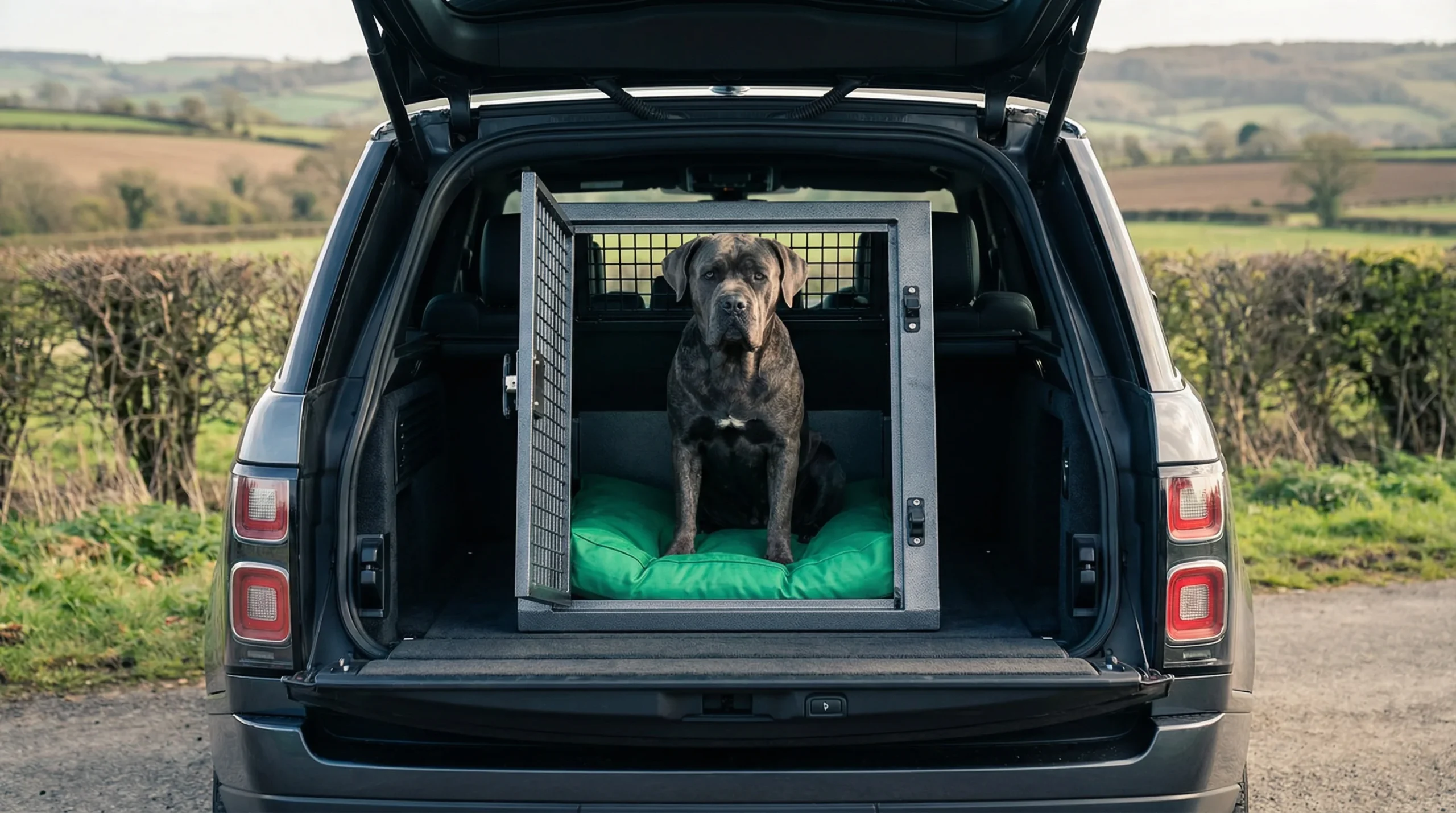
Dog car travel is not just about convenience — it is a legal, safety, and welfare responsibility for every UK dog owner. Whether you’re heading to the vet, taking a motorway journey, or driving to the coast, travelling incorrectly can put your dog, your passengers, and other road users at risk.
This guide covers what the law actually requires, which restraint claims you can trust, and what changes when your dog is a large or powerful breed — the part most dog car travel guides skip entirely.
TABLE OF CONTENTS
Why Dog Car Travel Safety Matters
Dog car travel safety is about impact protection, driver focus, and animal welfare, not comfort alone.
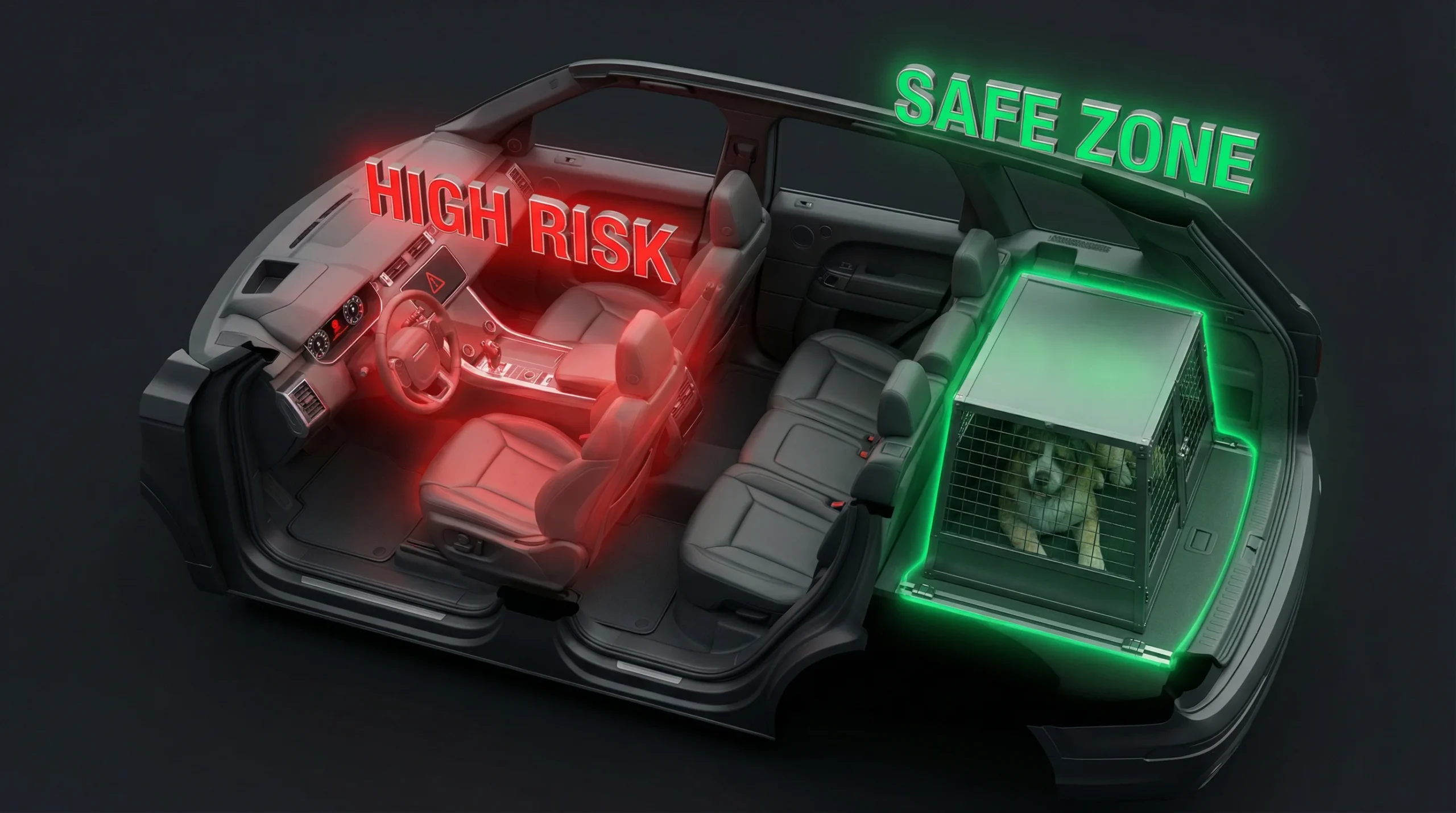
An unsecured dog can become a projectile in a sudden stop or collision. Even at low speeds, the forces involved can seriously injure the dog and the people in the car. A loose dog is also a leading cause of driver distraction, which contributes to a significant share of UK road accidents.
Beyond collisions, a poor dog car travel setup can cause:
- Heat stress from poor ventilation
- Escape risk when doors or the boot open
- Anxiety and motion-related stress
- Insurance complications after an accident
Safe dog car travel protects everyone in the vehicle, not just the dog.
UK Dog Car Travel Laws and Rules
Dog car travel in the UK is governed by the Highway Code, and getting it wrong carries real legal and financial consequences.
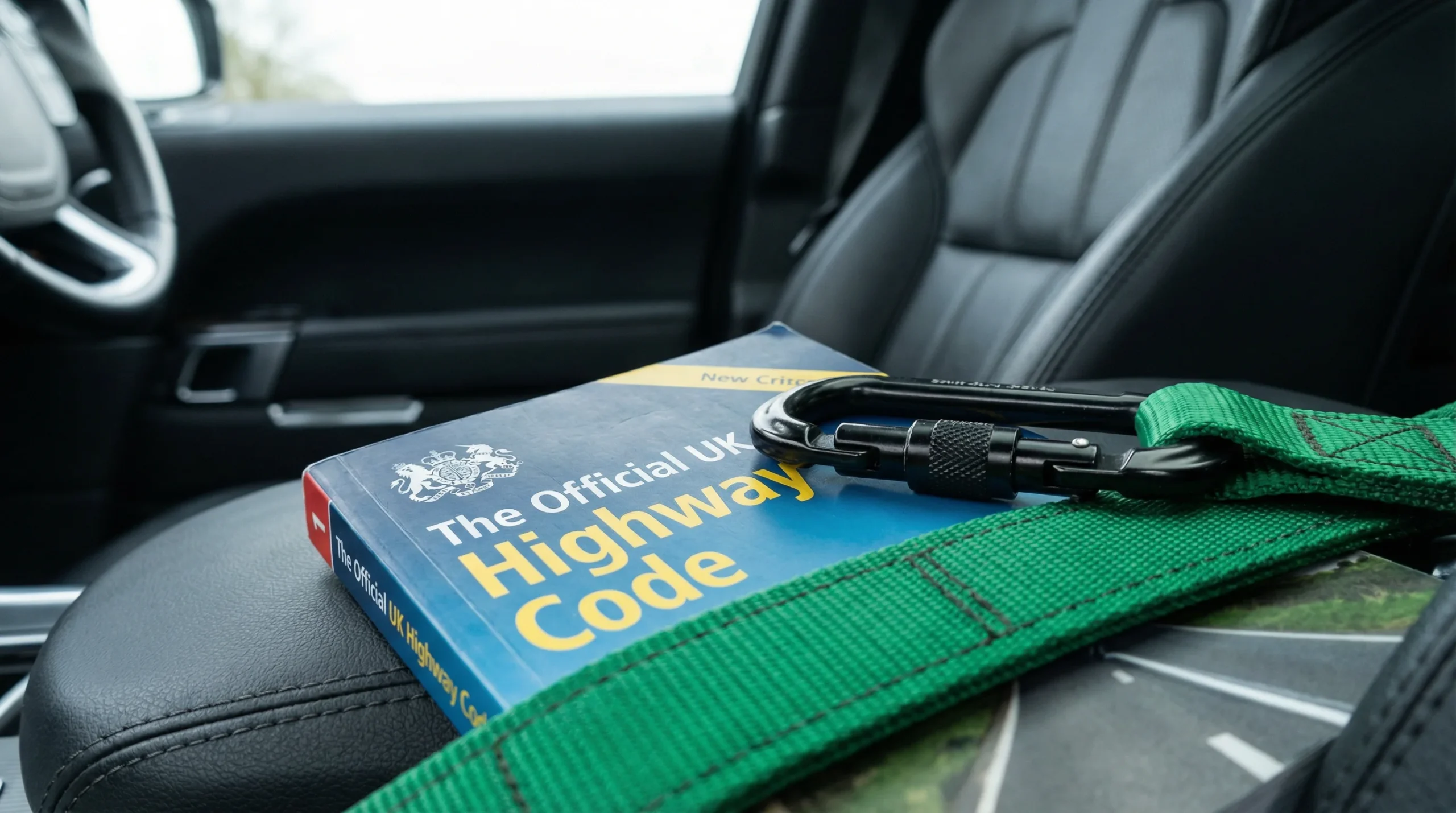
What the Highway Code says
Rule 57 of the Highway Code states that dogs must be suitably restrained when travelling in a vehicle so they cannot distract the driver or cause injury. This applies to cars, vans, and motorhomes. Valid restraint includes:
- A dog harness attached to a seatbelt
- A dog crate secured in the boot
- A fixed dog guard separating the boot from the cabin
There is no single “approved” restraint type in UK law — the requirement is that the dog is effectively restrained, not that it wears a specific product.
Legal consequences of an unsecured dog
If a dog isn’t properly restrained:
- You can be fined up to £5,000
- You may receive penalty points
- Your insurance may be invalidated after an incident
The “Crash-Tested” Problem
Here’s something almost no UK dog car travel guide tells you plainly: “crash-tested” is not a regulated term in the UK, and it means very different things depending on who’s using it.
In the US, the Center for Pet Safety independently crash-tests dog harnesses and crates against a published protocol — and has found that a large share of products marketed as “crash-tested” fail under real test conditions. There is no equivalent independent UK or EU certification body for dog restraints. Some manufacturers test against automotive child-restraint standards (like the US FMVSS 213 standard), which is a genuine, verifiable benchmark. Others use “crash-tested” as pure marketing language with no published methodology, no named testing facility, and no way to check the claim.
What to actually check before you trust a “crash-tested” claim:
- Is a specific standard named (FMVSS 213, ECE, ISO)? Vague phrases like “safety tested” or “impact resistant” aren’t standards.
- Is a testing facility or research institute named?
- Is there a published weight limit the product was tested to — and does your dog fall under it?
If a listing can’t answer these, treat the product as a containment aid, not a certified crash restraint. That’s not necessarily a dealbreaker — a well-fitted containment crate still meets the legal Rule 57 requirement and stops your dog becoming a projectile — but it’s an honest distinction worth knowing before you pay a premium for “safety” branding.
Harnesses vs Crates vs Guards: Which Restraint Is Right?
There’s no universal answer — the right option depends on your dog’s size, temperament, and how often you travel.
| Restraint type | Best for | Strengths | Limitations |
|---|---|---|---|
| Harness + seatbelt tether | Small–medium dogs, back-seat travel, short–moderate journeys | Easy to use, lets the dog sit or lie down, works in any car | Genuine crash protection varies hugely by product; many aren’t rated for larger/stronger dogs |
| Boot crate | Medium–large dogs, long journeys, dogs prone to anxiety | Excellent containment, reduces driver distraction, suits regular travel | Needs correct sizing and enough boot space; few options are independently crash-rated |
| Dog guard | Any dog already comfortable loose in the boot | Cheap, quick to fit, satisfies Rule 57 | Stops the dog reaching the cabin — doesn’t protect the dog itself in an impact |
If you travel with a larger breed, sizing is critical — see our guide on what size crate a Golden Retriever needs for how incorrect sizing can be nearly as dangerous as no restraint at all. And if you’re unsure whether a harness or collar belongs in a car at all, this comparison of dog harness vs collar explains why collars should never be used for car restraint — the neck simply can’t absorb that kind of force.
The safest setup is the one that prevents movement during a sudden stop while keeping your dog calm and well-ventilated — not the one with the most impressive-sounding marketing.
How Your Setup Changes as Your Dog Grows
If you’ve just brought a puppy home, the setup that works now almost certainly won’t be the one you’re using in a year — especially with a large breed. Here’s how that played out with my own dog, Dexter, a Cane Corso who’s now 4.5 years old and a stable 40 kg.
As a puppy: harness and seatbelt in the back seat
When Dexter was young, he travelled in the back seat on a waterproof dog car seat cover, restrained with a dog seatbelt harness that clips into the existing seatbelt buckle. This mattered because, like a lot of puppies, he’d try to climb forward toward the front seats — which is exactly the kind of movement Rule 57 is designed to prevent, since a dog leaning into the footwell or over a shoulder is a genuine driving hazard. A simple clip-in tether solved it, and it’s the setup I’d point most new owners toward: cheap, works in almost any car, and easy to fit correctly without tools.
As an adult: loose in the boot behind a guard
Now that Dexter’s fully grown, the setup has changed. He travels in the boot of my GLC behind a mesh dog guard — but without a harness tie-down. For the boot floor, I’ve actually been repurposing the same KYG back-seat cover, tying its clips around the metal headrest bars to keep it roughly in place — which works, but it’s a back-seat product being pressed into a job it wasn’t designed for. A purpose-built boot liner — with tightening straps and side protection actually made for the boot shape — is the setup I’d point readers toward rather than copying my shortcut.
Two honest reasons there’s no harness tie-down: there’s no accessible seatbelt anchor point in that section of the boot, and a 40 kg Cane Corso is at or beyond the tested weight limit of most car harnesses on the market anyway (see the “crash-tested problem” section above). He sits or lies down normally and stays settled. I also drive noticeably more cautiously — gentler braking, more following distance — knowing he’s back there loose.
Is that actually legal and safe?
Legal: yes. A dog guard that securely separates the boot from the cabin is explicitly one of the three restraint methods Rule 57 recognises — the other two being a harness-and-seatbelt or a secured crate. A properly fitted guard satisfies the legal requirement on its own; you don’t also need a tie-down for the setup to be compliant.
Safety: it’s a genuine trade-off, not a loophole. The guard does the job Rule 57 cares about most — stopping the dog reaching the cabin and distracting the driver. What it doesn’t do is stop the dog being thrown around within the boot space itself during a sudden stop, since nothing’s anchoring him in place. Driving more cautiously is a sensible habit and it does lower the odds of ever needing to find out — but it’s worth being clear that it’s a personal risk-reduction habit, not a substitute for restraint, and it doesn’t change the physics of what happens if another driver hits you from behind.
If your boot has any cargo tie-down loops (common in estates and SUVs, separate from seatbelt anchors), a boot-specific tether clipped to one of those — rather than a seatbelt harness — is worth checking for, as it can add a genuine anchor point even where a seatbelt-style harness has nowhere to attach.
Recommended Gear
For puppies and back-seat setups
IOKHEIRA Dog Seat Belt for Car (seatbelt-buckle, ISOFIX & LATCH compatible)

- Multi-Point Fitting: Connects to the front or rear seatbelt buckle, the ISOFIX child-seat socket, or the boot’s LATCH point.
- Reinforced Nylon Strap: 1.9mm-thick, 25mm-wide webbing built to resist wear over repeated use.
- High-Tension Hook: Aluminium alloy carabiner rated to withstand significant pulling force before releasing.
- Energy-Absorbing Buffer: Built-in shock absorption reduces the jolt transferred to the dog during sudden stops.
- Free-Rotating Clip: Swivels to stop the lead twisting or knotting as the dog moves.
This is the one we used for Dexter as a puppy, clipped straight into the back-seat seatbelt buckle. It’s an Amazon’s Choice listing and, as of this research, showing new from around £8.49 — genuinely the easiest, cheapest way for a new owner to get a compliant back-seat setup with no tools and no measuring.
KYG Dog Car Seat Cover / Hammock (back seat, with door protection)

- Multi-Layer Waterproofing: Oxford 600D, PVC, PP cotton and Oxford 210D layers, sealed with air-pressure stitching to keep moisture out.
- Seatbelt-Ready Cut-Outs: Pre-cut openings for seatbelt anchors so a harness tether still works underneath.
- Mesh Visual Window: Keeps sightline and airflow open between the front and back seats.
- Side Door Flaps: Extends protection up the door panels against scratches and muddy paws.
- Built-In Storage Pocket: Somewhere to stash toys or travel accessories on the go.
The one we used for Dexter’s puppy stage in the back seat — a waterproof hammock-style cover with side door flaps and a mesh viewing window, built with pre-cut openings for seatbelt anchors so it doesn’t interfere with fitting a harness tether underneath. Amazon’s Choice, seen at ~£25.99 new during this research. This is a back-seat product specifically — for the boot, see the dedicated boot liner below rather than repurposing this one.
Kurgo Impact Dog Car Harness (X-Large)

- Independently Crash Tested: Tested at an established university facility to the US FMVSS 213 child-restraint standard.
- Higher Weight Capacity: The Extra Large size covers substantially bigger dogs than the standard Large, giving more headroom for large and giant breeds.
- Single-Piece Webbing: One continuous length of tubular webbing with reinforced bar tacking for strength.
- Steel Nesting Buckles: Metal buckles rather than plastic clips, built for higher failure loads.
- Direct Seatbelt Integration: Clips straight into the existing vehicle seatbelt, no extra hardware needed.
For owners who want a harness with a named, checkable crash-test standard rather than just a seatbelt clip: tested at an independent facility to the US FMVSS 213 protocol (the same standard used for child restraint systems), using simulated crash-test dogs. Single-piece tubular webbing, steel nesting buckles, four adjustment points.
For adult and large dogs travelling in the boot
RAC Advanced Mesh Dog Guard

- Steel Alloy Construction: Durable frame with a non-toxic, rust-resistant powder coating.
- Tool-Free Headrest Fitting: Clamps directly onto the rear headrests — no drilling or tools required.
- Adjustable Universal Fit: Width-adjustable to suit most hatchbacks, estates and SUVs.
- Mesh Ventilation Panels: See-through mesh keeps the dog visible and well-ventilated, unlike a solid barrier.
- Rule 57 Compliant: Creates a secure boot-to-cabin barrier recognised as valid restraint under UK law.
This is the guard we actually use for Dexter in the boot of the GLC. From a recognisable UK motoring brand, it’s headrest-mounted, needs no tools to fit, and adjusts to most boots. It satisfies Rule 57 on its own by keeping the dog out of the cabin — but as covered above, it doesn’t protect the dog from being thrown around within the boot itself, so pair it with a tie-down where your car has an anchor point for it.
JOEJOY Car Boot Protector / Liner (with tightening straps and side protection)

- Adjustable Tightening Buckles: Cinches the liner taut so it doesn’t shift or bunch up over bumps.
- 10-Point Velcro Fastening: Side fastenings anchor the liner to the boot lip and walls.
- Non-Slip Base: Adhesive grip dots on the underside stop the liner sliding around.
- Bumper & Side Protection: Raised side panels shield the boot’s paintwork and bumper edge from scratches.
- Waterproof & Easy-Clean: 185×105cm antifouling fabric wipes clean of mud, hair and stains.
A purpose-built boot liner rather than a repurposed back-seat cover — waterproof, with safety buckles to tighten it in place and side/bumper protection panels, at 185×105cm. This is the setup we’d actually recommend over the back-seat-cover workaround described above.
Pet World XL 38″ Sloped Car Dog Crate (Hatchback/Estate/4×4 fit)

- Sloped Design: Purpose-built for angled boot spaces — fits without blocking the tailgate or touching the rear window.
- Bolt-Locked Sliding Door: Secure sliding front access that resists accidental openings in transit.
- Emergency Escape Hatch: Top-mounted hatch for added peace of mind if something goes wrong.
- High-Carbon Steel Frame: Lightweight but impact-resistant, powder-coated against rust.
- Folds Flat: Collapses for easy storage between trips and comes with a free comfort mat.
UK-designed, high-carbon steel, sloped profile built to use angled boot space without blocking the tailgate — genuinely sized for large breeds (97.5 cm width) rather than the small-to-medium crates most “car boot crate” searches surface. Comes with an emergency escape hatch and folds flat. Not independently crash-tested (see the honesty note above) — it’s a solid containment crate, not a certified crash restraint.
Common mistakes to avoid when travelling with a dog
Many dog car travel issues come from well-meaning but unsafe habits:
- Allowing dogs to sit on laps
- Using untested seatbelt clips
- Letting dogs roam between seats
- Using crates that are too large or left unsecured
- Ignoring ventilation in the boot area
Most accidents happen close to home, not on long trips — so “it’s just a five-minute drive” is exactly the journey most likely to catch an unrestrained dog out.
Frequently Asked Questions
Can dogs sit in the front seat of a car in the UK?
Yes, it’s legal, but not recommended. If a dog must travel in the front, disable the passenger airbag and push the seat as far back as possible — an active airbag can cause serious injury to a dog in a collision. Always use a harness and seatbelt restraint so the dog can’t interfere with the gear stick or steering wheel.
Is it illegal to leave a dog in a car in the UK?
There’s no specific law banning it outright, but it becomes a criminal offence under the Animal Welfare Act 2006 if the dog suffers or falls ill from heat or dehydration as a result. Police can break into a car if they see a dog in distress. In warm weather, a car’s interior can become fatal to a dog within minutes, even with windows cracked open.
How often should I stop when travelling with a dog?
On long journeys, aim to stop every 2–3 hours for water, toileting, and a stretch. Puppies and senior dogs may need stops every 1–2 hours. Regular breaks also reduce motion sickness and anxiety. Dog enrichment toys can help settle a dog during the drive itself.
Are all dog seat belts universal?
Most use a “universal” clip that fits the majority of UK vehicles, but not every model — some cars (Volvo among them) need specific adapters. Check the manufacturer’s compatibility list, or choose a restraint that loops around the headrest instead of clipping into the seatbelt buckle.
Does a dog guard count as a restraint?
Yes — a guard that securely separates the boot from the cabin satisfies the legal requirement. It stops the dog distracting the driver, but on its own it doesn’t protect the dog from injury in a crash. For genuine crash protection, pair a guard with a properly rated harness or crate rather than relying on the guard alone.
Can I put a dog crate on the back seat?
Yes, smaller crates or carriers can be secured on the back seat using the car’s seatbelt. However, the crate must be strapped in securely to prevent it from sliding or tipping during a turn. Large crates should always go in the boot or be placed in the rear footwell (for very small carriers) to minimise movement.
Do I need a “Dog on Board” sticker?
Not legally required, but emergency services often recommend one — it alerts first responders to an animal in the vehicle after a crash, which can save time during a rescue.
What crash-test standard should I actually look for?
For harnesses, look for a named standard (FMVSS 213 is the most common credible one on UK-available products) plus a stated tested weight limit. For crates, independent crash certification is rare in the UK market — treat “crash-tested” claims with the checklist above, and don’t assume a product is certified just because the word appears in the title.
