
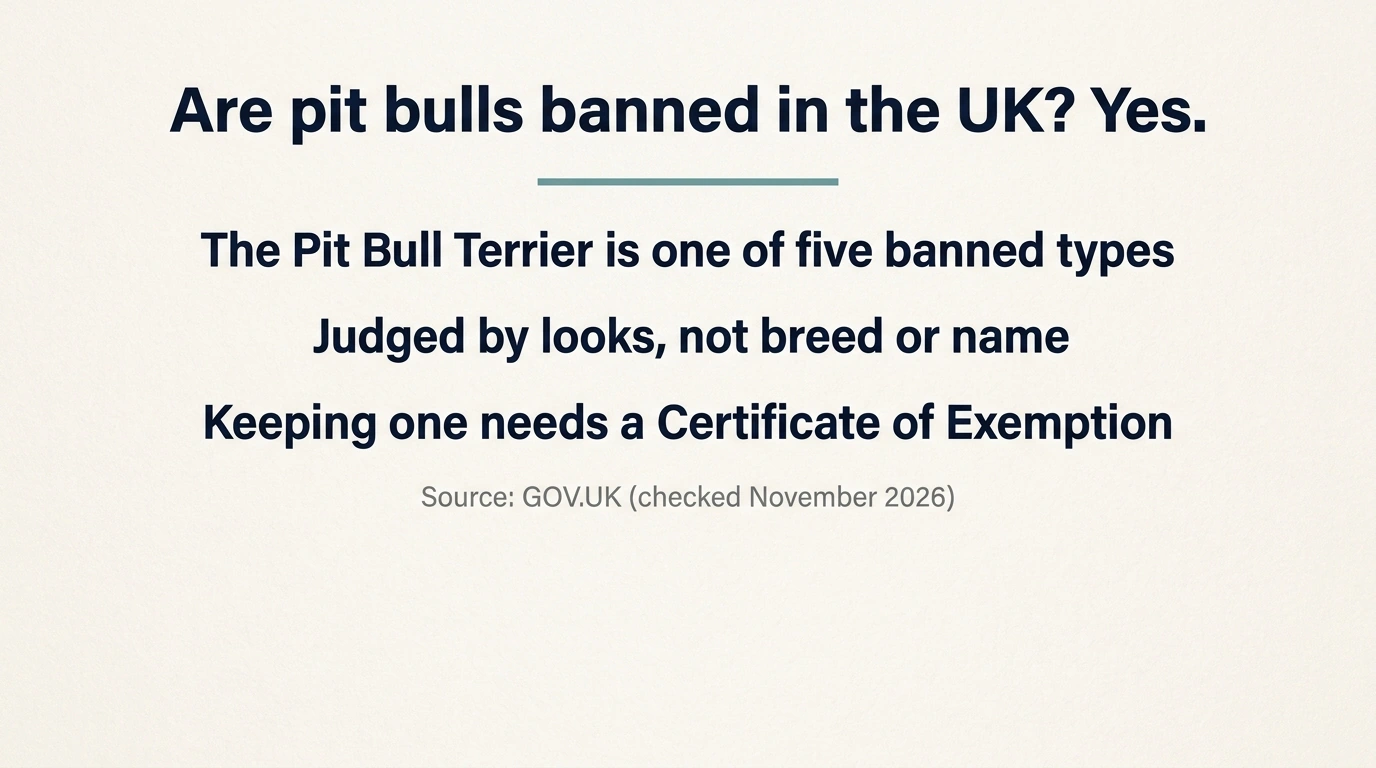
Are pitbulls banned in the UK? Yes. The Pit Bull Terrier is one of five banned types of dog, and GOV.UK judges whether a dog is a banned type by what it looks like, rather than its breed or name. The ban is still in force, and a banned dog can only be kept with a Certificate of Exemption.
This guide draws on GOV.UK, legislation.gov.uk, mygov.scot, nidirect and the Royal Kennel Club. It’s general information, not legal advice: if your own dog is affected, start with GOV.UK or speak to a solicitor.
TABLE OF CONTENTS
The pit bull ban in UK law
In the UK, it’s against the law to own certain types of dog. GOV.UK’s guidance on banned dogs names five: the Pit Bull Terrier, the Japanese Tosa, the Dogo Argentino, the Fila Brasileiro and the XL Bully. Our list of banned dog breeds in the UK covers all five.
It’s also against the law to sell, abandon, give away or breed from a banned dog.
GOV.UK is clear that the name on a dog doesn’t decide the question: “Whether your dog is a banned type depends on what it looks like, rather than its breed or name.” It gives the Pit Bull Terrier as its example: “if your dog matches many of the characteristics of a Pit Bull Terrier, it may be a banned type.”
Is the pit bull ban still in force?
Yes. GOV.UK sets out the ban in the present tense, and the law behind it, the Dangerous Dogs Act 1991, has been fully in force since 12 August 1991, according to legislation.gov.uk. Section 1 of the Act, which covers the banned types, is headed “Dogs bred for fighting”.
You may come across articles saying the ban has been lifted or is about to be. GOV.UK’s guidance is the current law, and it still lists the Pit Bull Terrier as a banned type.
Pitbull, pit bull or American Pit Bull Terrier: does the name matter?
UK law bans the Pit Bull Terrier as a type of dog, not as a registered breed. The Royal Kennel Club’s Breeds A to Z doesn’t list a Pit Bull Terrier or an American Pit Bull Terrier, so there’s no UK breed register to settle the question either way.
That means the name a dog is sold or registered under, whether “pitbull”, “pit bull”, “American Pit Bull Terrier” or something else, doesn’t decide whether it’s a banned type. What it looks like does, and a police or council dog expert makes that judgement. The same goes for crossbreeds: because the rule is about looks rather than breeding, a dog of mixed breeding isn’t automatically outside it.
A few neighbouring names cause confusion. The Staffordshire Bull Terrier is a Royal Kennel Club breed and isn’t a banned type: our Pitbull vs Staffy guide explains why. The American Bulldog isn’t one of the five named types either, as our Pitbull vs Bulldog guide sets out. The XL Bully is a separate banned type, covered in our banned list guide above. And for a large breed that isn’t banned, see our Cane Corso vs Pitbull guide.
If a dog is seized as a suspected pit bull type
How a dog’s type is judged
If the police or a council dog warden believe a dog is a banned type, they can take it away and keep it, even if it isn’t acting dangerously and nobody has complained. They may need permission from a court to do this. In a public place they don’t need a warrant; in a private place they do, although a warrant for something else, such as a drugs search, also lets them seize the dog.
GOV.UK says a police or council dog expert will judge what type of dog it is and whether it is, or could be, a danger to the public. The dog is then either released or kept in kennels while the police or council apply to a court. Owners aren’t allowed to visit their dog while they wait for the court’s decision.
Going to court
In court, GOV.UK puts the burden on the owner: “It’s your responsibility to prove your dog is not a banned type.” If you prove it, the court orders the dog to be returned. If you can’t, or you plead guilty, you’ll be convicted.
The penalty for having a banned dog against the law is an unlimited fine, up to 6 months in prison, or both, and the dog will be destroyed. However, if the court thinks the dog isn’t a danger to the public, it may issue a Contingent Destruction Order, which lets the owner apply for a Certificate of Exemption.
Before you give up a dog: GOV.UK says you can give up ownership of a seized dog, but you can’t be forced to. If you do, your dog could be destroyed without you even going to court.
Keeping a pit bull type legally: the Certificate of Exemption
A Certificate of Exemption lets you keep a banned dog as long as it doesn’t behave dangerously and you follow certain rules. GOV.UK says it’s valid for the life of the dog.
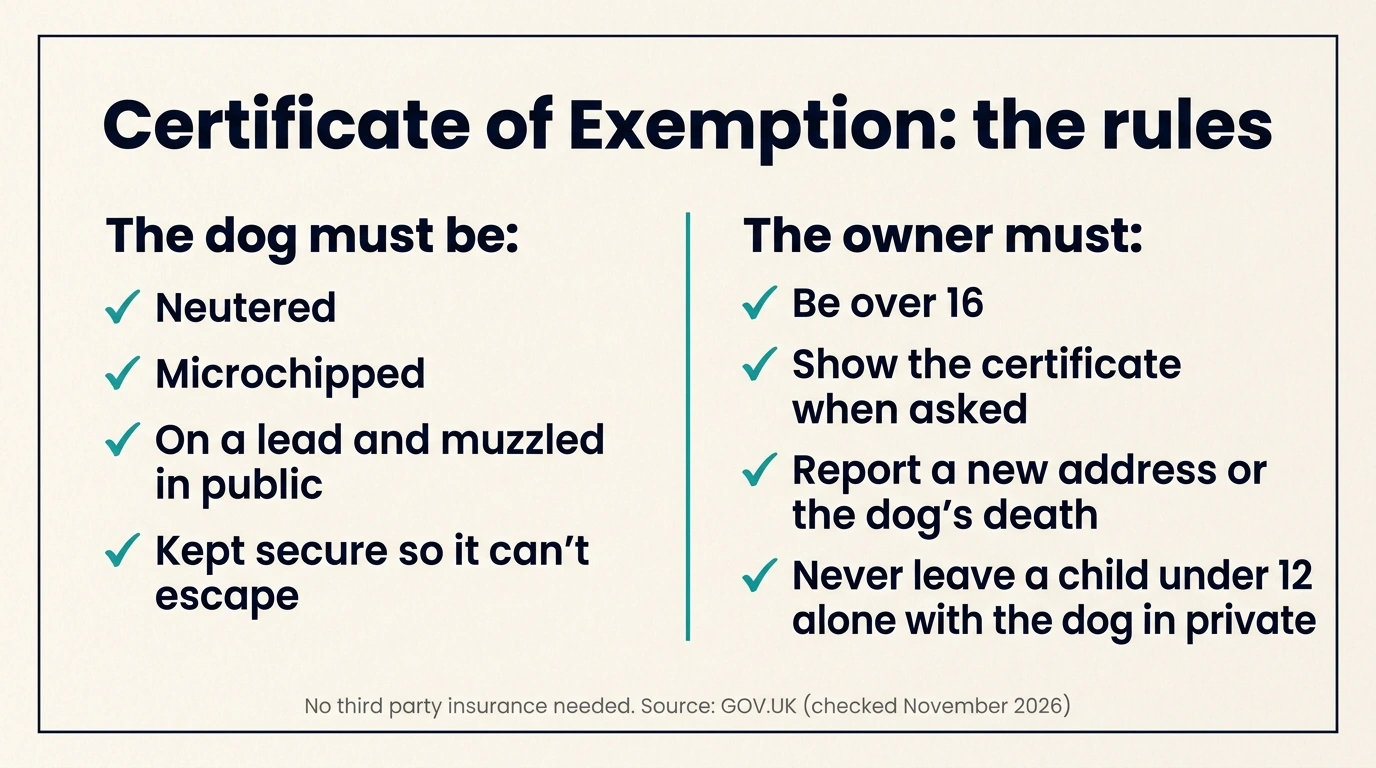
The dog must be:
- neutered
- fitted with a microchip
- kept on a lead and muzzled at all times when in public
- kept in a secure place so it can’t escape
As the owner, you must:
- be aged over 16
- show the Certificate of Exemption when a police officer or council dog warden asks, either at the time or within 5 days
- let the Index of Exempted Dogs know if you change address, or if your dog dies
Insurance is no longer required
GOV.UK’s guidance now says: “You do not need third party public liability insurance for banned dogs.” Every other condition listed above still applies.
Good to know: Older guides, including some still online, say third party insurance is compulsory for exempted dogs. GOV.UK’s current guidance says you do not need third party public liability insurance for banned dogs, so check GOV.UK before relying on an older article.
The 2026 rule on children under 12
From 1 November 2026, you must not leave a child under 12 in close contact with a banned dog in a private place, such as a home or garden, without adult supervision. Defra has published guidance on keeping children safe around banned breed dogs in the home, which GOV.UK links from its banned dogs page.
Pit bull law in Scotland and Northern Ireland
Scotland. mygov.scot lists the same five types and says it’s a crime to keep one without a valid Certificate of Exemption. For the rules on banned breeds, it points owners to GOV.UK.
Northern Ireland. nidirect lists the same five types. It says a dog that a council dog warden identifies as banned will be presumed to be so unless the owner can prove in court that it isn’t. An owner of a seized Pit Bull must tell the court at least 14 days before the hearing if they plan to give evidence that the dog isn’t a banned type.
In Northern Ireland, a court can make a “contingent destruction order” if it believes the dog wouldn’t be a danger to the public under strict conditions. As well as rules similar to GOV.UK’s, those conditions include making the dog available for inspection by council dog wardens and telling the council about a move, the dog’s death or its export. Owners then apply for a dog licence from the council.
Pit bull law across the UK at a glance
| England and Wales | Scotland | Northern Ireland | |
|---|---|---|---|
| Pit Bull Terrier type banned | Yes | Yes | Yes |
| Official guidance | GOV.UK | mygov.scot (points to GOV.UK) | nidirect |
| How a dog can be kept | Certificate of Exemption after a court decision | Valid Certificate of Exemption | Contingent destruction order, then a council dog licence |
Sources: GOV.UK banned dogs guidance; mygov.scot; nidirect (checked November 2026).
Every dog: the dangerously out of control offence
The banned list isn’t the only dog law that matters. It’s against the law to let any dog be dangerously out of control anywhere, including in a public place, in a private place such as a neighbour’s garden, and in your own home.
GOV.UK says a dog is dangerously out of control if it injures someone or makes someone worried that it might injure them. A court can also decide a dog is dangerously out of control if it attacks someone’s animal, or if the animal’s owner thinks they could be injured trying to stop the attack.
The penalty is an unlimited fine, up to 6 months in prison, or both, with heavier penalties if someone is hurt: up to 5 years if your dog injures someone, up to 14 years if it kills someone, and up to 3 years if it injures an assistance dog. If you’re worried about a dog, here’s how to report a dangerous dog, and our guide to the Dangerous Dogs Act 1991 covers the Act itself.
Why this guide doesn’t say what a pit bull type looks like
GOV.UK leaves the question of type to an expert’s judgement of how a dog looks, and an owner has to prove in court that their dog isn’t a banned type. There’s also no UK breed standard, charity breed guide or vet study for the Pit Bull Terrier type to describe it from.
So nothing on this page is meant to help anyone decide whether a particular dog is a pit bull type. If you’re unsure about your own dog, GOV.UK’s banned dogs guidance is the place to start. For breeds that aren’t banned, browse our breed guides.
Frequently Asked Questions
Has the UK lifted its pit bull ban?
No. GOV.UK still lists the Pit Bull Terrier as one of five banned types of dog in the UK, and the Dangerous Dogs Act 1991 is still in force. Owning one is only legal with a Certificate of Exemption, which comes with strict lifelong rules for both the dog and its owner.
Does the ban cover American Pit Bull Terriers?
UK law bans the Pit Bull Terrier as a type, judged by what a dog looks like rather than its breed or name. So a dog described as an American Pit Bull Terrier isn’t outside the ban because of its name: a police or council dog expert judges its type, and a court decides.
Can a pit bull cross still be a banned type?
Yes, it can. GOV.UK says a dog’s type depends on what it looks like, rather than its breed or name, so mixed breeding doesn’t by itself take a dog outside the ban. If a dog is seized, it’s up to the owner to prove in court that it isn’t a banned type.
Do I have to prove my dog isn’t a pit bull type?
If your dog is seized and the case goes to court, yes. GOV.UK says it’s the owner’s responsibility to prove the dog isn’t a banned type. If you can’t, you’ll be convicted, although the court can still let you apply for an exemption if it thinks the dog isn’t a danger to the public.
Do exempted dogs need third party insurance?
No. GOV.UK says you do not need third party public liability insurance for banned dogs, although older guides may still say otherwise. The other conditions still apply: the dog must be neutered, microchipped, kept on a lead and muzzled in public, and kept somewhere secure so it can’t escape.
