
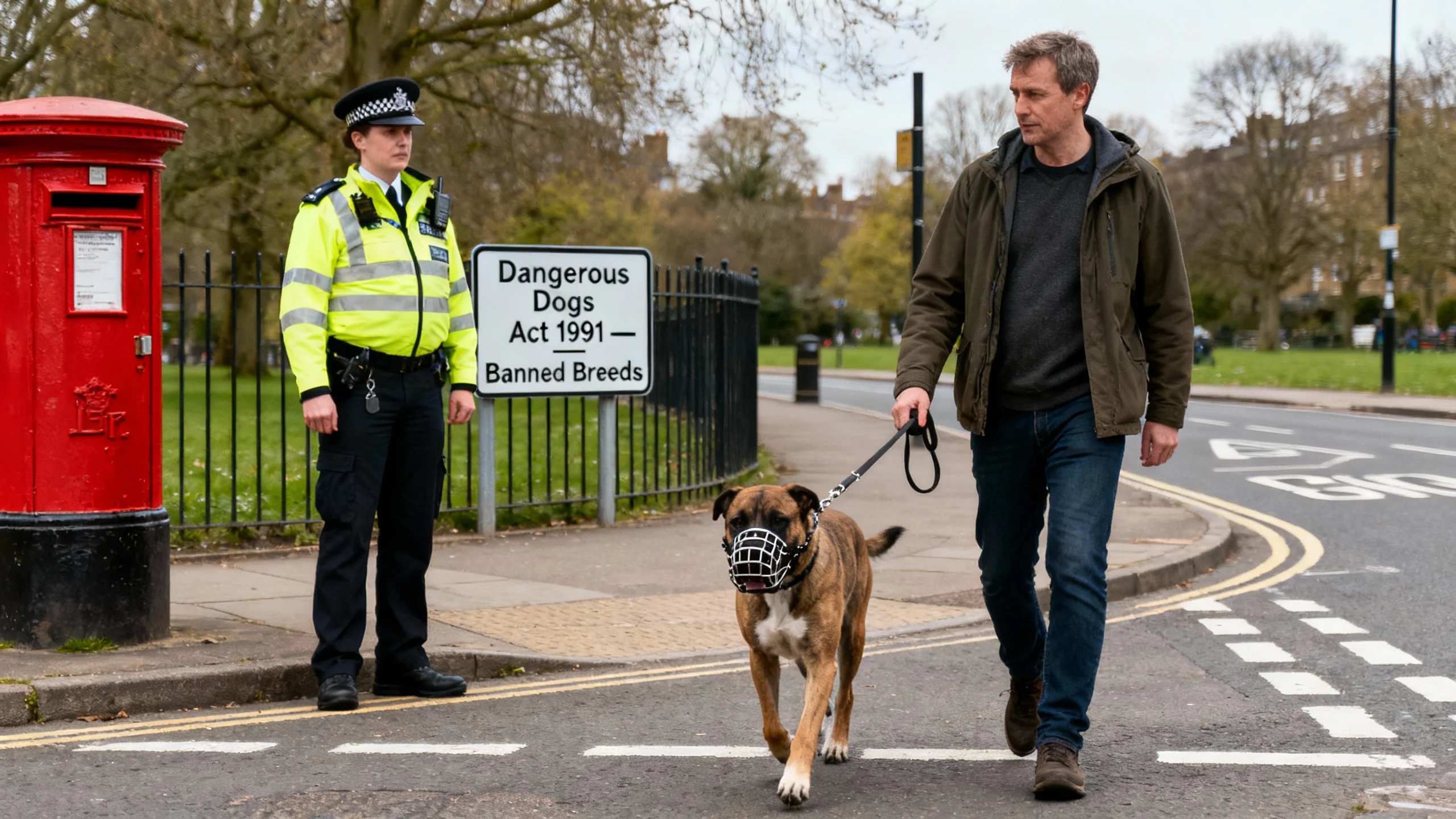
The Dangerous Dogs Act 1991 (DDA) remains one of the most controversial and heavily debated animal-related laws in the United Kingdom. Originally introduced to curb a rise in severe dog attacks, the Act continues to shape ownership rules, enforcement powers, and public attitudes toward specific dog breeds. As of February 2026, concerns around fairness, effectiveness and breed-specific legislation (BSL) have intensified—especially following the recent inclusion of the XL Bully.
If you want to understand wider public-safety rules for pet owners, see our guide on Dog Leash Laws in the UK.
TABLE OF CONTENTS
Background: Why the Dangerous Dogs Act UK Was Introduced
The Dangerous Dogs Act was passed on 25 July 1991 and fully enforced by 12 August 1991 after several high-profile dog attacks drew national attention.
Passed in July 1991 and fully enforced by August, the 1991 Dangerous Dogs Act responded to prominent attacks by banning ownership of certain fighting breeds and those considered threats to public safety. The Act specifically targets certain “types” of dogs rather than recognised kennel club breeds. This is why many people confuse Staffordshire Bull Terriers with Pitbull-type dogs, a topic we explain in detail in our Pitbull dog vs Staffy comparison.
Original banned breeds under Section 1:
Under the Dangerous Dogs Act, the UK currently recognises several banned dog breeds, originally identified as fighting or high-risk types.
- Pit Bull Terrier
- Japanese Tosa
- Dogo Argentino
- Fila Brasileiro
These banned dog breeds in the UK are restricted regardless of individual temperament, which is a major source of ongoing criticism.
The Act also gave the Secretary of State powers to add further breeds. The most notable recent addition is the XL Bully, banned in England and Wales from 31 December 2023, and in Scotland from 23 February 2024.
For additional information on dog-ownership rights, you can also read our guide to Service Dog Laws in the UK.
Key Provisions of the Dangerous Dogs Act 1991
The Act makes it a criminal offence to:
- Breed, sell, exchange, gift, or advertise a banned breed
- Allow a banned dog in public without a muzzle and lead
- Abandon or let a banned dog stray
- Own a banned breed without an official exemption certificate
Penalties under the Act
- Up to 6 months imprisonment, a Level 5 fine, or both
- Up to 14 years imprisonment if a dog attack results in death
- Up to 5 years imprisonment for attacks causing serious injury
Dangerous Dogs Act Penalties: Detailed Context
- The Dangerous Dogs Act 1991 in the UK makes it an offence to own or be in charge of a dog that is dangerously out of control in any place, including private property—not just public spaces.
- If found guilty, the basic penalty for allowing a dog to be dangerously out of control is up to 6 months imprisonment, an unlimited (formerly “Level 5”) fine, or both.
- If the offence results in a person’s death, the penalty rises dramatically to a maximum of 14 years’ imprisonment.
- Where a serious injury occurs (but not death), the maximum custodial sentence is up to 5 years.
- In cases where an assistance dog (such as a guide dog) is injured or killed, the penalty can be up to 3 years in prison.
Additional Legal Consequences
- Courts can also order the destruction of a dangerous dog, impose compensation orders to be paid to victims, and ban offenders from owning dogs for a period they see fit.
- The law’s scope includes actions by any dog, not only banned or listed breeds—so any dog owner can be prosecuted if their dog behaves dangerously.
Enforcement and Public Safety
- Police have the authority to seize dogs believed to be dangerously out of control, especially after an incident.
- Prosecutions and harsher sentences are especially likely when a dog causes serious injury, death, or targets assistance dogs.
The 2014 Anti-Social Behaviour, Crime and Policing Act also expanded the law to include attacks on private property, closing a major loophole.
Recent Amendments and Exemptions
Since its introduction, the Act has undergone multiple modifications to address enforcement challenges. In 2014, the Anti-Social Behaviour, Crime and Policing Act expanded the law to include attacks occurring on private property, closing a previous legal loophole.
A key criticism of the Act is its lack of a temperament assessment, focusing solely on breed-specific legislation (BSL). This has led to calls for more nuanced “deed not breed” policies that assess dogs based on behaviour rather than appearance.
Breed-Specific Legislation vs Behaviour Assessments
A long-standing criticism of the DDA is that it bans dogs based on appearance rather than behaviour. The law does not require a temperament test, meaning dogs may be deemed illegal purely due to physical characteristics.
This has led to increasing pressure for a “deed not breed” approach, where behaviour, training, socialisation and owner responsibility carry more weight than breed type.
Leading welfare organisations campaigning for reform include:
- The Kennel Club
- RSPCA
- Battersea Dogs & Cats Home
- Blue Cross
These groups argue that BSL diverts resources from education, early intervention, and responsible ownership.
The XL Bully Ban UK: Why It Was Introduced
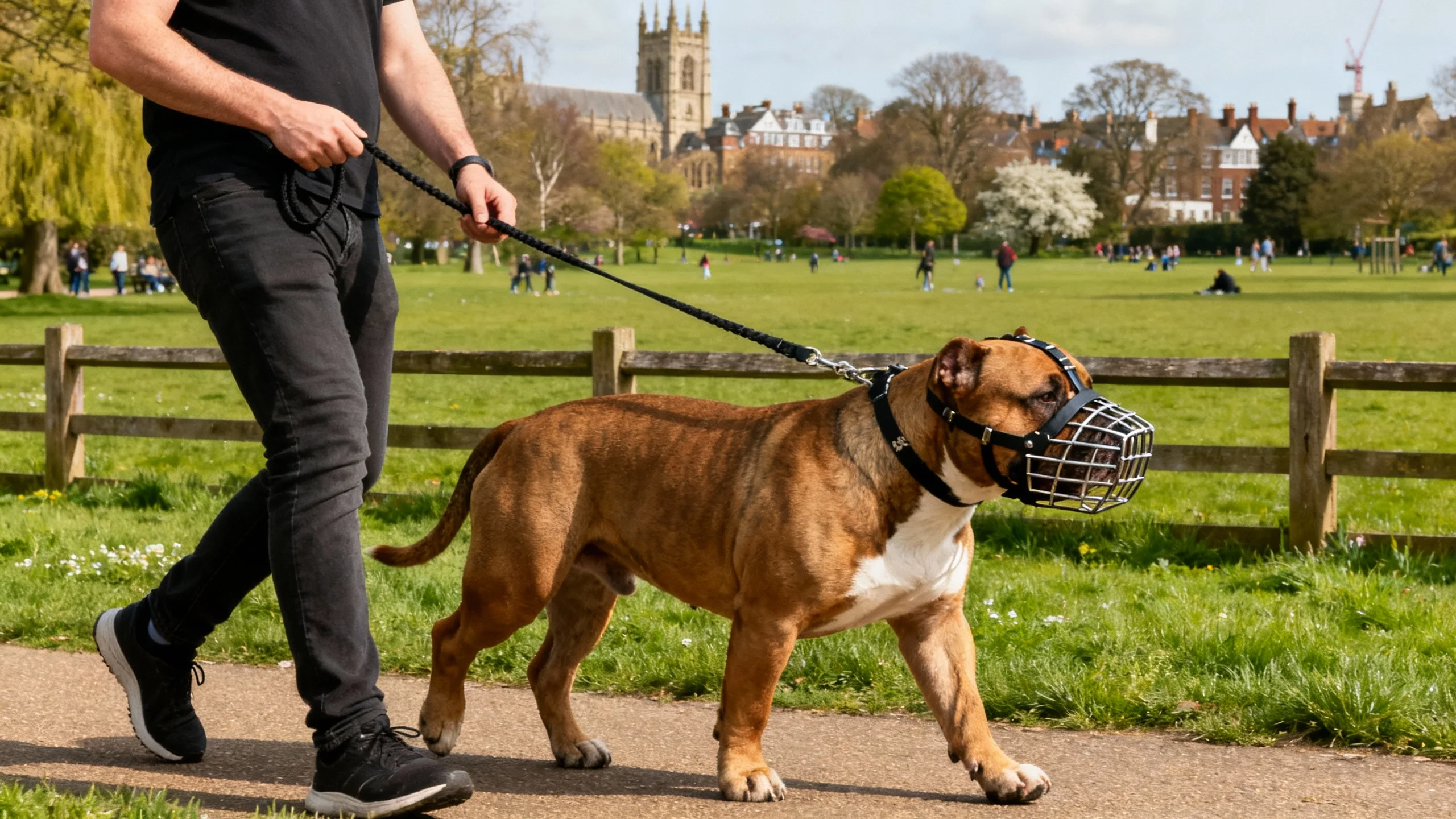
The addition of the XL Bully has become one of the most disputed changes to dog law in decades. The XL Bully ban in the UK came into force in late 2023 and early 2024, creating one of the largest public debates since the original Act was introduced.
Government rules require owners to:
- Register their dog under the exemption scheme
- Keep the dog muzzled and on a lead in public
- Ensure neutering by set deadlines
- Maintain secure, insured ownership
Supporters of the ban cite public-safety concerns following several serious incidents.
Critics argue that:
- Aggression is linked more to training, socialisation and handling
- Breed identification is inconsistent
- BSL has not reduced overall dog-attack statistics
Many animal welfare groups argue that the UK’s current breed-specific legislation (BSL) fails to address the root causes of dog aggression, including irresponsible ownership and inadequate training.
This debate has intensified calls for evidence-based reform in 2025.
Enforcement Challenges and Public Concerns
Despite strict legislation, dog attacks across the UK rose by 34% between 2020 and 2024, raising questions about whether the Act is achieving its core purpose.
Key challenges include:
- Difficulty identifying banned “types” vs recognised breeds
- Limited resources for enforcement officers
- Low public awareness of ownership responsibilities
- Inconsistent application of the law across regions
Many experts argue that the law penalises responsible owners while failing to address irresponsible breeding, lack of training, and unregulated online dog sales.
What Might Change? Ongoing Government Review (2026)
As of February 2026, the UK Government is reviewing the Dangerous Dogs Act, with discussions centred on:
- Replacing breed bans with behaviour-based assessments
- Mandatory owner training for large or powerful breeds
- Stronger penalties for neglectful owners
- National licensing or registration systems
- Early-intervention schemes for at-risk dogs
Animal welfare groups continue to push for a risk-based, scientific approach similar to legislation used in the Netherlands, Italy, and parts of Canada.
Conclusion: A Law in Need of Modernisation?
The Dangerous Dogs Act 1991 was created with the intention of protecting the public. However, more than three decades later, it remains one of the UK’s most contested pieces of legislation. With rising attack statistics and growing criticism of breed-specific rules, pressure for reform is increasing rapidly.
As the government review progresses in 2026, dog owners should stay informed, follow current regulations and support responsible ownership practices. Whether the Act is redesigned or replaced, its future will have a major impact on public safety, animal welfare, and the rights of dog owners across the UK.
Frequently Asked Questions
What are the main points of the Dangerous Dogs Act 1991?
The Dangerous Dogs Act 1991 (UK) covers two main aspects:
Prohibited dog types – The Act bans certain dog types from ownership unless exempted. These include the Pit Bull Terrier, Japanese Tosa, Dogo Argentino and Fila Brasileiro. More recently, the XL Bully was added under UK regulations.
For dogs of those types, the Act makes it illegal to breed, sell, advertise, exchange or abandon them, or allow them in public without a muzzle and lead unless an exemption certificate applies.
Ownership without a certificate is also an offence.
Any dog dangerously out of control – The Act creates an offence if any dog of any breed or type is kept in a way that it is “dangerously out of control” and causes injury or fear of injury, whether in a public or private place.
Courts have the power to order the destruction or disqualification of owners of dogs under this section.
Additionally, key support provisions include:
The ability for police and authorised officers to seize dogs of a prohibited type or dogs out of control.
Increased penalties when an attack results in serious injury or death, under this Act and subsequent legislation.
What dogs are banned in the UK under the Dangerous Dogs Act?
Under the Dangerous Dogs Act 1991 in the UK, the following “types” of dogs are prohibited (unless subject to an exemption certificate in specific circumstances):
Pit Bull Terrier — banned type.
Japanese Tosa — banned type.
Dogo Argentino — banned type.
Fila Brasileiro — banned type.
XL Bully — recently added to the banned list in England & Wales (from 31 Dec 2023) and in Scotland (from 23 Feb 2024)
The Act covers “types” rather than strictly established breeds. This means even cross-breeds or look-alike dogs may fall under the ban if they match physical & behavioural criteria.
It is illegal to sell, breed, give away, abandon, or allow a banned type to stray.
For the XL Bully specifically, strict ownership requirements (muzzle, lead, registration) apply unless an exemption certificate is in place.
What is Section 1 of the Dangerous Dogs Act 1991?
Section 1 of the Dangerous Dogs Act 1991 sets out the UK’s laws on prohibited dog types. It makes it an offence to own, breed, sell, exchange, advertise, or abandon certain dogs that are considered to be bred for fighting or pose a risk to public safety. The dogs banned under Section 1 are:
Pit Bull Terrier
Japanese Tosa
Dogo Argentino
Fila Brasileiro
XL Bully (added through later legislation in England, Wales, and Scotland)
Section 1 also gives the Secretary of State the power to add more types to the prohibited list in future. Any dog suspected of being a banned “type” can be seized and assessed, even if it is a cross-breed or not a pedigree.
What is Section 2 of the Dangerous Dogs Act 1991?
Section 2 of the Dangerous Dogs Act 1991 sets out the offence of failing to keep a dog under proper control, based on previous dog-control laws. This section applies to any dog, regardless of breed, and focuses on owner responsibility rather than specific banned types.
Under Section 2, an owner or person in charge of a dog can be prosecuted if the dog is:
Dangerously out of control in a public place
Causing fear or injury to a person or another animal
Not restrained or supervised in a way that prevents risk to the public
Although Section 2 was later replaced and updated by Section 3, it is still referenced as part of the overall framework that defines what “dangerously out of control” means.
What is Section 3 of the Dangerous Dogs Act 1991?
Section 3 of the Dangerous Dogs Act 1991 makes it a criminal offence for any dog—regardless of breed or type—to be dangerously out of control in a public or private place.
A dog is considered dangerously out of control if:
It causes injury to a person or an assistance dog
It causes someone to fear they may be injured
It attacks another animal in certain circumstances
It behaves aggressively in a way that puts public safety at risk
Under Section 3, owners (or the person in charge of the dog at the time) can face:
Fines and criminal charges
Prison sentences (up to 5 years for serious injury, up to 14 years if a death occurs)
Court orders such as destruction, contingent destruction, or disqualification from keeping dogs
Section 3 is one of the most commonly used parts of the Act because it applies to all dogs, not just banned breeds
What is Section 4 of the Dangerous Dogs Act 1991?
Section 4 of the Dangerous Dogs Act 1991 sets out the court powers and penalties when a dog is found to be a banned type or is judged to be dangerously out of control. Under this section, the court may:
Order the destruction of the dog
Issue a contingent destruction order, allowing the dog to be kept under strict conditions (for example, being muzzled in public, kept securely, or neutered)
Disqualify the owner from having custody of a dog for a set period
Impose fines or prison sentences depending on the severity of the offence
Section 4 essentially covers what happens after an offence has been proven, giving courts the authority to decide whether the dog can be kept safely under conditions or must be destroyed.
What is Section 5 of the Dangerous Dogs Act 1991?
Section 5 of the Dangerous Dogs Act 1991 sets out the powers of the police and authorised officers when dealing with suspected banned breeds or dogs that have been involved in an offence. It covers the following,
Entry and search powers – Police may enter premises (with a warrant, unless urgent) to seize a dog suspected of being a banned type or dangerously out of control.
Seizure and detention of dogs – Dogs can be taken into custody for assessment, especially if they may be a prohibited type under Section 1.
Evidence and burden of proof – The section explains how evidence can be used to determine whether a dog is of a banned type, and clarifies the responsibilities of the owner during proceedings.
Expenses and compensation rules – It also outlines how costs relating to seizure, kennelling or destruction may be handled.
In simple terms, Section 5 provides the legal authority and procedures that allow enforcement agencies to investigate, seize and assess dogs under the Act.
