
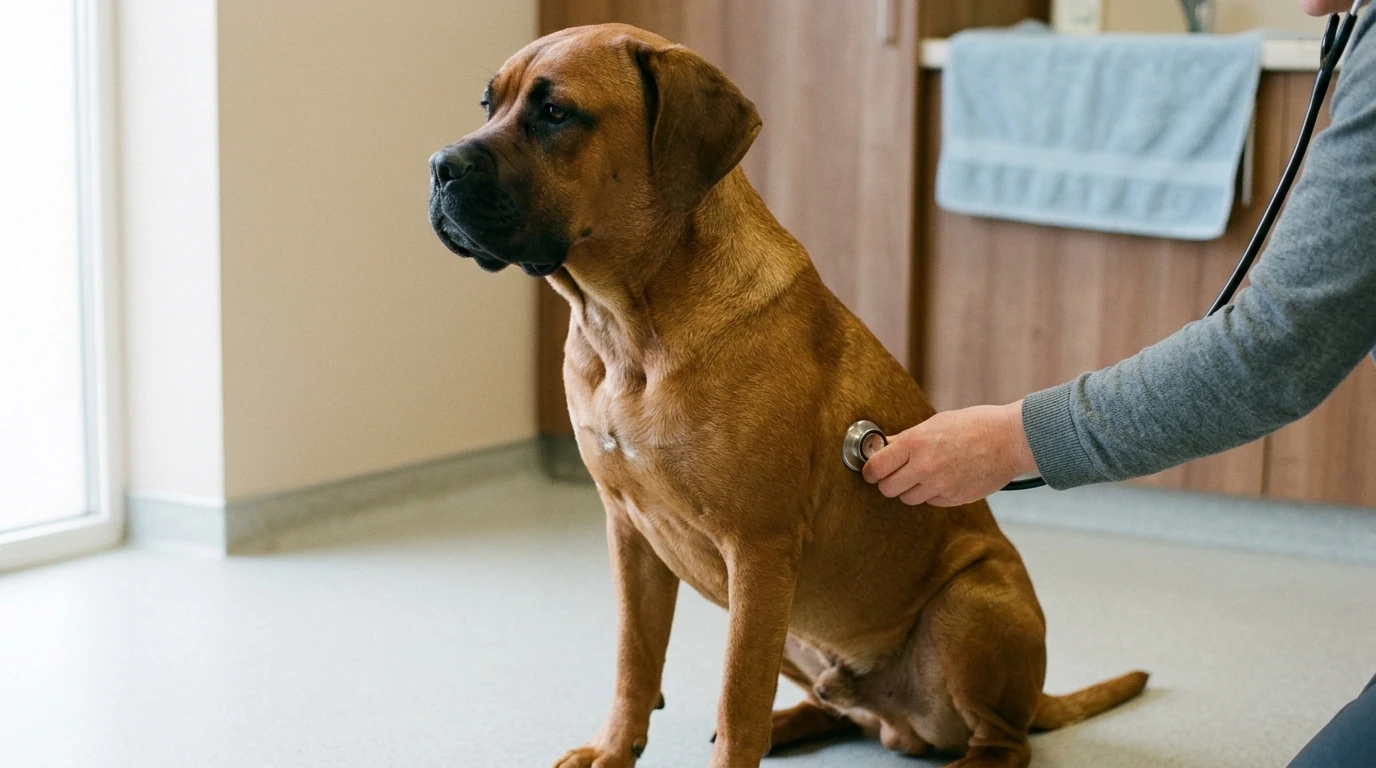
How long do Cane Corsos live? In a 2024 Dogs Trust study of UK dogs, the typical Cane Corso lived to about eight years old, one of the shortest figures for any breed in the study. PDSA lists hip and elbow problems, bloat and some eye conditions as possible concerns, though the breed is too uncommon in the UK to say which are most common.
The Cane Corso isn’t on the Royal Kennel Club’s list of recognised breeds, so there’s no UK breed standard to draw on. This guide uses the Dogs Trust lifespan study, PDSA’s Cane Corso guide and health pages, Dogs Trust’s breed page and the British Veterinary Association’s screening schemes, plus what we’ve learned with our own Cane Corso, Dexter, who is coming up to five. It’s general information, so your vet is the person to ask about your own dog.
TABLE OF CONTENTS
Cane Corso lifespan and health at a glance
| What to know | Cane Corso | Source |
|---|---|---|
| UK breed standard | None: the breed isn’t recognised in the UK | Royal Kennel Club Breeds A to Z |
| Typical lifespan in the UK | About 8 years (median 8.1, based on a small group of dogs) | Dogs Trust 2024 study |
| Health problems listed | Hip dysplasia, elbow dysplasia, bloat (GDV), entropion, ectropion, cherry eye | PDSA |
| How common each one is | Not known: too few Corsos in the UK to be sure | PDSA |
| Screening before breeding | Hip and elbow x-rays under the BVA/Kennel Club schemes, open to unrecognised breeds | PDSA and BVA |
| Routine vet care | A check-up every year, plus vaccinations and flea and worm treatment | PDSA |
| UK vet-records study of the breed | None found | Our search, November 2026 |
Sources checked November 2026.
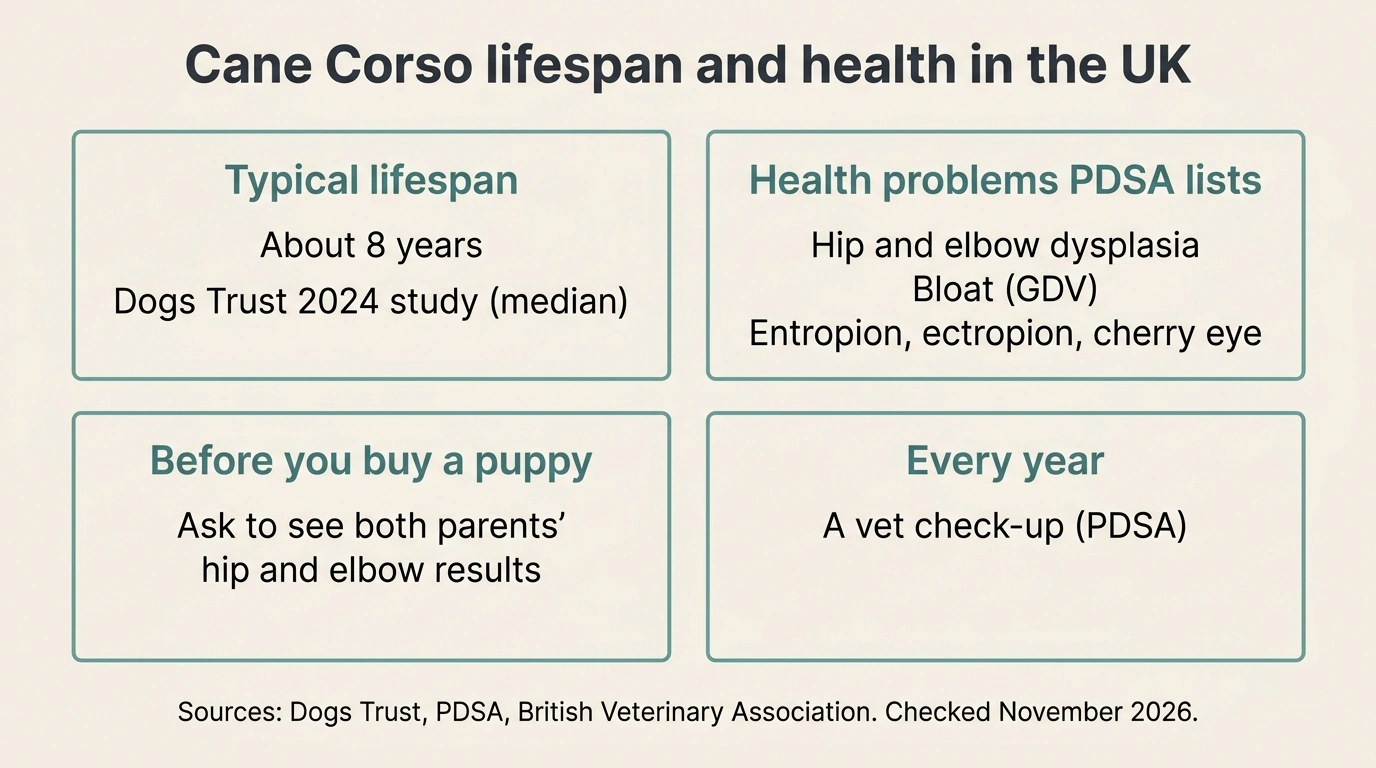
How long do Cane Corsos live?
The best UK figure comes from Dogs Trust’s 2024 study, which covered over half a million UK dogs and 155 breeds. It put the Cane Corso’s median lifespan at 8.1 years: half the Corsos in the study died before that age, and half lived longer. The charity named the Corso alongside the Caucasian Shepherd Dog, the Presa Canario and the French Bulldog as the breeds with the shortest life expectancy.
Two things are worth keeping in mind. The Corso figure is based on far fewer dogs than most breeds in the study, so read it as a rough guide. And a median is the midpoint of a group, not a forecast for your dog: some Corsos die younger, and some live well past eight.
The same research found that large breeds as a whole had a 20% higher chance of a shortened life than small breeds. It also grouped the Corso with related breeds that tend to live shorter lives, including Mastiffs, Bulldogs, the Neapolitan Mastiff and the Presa Canario, though it couldn’t say why. Our guide to the dogs with the longest lifespans shows how other breeds compare, and our Cane Corso vs Presa Canario guide compares the two breeds.
Why you’ll see “9 to 12 years” elsewhere
Most websites give the Cane Corso a lifespan of 9 to 12 years. We couldn’t find a UK study behind that range, and it’s higher than the UK figure above. We use the Dogs Trust figure because it comes from records of dogs in the UK. If you’re comparing figures, it’s worth checking where each one comes from.
Ask your vet: If you’re worried about your Corso’s age or health, book a check-up rather than going by a number. Your vet knows your dog and can tell you what to look out for as they get older.
Cane Corso health problems: what PDSA lists
PDSA’s Cane Corso guide notes that there aren’t many Cane Corsos in the UK, so the charity can’t be sure which health conditions are more common in the breed. It says there’s some evidence that the conditions below may be a concern. None of them affects every Corso, and no UK study has measured how often they happen in the breed.
Hip and elbow dysplasia
Both conditions mean a joint grows into the wrong shape while a puppy is developing, so it doesn’t fit together properly and eventually leads to arthritis. Both are often inherited and mostly affect medium and large breeds. Hip signs usually start at around five to six months and elbow signs between five and 18 months, though a mildly affected dog may show nothing until arthritis sets in later (PDSA).
Signs to tell your vet about include:
- limping or stiffness, especially after exercise
- difficulty getting up, lying down, jumping or using the stairs
- “bunny hopping”, with both back legs moving together
- less interest in walks or play
Extra weight makes both conditions worse, so keeping your Corso slim matters. Our Cane Corso size guide has five checks for a healthy weight.
Bloat (GDV): an emergency
GDV, the condition often called bloat, is a stomach that swells with gas and then twists on itself. PDSA describes it as painful and life-threatening. It mostly affects large, deep-chested dogs, more often from middle age onwards and in dogs with a parent or full sibling who has had it. Even with treatment, some dogs don’t survive.
The signs to watch for are:
- retching or trying to be sick but bringing up little or nothing
- a swollen tummy, which isn’t always obvious
- restlessness, panting and pacing
- drooling more than usual
- difficulty breathing, pale gums or collapse
To lower the risk, the charity advises avoiding exercise and car journeys for an hour before and after meals, and feeding several smaller meals rather than one big one. Feed from a bowl on the floor, because raised bowls are now linked to a higher risk. Encourage your dog to drink little and often, but never take water away, and use a slow-feeder bowl or scatter feeding if they eat fast.
When to see your vet: Straight away. If you think your Cane Corso has bloat, call your vet or the nearest out-of-hours vet immediately. PDSA says the signs get worse quickly and you should never wait to see if they improve.
Eye problems: entropion, ectropion and cherry eye
Entropion is when an eyelid rolls inwards and rubs the surface of the eye. It’s painful and, left untreated, can lead to ulcers and infections. PDSA also names ectropion among the eyelid problems that may affect the breed.
Cherry eye is when the gland inside the third eyelid pops out, leaving a red swelling in the corner of the eye. PDSA names the Cane Corso among the breeds where it’s especially common, and says it’s often inherited, usually appears before two years of age and most often needs surgery to put the gland back.
Watch for a weepy, red or half-closed eye, rubbing at the face, discharge or a red lump in the corner of the eye. With eye problems, contact your vet rather than waiting to see if they clear up.
What UK sources don’t tell us
We couldn’t find a UK study that measures how often Cane Corsos get any particular condition, and there’s no RVC VetCompass study of the breed. No UK charity or vet source we found gives Corso figures for heart problems, cancer, allergies or skin conditions, so we don’t give any. If another site gives a percentage for the breed, it’s worth asking where it comes from.
Health screening before you buy a Cane Corso puppy
Hip and elbow dysplasia can be passed from parents to puppies, so the most useful checks happen before a puppy is born. PDSA says breeding dogs should be x-rayed under the BVA/Kennel Club schemes for hips and elbows, and that you should make sure your puppy’s parents have had the right health screening.
Because the Cane Corso isn’t a recognised breed in the UK, you might wonder whether those schemes apply. The British Veterinary Association says they’re open to all dogs, including unrecognised breeds and dogs not registered with the Royal Kennel Club.
Dogs Trust suggests asking your vet whether they offer a pre-purchase consultation, where you can get advice on possible health conditions, how they’re managed, rough costs and finding a responsible breeder. Our guide to common health problems by breed explains how health tests work across breeds.
Questions to ask a breeder or rescue centre
- Have both parents had their hips x-rayed and scored, and can I see the results?
- Have both parents had their elbows x-rayed and graded?
- Has either parent, or any puppy from an earlier litter, had bloat or cherry eye?
- Has the puppy been checked by a vet and had its first vaccinations?
- For a rescue dog: what health problems do you know about?
PDSA also suggests insuring your dog as soon as they come home, before any signs of illness start.
Everyday care that protects a Cane Corso’s health
Every dog needs a check-up once a year, along with vaccinations and regular flea and worming treatments, and those visits are a good chance to catch problems early (PDSA). For a Corso in particular, the same guide advises:
- a complete, balanced food that keeps them slim, usually split into two meals
- treats making up no more than 10% of their daily calories
- a gap between eating and exercise
- about two hours’ exercise daily, without expecting a heavy dog to run for miles
Dogs Trust adds that some Cane Corsos have skin folds that need regular cleaning, and that your vet can show you how.
As your Cane Corso gets older
No UK source says at what age a Cane Corso counts as a senior. Once a dog is older, Dogs Trust advises a vet check twice a year, and mentioning any change in behaviour to your vet instead of assuming it’s just age. Our dog years guide explains life stages by size.
Dexter’s health: one Cane Corso at almost five
Dexter, our Cane Corso, will be five in January. Until he was about three he was full of beans; he’s much calmer now, though he still sprints and leaps about in play. His vet sees him for a yearly check-up, and in between when something crops up, such as a paw injury.
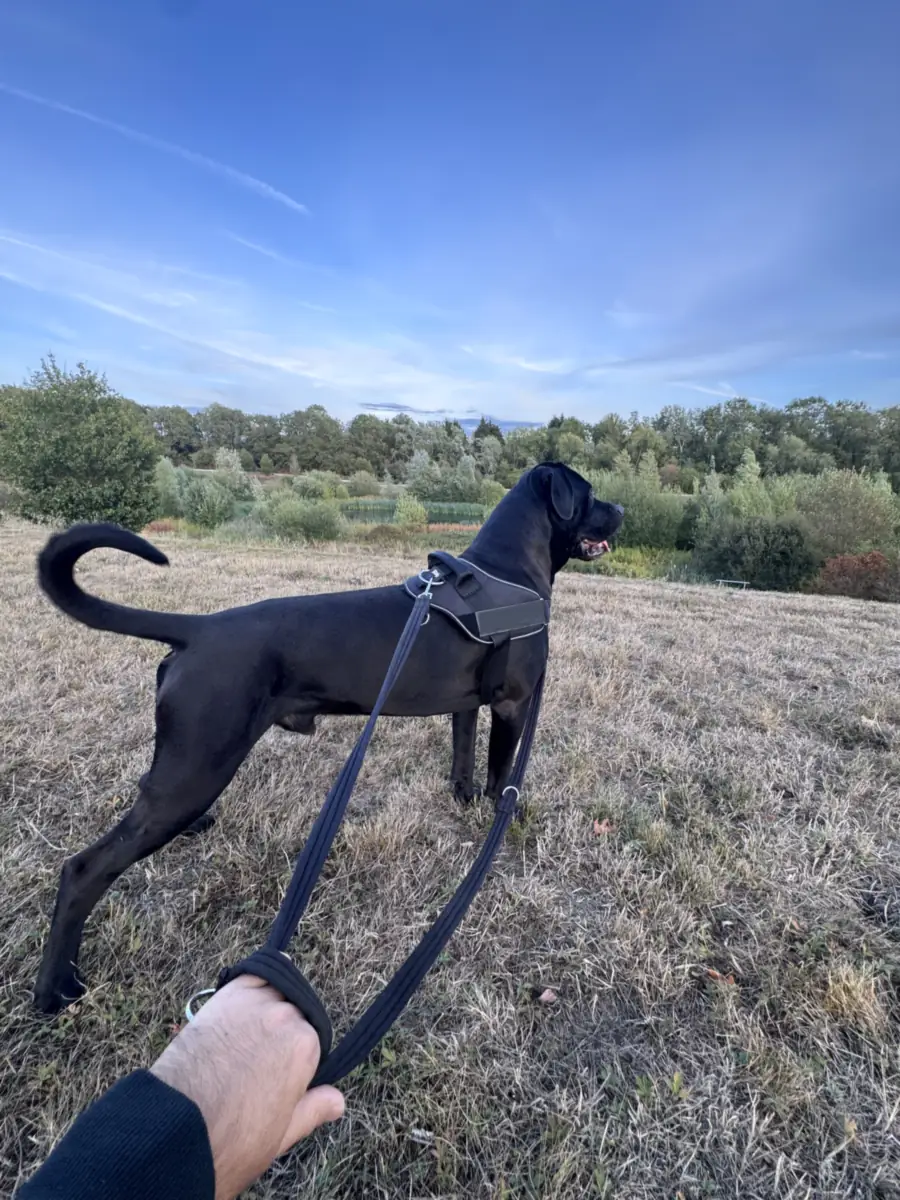
The one health problem that has followed him is his ears. At around a year old they turned red inside and he scratched at them. For a few months we tried a pet-shop ear cleaner, then took him to the vet, who put it down to a food allergy. For four to five months he ate a vet protein diet and nothing else, treats included. After that we brought back chicken as the only meat in his food, and he fully improved. Any change to his food still happens slowly.
Ear allergies aren’t on PDSA’s list for the breed, so this is one dog’s story rather than a Cane Corso pattern. Our guide to dog ear infections and food allergy covers the signs and what vets do.
From our home: Dexter has never had any health screening. We bought him from a friend as first-time owners and didn’t know to ask about his parents’ hips and elbows. Health screening is something we’ve only learned about since, and it’s the first thing we’d ask about with any future puppy.
Final thoughts on Cane Corso lifespan and health
- If you’re thinking about a Cane Corso, plan for a shorter life than many breeds: in UK data, the typical Corso lived to about eight.
- If you’re buying a puppy, ask to see both parents’ hip and elbow results.
- If your Corso shows signs of bloat, treat it as an emergency.
- If you notice limping, stiffness or a red lump in the corner of an eye, see your vet.
- If you already have a Corso, a yearly check-up and a slim body are the everyday basics.
Frequently Asked Questions About Cane Corso Lifespan and Health
What is the average Cane Corso life expectancy in the UK?
About eight years. Dogs Trust’s 2024 study of UK dogs put the Cane Corso’s median lifespan at 8.1 years, so half the Corsos in the study lived less than that and half lived longer. It was one of the shortest figures in the study, and it’s based on a small group of dogs.
Is the Italian Mastiff the same as the Cane Corso?
Often, yes: Dogs Trust says Cane Corsos are sometimes called Italian Mastiffs. Don’t confuse the Corso with the Neapolitan Mastiff, a different Italian breed that the Royal Kennel Club does recognise. In the Dogs Trust study, the Neapolitan Mastiff’s median lifespan was 9.3 years, so its figures don’t apply to a Corso.
Do male or female Cane Corsos live longer?
No UK source gives separate lifespans for male and female Cane Corsos. Across all breeds, the Dogs Trust study found that females lived a little longer than males, 12.7 years compared with 12.4, but that’s a figure for dogs in general, not for the Corso.
Are Cane Corsos healthy dogs?
UK sources can’t say how healthy the breed is overall. PDSA says there are too few Cane Corsos in the UK to be sure which problems are most common, and lists hip and elbow dysplasia, bloat and some eye problems as possible concerns. Screened parents and a yearly check-up are the best places to start.
Is cherry eye common in Cane Corsos?
PDSA names the Cane Corso among the breeds where cherry eye is especially common. It’s often inherited and usually shows up before two years of age as a red swelling in the corner of the eye. Most dogs need surgery to put the gland back, so see your vet if you notice one.
Should I have my Cane Corso hip scored?
Hip and elbow scoring is mainly for dogs that will be bred from. PDSA says breeding dogs should be x-rayed under the BVA/Kennel Club schemes, which are open to unrecognised breeds like the Corso. For a pet, see your vet if you notice limping, stiffness or difficulty getting up.
