

For generations, dog owners have relied on a simple mathematical formula to figure out the age of their beloved canine companions: take the dog’s age, multiply it by seven, and you have their age in human years. It is a comforting and straightforward rule, one that has been passed down from parent to child, and shared countless times at dog parks across the globe. But as our understanding of canine biology and veterinary science has evolved, we have learned that this age-old calculation is fundamentally flawed.
If you find yourself looking at your furry best friend and wondering, “How old is my dog in human years?”, the true answer is far more complex, fascinating, and deeply dependent on their unique genetic makeup.
At FlexK9, our mission is to provide you with honest, authoritative, and practical guidance on all dog-related subjects. While we are an online educational resource and not a veterinary clinic, we rely on established scientific research to help you better understand your dog. Knowing your dog’s true biological age is not just a matter of trivia; it is a critical component of responsible pet ownership. It dictates when you should switch to a senior diet, when to increase veterinary screenings, and how to appropriately manage their daily exercise routines.
In this comprehensive guide, we will dismantle the myths surrounding canine ageing, provide you with scientifically backed tools to calculate their life stage, and offer a practical checklist for estimating the age of rescue dogs with unknown backgrounds. By the end of this article, you will have a much clearer picture of your dog’s timeline, empowering you to give them the happiest, healthiest life possible.
TABLE OF CONTENTS
The Science Behind Canine Ageing
To truly understand how dogs age, we must look beyond basic mathematics and delve into the biology of the canine species. Dogs are incredibly unique in the animal kingdom due to the sheer diversity of their physical forms. From the tiny Chihuahua to the massive Mastiff, the physical disparities within a single species are unparalleled. Because of these vast differences in size, weight, and genetics, it is biologically impossible for all dogs to age at the exact same rate.
According to veterinary experts at VCA Animal Hospitals, a dog’s ageing process and senior care requirements are heavily influenced by their breed size. Understanding this biological reality is the first step in properly assessing where your dog is on their life journey.
Why the 7-Year Rule is a Myth
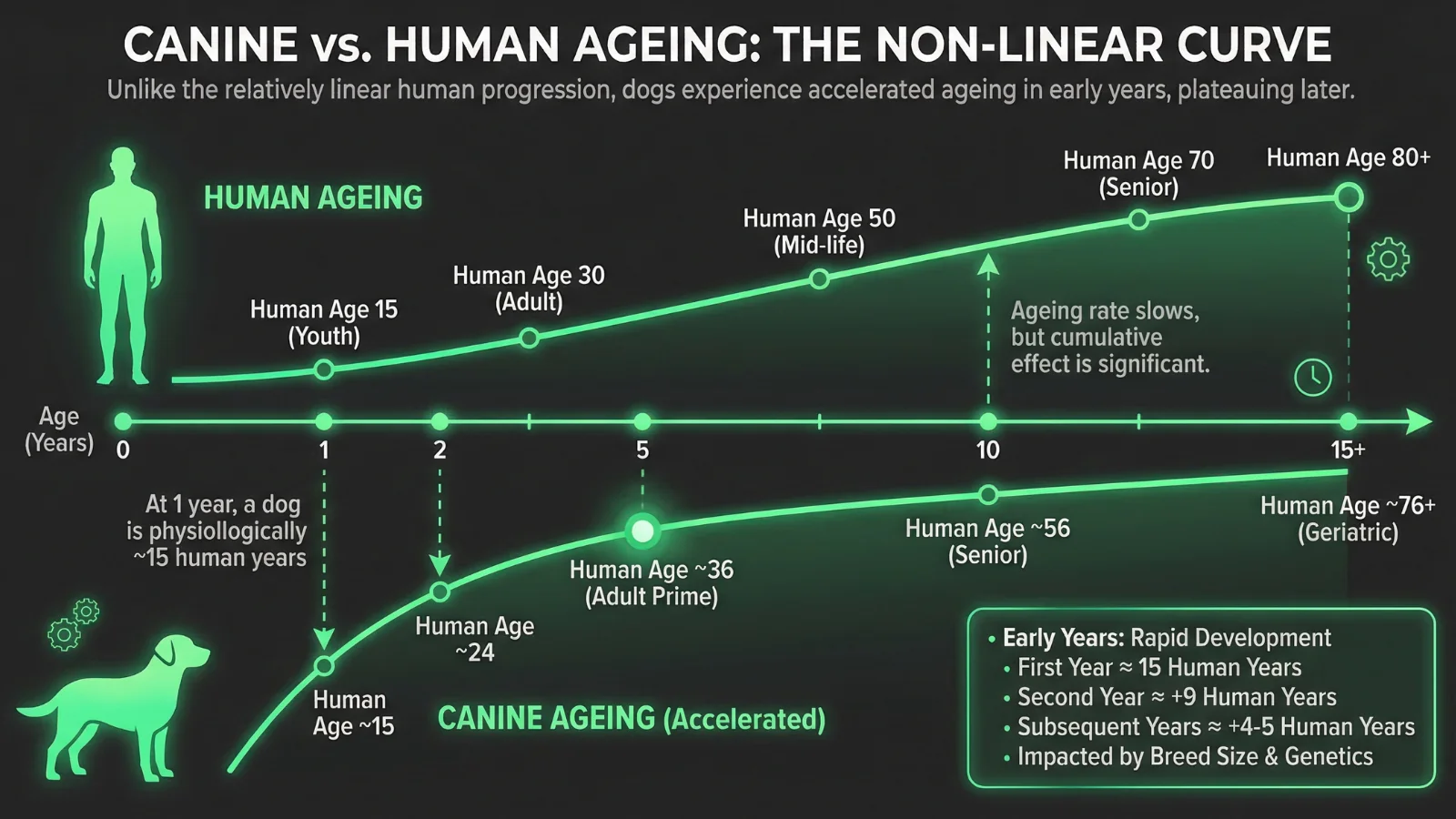
The “one dog year equals seven human years” rule was likely created decades ago as a marketing tactic. It was a simple way to encourage pet owners to bring their dogs to the veterinarian at least once a year. The logic was somewhat sound for the time: if humans visit the doctor once every few years, and dogs age seven times faster, then a yearly vet visit for a dog makes perfect sense. However, this linear calculation completely ignores the rapid maturation process that occurs early in a dog’s life.
Canines experience an incredibly accelerated growth period during their first two years. In fact, a one-year-old dog is not biologically equivalent to a seven-year-old human child. Instead, a one-year-old puppy is much closer to a human teenager—around 14 to 15 years old! They have reached sexual maturity, their adult teeth have fully emerged, and they are nearing their full adult height. By the time a dog reaches two years of age, they are roughly equivalent to a 24-year-old human. After this initial sprint of development, the ageing process begins to slow down and plateau, varying significantly based on the dog’s adult size.
Furthermore, recent scientific studies involving epigenetic clocks—which measure the chemical modifications to DNA over time—have confirmed that dogs age non-linearly. Their DNA methylation patterns change rapidly in their youth and then stabilise as they enter adulthood.
Therefore, applying a flat multiplier of seven is scientifically inaccurate and can lead to misunderstandings about your dog’s health needs, lifespan expectations, and long-term care planning. If you want to compare breed longevity patterns, see our guide to dogs with the longest lifespan.
How Breed Size Affects Your Dog’s Lifespan
The most crucial factor in determining how fast your dog ages is their size and weight. In the canine world, larger bodies equate to shorter lifespans. This phenomenon is somewhat unique to dogs; in many other parts of the animal kingdom, larger mammals (like elephants and whales) tend to live longer than smaller ones. For dogs, the physiological strain of growing so rapidly and maintaining a massive body structure takes a toll on their internal organs, joints, and cellular health.
When evaluating canine ageing, veterinarians generally divide dogs into four primary size categories:
- Small Breeds (Under 10 kg): Dogs like Pomeranians, Pugs, and Dachshunds. These dogs have the longest life expectancies, often living well into their mid-to-late teens. They are generally not considered “senior” until they are about 11 or 12 years old.
- Medium Breeds (10 kg to 25 kg): Breeds such as Spaniels, Border Collies, and standard Beagles. They have an average lifespan and are usually classified as seniors around 9 to 10 years of age.
- Large Breeds (25 kg to 40 kg): This category includes popular family pets like Golden Retrievers and Labrador Retrievers. Sadly, owners often wonder why Golden Retrievers are dying younger, as large breeds age more rapidly. They are typically considered seniors by the time they reach 7 to 8 years old.
- Giant Breeds (Over 40 kg): Think of the Great Dane, the Mastiff, or the massive Central Asian Shepherd dog size. These gentle giants age the fastest. A giant breed can be considered a senior citizen at just 5 or 6 years old, and their average lifespan is often significantly shorter than that of smaller dogs.
Understanding these categories is vital because the age at which a dog is considered a senior dictates when you need to start monitoring them for age-related conditions. Larger dogs will need proactive joint care and different nutritional support much earlier in life than a toy breed.
Using a Dog Age Chart and Calculator
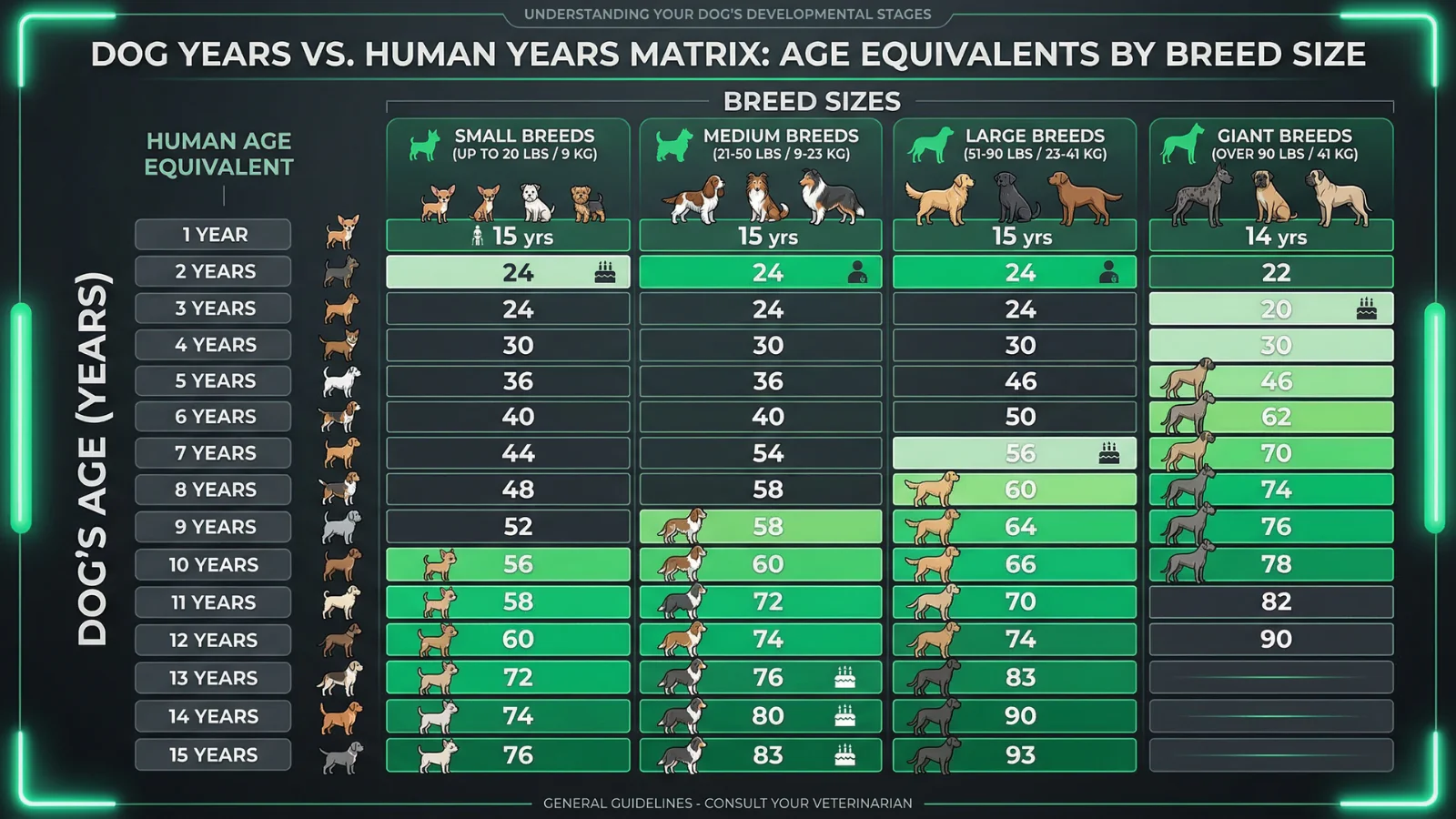
Now that we understand the science, how do we accurately calculate your pet’s age? Because of the complexities involved, the most reliable method is to use a structured, size-based chart. The American Kennel Club (AKC) strongly recommends evaluating your dog’s age based on these distinct weight classes.
If you know your dog’s exact birthdate, you can easily map their chronological age to their biological human equivalent using specialised tools and matrices.
The FlexK9 Live Dog Age Calculator
Select your dog’s current age and weight class below to instantly reveal their true biological age using veterinary-standard multipliers.
Is your large breed entering their golden years?
Large and powerful breeds age differently. Don’t wait for a limp to start protecting their joints. Tell us where to send The FlexK9 Senior Power Breed Protocol (Free PDF) to discover the exact mobility stack, gear upgrades, and tactical nutrition needed to extend their lifespan.
*We will email the PDF directly to your inbox. No spam, just tactical K9 intel.
Human to Dog Years Calculator Explained
A modern human-to-dog years calculator does not use a flat multiplier. Instead, it uses a tiered algorithm based on the scientific consensus we discussed earlier. Here is a breakdown of how a calculator processes your dog’s age:
- Year 1: Regardless of size, the first year of a dog’s life is roughly equal to 15 human years.
- Year 2: The second year adds approximately 9 human years. So, a two-year-old dog of any size is about 24 in human years.
- Years 3 and Beyond: This is where the calculation splits based on size. For every chronological year after the second, the calculator adds:
- 4 human years for small breeds.
- 5 human years for medium breeds.
- 6 human years for large breeds.
- 7 to 9 human years for giant breeds, scaling upward as the dog gets older.
By using this structured approach, you get a much more realistic picture. For instance, a 10-year-old small dog is roughly 56 in human years, while a 10-year-old large dog is closer to 66. This decade-long difference highlights why tailored care is so important. When your dog reaches a new life stage, it becomes easier to adjust feeding appropriately using breed-specific resources such as our Golden Retriever feeding chart by age.
Physical Signs to Guess Your Dog’s Age
For many pet parents, especially those who have opened their homes to rescue dogs, a dog’s actual birthdate is a mystery. If you do not have a pedigree or veterinary records from puppyhood, a calculator won’t help you. In these cases, you must act like a canine detective and look for physical markers. While only an approximation, examining your dog’s body can yield highly accurate estimates.
Here is a checklist of physical signs to help you estimate your dog’s age:
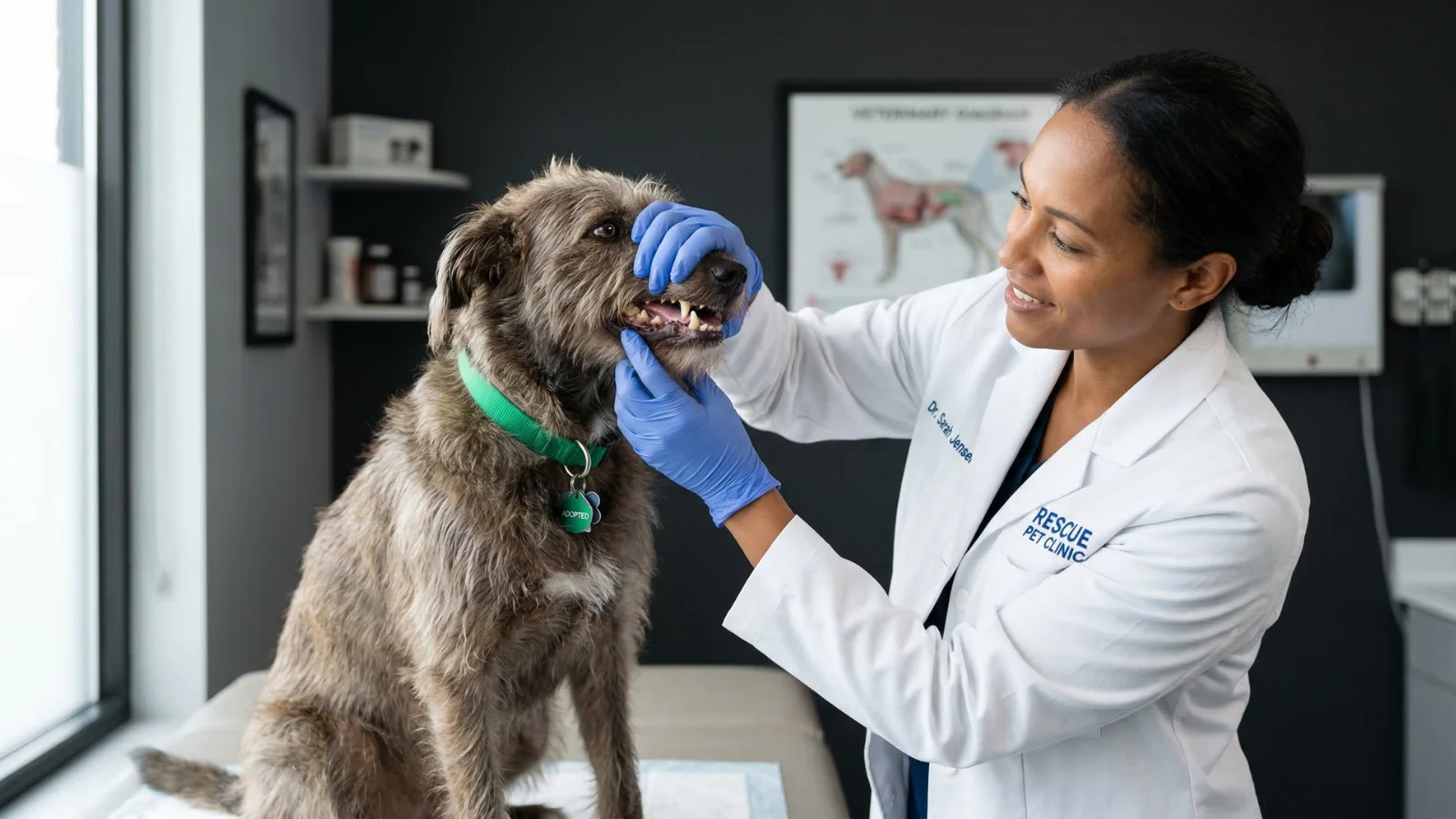
- Examine the Teeth: Dentition is the most reliable indicator of a dog’s age, particularly in their early years. Puppies have pristine, sharp white teeth. By one to two years, the teeth are still white but slightly duller. By age three to five, you will likely notice yellowing and tartar buildup, particularly on the back molars. If you are learning how to clean dog teeth without brushing, establishing a routine early can mitigate this, but natural wear still occurs. A dog over the age of five will typically show significant dental wear, heavy tartar, and potentially missing teeth.
- Look at the Eyes: Just like humans, a dog’s eyes change as they age. Around six to eight years of age, many dogs develop lenticular sclerosis, a condition that gives the pupils a cloudy, bluish-grey, or hazy appearance. Unlike cataracts, this condition does not usually significantly impair vision, but it is a hallmark sign of a senior dog.
- Check the Coat: Greying is a common sign of ageing. A dog will often start to go grey around the muzzle, eyes, and paws, anywhere from five to seven years of age. Keep in mind, however, that some dogs, much like humans, go grey prematurely due to genetics or stress, so this sign should be evaluated alongside others.
- Evaluate Mobility and Muscle Tone: Younger dogs are supple, muscular, and have boundless energy. As dogs age, they naturally lose muscle mass and may become stiffer, particularly after resting. If you notice your dog hesitating to jump into the car or struggling with stairs—prompting you to wonder do you need a dog ramp—this is a strong indicator they have entered their senior years.
- Inspect the Paws and Nails: An older dog’s paw pads may become thicker, rougher, and more calloused. Additionally, their nail growth can change, becoming more brittle. Knowing how often to clip dog nails and how to cut dog nails that are black is crucial for older dogs, as overgrown nails can severely impact their already compromised mobility.
By combining these observations, you can usually place a rescue dog within a two-year age bracket, allowing you to tailor their care appropriately.

Caring for Your Ageing Best Friend
Once you have successfully calculated or estimated your dog’s age, the next and most important step is adapting your care routine to meet their evolving needs. Recognising that your dog is officially a senior should not be a cause for sadness; rather, it is an opportunity to provide them with the specialised comfort and attention they deserve in their golden years.
First, you must be vigilant about preventative health. Older dogs are more susceptible to a range of issues, making it essential to familiarise yourself with dog breeds common health problems. You will need to monitor them closely for lumps and bumps; understanding the difference between a harmless fatty deposit and something more serious, like a dog cyst vs tumour, can prompt life-saving veterinary intervention.
Dietary adjustments are equally critical. Senior dogs generally require fewer calories as their metabolism slows down, but they need higher-quality, easily digestible proteins to maintain muscle mass. You must also be stricter about what human foods they have access to; older organs are less resilient, making it even more important to avoid the 22 foods that can kill your dog.
Finally, consider their comfort in daily life. Dog car travel might become more stressful if they suffer from arthritis, stiffness, or reduced mobility, which is why softer bedding, joint support, and gentle daily handling become increasingly important. Ultimately, regardless of breed or role, a dog’s age dictates their physical limitations, and it is our job as pet parents to accommodate them gracefully.
Understanding your dog’s true biological age removes the guesswork from pet parenting. By discarding the outdated seven-year myth and embracing a scientifically accurate approach based on breed size and physical markers, you are equipping yourself with the knowledge needed to advocate for your dog’s health. At FlexK9, we believe that every stage of a dog’s life is special, from the chaotic puppy years to the peaceful, dignified senior days. Armed with this knowledge, you can ensure that every single one of those years—human or dog—is filled with the utmost love, care, and comfort.
Frequently Asked Questions: How Old is My Dog in Human Years?
Is 1 dog year really 7 human years?
No, the 1 dog year to 7 human years rule is a myth. Dogs age much faster in their first two years, reaching the human equivalent of about 24 years old by age two. After that, their ageing rate slows down and depends entirely on their breed size, with larger dogs ageing faster than smaller ones.
How can I tell how old my rescue dog is?
You can estimate a rescue dog’s age by examining their physical features. Look at their teeth for wear and tartar buildup, check their eyes for a cloudy haze (lenticular sclerosis), and observe if they have grey hairs around their muzzle or paws. A veterinarian can provide the most accurate age estimate during a physical exam.
How old is a 10-year-old dog in human years?
A 10-year-old dog’s age in human years depends on their weight class. A 10-year-old small breed is roughly 56 in human years. A medium breed is about 60, a large breed is approximately 66, and a giant breed is closer to 78 human years.
At what age is a dog considered a senior?
A dog is generally considered a senior when they enter the last 25% of their estimated lifespan. Due to size differences, small breeds become seniors around 11 to 12 years old, medium breeds at 9 to 10 years, large breeds at 7 to 8 years, and giant breeds as early as 5 to 6 years old.
Do small dogs live longer than large dogs?
Yes, small dogs generally live significantly longer than large dogs. In the canine world, larger bodies equate to shorter lifespans. The physiological strain of rapid puppyhood growth and maintaining a massive adult body size causes large and giant breeds to age biologically faster than smaller breeds.
