
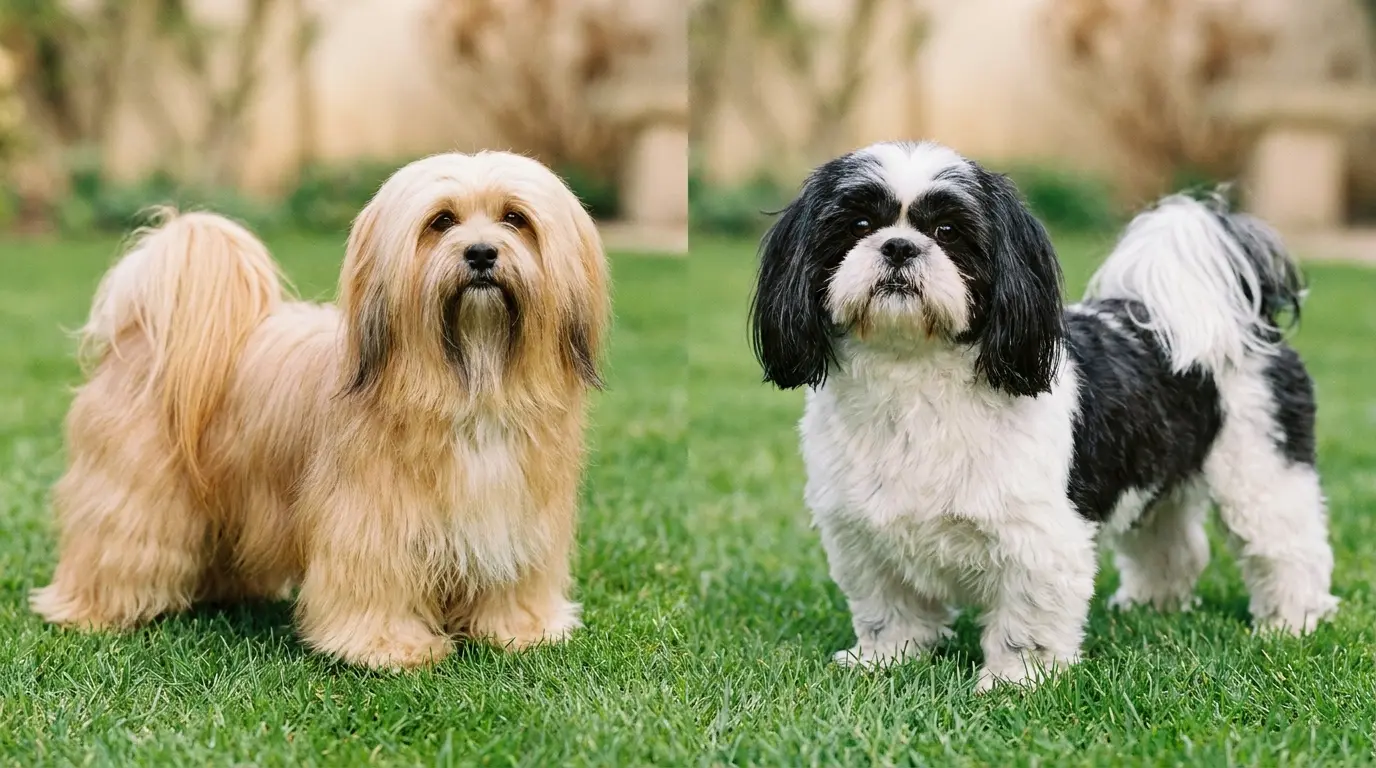
Lhasa Apso vs Shih Tzu comes down to the face, the coat and the attitude. The Lhasa has a straighter, longer foreface, a hard coat and a reserve with strangers. The Shih Tzu has a short, flat “chrysanthemum” face, and its breed standard describes it as friendly and independent.
In the UK, both are Utility breeds rather than toy breeds. In the Dogs Trust UK lifespan study, the Lhasa Apso had the longer median lifespan, and only the Shih Tzu is covered by the Royal Kennel Club’s breathing assessment scheme.
We haven’t owned either breed, so there’s no first-hand section on this page. This comparison is built from the Royal Kennel Club breed standards, PDSA breed guidance, the Dogs Trust UK longevity study and research from the Royal Veterinary College (RVC).
TABLE OF CONTENTS
Lhasa Apso vs Shih Tzu at a Glance
| Lhasa Apso | Shih Tzu | |
|---|---|---|
| Royal Kennel Club group | Utility | Utility |
| Origin | Tibet | China, with Tibetan ancestry |
| Face | Straight foreface, muzzle about 4cm | Short, square, flat muzzle |
| Coat | Long, heavy, straight and hard | Long and dense, slight wave allowed |
| Temperament in the breed standard | Alert, steady, somewhat aloof with strangers | Friendly and independent |
| Height | Ideal 25cm for dogs, bitches slightly smaller | Up to 27cm |
| Weight | Not given in the breed standard | 4.5–8kg |
| UK median lifespan | 14.0 years | 12.8 years |
| RKC breathing scheme (RFGS) | Not included | Included |
Sources: Royal Kennel Club breed standards (2025); Dogs Trust UK longevity study (2024). Breed standard sizes describe the ideal dog, so an individual dog may be larger or smaller.
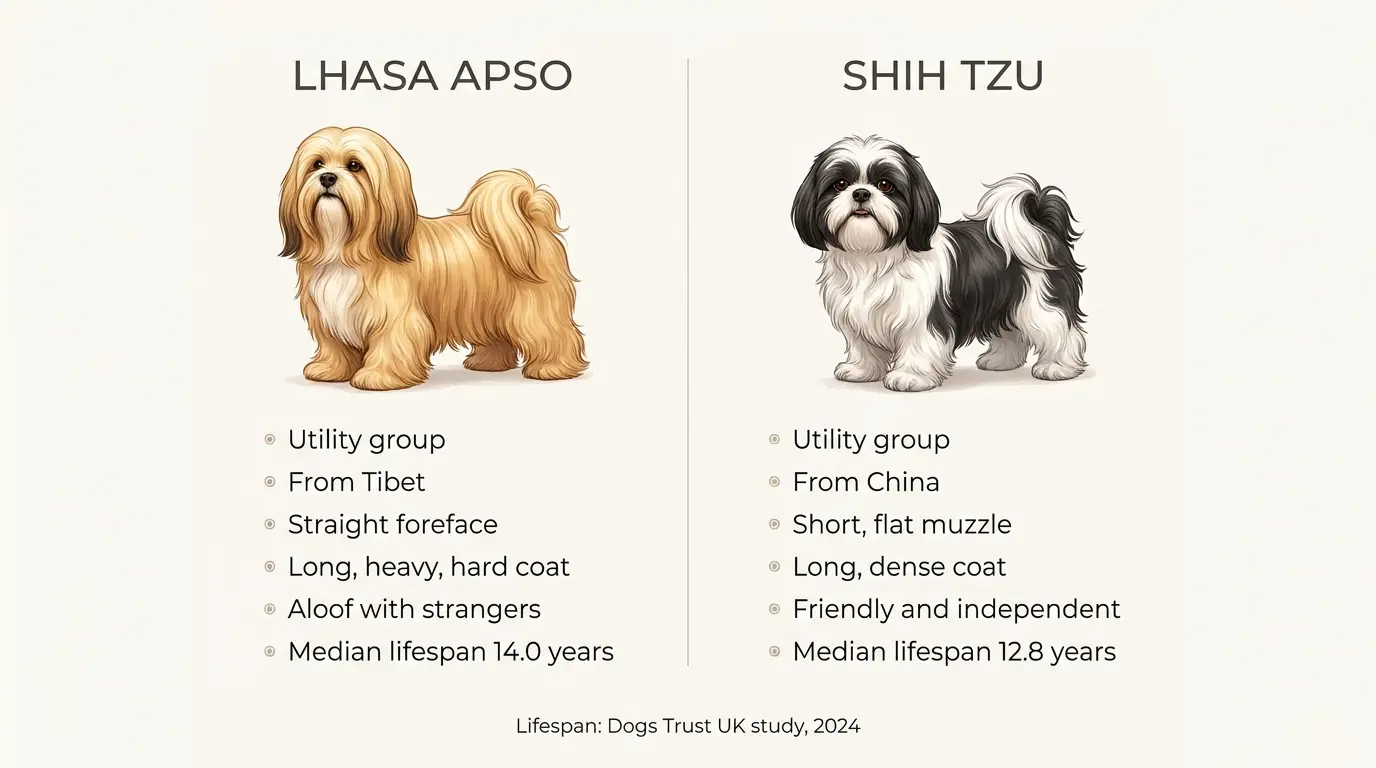
How to Tell a Lhasa Apso From a Shih Tzu
The two breeds are easy to mix up. Both are small, long-coated dogs with drooping, heavily coated ears and a tail carried over the back. The clearest differences are in the head, then the coat.
Face and head
The Lhasa Apso has a moderately narrow skull that the breed standard says should not be domed or apple-headed. Its foreface is straight, and the muzzle is about 4cm long, roughly a third of the length from the nose to the back of the skull. The eyes are medium-sized and oval.
The Shih Tzu’s head is broad and round. Its muzzle is short, square and flat, with the nose roughly 2.5cm (one inch) from the tip to the stop. The hair on the muzzle grows upwards, which gives the breed its “chrysanthemum-like” face. The eyes are large and round.
The bite differs too. The Lhasa standard asks for a reverse scissor bite, with the upper teeth closing just inside the lower teeth. The Shih Tzu standard allows a slightly undershot or level mouth.
Coat
The Lhasa’s top coat is long, heavy, straight and hard, and the standard says it should be neither woolly nor silky. The Shih Tzu’s outer coat is long and dense, not curly, with a slight wave permitted. Both breeds have a moderate undercoat.
Colour won’t settle the question. Both breed standards allow almost any colour except merle.
Size
The two breeds are close in height. The Royal Kennel Club standard gives an ideal height of 25cm for a male Lhasa Apso, with bitches slightly smaller, and gives no weight. The Shih Tzu standard sets a maximum height of 27cm and a weight of 4.5–8kg.
The Royal Kennel Club points out that these figures describe the ideal, not a promise, so individual dogs of either breed can be larger or smaller.
Where the Two Breeds Come From
According to the Royal Kennel Club, the Lhasa Apso was kept for centuries by Tibetan monks as a companion and watchdog, and was known as the “Talisman Dog”. It was recognised by the Kennel Club in 1908, and at first it was grouped with the Tibetan Terrier as the “Lhasa Terrier”. The two breeds were separated in 1934.
The Shih Tzu is generally accepted to have originated in China with Tibetan ancestry, and was once known as the “Lhasa Lion dog”. The Royal Kennel Club notes that the Pekingese may also have played a part in its development.
The shared history explains a lot of the confusion. When the first Shih Tzus were shown in England in 1933, they were shown alongside Lhasa Apsos, and the difference in head type soon established them as separate breeds. The Shih Tzu Club of England was founded in 1934, and the breed was officially recognised in the 1940s.
Lhasa Apso vs Shih Tzu Temperament
The breed standards describe two quite different characters.
The Lhasa Apso standard describes the breed as “alert, steady but somewhat aloof with strangers” and “gay and assertive”. PDSA notes that Lhasas can be a little warier of strangers. It also notes that they can be quite stubborn, which can make training more of a challenge.
The Shih Tzu standard describes the breed as “friendly and independent” and “intelligent, active and alert”. According to PDSA, Shih Tzus were bred mainly as companions but were also used as watchdogs to announce visitors. PDSA also says they are eager to learn and usually take well to reward-based training, which makes them a good fit for first-time owners.
Both breeds may let you know when someone is at the door, so neither should be chosen as “the quiet one”. No UK study has compared the behaviour of the two breeds directly. What’s written here comes from the breed standards and PDSA guidance, and individual dogs vary a great deal within any breed. PDSA also says both breeds can get on well with children and other pets when they’re well socialised, and advises supervising dogs around children.
Lifespan and Health
Which lives longer?
The best UK data comes from the 2024 Dogs Trust study of over half a million UK dogs across 155 breeds.
- Lhasa Apso: median lifespan of 14.0 years (95% confidence interval 13.9–14.2; 7,216 dogs, 2,723 of them deceased).
- Shih Tzu: median lifespan of 12.8 years (95% confidence interval 12.6–12.9; 12,007 dogs, 5,894 of them deceased).
Both samples are large and the ranges don’t overlap, so in this study the Lhasa Apso had the longer median lifespan. For comparison, the median across all purebred dogs in the study was 12.7 years. You can read the full study on the Dogs Trust breed longevity page, and see how both breeds compare with others in our guide to dogs with the longest lifespan.
A separate RVC study of Shih Tzus under UK veterinary care found an average age at death of 12.7 years. That’s a different measure from a median life expectancy, but it points in the same direction.
Shih Tzu health
The RVC’s VetCompass programme studied the veterinary records of 11,082 Shih Tzus. Dental (periodontal) disease was the most common problem, diagnosed in 9.5% of Shih Tzus each year. Anal sac impaction and ear disorders came next. The researchers found the breed predisposed to eye problems, but overall its pattern of common disorders was closer to that of dogs in general than to flat-faced breeds such as French Bulldogs and Pugs. Because dental disease tops the list, tooth care matters; our guide to cleaning dog teeth without brushing covers the alternatives.
Breathing is the other issue to know about. A 2026 University of Cambridge study placed the Shih Tzu among five breeds at moderate risk of brachycephalic obstructive airway syndrome (BOAS). Across those five breeds, half to three-quarters of the dogs studied were affected to some degree. Being overweight was a significant risk factor in Shih Tzus, and so were shorter tails. The Shih Tzu is now covered by the Royal Kennel Club and University of Cambridge Respiratory Function Grading Scheme (RFGS), which grades dogs from 0 (no signs of BOAS) to 3 (severe signs).
Before you buy a Shih Tzu puppy: The Royal Kennel Club advises puppy buyers, for breeds covered by the breathing scheme, to make sure both parents have been tested under it. Ask the breeder for both parents’ respiratory function grades.
Lhasa Apso health
There’s no Lhasa-specific VetCompass study, so the best UK guidance comes from PDSA. The conditions it lists for the breed include slipping kneecaps (luxating patellas), progressive retinal atrophy, dry eye, cherry eye and intervertebral disc disease. The Lhasa Apso is not covered by the breathing scheme.
When to see your vet: A breed’s health risks describe the breed, not your individual dog. If you notice noisy breathing, sore or cloudy eyes, bad breath or limping, speak to your vet.
For a wider look at breed-related conditions, see our guide to dog breeds with common health problems. If you’re weighing up other flat-faced companions, our Pug vs French Bulldog comparison covers two breeds where breathing is a bigger concern.
Grooming and Daily Care
Both breeds need grooming every day and up to an hour of exercise a day, according to the Royal Kennel Club. Both are listed as suitable for a flat.
For the Shih Tzu, PDSA says a daily brush keeps the coat free of knots. Unless the dog is being shown, most owners keep the coat clipped every 6–8 weeks, usually by a professional groomer. The hair on the face grows upwards and needs occasional trimming. Food can collect around the mouth, and gunk can gather in the corners of the eyes, so both areas need gentle cleaning. The breed standard recommends tying up the hair on the head.
The Lhasa Apso’s head hair falls over its eyes, but the breed standard says it must not affect the dog’s ability to see. Keeping that hair trimmed or tied back is part of everyday care. The hard, heavy coat needs daily attention to stop it matting.
If you’re putting together a grooming kit for either breed, our guide to the different types of brushes for dogs explains which brush does what.
Which Breed Suits Which Owner?
Neither breed is better. They suit different homes.
A Lhasa Apso may suit you if you’re happy with a dog that’s alert and somewhat reserved with visitors, you’re patient with training, and you want a longer-muzzled breed that isn’t covered by the breathing scheme.
A Shih Tzu may suit you if you want a dog whose breed standard calls it friendly, and you’re prepared for the extra checks. That means keeping it lean, keeping on top of dental care and checking both parents’ breathing grades before you buy.
Both need daily coat care, and both fit flat living if they get their daily exercise. For more breed comparisons, browse our breed guides.
Frequently Asked Questions
What is the main difference between a Lhasa Apso and a Shih Tzu?
The main difference is the face. The Lhasa Apso has a straight foreface and a muzzle of about 4cm, while the Shih Tzu has a short, flat, “chrysanthemum” face. Their coats differ too: the Lhasa’s is hard, the Shih Tzu’s is dense with a slight wave. Their breed standards also describe different temperaments.
Which is bigger, a Lhasa Apso or a Shih Tzu?
They’re very close in size. The Royal Kennel Club standard gives an ideal height of 25cm for a male Lhasa Apso and a maximum of 27cm for a Shih Tzu. Only the Shih Tzu standard gives a weight, of 4.5–8kg. Individual dogs of either breed can be larger or smaller than the standard.
Which lives longer, a Lhasa Apso or a Shih Tzu?
In the 2024 Dogs Trust study of UK dogs, the Lhasa Apso had a median lifespan of 14.0 years and the Shih Tzu 12.8 years. Both samples were large (over 7,000 Lhasas and 12,000 Shih Tzus) and the ranges didn’t overlap. Both breeds lived longer than many larger breeds.
Do Lhasa Apsos have breathing problems like Shih Tzus?
The Shih Tzu is a flat-faced breed that a 2026 Cambridge study placed at moderate risk of BOAS, and it’s covered by the Royal Kennel Club’s breathing grading scheme. The Lhasa Apso has a longer, straight foreface and isn’t on the scheme. Any dog with noisy or laboured breathing should still see a vet.
Are Lhasa Apsos and Shih Tzus toy breeds?
Not in the UK. The Royal Kennel Club lists both the Lhasa Apso and the Shih Tzu in the Utility group, which covers breeds originally kept for a particular job. Some countries class the Shih Tzu as a toy breed, which is why you’ll see that label on non-UK websites.
