
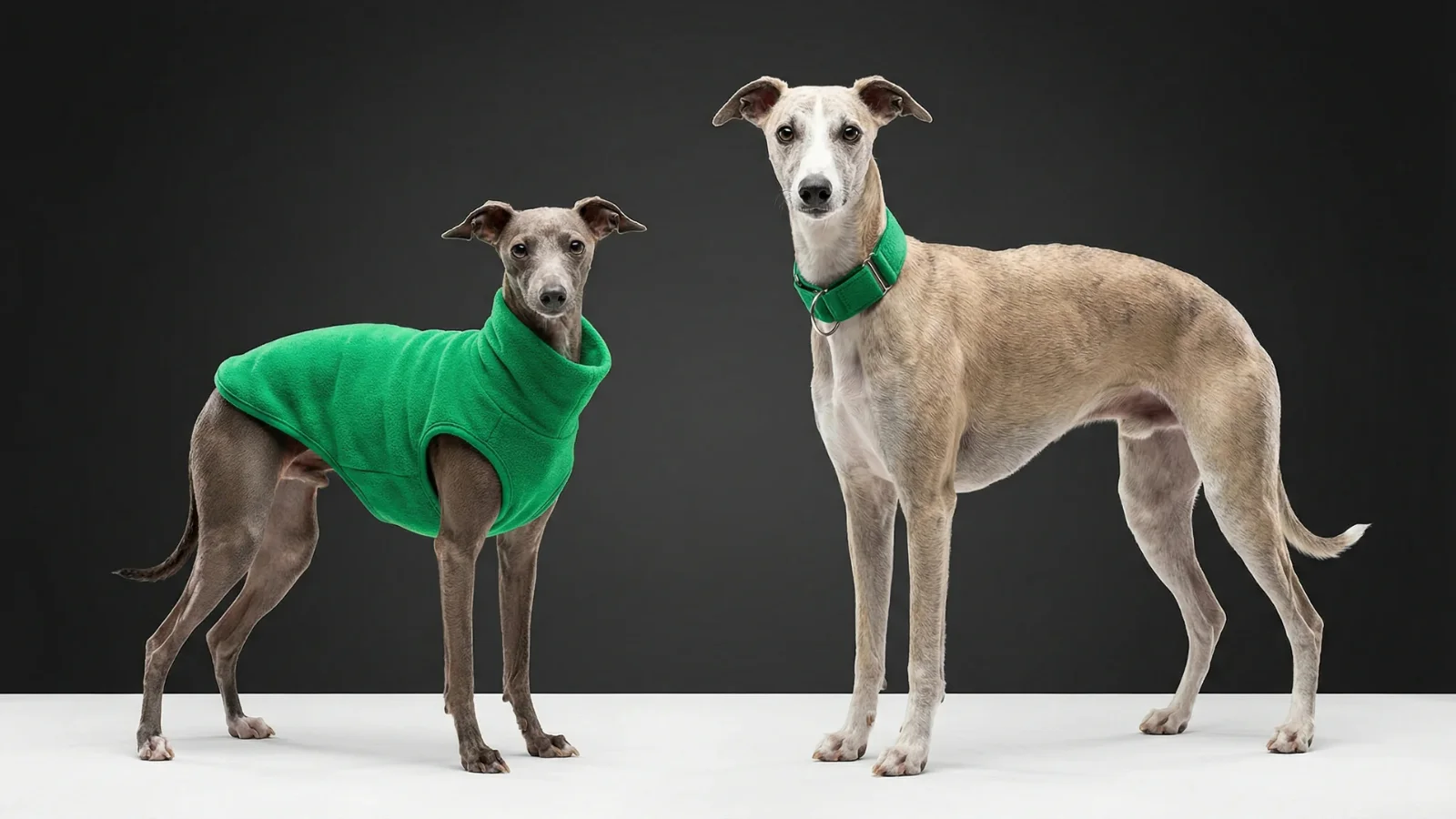
At a glance, you might think you are looking at the same dog in two different font sizes. It is the most common misconception we hear at FlexK9: “Oh, look at the miniature greyhound!”
While both the Italian Greyhound (“Iggy”) and the Whippet share the iconic sighthound silhouette—deep chests, tucked waists, and aerodynamic heads—they are distinctly different breeds with vastly different needs. They aren’t just scaled-up or scaled-down versions of one another; they are unique dogs suited to very different types of owners.
If you are torn between the portable elegance of the Italian Greyhound and the athletic versatility of the Whippet, this guide will strip away the fluff. We are looking at the honest realities of owning these breeds in the UK—from the notorious house-training struggles of the Iggy to the high prey-drive challenges of the Whippet.
Quick Comparison: Italian Greyhound vs Whippet
| Feature | Italian Greyhound | Whippet |
|---|---|---|
| Size | Toy | Medium |
| Weight | 3.6–5 kg | 11–18 kg |
| Fragility | Very Delicate | Moderately Robust |
| House Training | Often Difficult | Usually Straightforward |
| Prey Drive | Moderate | High |
| Exercise Needs | Low–Moderate | Moderate (Sprint Based) |
| Separation Anxiety Risk | High | Moderate |
| Best For | Quiet Homes | Active Families |
TABLE OF CONTENTS
Physical Differences: An Italian Greyhound vs Whippet Size Comparison
In any Italian Greyhound vs Whippet comparison, the most striking factor is the bone density. Whippets are built for the rugged UK outdoors, whereas the Italian Greyhound’s delicate frame makes it much more susceptible to injury. This is a primary consideration for families weighing up the Italian Greyhound vs the Whippet for a household with small children.
The Whippet is a medium-sized dog. They are sturdy, muscular, and robust enough to handle a bit of rough-and-tumble play. They were originally bred for racing and rabbit coursing, meaning they are built for explosive power. In a UK family home, a Whippet can generally hold its own with children or other dogs (provided they are gentle).
The Italian Greyhound, conversely, is a Toy breed. They are fine-boned and elegant, often described as looking like porcelain. This beauty comes with a risk: they are fragile. Leg breaks are a terrifyingly common and expensive reality for Iggy owners, often caused by something as simple as jumping off a sofa.
Size Comparison Table (UK Metrics)
| Feature | Italian Greyhound (IG) | Whippet |
| Height | 32–38 cm (at shoulder) | 44–51 cm (at shoulder) |
| Weight | 3.6–5 kg | 11–18 kg |
| Bone Structure | Very Fine / Delicate | Medium / Athletic |
| Coat Type | Very Short, Single Coat | Short, Fine to Dense |
| Cold Tolerance | Very Low (Shiver easily) | Low (Need coats in winter) |
Temperament and Training: The Clingy vs. The Chill
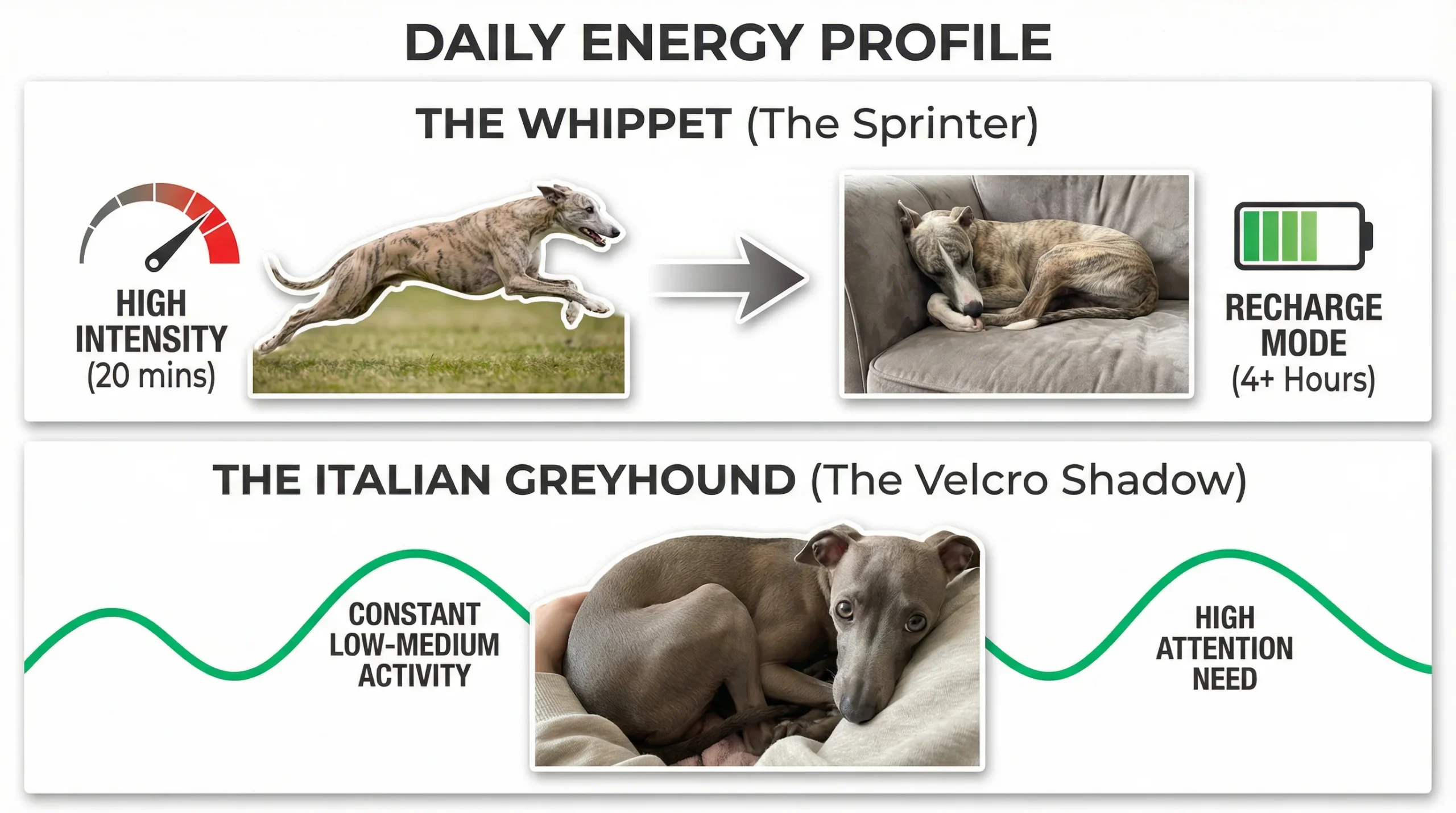
While both breeds love a cuddle, the intensity of their affection differs.
Italian Greyhounds are often called “Velcro dogs.” They do not just want to be near you; they want to be on you. They are intensely affectionate, often sleeping under the duvet with their owners. However, this deep bond often manifests as separation anxiety. An Iggy left alone for long periods is often a distressed Iggy.
Whippets are affectionate but independent. They have a fantastic “on/off” switch. They will run around like lunatics for 20 minutes (the famous “zoomies”) and then sleep for the next four hours. They are generally happier to snooze on the sofa while you work from home, whereas an Iggy will likely be demanding your attention.
The House-Training Reality
We promised honesty, so here it is: Italian Greyhounds are notoriously difficult to house train.
- Many Iggies never become 100% reliable, especially in British weather. If it is raining (and let’s face it, it’s the UK, so it usually is), an Iggy may simply refuse to go outside.
- Whippets are generally much easier to house train, though they also dislike the rain. A Whippet can usually be persuaded with a treat and a waterproof coat; an Iggy may still refuse.
Exercise and Living Requirements in the UK
Do you live in a flat in London or a house with a garden in the Cotswolds? Your environment plays a huge role in which breed is better for you.
The Whippet: The 30mph Couch Potato
Whippets are sprinters. They need a good gallop to burn off steam, but they do not need hours of marching.
- Exercise: Two 30–45 minute walks a day, ideally with some off-lead time in a secure area.
- Prey Drive: This is the Whippet’s biggest management challenge. If a squirrel or a cat runs, a Whippet will chase it. Their recall can vanish in a split second.
- Fencing: You need a secure garden. A Whippet can easily clear a low fence if they spot something interesting. 5-6ft fencing is the standard recommendation.
You also need to consider safety during transport; due to their fragile frames, proper dog car travel setups are vital to prevent injury on the road.
The Italian Greyhound: The Indoor Sprinter
Because of their size, an Iggy can actually burn a lot of energy running circles around your living room.
- Exercise: They still need walks (mental stimulation is vital), but 20–30 minutes twice a day is often sufficient.
- Safety: You must be hyper-vigilant about other dogs. A friendly Labrador body-slamming an Iggy at the park can result in a trip to the emergency vet. Many Iggy owners prefer on-lead walking or “small dog only” meet-ups.
The “Sighthound wardrobe” is mandatory for both. In the UK, you will need to invest in jumpers, fleeces, and waterproof coats. These breeds have very little body fat and thin fur. If you feel cold, they are freezing.
Health, Lifespan, and Care Costs
Both breeds are generally healthy and often reach 12–15 years, placing them firmly among the dogs with longest lifespan. However, their specific health risks are quite different and should factor into your budget (and insurance policy).
Italian Greyhound Health Watch
- Leg Fractures: As mentioned, the radius/ulna breaks are common in the breed. Surgery to fix this can cost £3,000–£5,000+ per leg.
- Dental Disease: Their small mouths often lead to overcrowding and decay. Daily brushing and professional scaling are non-negotiable. If your Iggy refuses a brush, you must explore how to clean dog teeth without brushing to prevent serious gum issues.
- Epilepsy: There is a known prevalence of epilepsy in some lines.
Because of their fragility, many end up needing help. We strongly recommend visiting the Italian Greyhound Rescue Charity to understand the real-world commitment required.
Whippet Health Watch
- Skin Tears: Their skin is thin. Running through brambles or a rough play session can result in skin tears that require staples or stitches.
- Heart Issues: Mitral Valve Disease can occur, so annual vet checks are important.
- Corns: Whippets can suffer from corns on their paw pads, which can be painful and tricky to treat. Sighthounds have fast-growing claws, so knowing dog broken nail home treatment is essential if they snag one while sprinting.
Who is the Italian Greyhound For?
- The Apartment Dweller: You have limited space but plenty of time.
- The Home-Worker: You work from home and want a constant companion on your lap.
- The Gentle Handler: You are happy to manage a delicate dog and don’t have boisterous children or large, clumsy pets.
- The Patient Trainer: You can handle the frustration of slow house training and separation anxiety.
Who is the Whippet For?
- The Active Family: You want a dog that can join in with family walks and play (respectfully) with older children. Their gentle nature is exactly why they consistently rank highly among the best family dogs UK.
- The “Best of Both Worlds” Seeker: You want a dog that is up for a hike but equally happy to binge-watch Netflix on a rainy Sunday.
- The Robust Sighthound Lover: You love the sighthound look and personality, but need a dog that isn’t quite so fragile.
The Verdict: Which is Better, the Italian Greyhound vs Whippet?
If you want a robust, versatile family companion that brings the elegance of a sighthound without the fragility, the Whippet is the clear winner for most UK households. They balance energy and calmness perfectly.
If you want a devoted, baby-like companion and are prepared to manage the fragility and toileting quirks, the Italian Greyhound offers a bond like no other. They are ideal for quiet homes where they will be the centre of your universe.
Next Step: Would you like me to generate the SEO Pack (Title, Alt Text, Captions) for the images you plan to add later, or shall we move on to drafting a social media post to promote this blog?
Frequently Asked Questions
Are Whippets and Italian Greyhounds hypoallergenic?
No, neither breed is hypoallergenic. While they have very short coats and produce less dander than a double-coated breed like a German Shepherd, they do shed. They produce oils and dander that can trigger allergies. However, their low-shedding nature makes them easier to live with for mild allergy sufferers compared to other breeds.
Can Whippets and Italian Greyhounds live with cats?
This is a risky area. Whippets have a high prey drive and are generally not recommended for households with cats unless they are raised with them from puppyhood—and even then, caution is required. Italian Greyhounds have a lower prey drive and, due to their small size, are often safer with cats, though they may still chase them for fun.
Do sighthounds bark a lot?
Generally, no. Both breeds are considered relatively quiet indoors. They will bark to alert you to a knock at the door, but they are not “yappy” dogs like some terriers. However, an Italian Greyhound with separation anxiety may howl or bark when left alone.
Why are Italian Greyhounds so expensive to insure?
Insurance premiums for Italian Greyhounds are often higher than for Whippets due to the high risk of leg fractures. These breaks are complex to fix and require specialist orthopaedic surgery. Insurers factor this high likelihood and high cost into the monthly premium.
Can I let my Whippet off-lead in the UK?
Only in safe, enclosed areas away from roads and livestock. Sighthounds hunt by sight; if they spot a rabbit, squirrel, or deer, they will lock onto it and run. No amount of recall training can 100% guarantee they will stop mid-chase. We recommend using a long line or renting secure “dog fields” for free running.
Do they need special collars?
Yes. Both breeds have heads that are narrower than their necks, meaning they can easily slip out of a standard flat collar. You must use a “Martingale” collar or a “Fishtail” collar (wide in the middle, tapered at the ends), which tightens gently if the dog pulls, preventing escape without choking them. To fully understand the safety benefits for thin-necked breeds, read our comparison on dog harness vs collar before buying your walking gear.
Are they good apartment dogs?
Yes, both are excellent apartment dogs, provided they get their daily walks. They are clean, quiet, and love to sleep. However, the Italian Greyhound is slightly better suited to smaller flats due to their tiny size, whereas a Whippet might find a studio apartment a bit cramped during their “zoomie” moments.
