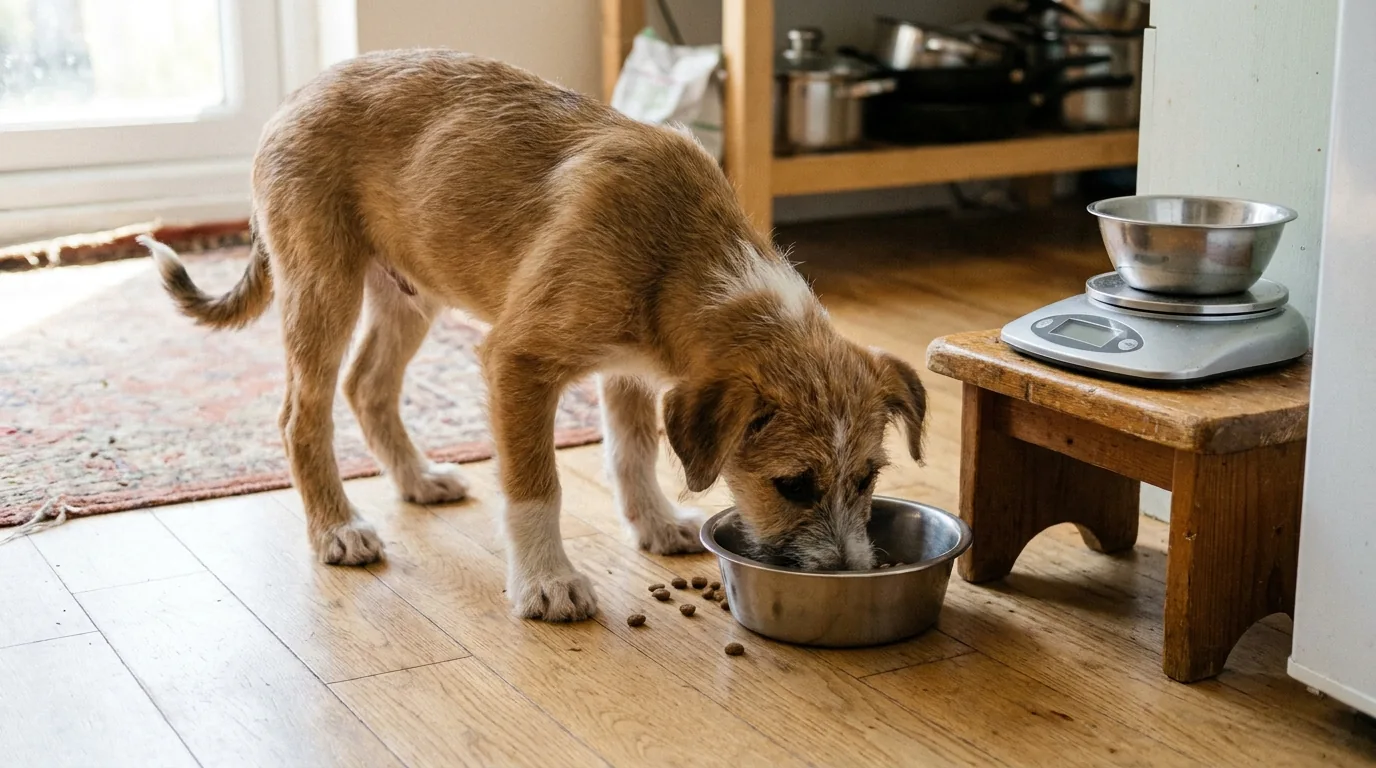
Wondering how much to feed a puppy? Start with the feeding guide on the packet, weigh out that daily amount and split it into small meals: about four a day for a young puppy, dropping to two by around six months. Then keep an eye on your puppy’s shape, weigh them regularly and adjust the amount as they grow.
This guide brings together the puppy feeding advice of four UK sources: PDSA, Blue Cross, Dogs Trust and the Royal Kennel Club. They agree on most things and differ on a few timings, so where they differ we show each one rather than averaging them. We’ve also added what we did with our own dog, Dexter, a Cane Corso we raised from a puppy. Where UK sources say nothing, we’ve said so.
TABLE OF CONTENTS
How much to feed a puppy each day
The feeding guide on your puppy’s food is the place to start. It tells you how much of that food your puppy needs each day for their age, depending on what they’ll weigh as an adult, PDSA’s Weigh Up puppy guide explains. Some packet guides go by your puppy’s current weight instead, so check which yours uses. If it’s the expected adult weight, the Royal Kennel Club suggests asking the breeder how big the puppy’s parents are.
Treat that figure as a starting point, not a target. Blue Cross suggests starting with the smallest recommended amount for your puppy’s age and size, and only increasing it if your puppy starts to look thin.
Weigh the daily amount on digital kitchen scales, which is much more accurate than a measuring cup, then split it across the day’s meals. As your puppy grows, adjust the amount and weigh your puppy regularly to keep track of their growth. All of that comes from PDSA, whose guide to your dog’s diet also covers choosing a complete, life stage food.
No UK chart in grams: use the packet instead
You’ll find puppy feeding charts online that give grams by weight or age. We couldn’t find one from any UK vet charity or the Royal Kennel Club, and none of them publishes a puppy food calculator. The right amount depends on the food itself as well as your puppy’s weight, age, activity and health, and PDSA’s vets say there’s no single number that suits every pet. The chart on your puppy’s own food is the one to use, and your vet or vet nurse can help if you’re unsure.
Puppy meals a day: what each UK source says
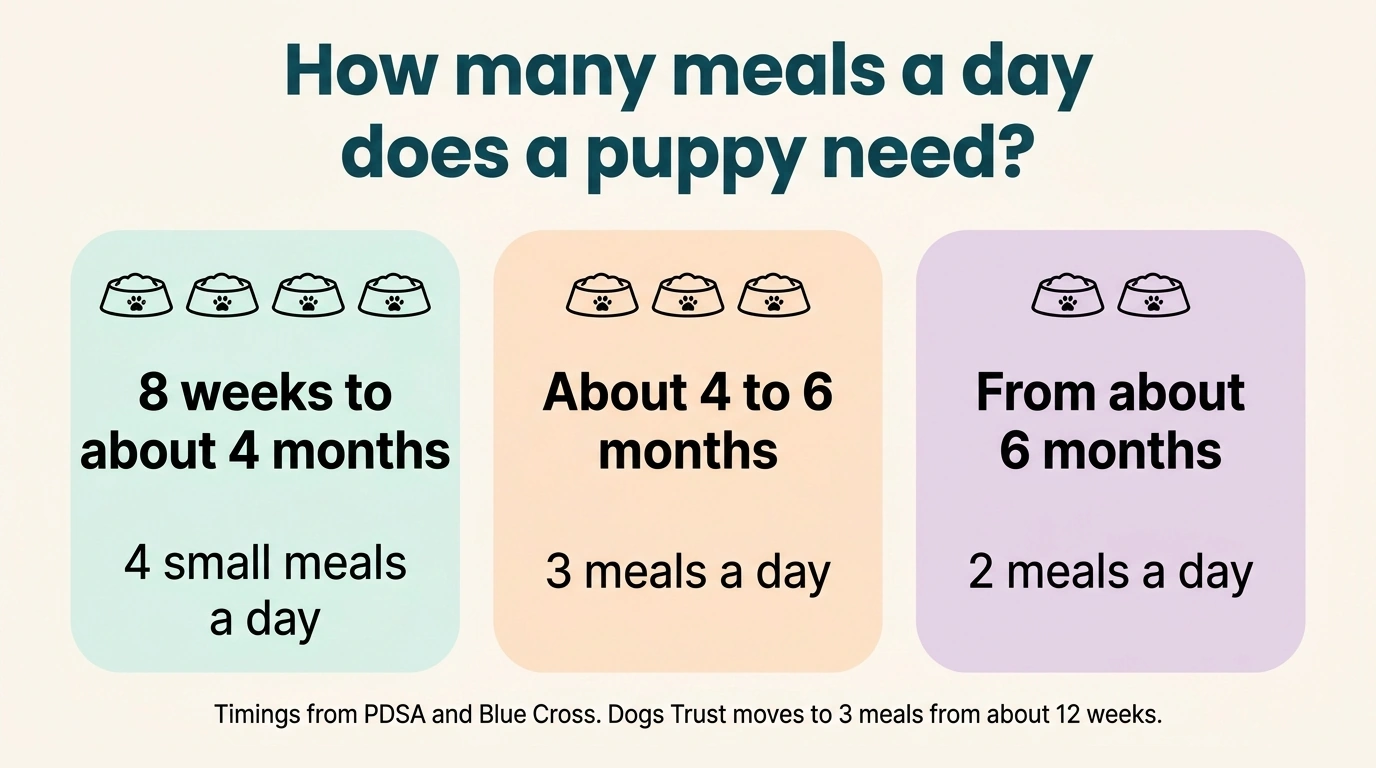
Puppies have small tummies, so their daily food is split into small meals fed regularly through the day. The number of meals falls as they grow. Here’s what each source says:
| Source | First weeks at home | Next step down | From about six months |
|---|---|---|---|
| PDSA (Weigh Up puppy guide) | 4 meals a day from 8 to 16 weeks | 3 meals a day from 16 weeks to 6 months | 2 meals a day from 6 months |
| Blue Cross | 4 meals a day from 8 weeks to 4 months | 3 meals a day from 4 months | 2 meals a day from 6 months, for life |
| Dogs Trust | 4 meals a day under 12 weeks | 3 meals a day from about 12 weeks | 2 meals a day from 6 months |
| Royal Kennel Club | 4 to 6 meals a day at weaning (around 2 months), then 4 from 2 to 3 months | 2 to 3 meals a day from 4 to 6 months | 2 meals a day over 6 months, depending on the breed |
All four start young puppies on four meals a day and have them on two by about six months. The difference is when to drop to three meals, which ranges from about 12 weeks to around four months. PDSA calls its timings a guideline only, because individual puppies vary, and Dogs Trust suggests asking your vet before you cut down a meal.
Spacing meals through the day
When you feed is up to you. Blue Cross recommends spacing meals evenly through the day and keeping to the same times, so your puppy settles into a routine. We found no UK source that sets out clock times, so fit the meals around your own day.
Give each meal in a quiet spot where your puppy won’t be disturbed, and don’t feed right before or after exercise. The Royal Kennel Club links feeding around exercise to a life-threatening condition called bloat, and Blue Cross also advises a quiet spot and no strenuous exercise straight after eating. Fresh water should always be available, Dogs Trust adds.
Is your puppy eating the right amount?
Your puppy’s shape is the best everyday check. Look down from above: their waist should curve in to give an hourglass shape, and you should be able to feel their ribs through a thin layer of fat without the ribs being highly visible. If your puppy looks oval from above, they’re probably getting too much, and if the hourglass is very pronounced, they may be underweight. That’s Blue Cross’s advice.
Too much food can do harm. Overfeeding a puppy may cause excessive weight gain, an upset stomach or, particularly in larger breeds, bone deformities, the Royal Kennel Club warns. Feeding little and often helps to stop a puppy overeating, which can cause constipation or diarrhoea. For most dogs, leaving food out all day isn’t a good idea either, as it can lead to overeating. Both points come from PDSA.
Weigh your puppy regularly too. No UK source publishes a month-by-month puppy weight chart, so we don’t give one, but the Royal Kennel Club suggests asking your vet whether they can supply a growth chart. Our Rottweiler weight chart and Cane Corso size guide explain what UK figures exist for adult dogs of those breeds.
When to see your vet: Speak to your vet or vet nurse if your puppy isn’t finishing their meals, seems to be losing weight, looks oval from above, or you’re not sure when to cut down a meal. All four UK sources in this guide point owners to their vet for help with a puppy’s diet.
Do treats count? Training rewards and leftovers
They do. Treats should make up no more than 10% of your puppy’s daily food, with their meals cut back to allow for them, PDSA and Dogs Trust both advise. A few pieces of your puppy’s daily kibble make good training rewards, and a small piece of plain steamed chicken breast or a flake of white fish is a low-fat reward, according to PDSA’s puppy guide.
Puppies don’t need milk once they’ve been weaned. Blue Cross advises never giving puppies milk or other dairy products, and PDSA’s vets say it adds extra calories and can upset their tummy.
Keep table scraps out of the bowl as well. The charity gives the reasons: leftovers can leave a puppy short of vital nutrients, many are high in fat, sugar and salt, they can put a puppy off their own food, some human foods are poisonous and they encourage begging at mealtimes. Never give cooked bones, which can break into small pieces and cause damage, the Royal Kennel Club adds.
Switching a new puppy onto a different food
When your puppy first comes home, keep them on the food and routine they’re used to, as sudden changes can upset their tummy. PDSA’s Weigh Up guide suggests asking the breeder these four questions before you bring your puppy home:
- What food are they used to eating?
- How many times a day do they eat?
- What time of day do they eat?
- How much food are they eating?
If you want to switch foods, give your puppy a few weeks to settle in first, then make the change gradually. The charities give slightly different timescales: 7 to 14 days in PDSA’s puppy guide, a week to 10 days from Blue Cross, and a few days to a week from Dogs Trust. In each case, start with a small amount of the new food and slowly increase it while reducing the old one. If your puppy’s tummy is upset, our guide to dog diarrhoea and vomiting covers when to call your vet.
Puppy food or adult food: when to change
Puppies need puppy food while they’re growing, and the right time to switch depends mostly on their size. As a general rule, small dogs stay on puppy food until around a year old and large or giant breeds until around 18 months, PDSA’s vets say. Blue Cross suggests a labelled puppy food until about a year, and notes that your vet may recommend a large or giant breed puppy food for longer. Dogs Trust puts it simply: puppies can move onto adult food once they’ve stopped growing.
Neutering can affect the timing too, according to PDSA, and neutered dogs generally need fewer calories, so their food may need adjusting once they’ve fully recovered from the operation. The pack usually gives a guide, and your vet can tell you when your own puppy is ready. Our guides to small breed dog food and large breed dog food cover the adult years.
Sharing food between puppies and adult dogs
Puppies need puppy food: adult dog food doesn’t contain the right balance of nutrients for growth, PDSA says. The reverse matters too. The charity and Dogs Trust both advise feeding each dog a food made for their life stage, and Blue Cross notes that puppy food contains extra calories for growth.
We found no UK source that says what happens if an adult dog eats a little puppy food now and then, so if your older dog keeps helping themselves, ask your vet. When a new puppy arrives, PDSA suggests feeding your dogs away from each other, so neither can guard their food and each gets the right diet.
Feeding puppies of different sizes
Larger breeds mature more slowly and need a puppy food that supports bone and joint health through a growth phase that can last up to two years in giant breeds, PDSA’s puppy guide explains. Smaller breeds mature earlier and need a smaller kibble. That’s why its vets suggest looking for puppy foods labelled for large or giant breeds, or for toy or small breeds.
We cover the foods themselves in separate guides: large breed puppy food, small breed puppy food and, for one popular breed, Golden Retriever puppy food.
From our home: Our Cane Corso, Dexter, had several meals a day as a puppy. He started on puppy kibble and wet food, then moved onto a giant breed puppy food and, from about eight or nine months, a junior food. We didn’t keep a record of how much he ate each day, so we can’t give his amounts. He’s nearly five now and eats an adult food. The puppy food he ate is marked in our large breed puppy food guide.
Final thoughts: getting puppy feeding right
Getting how much to feed a puppy right comes down to a few steady habits:
- If your puppy has just come home, keep the breeder’s food and routine, then change slowly.
- If you’re unsure how much to give, start with the packet’s smallest amount for their age and weigh it.
- If your puppy is young, four small meals a day is where all four UK sources start.
- If your puppy is around six months old, they can usually move to two meals a day.
- If your puppy looks oval from above, cut back a little and talk to your vet.
Frequently Asked Questions About How Much to Feed a Puppy
How much food should a puppy eat each day?
It depends on the food and your puppy, so start with the feeding guide on the packet for their age and expected size. Blue Cross suggests beginning with the smallest recommended amount and increasing it only if your puppy looks thin. Weigh the daily amount, split it into meals and check your puppy’s shape as they grow.
How many times a day should I feed my puppy?
Young puppies usually have four small meals a day. PDSA and Blue Cross reduce this to three at around four months and Dogs Trust from about 12 weeks. All four UK sources we checked have puppies on two meals a day by about six months, and your vet can advise on your own puppy.
When can a puppy go down to two meals a day?
At around six months, according to PDSA, Blue Cross, Dogs Trust and the Royal Kennel Club, though the Royal Kennel Club says it can depend on the breed. Blue Cross suggests keeping a morning and evening meal for life. If you’re not sure your puppy is ready, ask your vet before cutting a meal.
Can adult dogs eat puppy food?
It isn’t what UK charities advise as an everyday diet. PDSA and Dogs Trust recommend a food made for your dog’s life stage, and Blue Cross notes that puppy food has extra calories for growth. We found no UK guidance on an adult dog eating a little puppy food now and then, so ask your vet if it keeps happening.
Should I leave food out for my puppy all day?
Not for most puppies. PDSA says leaving food out all day, known as free feeding, can lead to overeating. Set meals at regular times help your puppy settle into a routine, and the Royal Kennel Club suggests checking that your puppy finishes their food. Fresh water, though, should be available all the time.
Can I use an online puppy food calculator?
You can, but we found no puppy food calculator from a UK vet charity or the Royal Kennel Club. The feeding guide on your puppy’s food is written for that food, so it’s the better starting point. Weigh the amount, check your puppy’s shape regularly and ask your vet or vet nurse if you’re unsure.
