
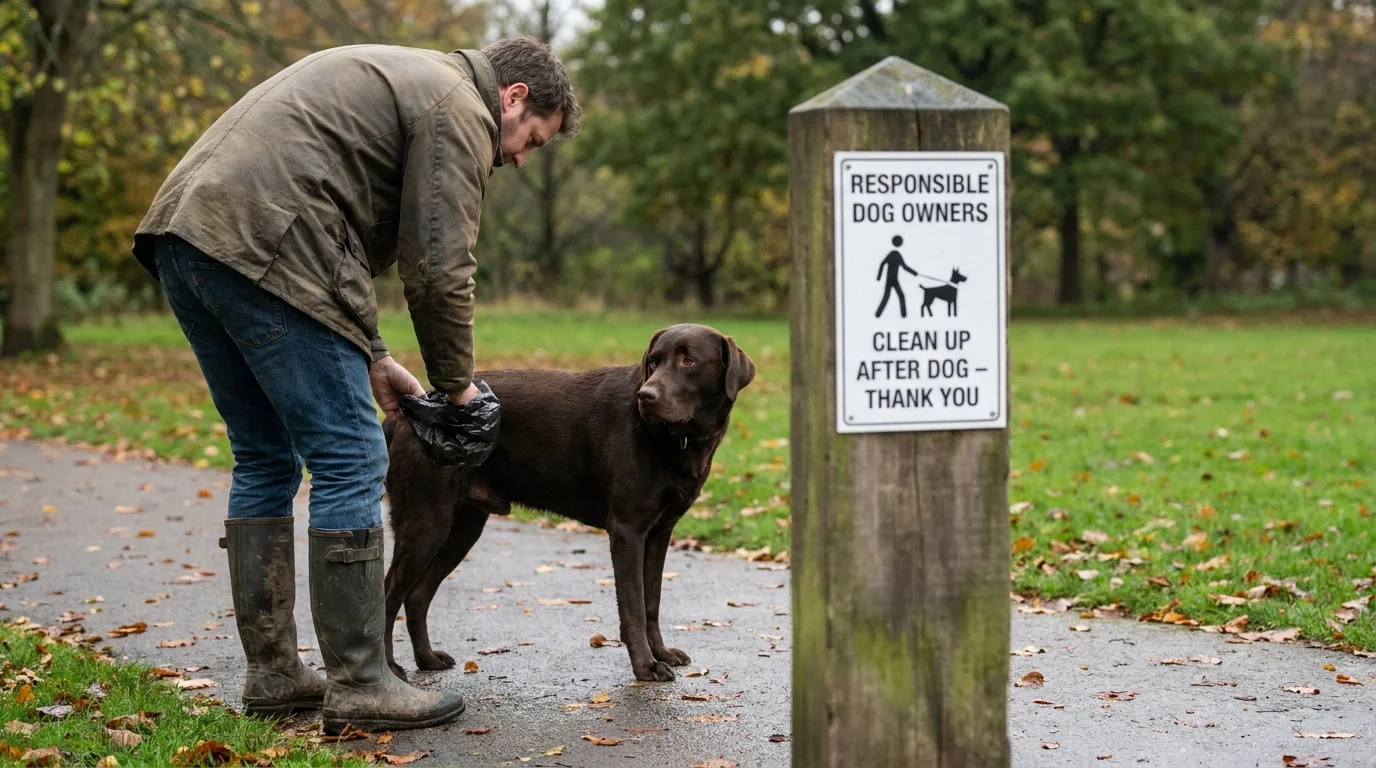
Step in dog mess on a UK pavement and you’ve experienced one of the country’s most common — and most avoidable — public nuisances. Councils estimate the UK’s dogs produce over 1,000 tonnes of waste every day, and dog fouling consistently ranks among the most complained-about issues in public spaces.
What most owners don’t realise is how much teeth the law actually has. It’s not just a strongly worded council sign — failing to clean up after your dog is a specific criminal offence, with fines that vary far more by area than the “up to £100” figure most guides quote, and real prosecutions that go well beyond that. Here’s what dog fouling law UK residents need to know: what it actually costs, and what your genuine legal responsibilities are.
TABLE OF CONTENTS
Dog Fouling Law UK: What It Actually Says
The legislative history here is more layered than most guides let on. The Dogs (Fouling of Land) Act 1996 was the original UK-wide law making it an offence to fail to clean up after your dog on “designated land” — but it’s worth knowing this Act was actually repealed in 2006 (England) and 2007 (Wales), replaced first by “dog control orders” under the Clean Neighbourhoods and Environment Act 2005.
Today, the operative mechanism is the Public Spaces Protection Order (PSPO), introduced under the Anti-social Behaviour, Crime and Policing Act 2014, which explicitly replaced dog control orders alongside several other older powers. A PSPO lets a council restrict specific behaviours — including dog fouling — across a defined area, and issue Fixed Penalty Notices (FPNs) to anyone who breaches it. West Suffolk Council, for example, enforces fouling specifically under its “Public Spaces Protection Order (Dogs) 2020.”
The practical difference doesn’t matter much day-to-day — either way, failing to clean up after your dog in a public place is an offence, and either way you can be fined. But it explains why exact fine amounts and boundaries differ by council: each PSPO is set locally, not nationally. Dog fouling isn’t the only rule shaping how you walk your dog in the UK, either — lead requirements are a separate, equally strict set of laws, covered in our guide to UK dog leash laws.
Scotland runs its own separate regime entirely: dog fouling law there sits under the Dog Fouling (Scotland) Act 2003, rather than the PSPO framework used in England and Wales — part of why enforcement and fine structures look slightly different north of the border.
How Much Is the Fine? (It’s Not Just “Up to £100”)
Most guides summarise dog fouling law with a single figure — “up to £100” — but that’s not the full picture. Fixed Penalty Notices are set locally by each authority, from London borough councils like Lambeth to district and unitary authorities elsewhere, and the amounts genuinely vary:
| Council | Fixed Penalty Notice | Maximum Court Fine |
|---|---|---|
| Lambeth | £50 | £1,000 |
| St Helens | £80 | £1,000 |
| South Lakeland | £100 | £1,000 |
| Hinckley & Bosworth | £100 | — |
| Bath & North East Somerset | £200 | £1,000 |
| Scotland (typical) | £80, rising to £100 if unpaid within 28 days | — |
What’s consistent everywhere: if you don’t pay the FPN and the case goes to court, you’re looking at a fine of up to £1,000 in England and Wales regardless of which council you’re in. Some prosecutions have gone even higher — more on that below.
It Actually Happens — A Real Prosecution
It’s easy to assume dog fouling law is rarely enforced in practice. Prosecutions are not as rare as you might think. In 2023, North Lincolnshire Council secured a conviction resulting in a £466 fine — specifically for a dog owner who wasn’t carrying poop bags on a walk. That’s not the theoretical maximum penalty; it’s an actual court outcome, and a clear reminder that “I forgot my bags” doesn’t hold up as a defence.
“I Didn’t Have a Bag” Is Not a Legal Defence
Multiple councils are explicit on this point. Wealden District Council states it plainly: being unaware a dog has fouled, or not having a suitable bag, is not a reasonable excuse. Bath & North East Somerset and Hinckley & Bosworth both confirm the same position independently.
In practice, this means the only real defence against a fouling fine is prevention — genuinely always having a bag to hand. If you’ve ever been caught out mid-walk without one, our guide to the best dog poop bag holders covers several options specifically designed to stay clipped to your lead permanently, so this scenario simply doesn’t come up.
Does the Law Apply to My Own Garden?
The public fouling law only covers land the public has access to — pavements, parks, and other public spaces. Your own private garden isn’t covered by the same offence.
That doesn’t mean it’s a free-for-all, though. If a neighbour repeatedly complains that fouling in your own garden is causing a genuine nuisance — smell, mess visible from their property, and so on — councils can investigate and, in some cases, formally require you to address it under separate nuisance powers, rather than the fouling-specific FPN process. Newark & Sherwood District Council notes it receives regular complaints about exactly this scenario, and suggests practical fixes like a sunken “dog loo” or a dedicated burial area, rather than fines, as the first response.
Who’s Exempt?
There’s one clear, consistent exemption across UK councils: registered blind people — and in some areas, people with a physical disability that prevents them from cleaning up — are not legally required to pick up after their dog. This exemption doesn’t extend to simply forgetting bags or being in a hurry; it specifically covers genuine physical inability.
How Councils Actually Enforce This
On paper, the law sounds strict. In practice, enforcement is genuinely harder than it looks. For a council to take formal action, an officer or witness generally needs to see both the dog fouling and the person failing to clean it up — not just find the mess afterwards. West Suffolk Council states this explicitly as part of its evidence requirements.
That’s part of why councils lean so heavily on public reporting: most UK councils let you report a dog fouling problem directly through an online form, and if you’re willing to give a statement as a witness, many will investigate and keep your identity confidential throughout. It’s also a reminder that responsible ownership matters more than assuming you’ll never get caught — for more on what that looks like day-to-day, see our guide to keeping dogs on leads in public spaces.
Frequently Asked Questions
Can I be fined for my dog fouling in my own garden?
No — the standard dog fouling fine applies to public land, not private property. However, if a neighbour makes a repeated nuisance complaint about fouling in your garden, your council can investigate separately and may require you to address it, even though it isn’t processed as a standard Fixed Penalty Notice offence.
What counts as a reasonable excuse for not picking up dog mess?
Very little, in practice. Multiple UK councils explicitly state that forgetting a bag or not noticing your dog has fouled does not count as a reasonable excuse. The only well-established exemption is for registered blind owners, and in some areas, people with a physical disability that prevents them from cleaning up.
Do I have to use a dedicated dog bin, or will any litter bin do?
Most UK councils confirm that any public litter bin is fine for dog waste, not just dedicated dog bins — several specifically recommend double-bagging first. Dedicated dog bins are a convenience, not a legal requirement.
Is the dog fouling fine the same across the whole UK?
No. Fixed Penalty Notices are set locally by each council and genuinely vary — from around £50 in some areas to £200 in others — though the maximum court fine, if a case is prosecuted, is £1,000 almost everywhere in England and Wales.
Is dog fouling a criminal offence?
Yes. Failing to clean up after your dog on public land is a specific criminal offence under your local council’s Public Spaces Protection Order, not just a bylaw or guideline. It’s usually dealt with through a Fixed Penalty Notice, but unpaid fines or repeat offences can lead to prosecution and a criminal record, with court fines of up to £1,000.
What should I do if my neighbour doesn’t pick up after their dog?
If it’s happening on public land — a street, park, or path — you can report it directly to your local council, usually via an online form, and you can typically remain anonymous. If it’s specifically affecting your own property, that’s usually treated as a nuisance complaint rather than a standard fouling offence, and your council’s environmental health team is the right first point of contact.
When did picking up dog poop become law in the UK?
The Dogs (Fouling of Land) Act 1996 was the first dedicated UK law, receiving Royal Assent on 17 June 1996 and coming into force that August. It’s since been repealed and replaced — first by the Clean Neighbourhoods and Environment Act 2005, then by the Public Spaces Protection Orders most councils use today — but the core legal duty to clean up after your dog has been continuously in place since 1996.
