
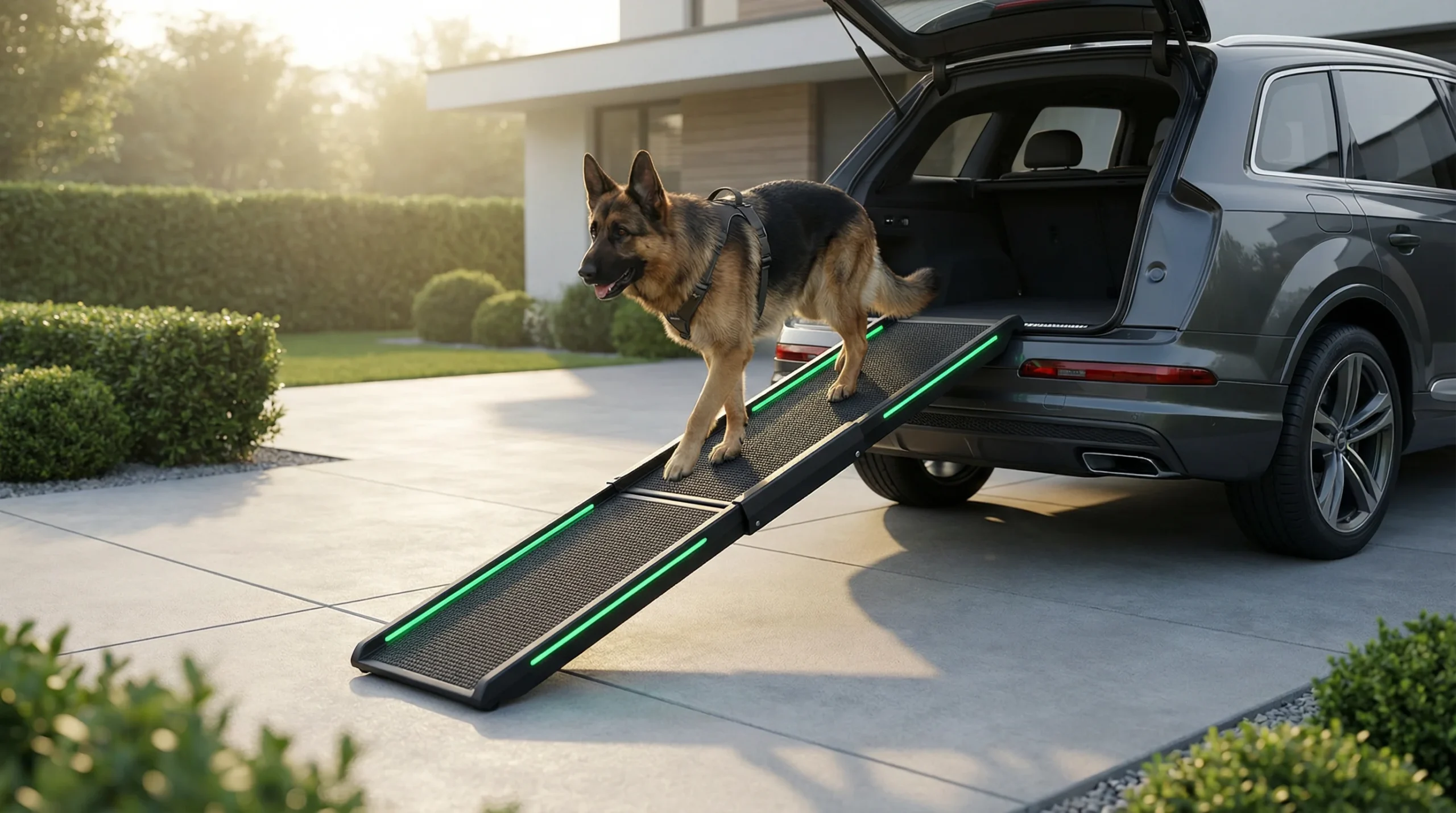
For many dog owners, a dog jumping into the boot can look effortless. In reality, repeated jumping in and out of vehicles places unnecessary strain on joints, muscles, and tendons, especially for larger, older, or heavier dogs.
A dog ramp for car travel is not about convenience. It is about reducing impact, improving safety, and making car journeys more sustainable for your dog over time. Whether you drive a low estate car or a high-clearance SUV, how your dog enters and exits the vehicle is one of the most important and often overlooked aspects of safe dog car travel.
This guide explains when a dog ramp is genuinely useful, which type suits different vehicles, and how to choose a ramp your dog will actually use.
TABLE OF CONTENTS
Why Using a Dog Ramp for Car Travel Matters
Car travel itself is passive, but entry and exit are not. Jumping down from a boot or tailgate is a high-impact movement, repeated over months and years.
The impact of jumping in and out of vehicles
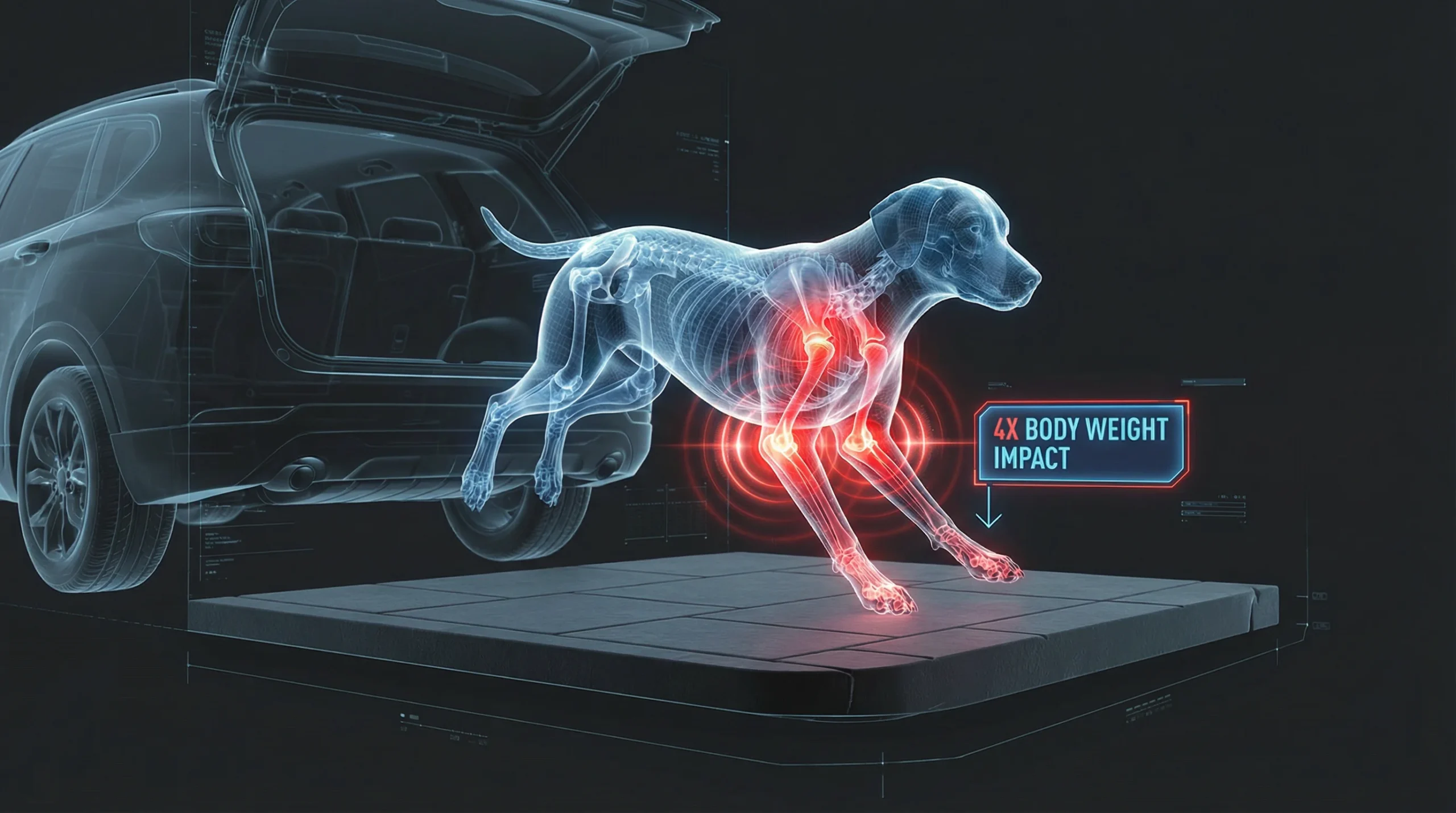
When a dog jumps from a raised surface, their front legs absorb most of the landing force. In higher vehicles such as SUVs, 4x4s, and vans, that force increases significantly due to height and angle.
While many dogs cope without immediate signs of discomfort, repeated impacts over time can lead to joint strain, reduced confidence, and hesitation when getting into the car. A ramp turns a jump into a controlled walk, reducing joint stress and making car travel more predictable and comfortable for the dog.
While ramps reduce physical impact, some owners also support long-term mobility through targeted dog joint supplements designed to support cartilage health.
This proactive approach can be especially valuable for senior dogs, large breeds, or dogs that regularly jump in and out of vehicles, where repeated strain may quietly accelerate joint wear over time.
When Do You Need a Dog Ramp for Your Car?
Not every dog needs a ramp, but for some, it quickly becomes one of the most practical travel tools you can own.
Large and Heavy Dog Breeds
Large and heavy breeds place a greater load on their joints when jumping down from a vehicle. Dogs such as Labradors, German Shepherds, Rottweilers, and Cane Corsos often benefit from a ramp long before any visible mobility issues appear.
A ramp also removes the need for owners to lift heavy dogs into the boot, which is safer for both the dog and the handler.
Older Dogs and Dogs with Reduced Mobility
As dogs age, flexibility and explosive power tend to decline. Jumping into a boot may become awkward, hesitant, or inconsistent.
For Senior dogs, a ramp:
- Preserves independence
- Reduces anxiety around car travel
- Allows continued access to walks and outings without forcing jumps
Ramps are also useful for dogs experiencing temporary stiffness or reduced confidence, where avoiding impact helps maintain comfort during daily travel.
Joint protection also extends beyond movement, which is why many large breeds benefit from nutrition formulated specifically for skeletal support.
Diets designed for large and heavy dogs often include controlled calcium levels, joint-supporting nutrients, and balanced energy to reduce long-term strain on growing and ageing joints.
Explore large breed dog food options designed with joint and skeletal health in mind.
When You Do NOT Need a Dog Ramp for Car Travel
Being honest matters — a ramp is not always necessary.
- Small, agile dogs: Lightweight dogs that can be safely lifted or step easily into a low boot may not need a ramp.
- Low vehicle height: Hatchbacks and estates with a low boot lip pose minimal challenge for healthy adult dogs.
- Infrequent travel: If your dog only travels occasionally and lifting is safe, a ramp may be impractical.
A ramp should solve a problem — not create one.
Types of Dog Ramps for Cars Explained
Once you’ve decided a ramp makes sense, choosing the correct type is critical. Not all ramps work well with all vehicles.
Watch: Folding vs. Telescopic Ramps Tested (UK SUV Test)
Folding dog ramps for cars
Folding ramps typically fold in half or thirds for compact storage.
Best for:
Hatchbacks, estate cars, and owners with limited boot space.
Pros:
- Lightweight
- Quick to deploy
- Easy to store
Cons:
- Often shorter
- Can be too steep for SUVs or high tailgates
Short folding ramps used with tall vehicles often create angles that dogs find intimidating or unstable.
Telescopic dog ramps for SUVs and 4x4s
Telescopic ramps slide out to extend to longer lengths.
Best for:
SUVs, 4x4s, vans, and high-boot vehicles.
Pros:
- Longer length creates a gentler slope
- Better suited for large and heavy dogs
- Often higher weight capacity
Cons:
- Heavier
- Takes up more width when stored
For modern SUVs, telescopic ramps are usually the safer and more practical option.
Dog ramps vs dog stairs for car travel
Dog stairs are often marketed for vehicles, but ramps are generally the better choice for car use.
- Stability: Ramps provide continuous contact with the ground and vehicle.
- Movement: Walking up a ramp is more natural than stepping up narrow stairs.
- Confidence: Many dogs feel more secure on a flat surface than climbing steps.
For vehicle entry and exit, ramps offer better control and consistency.
FlexK9 Recommended Ramps
Best for SUVs (The “Gold Standard”)
1. PetSafe Happy Ride Telescoping Dog Ramp

- Adjustable Telescoping Design: Extends from short to long (approx. 119–221 cm), making it suitable for most cars and SUVs with different boot heights.
- Heavy-Duty Support: Strong aluminium build with anti-slip surface supports up to ~136 kg — ideal for large and powerful breeds.
- Reflective Safety Edges: Built-in reflective strips increase visibility in low-light situations, adding peace of mind for evening travels.
- Portable & Practical: Collapsible telescopic design stores compactly in the boot with minimal fuss, perfect for regular travel.
- All-Weather Traction: High-traction surface helps dogs maintain secure footing in wet or muddy conditions.
Why it’s a top pick
The PetSafe Happy Ride Telescoping Dog Ramp is a robust, adjustable ramp that adapts from shorter heights up to around 182 cm, making it ideal for cars, SUVs and 4x4s. Its durable aluminium frame and textured high-traction surface give a confident walking path for dogs of all sizes. Reflective edges add visibility in low light, and the folding design keeps it practical for travel and everyday outings. This picks up where basic ramps fall short, offering strength and adaptability without overly complex setup.
Specifications:
- Ramp Type: Telescopic, extendable
- Max Weight Capacity: ~180 kg
- Best For: Large breeds, SUV boots, frequent car travel
- Key Features: Anti-slip surface, reflective safety edges, lightweight aluminium
✅ Reasons to Buy:
- Adjustable length suits a wide range of vehicles
- Heavy-duty build for larger dogs
- Portable and lightweight relative to strength
💬 Customer Feedback
“Excellent quality and sturdy even for big dogs.” — Dog parent
“Extendable range makes it very versatile for our SUV trips.” — Verified purchaser
❌ Reasons to Avoid:
- More expensive than basic folding ramps
- Slightly bulkier when stored compared to small folding alternatives
📝 Mini Verdict
A top-tier, adjustable ramp that handles a wide range of vehicle heights and dog sizes with confidence. Its sturdy build and telescopic design make it worth the investment for frequent car travel.
Best for Hatchbacks (Budget Friendly)
2. TRIXIE Folding Dog Ramp for Dogs

- Budget-Friendly & Practical: A cost-effective ramp that introduces easy vehicle access for dogs without compromising on essential safety and stability.
- Non-Slip Sandpaper Surface: Textured walking area provides good traction so dogs feel more secure on the incline, even in wet or muddy conditions.
- Compact Foldable Design: Folds neatly in half for quick storage in car boots or alongside other gear — ideal for everyday trips.
- Side Rails for Stability: Raised edges help guide dogs up and down confidently while preventing missteps off the ramp’s edge.
- Light & Easy to Handle: Lightweight construction makes it straightforward to lift, position, and carry — perfect for frequent use.
Why it’s a top pick
The TRIXIE Folding Dog Ramp keeps things simple and reliable without premium pricing. This bi-fold ramp has a non-slip sandpaper walking surface and a sturdy plastic build that supports dogs up to about 90 kg — plenty for most medium and many large breeds. When unfolded, its length helps create a flatter incline, which is generally easier for dogs to walk up compared with a steep jump. Side rails and a generous tread width also help offer confidence on the way up and down.
Specifications:
- Ramp Type: Folding (bi-fold)
- Max Weight Capacity: ~90 kg
- Best For: Medium to large dogs, occasional travel
- Key Features: Non-slip sandpaper surface, compact fold for easy storage
✅ Reasons to Buy:
- Very wallet-friendly for a ramp of this size
- Lightweight and easy to store in a boot
- Good grip helps hesitant dogs
❌ Reasons to Avoid:
- Not as heavy-duty as telescopic ramps
- Material is plastic — less premium feel
💬 Customer Feedback
“Great ramp for the price, folds away neatly.” — Verified purchaser
“Good surface grip and stable for my Labrador.” — Dog parent
📝 Mini Verdict
A dependable, wallet-friendly option that provides secure traction and simple storage for most everyday car trips. Ideal if you want solid performance without the premium price tag.
Best for Senior Dogs (Gentle Grip)
3. Gen7Pets Natural Step Dog & Cat Ramp

- Comfortable Natural Step Design: A gentle walking surface helps older or less mobile dogs climb into cars with less hesitation and strain, ideal for everyday travel.
- High Load Capacity: Holds up to ~113.4 kg (~250 lbs), making it suitable for a wide range of dog sizes including heavier pets.
- Lightweight & Foldable: At around 7.7 kg, it’s easy to handle and stow in a boot without eating into cargo space — great for frequent use.
- Soft Rubber Grip Surface: Provides secure footing that’s gentle on paws and helps dogs feel confident as they walk up and down.
- Portable & Durable: Compact fold and built-in handle make this ramp easy to carry and store, while the robust design lasts for regular outings.
Why it’s a top pick
The Gen7Pets Natural Step Dog Ramp is a versatile, lightweight ramp that’s perfect if you want a straightforward, portable solution for cars with modest boot height. Its soft rubber-grip surface and compact fold make it easy to carry and stow, while the natural-step style gives dogs a confident, ergonomic platform to walk up and down. This ramp is especially appealing if you prioritise ease of storage and everyday use.
Specifications:
- Ramp type: Natural-step foldable ramp
- Approx. Length: ~182.9 cm (72 inches) when deployed
- Max Weight Capacity: ~113.4 kg (~250 lbs)
- Dimensions: ~182.9 cm L x 40.6 cm W x 3.8 cm H
- Item Weight: ~7.7 kg (17 lbs)
- Material: Blend / rubber-grip surface
- Best For: Small to medium dogs, seniors needing gentle inclines
- Special features: Lightweight and compact fold-away design
✅ Reasons to Buy:
- Very portable and easy to handle
- Comfortable grip underpaw
- Great for regular short trips
❌ Reasons to Avoid:
- Shorter length makes it less ideal for tall SUVs
- Not designed for very large or very heavy dogs
💬 Customer Feedback
“Perfect for regular errands — folds up so small.” — Dog owner
“Grippy surface makes my dog feel confident.” — Verified purchaser
📝 Mini Verdict
An easy-to-use, gentle-incline ramp that helps senior or mobility-limited dogs enter and exit vehicles with less hesitation. Lightweight and comfortable, it’s perfect for daily use on lower boot heights.
How to Choose the Right Dog Ramp for Your Vehicle
Choosing the wrong ramp is a common mistake. A ramp that is too short, unstable, or poorly suited to your vehicle will likely go unused.
The most important rule is simple:
The higher the vehicle, the longer the ramp needs to be.
Short ramps used with tall boots create steep angles that defeat the purpose of using a ramp at all. Dogs may scramble, slip, or refuse to use them.
Measure your boot height and choose a ramp that allows for a gentle walking angle, not a climb.
Weight capacity, surface grip, and stability
- Weight capacity: Always exceed your dog’s weight comfortably.
- Surface grip: Look for rubberised or textured walking surfaces rather than abrasive tapes.
- Stability: A good ramp should hook securely onto the boot lip and have non-slip feet at ground level.
Why ramp length matters more than ramp height
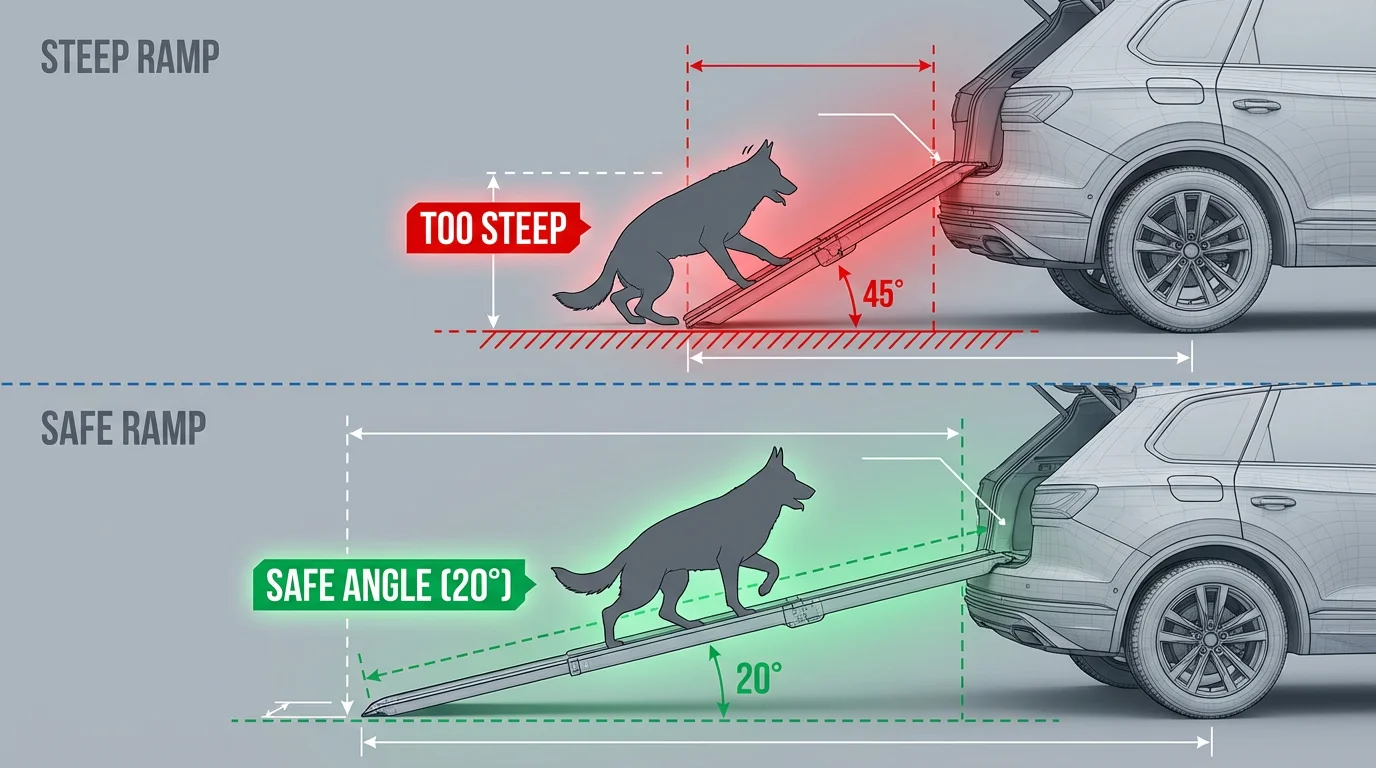
Ramp height gets attention, but incline angle is what matters. Longer ramps reduce the incline, allowing dogs to walk naturally without hesitation or strain. A longer ramp used correctly is safer than a short ramp on almost any vehicle.
Training Your Dog to Use a Car Ramp Safely
Even the best ramp is useless if your dog doesn’t trust it.
Never force a dog onto a ramp. Start with the ramp flat on the ground, reward calm interaction, and build confidence gradually before introducing height.
For a complete step-by-step approach, see our dedicated guide on how to teach a dog to use a ramp.
Using a dog ramp early before problems appear is one of the simplest ways to support safe, more comfortable car travel. The right ramp turns every journey into a controlled, predictable routine that works for both dog and owner.
Frequently Asked Questions
What is the best ramp length for an SUV?
For high-clearance vehicles like Land Rovers or Q5s, look for a telescopic ramp that extends to at least 1.8 meters (70 inches). Anything shorter will create a steep “climbing wall” angle that puts strain on your dog’s hips.
Can I just use a plank of wood?
We strongly advise against this. Wood becomes incredibly slippery when wet and lacks the safety side-rails of a purpose-built ramp. A slip can cause a serious groin injury or cruciate ligament tear, costing far more in vet bills than a proper ramp.
My dog is scared of the ramp. What should I do?
Never force them. Lay the ramp flat on the ground first and use high-value treats (chicken/cheese) to lure them across it. Once they are confident walking on the texture, elevate it slightly. For dogs that show signs of travel anxiety, short-term calming products can help build confidence during early ramp introduction.
Are folding ramps safe for 50kg+ dogs?
Most folding ramps are rated for high weight, but they often have a “bounce” in the middle hinge, which can scare heavy dogs. For giant breeds (Cane Corsos, St. Bernards), a solid telescopic ramp is usually more rigid and stable.
Do dog ramps scratch the car bumper?
Quality ramps come with rubberised feet or a safety latch to protect your paintwork. If you are worried, you can place a simple microfibre towel under the contact point for extra protection.
Can I use a dog car ramp for the back seat side door?
Yes, but standard boot ramps are often too wide or too long for side doors. The angle of the door opening limits your space. For back seat access, look for a specialised ‘Side Door’ ramp or a shorter telescopic model that won’t get wedged against the front seats. Always measure the width of your door opening before buying.
Should puppies use a car ramp?
Absolutely. Puppies have soft growth plates that do not fully harden until 12–18 months. Letting a puppy jump out of a car boot can cause permanent damage to these developing joints or lead to early-onset arthritis. Training a puppy to use a ramp from 8 weeks old protects their long-term health and builds confidence early.
