

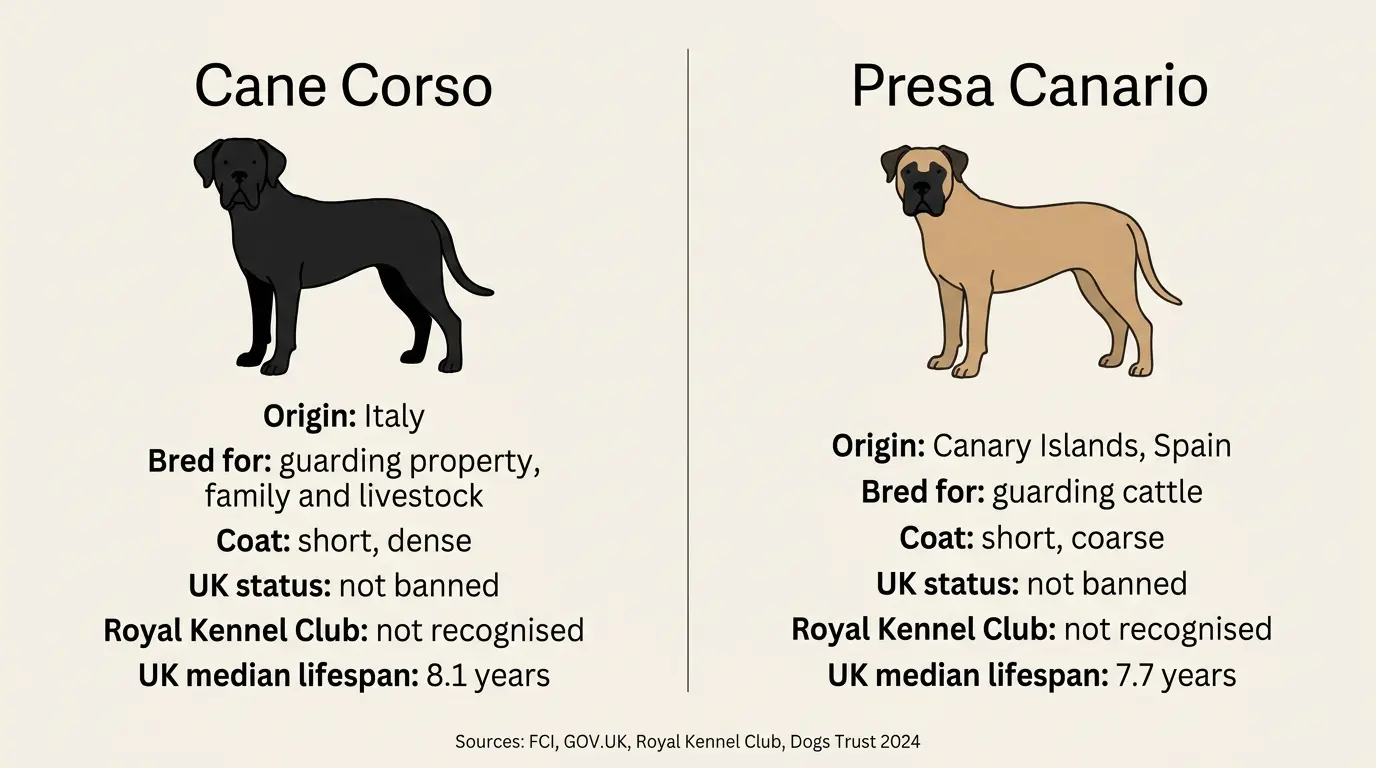
If you’re weighing up a Cane Corso vs Presa Canario, you’re looking at two large guardian mastiffs that are easy to mix up in photos and very easy to misdescribe online. Here’s the short version: both are legal to own in the UK, and neither is recognised by the Royal Kennel Club. The Corso is an Italian all-round guardian. The Presa Canario is a Canary Islands cattle guard with a heavier, squarer head and a black mask. Both need an experienced owner.
A note on where this comes from. I live with Dexter, a roughly 45kg Cane Corso. I’ve never met a Presa Canario, so everything I say about the Presa comes from the breed standards and UK sources, not experience. Where a claim has no reliable source, I’ve left it out, which is why you won’t find bite-force numbers here.
TABLE OF CONTENTS
At a glance
| Cane Corso | Presa Canario | |
|---|---|---|
| Origin | Italy | Canary Islands, Spain |
| Bred for | Guarding property, family and livestock | Guarding cattle |
| Build | Medium to large, athletic | Medium-sized, heavy-headed, longer than tall |
| Coat | Short, dense, slight undercoat | Short, coarse, no undercoat |
| UK legal status | Not banned | Not banned |
| Royal Kennel Club | Not recognised | Not recognised |
| UK median lifespan | 8.1 years* | 7.7 years* |
Sources: FCI breed standards 343 (Cane Corso) and 346 (Presa Canario), 2023; the Royal Kennel Club breeds list; GOV.UK. *Dogs Trust 2024 study of UK dogs. The samples were small, so see the lifespan section below.
Presa Canario, Dogo Canario, Canario Dog: one breed, three names
These are all the same dog. The FCI, the international body that holds the breed standard, listed it as the Dogo Canario until the Spanish kennel club asked for the name to change. Since 1 January 2019 its official name has been Presa Canario. “Canario Dog” is an informal English shorthand, which is why this page’s address still uses it, and you’ll also see the full Spanish name, Perro de Presa Canario.
Some sites claim the name was changed to soften the breed’s image. I couldn’t find a source for that, so I won’t repeat it.
Where they come from and what they were bred to do
Cane Corso
The Corso’s breed standard traces it back to the old Roman Molossian. It was once found all over Italy but, more recently, survived mainly in Apulia and the neighbouring regions of southern Italy. Its name is linked to a Latin word for a protector or guardian of the farmyard, and that fits. The standard describes it as a guardian of property, family and livestock that was also used in the past for herding cattle and hunting big game.
Presa Canario
The Presa comes from Tenerife and Gran Canaria. Its standard says it’s believed to descend from crosses between the majorero, a dog native to the islands before the Spanish conquest, and other mastiff-type dogs brought in later. Old island records describe these dogs mainly as guards and protectors of cattle.
What that means for a UK owner
Both were bred to guard. The difference is breadth. The Corso’s standard describes a versatile working dog, while the Presa’s is built around guarding. Neither was bred to ignore a knock at the door.
Cane Corso vs Presa Canario size and build, in plain words
You won’t find height and weight figures here. Neither breed has a UK breed standard, and the figures quoted online vary by source. Instead, here’s how the official standards describe each dog’s shape.
- Cane Corso: medium to large, robust and sturdy but with some elegance, and lean, powerful muscle. It’s slightly longer than it is tall.
- Presa Canario: described as medium-sized, but with a massive, roughly cube-shaped head and a body that’s noticeably longer than it is tall, more so in females. Fawn and brindle Presas always have a black mask.
The coats differ too. The Corso has a short, shiny, very dense coat with a slight undercoat, in black, greys, fawns and brindles. The Presa’s coat is short, coarse and flat, normally with no undercoat, in brindle, fawn or black, with only limited white marks allowed.
Then there are the ears. The current Corso standard specifies natural, uncropped ears. The Presa standard describes ears that hang naturally, and only allows cropped, upright ears in countries where cropping is legal. The UK isn’t one of them, as the law section below explains.
For Corso heights and weights by age, see our Cane Corso size and weight guide.
Temperament: what the standards say, and what they don’t
The Corso’s standard describes an extremely agile and responsive dog. The Presa’s describes a balanced, very self-confident dog that’s obedient with its family and devoted to its owner, but can be suspicious of strangers and holds itself a little apart.
One thing they agree on: both standards treat an aggressive or overly shy dog as a disqualifying fault. A well-bred dog of either breed isn’t meant to be aggressive.
What doesn’t exist is reliable UK data comparing how the two breeds actually behave. No UK vet body or welfare charity has published it. Sites that score one breed as “easier to train” or “more territorial” than the other are giving you opinion, not evidence.
What I can give you is one Corso’s version. Dexter has mixed feelings about strangers. He doesn’t like someone walking straight up to him and staring, and he’s uneasy when a person comes up quickly behind me. When I’m securing him in the boot with my back to the street, he keeps looking past me to check what’s behind. Couriers and anyone knocking at the door get barked at. That’s watchfulness, not aggression, and it’s why I manage introductions instead of leaving them to chance.
🐾 Dexter’s visitor routine: Before anyone visits, I say their name to Dexter alongside “Teeto”, his word for treats, so the name and the good stuff go together. Visitors know they’re meeting a large dog and go along with the plan: the first meeting happens in the back garden, with a sniff and then a game with the ball. Only once that’s done do we all go inside and settle. It works every time, because he remembers that person as a good experience.
Living with a guardian breed in the UK: a Corso owner’s routine
Out in public
Dexter is always on a lead, and I keep our distance from other people and dogs, for his safety as much as theirs. When another dog approaches, he sometimes freezes and crouches. Sometimes that’s the start of a play invitation, and sometimes it’s unease. I can’t tell which from the freeze alone, so I watch the rest of his body language before letting anything get closer.
With children he’s generally gentle, as long as they aren’t crowding him, and he’s keen to get close and sniff. At his size, even a friendly lean towards a child is too much, so I keep a sensible gap.
Socialisation
Dexter went to reward-based group training classes and walking groups from a young age. He’s also come with us on trips to Devon and to the Cotswolds at busy times. He’s still uneasy around unfamiliar dogs. That’s my honest takeaway: socialisation shapes a guardian dog, but it doesn’t turn it into a different kind of dog.
Exercise
Most walks are about 40 minutes, roughly 70% pavement and 30% woodland. On top of that, he gets two or three garden play sessions a day: flat-out running and chasing, play-fighting, and scent games where he has to find treats I’ve hidden. Between them, they tire him out properly.
A Presa owner’s routine may look quite different. I can’t speak to it, and I’d be wary of anyone who says one of these breeds needs more exercise than the other without saying how they know.
Lifespan and health in the UK
The best UK data comes from a 2024 Dogs Trust study of more than half a million dogs in the UK. Of the 155 breeds it covered, the Presa Canario (median 7.7 years) and the Cane Corso (8.1 years) had the second- and third-shortest median lifespans. Only the Caucasian Shepherd Dog was shorter.
Read those figures carefully. The study included only 144 Presas and 202 Corsos, and the ranges it gives are wide and overlapping: 7.0 to 9.5 years for the Presa, 6.5 to 9.5 years for the Corso. So the data doesn’t show that one breed lives longer than the other. What it does show is that both sit near the bottom of the table.
Dogs Trust also found that large breeds have a higher risk of a shorter life. It placed both breeds in a cluster of related breeds with lower life expectancies, alongside Mastiffs and the Neapolitan Mastiff. The study doesn’t say why. You can read the findings on the Dogs Trust breed longevity page, and see how lifespan varies across breeds in our wider guide.
Ask your vet: These are population figures, not a prediction for any one dog. If you own either breed or are thinking about one, ask your vet which health checks make sense for a large breed.
UK law: what applies to both breeds
Neither breed is banned. According to GOV.UK, the UK’s banned types are the Pit Bull Terrier, Japanese Tosa, Dogo Argentino, Fila Brasileiro and XL Bully. The Cane Corso and Presa Canario aren’t on that list. Don’t confuse the Dogo Argentino, which is banned, with the Dogo Canario, which is just the Presa’s old name. Our Cane Corso vs Dogo Argentino guide explains what the Dogo ban means, and the full list of banned dog types in the UK has the detail.
That doesn’t mean there are no rules. It’s against the law to let any dog be dangerously out of control anywhere, including in your own home. GOV.UK says a dog counts as dangerously out of control if it injures someone or makes someone worried that it might. With a dog this size, keeping it under control isn’t optional. Our guide to the Dangerous Dogs Act 1991 explains how the law works.
Neither breed is recognised by the Royal Kennel Club, so neither has a UK breed standard or a Royal Kennel Club breed register.
Ear cropping is illegal in every part of the UK. The Animal Welfare (Import of Dogs, Cats and Ferrets) Act 2025 also gives the government powers to ban dogs with cropped ears from being brought into the country, through regulations made under the Act. If you’re looking at dogs from a breeder, natural ears are what you should expect to see. The Corso’s own breed standard now calls for them.
Which suits which owner?
There isn’t a winner here, and anyone who tells you otherwise is guessing. Both are large guardian breeds for experienced owners with the time, space and patience to manage introductions for the dog’s whole life.
If the standards are a guide, the Corso is the more athletic, responsive all-rounder, which may suit someone who wants an active working partner. The Presa is described as a reserved, self-confident guard with a heavier frame. But a standard describes the ideal, not the dog in front of you.
Whichever you’re leaning towards, meet adult dogs of the breed first, see how they are with strangers, and be honest with yourself about handling a guardian dog every day, not just on the good days.
For more side-by-side guides, see our breed comparisons.
Frequently Asked Questions
Is the Dogo Canario the same as the Presa Canario?
Yes, they’re the same breed. The FCI used the name Dogo Canario until the Spanish kennel club asked for a change, and since January 2019 the official name has been Presa Canario. “Canario Dog” and “Perro de Presa Canario” are other names you’ll see for the same dog.
Are Cane Corsos or Presa Canarios banned in the UK?
No. Neither is one of the UK’s banned dog types, which are the Pit Bull Terrier, Japanese Tosa, Dogo Argentino, Fila Brasileiro and XL Bully. But the law against letting a dog be dangerously out of control applies to every dog, including in your own home.
Does the Royal Kennel Club recognise the Cane Corso or the Presa Canario?
No. Neither breed is on the Royal Kennel Club’s list of recognised breeds, so there’s no UK breed standard for either. Both are recognised internationally by the FCI, whose standards come from the breeds’ home countries, Italy and Spain.
Which lives longer, the Cane Corso or the Presa Canario?
A 2024 Dogs Trust study of UK dogs found median lifespans of 8.1 years for the Cane Corso and 7.7 years for the Presa Canario. The samples were small and the ranges overlap, so the data doesn’t show a real difference between them. Both are among the shortest-lived breeds in the study.
How can you tell a Cane Corso from a Presa Canario?
Look at the head and the coat. The Presa has a massive, cube-shaped head, a black mask on fawn and brindle dogs, and a coarse coat with little or no undercoat. The Corso is more athletic in outline, with a short, dense, shiny coat and a slight undercoat.
