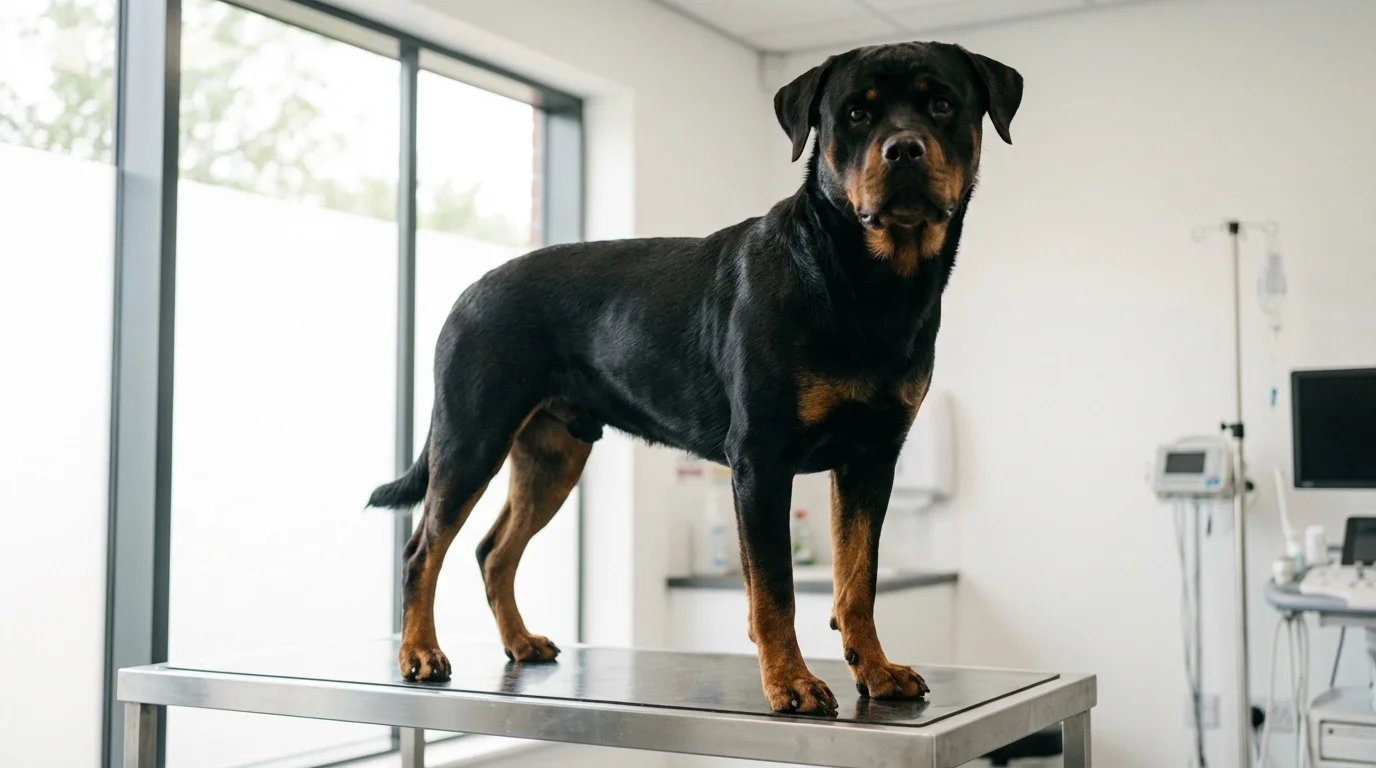
Rottweilers grow fast, fill out slowly, and mature differently depending on sex, genetics, and line type. Getting their weight right during the first 24 months is critical — it affects joint health, mobility, lifespan, and long-term behaviour.
This rottweiler dog weight chart gives you a clear view of how males and females typically grow month by month, helping you spot any unusual weight changes early.”
TABLE OF CONTENTS
Rottweiler Growth and Weight Chart Explained
Rottweiler growth isn’t linear. Puppies gain weight rapidly from 2–6 months, then slow down as muscle and bone density develop.
These charts use UK-appropriate kg ranges and reflect typical European-line Rottweilers. The lines most common in the UK. Use the ranges as guidance, but always judge by body condition as well as numbers.
For context, the Kennel Club’s official Rottweiler breed standard outlines the typical size, build and proportions expected in healthy adults.
Male Rottweiler Weight Chart (kg)
This weight chart rottweiler owners rely on is designed to show the typical growth range for male Rottweilers from 2 to 24 months.
| Age | Expected Weight | Healthy Range* |
|---|---|---|
| 2 months | ~ 7-10 kg | 6-12 kg |
| 3 months | ~ 12-16 kg | 10-18 kg |
| 4 months | ~ 18-23 kg | 16-25 kg |
| 5 months | ~ 24-30 kg | 22-32 kg |
| 6 months | ~ 30-36 kg | 28-38 kg |
| 7 months | ~ 34-40 kg | 32-42 kg |
| 8 months | ~ 37-43 kg | 34-45 kg |
| 9 months | ~ 39-45 kg | 36-49 kg |
| 10 months | ~ 41-47 kg | 38-50 kg |
| 11 months | ~ 43-49 kg | 40-52 kg |
| 12 months | ~ 44-50 kg | 42-55 kg |
| 18 months | ~ 47-55 kg | 45-60 kg |
| 24 months (2 yrs) | ~ 50-60 kg | 48-65 kg |
*Healthy range accounts for line variation, muscle build, working vs pet dogs.
Most males won’t look “finished” until 24–30 months. They keep adding muscle and chest width long after height stops.
Notes: Adult working show males often reach 50-60 kg (110-132 lbs) or more.
Female Rottweiler Weight Chart (kg)
This chart shows the typical growth pattern for female Rottweilers from puppyhood through to full maturity.
| Age | Expected Weight | Healthy Range* |
|---|---|---|
| 2 months | ~ 6-8 kg | 5-10 kg |
| 3 months | ~ 10-14 kg | 9-16 kg |
| 4 months | ~ 16-21 kg | 15-23 kg |
| 5 months | ~ 22-28 kg | 20-30 kg |
| 6 months | ~ 28-34 kg | 26-36 kg |
| 7 months | ~ 32-38 kg | 30-40 kg |
| 8 months | ~ 35-40 kg | 33-42 kg |
| 9 months | ~ 37-42 kg | 35-45 kg |
| 10 months | ~ 38-44 kg | 36-46 kg |
| 11 months | ~ 39-45 kg | 37-48 kg |
| 12 months | ~ 40-46 kg | 38-50 kg |
| 18 months | ~ 42-48 kg | 40-52 kg |
| 24 months (2 yrs) | ~ 42-50 kg | 40-55 kg |
Females mature faster and earlier. Most are nearly full-grown by 18 months.
*Healthy range allows for variation in size and build.
According to UK-based data, females often weigh 32-40 kg for pet type, but large working lines may exceed 45 kg.
Rottweiler Growth, Health & Development Guide
Male vs Female Growth Differences
- Males grow for longer, often adding muscle past two years.
- Females reach maturity sooner, especially in chest and weight distribution.
- Males carry heavier bone and broader heads.
- Females typically settle 10–15 kg lighter yet stay more agile.
- Line type matters: European working lines grow larger than American pet lines.
If you’re looking at growth alongside behaviour, our guide on whether a Rottweiler is a good family dog explains how maturity affects temperament and energy levels.
Genetics and Line Differences in Rottweiler Size
Rottweiler growth is heavily shaped by genetics, and understanding the differences between bloodlines helps explain why two dogs of the same age may look completely different. European Rottweilers, especially those from German and Serbian working lines, typically have heavier bone density, broader heads, and more muscle mass than American pet lines. This genetic foundation affects not only final size but also how quickly a Rottweiler reaches each growth milestone.
Puppies from larger working lines often show faster early growth and may track toward the higher end of the weight chart. In contrast, lighter American lines may develop more gradually and finish at the lower or mid-range end of the chart. This variation is completely normal and should not be mistaken for underfeeding or overfeeding.
Growth plate development is another genetic factor. Large working-line puppies often have growth plates that take longer to close, meaning their “filling out” phase extends well past the first year. Premature growth-plate closure — which can happen due to overfeeding, excessive calcium, or intense exercise — can affect height and structure. Monitoring steady, controlled growth is far more important than trying to meet the biggest possible weight number.
Because Rottweilers are a slow-maturing breed, genetics also influence when height and chest width stabilise. Some males from heavier lines may not reach their full muscular build until 30–36 months, while lighter lines may complete development closer to 24 months. If your dog’s parents were smaller or leaner, expect similar patterns. Genetics sets the blueprint, and your job is simply to support healthy development with balanced nutrition and age-appropriate exercise.
Rottweiler Growth Timeline
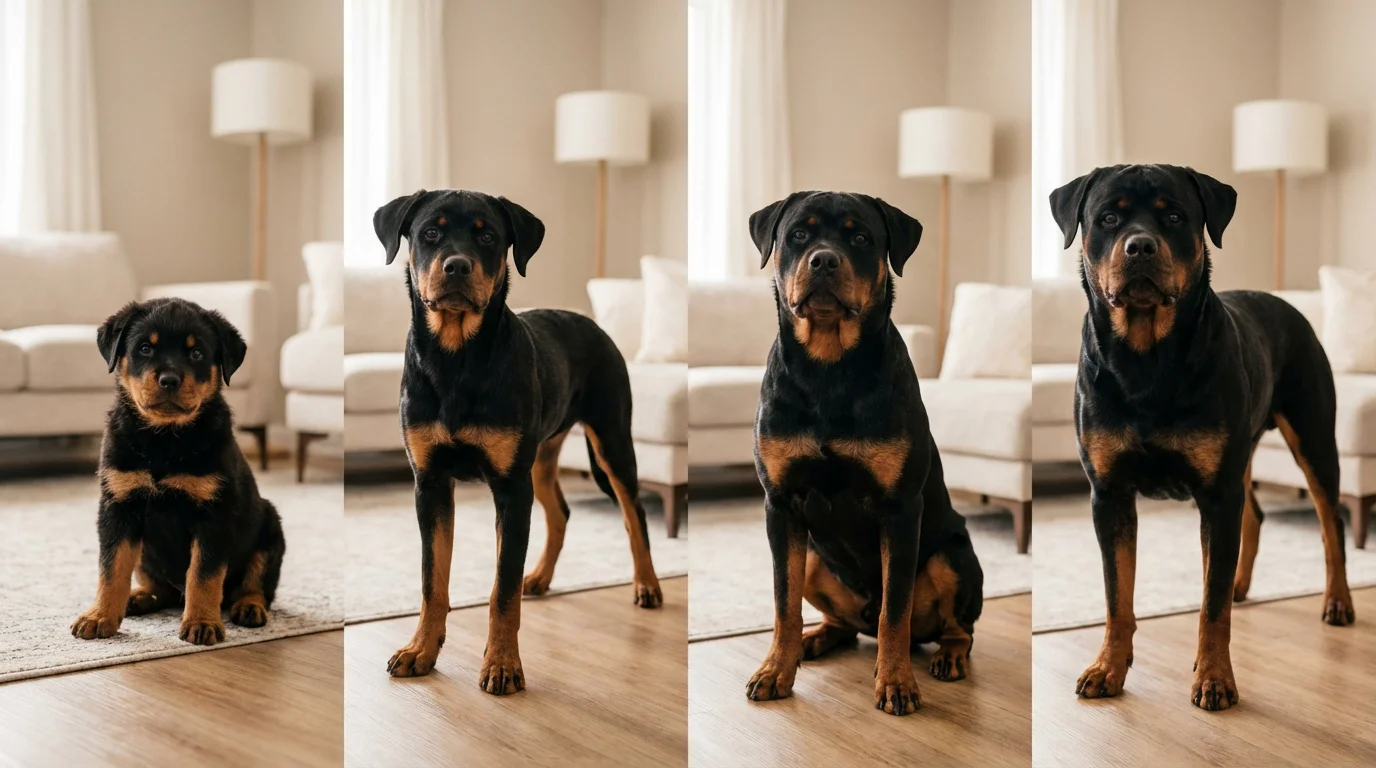
Early Puppy (2–4 months)
Massive bone and joint development; requires correct nutrition to avoid growth plate issues.
Adolescent Stage (5–8 months)
The biggest weight jump — legs lengthen, chest widens, and appetite increases.
Late Puppy (9–12 months)
Growth slows, but muscle definition improves.
Maturity Stage (12–24+ months)
Males keep building mass. Females refine shape rather than gain size.
Rottweiler Growth Timeline
Rottweilers stop growing in height around 12–15 months, but weight and muscle mass can continue to develop until 24–30 months.
Large males from heavy European lines may continue subtle filling out up to 36 months.
How to Tell If Your Rottweiler Is Growing Too Fast
Fast growth sounds positive, but for large-breed dogs like Rottweilers, rapid weight gain can be harmful. Growth that moves too quickly puts extra strain on developing joints, tendons, and growth plates. The most common issue linked to rapid development is panosteitis (also called “growing pains”), which causes intermittent lameness in the legs. Another risk is early growth-plate damage, which can affect limb alignment and long-term mobility.
The easiest way to identify overly rapid growth is by watching how your dog moves. Puppies that grow too fast often show stiffness after rest, reluctance to jump, or awkward, uncoordinated movement. Their bones may look long and thin before their muscles catch up, and you might notice more clumsiness during adolescence. These are signs that joints are under pressure.
Diet plays a major role here. Feeding too many calories, too high a protein percentage, or adding unnecessary supplements — especially calcium — increases the risk of accelerated growth. Many owners mistakenly assume their puppy is “too skinny” and increase food, causing unhealthy jumps in weight. A visible waist and palpable ribs are signs of correct growth, not underfeeding.
Another strong indicator is deviation from the expected curve. If your puppy’s weight suddenly leaps two categories ahead of the chart in a single month, slow things down. Switch to a controlled-growth large-breed puppy food and reduce calorie intake slightly. It’s safer for a Rottweiler puppy to grow steadier and leaner than to pack on mass too quickly. Healthy development prioritises joint longevity, not size.
Understanding Rottweiler Body Condition Score (BCS)
The weight chart tells you what’s typical, but the Body Condition Score (BCS) tells you what’s healthy. Rottweilers should ideally sit at a 4 or 5 out of 9 on the BCS scale, which means you can feel the ribs without pressing hard, see a defined waist when viewed from above, and notice a slight abdominal tuck from the side. This balance ensures strong muscle development without excess fat.
Dogs that sit at a 6 or 7 on the BCS scale are carrying too much weight, even if they appear “big-boned” to the untrained eye. Excess fat around the ribs, chest, and lower back puts pressure on the hips and elbows, increasing the risk of osteoarthritis and cruciate ligament injury. This is especially important for Rottweilers, whose joints already carry significant mass.
On the opposite end, a BCS of 3 or below indicates underweight status. Ribs that are sharply visible, a narrow chest, or a flat rump are indicators of insufficient nutrition or an underlying health issue. Puppies with low BCS often fatigue quickly, show poor coat quality, and struggle to develop muscle.
BCS becomes increasingly important between 6 and 18 months, when growth patterns change rapidly. Instead of relying solely on scales, combine monthly weigh-ins with a visual and tactile assessment using the BCS chart. This balanced approach gives a more accurate picture of overall health than weight alone.
Diet for a Rottweiler: Feeding Guide by Age & Weight
Puppies (2–8 months):
- Feed a large-breed puppy formula.
- Aim for slow, controlled growth — too many calories = joint issues.
- Split meals into 3 portions per day.
Adolescents (9–24 months):
- Maintain large-breed puppy or transition around 18 months (females) or 24 months (males).
- Monitor weight weekly.
Adults (24 months+):
- Average male ~50 kg: approx 1,200–1,600 kcal/day (varies by activity).
- Average female ~42 kg: approx 1,000–1,300 kcal/day.
Continually assess weight by body condition, not calories alone.
Maintaining a healthy coat also supports body condition, and our guide to the best dog brush for Rottweilers explains which tools help keep their skin and coat in peak shape.
Neutering and Its Impact on Growth
Neutering affects metabolism and growth plate closure.
- Early neutering = slightly taller dog, leaner frame, higher risk of weight gain.
- Late neutering (after maturity) = more natural chest development and broader build. Calorie needs typically drop 10–20% post-neuter.
Healthy Rottweiler Weight Checks (Home & Vet Signs)
- Step on a scale, then pick up your dog and subtract your weight.
- Use vet scales when possible for accuracy.
- Track weight monthly during the first year, then quarterly.
- Pair weight with BCS observations — numbers don’t tell the full story.
If you’re researching Rottweiler development and ownership in the UK, our update on whether Rottweilers are banned in the UK provides current legal clarity.
Underweight vs Overweight Signs in Rottweilers
Underweight:
- Ribs sharply visible
- Prominent hip bones
- Low strength or poor stamina
- Lack of muscle over shoulders or hindquarters
Overweight:
- No visible waist
- Heavy breathing or quick fatigue
- Difficulty rising
- Noticeable belly sway
- Thick fat pad over ribs
Body Condition Score (BCS) guides are useful — Rottweilers should ideally sit at 4–5 out of 9.
For owners noticing coat or body condition changes, this guide on what grooming a Rottweiler needs explains how coat quality can reflect overall health.
Final Summary
Rottweilers grow fast, fill out slowly, and vary significantly by sex and genetics. Using the charts above — alongside body condition and vet guidance — gives you the most accurate picture of healthy development. Regular monitoring ensures your Rottweiler grows strong, balanced, and at a safe pace through puppyhood into adulthood.
Frequently Asked Questions
What is a healthy weight for a Rottweiler in kg?
Most males fall between 50–60 kg, while females sit around 42–50 kg.
The best indicator is still body condition: you should feel, not see, the ribs.
Why is my Rottweiler smaller than the chart?
Genetics, early neutering, illness during puppyhood, low calorie intake, or simply a lighter line.
If your dog is consistently 10% or more below range, check with your vet.
How heavy should a 6-month-old Rottweiler be?
Males usually weigh 30–36 kg, and females 28–34 kg.
Slight variations are normal as long as body condition looks healthy.
When do Rottweilers have their biggest growth spurt?
Between 5–8 months, when bone density and leg length increase rapidly.
How can I help my underweight Rottweiler gain weight?
Increase calories gradually, add an extra meal, choose a high-protein diet (25–28%), and introduce controlled strength-building exercise.
Rule out parasites or medical issues first.
Are European Rottweilers heavier than American lines?
Yes. European working lines typically have denser bone, heavier heads, and thicker frames.
Why is my Rottweiler overweight?
Too many calories, lack of daily exercise, or post-neutering metabolic slowdown.
How much exercise does an overweight Rottweiler need?
Start with two 20–30-minute walks daily and increase gradually. Avoid high-impact exercise until weight stabilises.
Does genetics affect Rottweiler size?
Absolutely. Parent size and line type strongly influence height, weight, bone structure, and maturity rate.
How much should a neutered Rottweiler weigh?
Same target range, but lower calorie intake is needed to maintain ideal weight.
How do I know if my Rottweiler puppy is growing properly?
Consistent weight gain, visible waist, palpable ribs, steady energy levels, and tracking close to the expected range.
For a broader comparison of growth rates and maturity, our Rottweiler vs German Shepherd guide highlights how different breeds develop at different speeds.
