
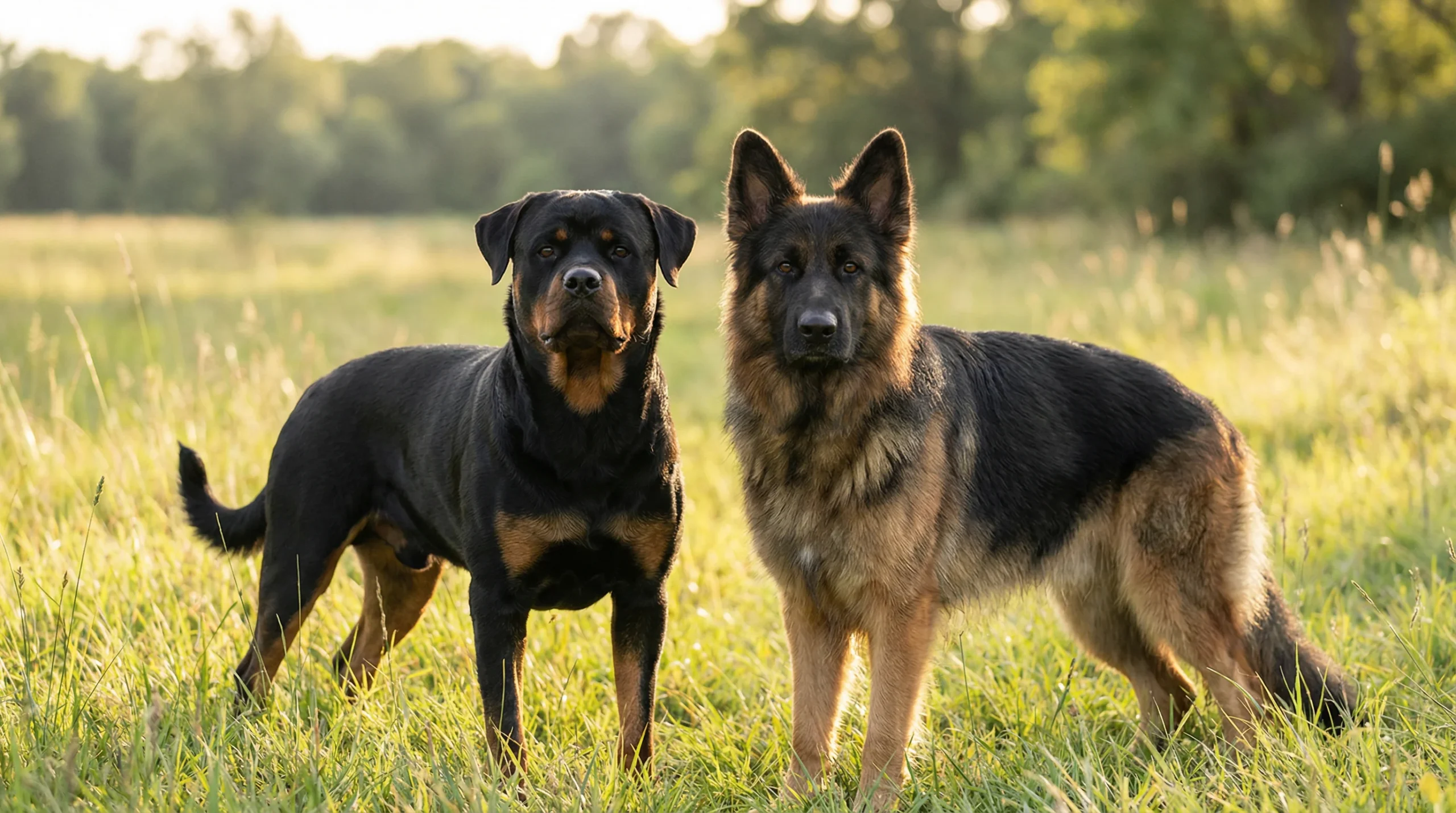
If you’re comparing a Rottweiler vs German Shepherd, both are intelligent, loyal, and iconic working dogs — but they suit different households.
The Rottweiler is confident, calmer indoors, powerful, and naturally protective.
The German Shepherd is alert, highly energetic, easy to train, and thrives on structured work.
Many owners also search for “Rottweiler dog vs German Shepherd”, but the comparison is the same, and this guide covers everything you need to make the right choice.
If you’re comparing other working breeds, our Doberman vs Rottweiler guide is also helpful.
TABLE OF CONTENTS
Breed Overview & Temperament Comparison
Breed Origins: Why These Two Dogs Behave the Way They Do
Rottweiler
- Origin: Ancient Roman drover dog, later a cattle-driving and guard dog in Rottweil, Germany.
- Purpose: Guarding, protection, strength-based work.
- Behaviour link: Confident, steady, powerful, naturally territorial.
German Shepherd
- Origin: Late 1800s Germany, bred by Max von Stephanitz.
- Purpose: Herding, obedience, utility work.
- Behaviour link: High-alert, fast learner, excellent at following commands and routines.
Why origins matter:
Breed purpose shapes modern behaviour. Rottweilers remain steady and protective. German Shepherds remain driven and quick-thinking.
Temperament Difference
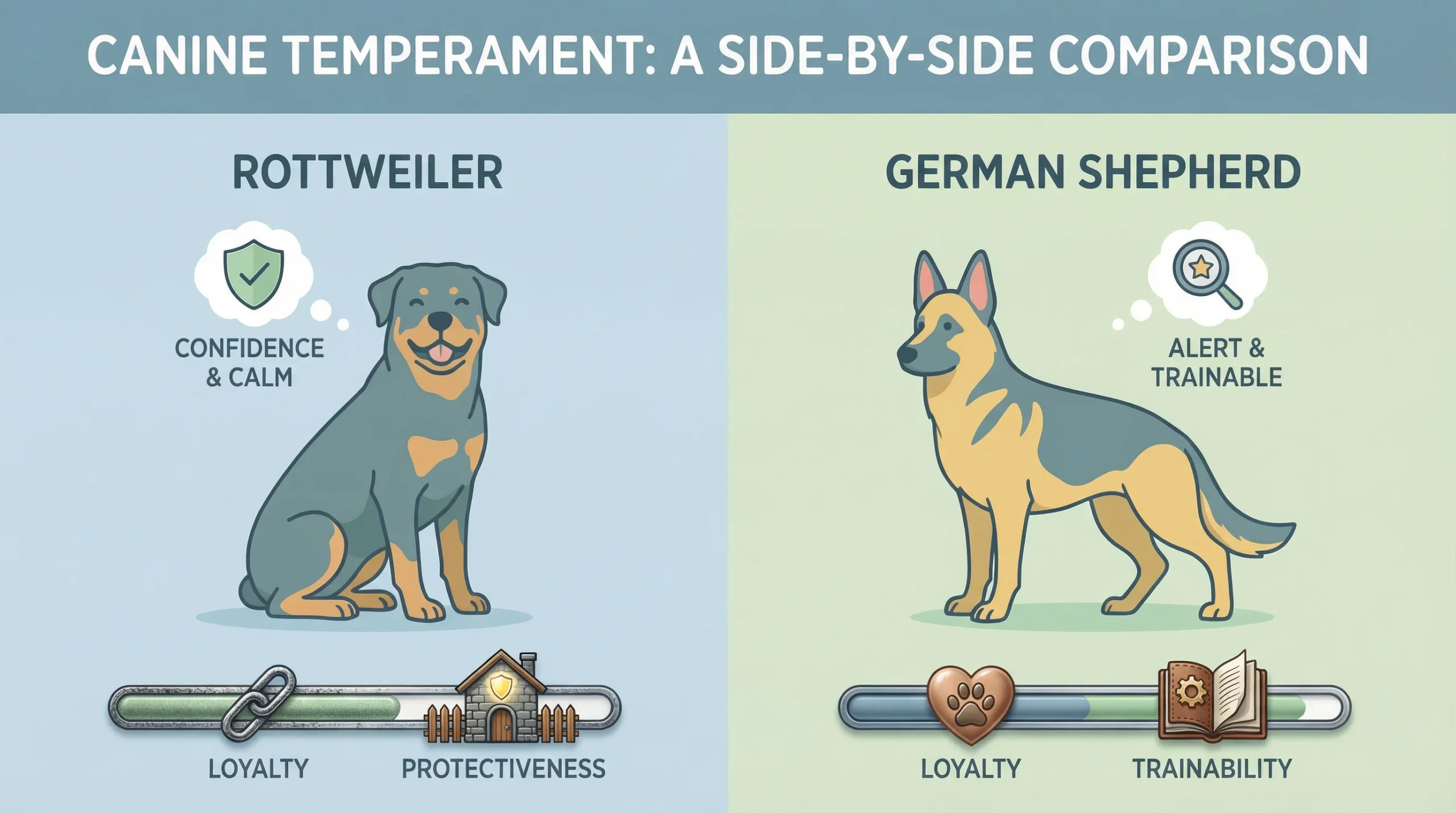
Rottweiler Temperament
- Calm and confident
- Strong guarding instincts
- Deeply loyal to their inner circle
- Can be aloof with strangers
- Matures more slowly (mentally and physically)
German Shepherd Temperament
- Alert and highly responsive
- Strong desire to work and obey
- More sensitive to owner’s tone
- Excellent problem solvers
- Quick to form bonds with family
If you want a dog that settles indoors and is less reactive, the Rottweiler leans in your favour. If you want a dog that is constantly switched on and easy to direct, the German Shepherd is unmatched.
For trusted guidance on dog behaviour and training, see the Blue Cross dog behaviour advice.
Intelligence & Trainability
Both breeds sit within the top tiers of canine intelligence, but they excel in different ways.
German Shepherd
- Obedience and working intelligence: exceptional
- Quick to learn new commands
- Highly responsive to structured training
- Preferred for military, police, and service work
Rottweiler
- Strong problem-solving ability
- Very trainable, but firm consistency is required
- Learns slower initially but retains commands extremely well
- More independent than a GSD
Verdict:
If you’re a first-time owner or want a dog that picks up routines fast, the German Shepherd is easier.
If you want a steady, confident protector, the Rottweiler excels.
Puppy Behaviour: Rottweiler vs German Shepherd
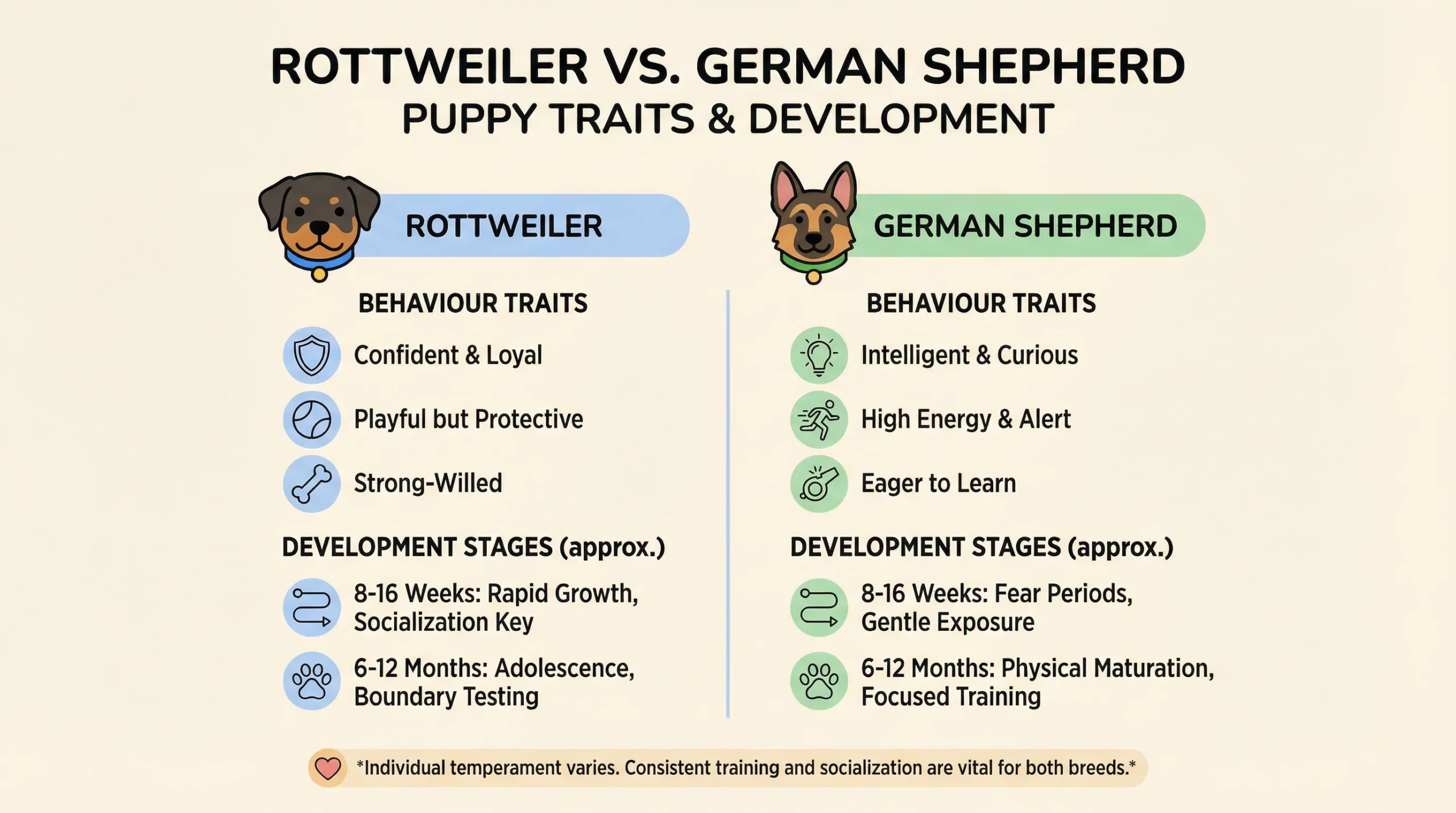
Rottweiler Puppies
- Slower to mature
- Strong-willed
- Needs early socialisation
- More mouthy during teething
German Shepherd Puppies
- Fast-learning
- Highly energetic
- Sensitive to corrections
- Eager to please
If you’re new to training, a GSD puppy gives an easier start — but also demands more time.
Family Life & Children
Both breeds can be excellent family dogs when raised well.
Rottweiler
- Naturally calmer at home
- Excellent with children when socialised early
- Protective without being hyper-reactive
- Needs clear boundaries
For deeper guidance, see:
👉 Is a Rottweiler a Good Family Dog?
German Shepherd
- Very affectionate with their household
- Bonds quickly and strongly
- Highly protective
- Very aware of their environment and noises
Honest Verdict:
If you want a calm giant who will relax with the family, choose the Rottweiler.
If you want an active companion to join you everywhere, choose the German Shepherd.
For expert, behaviour-safe guidance on socialisation, training and understanding your dog’s body language, see the RSPCA dog behaviour advice.
Safety & Behaviour Myths
Honest Facts:
- Both breeds are strong working dogs.
- Bite force claims online are mostly exaggerated.
- Behaviour depends heavily on training and socialisation.
- Neither breed is banned in the UK. For clarity on UK legislation, see our full list of banned breeds in the UK.
To understand public perception of Rottweilers, see:
👉 Is a Rottweiler a Dangerous Dog?
Which is safer?
Neither breed is inherently unsafe.
The difference lies in the owner’s experience and environment.
A poorly trained GSD becomes anxious or vocal.
A poorly trained Rottweiler becomes pushy and dominant.
Size, Exercise & Grooming Needs
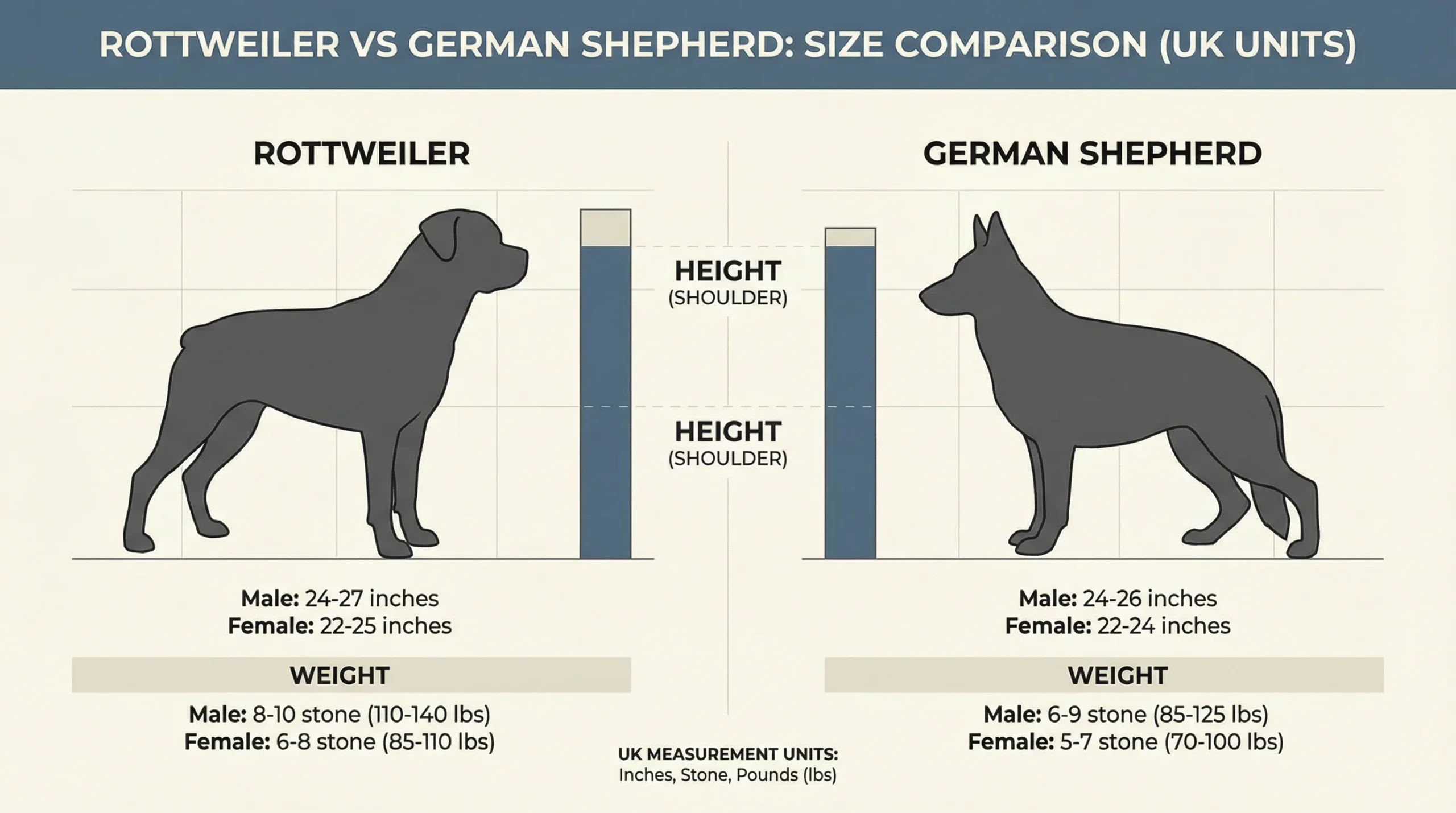
Size & Build Comparison Table
Rottweiler vs German Shepherd — Size, Strength, Temperament & Lifestyle
| Feature | Rottweiler | German Shepherd |
|---|---|---|
| Height | 56–69 cm | 55–65 cm |
| Weight | 35–60 kg | 22–40 kg |
| Build | Heavy, muscular, powerful | Athletic, agile, leaner |
| Temperament | Calm, confident, protective | Alert, energetic, responsive |
| Trainability | High, but needs firm consistency | Very high, learns quickly |
| Exercise Needs | Moderate–high | High–very high |
| Energy Indoors | Low–moderate | Moderate–high |
| Grooming | Moderate shedding | Heavy shedding |
| Lifespan | 9–10 years | 10–13 years |
| Best For | Experienced owners, calm homes | Active homes, working roles |
For full growth stages and weight charts, see our updated Rottweiler Weight Chart (2026)
Exercise Needs & Energy Levels
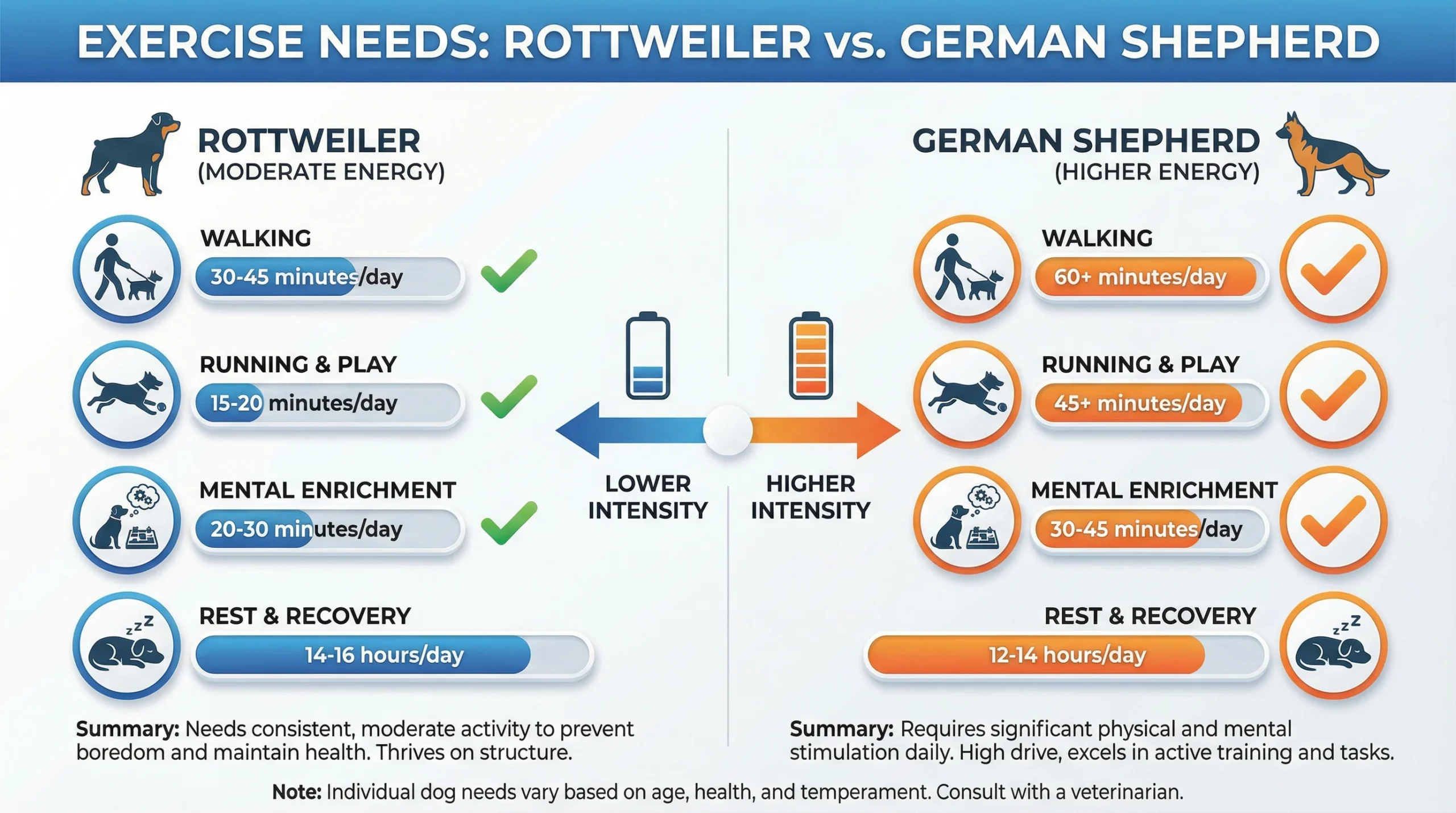
Rottweiler
- 60–90 minutes daily
- Prefers structured exercise
- Calm indoors once needs are met
- Benefits from mental stimulation
German Shepherd
- 90–120 minutes daily
- Needs high-intensity work
- Thrives on obedience, agility, and tracking
- Without exercise, can become vocal or restless
If you’re not active, a GSD will overwhelm you.
A Rottweiler is powerful outdoors but relaxed indoors.
Grooming & Shedding
Rottweiler Grooming
- Moderate shedding
- Weekly brushing
- Short, dense double coat
- Sheds heavier in spring and autumn
For full grooming steps:
👉 What Grooming Does a Rottweiler Need?
German Shepherd Grooming
- Heavy year-round shedding
- Needs brushing 3–4 times weekly
- Thick double coat
- Blows coat twice per year
If your household cannot handle fur on furniture, the GSD will test you.
Health, Costs & Choosing the Right Breed
Common Health Issues
Rottweiler Health
Common issues:
- Hip and elbow dysplasia
- Cruciate ligament tear
- Bloat
- Osteosarcoma
- Heart conditions (DCM)
Lifespan: 9–10 years
German Shepherd Health
Common issues:
- Hip and elbow dysplasia
- Degenerative myelopathy
- Digestive sensitivity
- Allergies
- EPI (Exocrine Pancreatic Insufficiency)
Lifespan: 10–13 years
Feeding & Cost of Ownership
Both are large, high-cost breeds.
Rottweiler Monthly Costs (UK)
- Food: £70–£100
- Insurance: £40–£75
- Grooming: Low
- Training: Moderate
- Vet care: Medium-high
German Shepherd Monthly Costs (UK)
- Food: £60–£90
- Insurance: £45–£80
- Grooming: Moderate-high
- Training: Medium
- Vet care: Medium-high
Which Breed Is Better for First-Time Owners?
Choose a Rottweiler if you want:
- A calmer indoor companion
- A confident, steady protector
- A dog that needs structure but not nonstop activity
- A more relaxed household energy
Choose a German Shepherd if you want:
- A highly trainable dog
- A companion for active outdoor routines
- A sharp, responsive working dog
- A loyal, sensitive family protector
Working Roles and Intelligence
Both dominate working-dog environments, but in different ways:
German Shepherd
- Police
- Military
- Security
- Search & rescue
- Assistance dogs
- Therapy dogs
Rottweiler
- Protection
- Guarding
- Cart pulling
- Police work (historically)
- Personal protection companionship
GSDs are more versatile.
Rottweilers excel in confidence-based roles.
German Shepherds or Rottweilers – Which Should You Choose?
Although both breeds share loyalty and intelligence, their day-to-day behaviour differs. Rottweilers are calmer indoors and naturally confident, while German Shepherds stay more alert and thrive on constant activity. The Rottweiler suits a structured but relaxed home, whereas the German Shepherd performs best in busy, high-energy households.
Rottweilers vs Shepherds – Key Differences at a Glance
Rottweilers are generally calmer and more self-assured, while German Shepherds stay alert and active throughout the day. A Rottweiler suits homes that want a steady, powerful companion with a relaxed indoor temperament. In contrast, a German Shepherd fits households that enjoy structure, training, and regular outdoor activity. Both breeds are loyal, but they offer very different daily experiences.
Final Verdict
Both the Rottweiler and German Shepherd are exceptional dogs — but they fit different lifestyles.
Choose a Rottweiler if you prefer a calmer but powerful companion.
Choose a German Shepherd if you want a high-energy, intelligent working partner.
With the right training and environment, both make outstanding family dogs.
Frequently Asked Questions
Which breed is better for first-time dog owners, a Rottweiler or a German Shepherd?
A German Shepherd is usually the better choice for first-time owners because they learn quickly, respond well to structured training, and communicate clearly. Rottweilers are also very trainable, but their strength and slow maturity mean they need confident, consistent guidance. Both breeds require commitment, but GSDs tend to be more forgiving for beginners.
Are Rottweilers more aggressive than German Shepherds?
No. Neither breed is naturally aggressive. Behaviour depends on training, socialisation, and environment. Rottweilers are calm and confident but protective, while German Shepherds are alert and responsive to cues. With proper socialisation, both breeds are stable and reliable companions.
Do Rottweilers or German Shepherds shed more?
German Shepherds shed significantly more. Their thick double coat releases hair year-round and heavily during seasonal coat blows. Rottweilers also shed, but their shorter coat is easier to manage.
Which breed is easier to train, the Rottweiler or the German Shepherd?
German Shepherds are generally easier to train because of their quick learning speed and high responsiveness. Rottweilers learn well too but can be more independent and slower to mature, requiring patience and firm consistency.
Are Rottweilers good with other dogs compared to German Shepherds?
Both breeds can live calmly with other dogs when socialised early. German Shepherds tend to be more naturally social, while Rottweilers can be selective without proper exposure. Early group training and controlled introductions help both breeds succeed.
Which breed is more protective of their family?
Both are protective, but in different ways. Rottweilers show calm, confident guarding behaviour, whereas German Shepherds are more alert and quick to respond to changes in their environment. Neither should be encouraged into overprotectiveness.
Is a Rottweiler or a German Shepherd better for a calm home?
A Rottweiler usually suits a calm home better because they are steady and relaxed indoors once exercised. German Shepherds stay more alert and active in the house, which may feel intense for quieter families.
Do Rottweilers or German Shepherds need more exercise per day?
German Shepherds need more exercise, averaging 90–120 minutes daily plus mental stimulation. Rottweilers need around 60–90 minutes and are generally more settled afterwards.
Are Rottweilers more expensive to insure than German Shepherds in the UK?
Yes, typically. Rottweilers often have higher insurance premiums due to breed-specific health risks and their larger size. German Shepherds can also be expensive to insure but generally fall slightly lower than Rottweilers.
Which breed lives longer, the Rottweiler or the German Shepherd?
German Shepherds tend to live longer, with an average lifespan of 10–13 years. Rottweilers average around 9–10 years. Genetics, weight management, and routine vet care greatly influence lifespan for both breeds.
Are Rottweilers harder to socialise than German Shepherds?
Rottweilers can be slightly harder to socialise because they mature slowly and can be cautious with unfamiliar dogs or people. German Shepherds tend to be more curious and quicker to adapt. Early, positive social exposure is essential for both.
Do Rottweilers mature slower than German Shepherds?
Yes. Rottweilers are slower to reach full mental and physical maturity, often taking up to three years. German Shepherds mature earlier, usually between one and two years, making their behaviour more predictable sooner.
Which breed has more health problems, the Rottweiler or the German Shepherd?
Both have known health risks, but they differ. Rottweilers have higher rates of bone cancer, joint issues, and heart conditions. German Shepherds are more prone to hip dysplasia, digestive issues, skin allergies, and degenerative myelopathy. Choosing a responsible breeder reduces risk for both breeds.
