
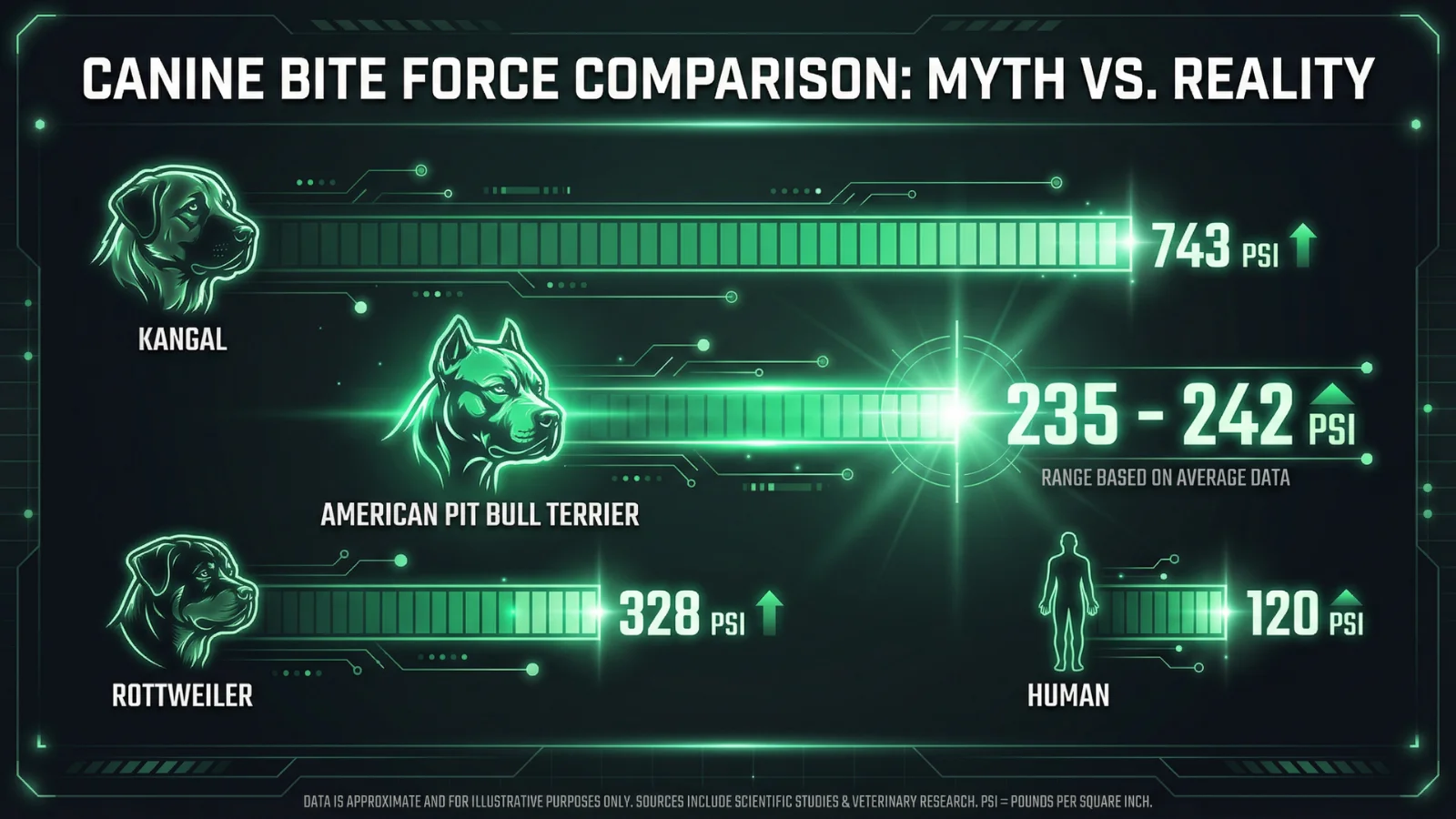
When it comes to the American Pit Bull Terrier, few topics spark as much heated debate as their jaw strength. If you’ve spent any time in dog parks or online forums, you’ve likely heard staggering claims—numbers reaching into the thousands or terrifying tales of “locking jaws.”
At FlexK9, we believe in grounding these discussions in canine science rather than urban legend. Understanding the actual pitbull bite force PSI isn’t just about debunking myths; it’s about responsible ownership and knowing the physical capabilities of the dogs we love. Whether you’re a lifelong advocate or a curious researcher, it’s time to separate the sensationalism from the biology.
TABLE OF CONTENTS
The Science of Bite Force: What Does PSI Actually Measure?
Before diving into the specific numbers, we need to define what we are measuring. PSI (Pounds per Square Inch) is a unit of pressure. In the context of a dog bite, it represents the amount of force exerted when the upper and lower jaws come together.
It is important to note that PSI is not a fixed number for any breed. Factors like the dog’s age, individual muscle mass, and even the “motivation” behind the bite (play vs defence) can cause measurements to fluctuate. In fact, an analysis highlighted by the Royal College of Surgeons of England noted that many historical claims attributing extreme bite forces to specific breeds actually lack verifiable, peer-reviewed data.
Pitbull Bite Force PSI vs. Other Powerful Breeds
If you’re looking for the ‘strongest pitbull’ in terms of raw jaw pressure, you might be surprised to find they aren’t actually at the top of the leaderboard when compared to the dog breeds with the strongest jaws. While they are incredibly tenacious, their PSI is often lower than that of larger guarding breeds.
The Comparative PSI Leaderboard (2026 Updated)
| Dog Breed | Estimated Bite Force (PSI) |
| Kangal | 743 PSI |
| Cane Corso | 700 PSI |
| English Mastiff | 556 PSI |
| Rottweiler | 328 PSI |
| German Shepherd | 238 PSI |
| American Pit Bull Terrier | 235 – 242 PSI |
| Human (For Comparison) | 120 – 160 PSI |
As the data shows, the bite force of a pitbull is statistically comparable to a German Shepherd or a large Labrador. They are powerful, yes, but they do not possess the bone-crushing pressure of a 150lb Kangal or Mastiff. Bite force statistics are often discussed online, but breed identification and legal classification are far more complex. For a clearer explanation of how Pitbull-type dogs differ from recognised UK breeds, read our full Pitbull dog vs Staffy guide.
For a more detailed breakdown of how these physical traits and temperaments differ in a head-to-head matchup, check out our guide on the Cane Corso dog vs Pitbull.
Do Pitbulls Have Locking Jaws?
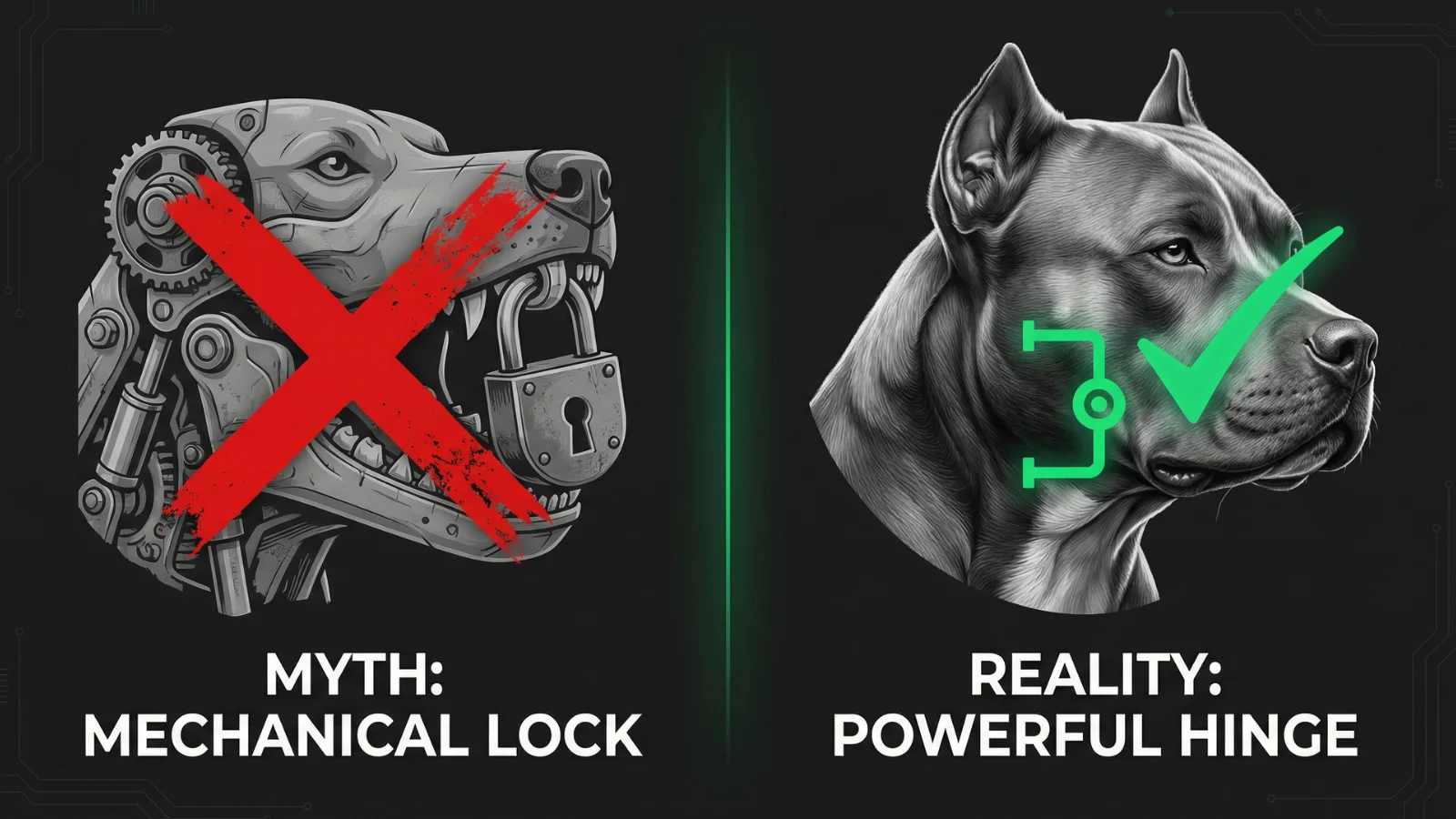
One of the most persistent misconceptions about pit bull bites is the ‘locking jaw’ theory. To be clear: No dog breed, including the Pit Bull Terrier, possesses a physical mechanism that allows their jaws to “lock.”
Their skull anatomy is fundamentally the same as that of any other domestic dog. The reason people think they lock is due to their gameness—a selective breeding trait that gives them incredible focus and a refusal to give up once they have gripped something. This is a behavioural trait, not a mechanical one.
Leading UK animal welfare charities, including Blue Cross, have continually presented evidence to the government confirming that the idea of a pitbull having an inherently dangerous ‘locking jaw’ is a complete, inaccurate myth.
The Impact of Skull Shape on Bite Strength
Canine jaw strength is largely a product of “morphology”—the size and shape of the head. Dogs with broader, shorter snouts (brachycephalic or mesocephalic) generally have a mechanical advantage. Because Pit Bulls have wide skulls and significant attachment points for the temporalis and masseter muscles, they can exert a high amount of force relative to their medium body size.
Why “Bite and Hold” is Often Misunderstood
While a Pit Bull’s PSI isn’t the highest, their style of biting is unique. Unlike breeds that “snap and release,” bully breeds were historically selected for grip strength and tenacity in specific working roles. This tenacity can make a 240 PSI bite feel far more damaging than a higher PSI bite from a dog that lets go immediately.
Does a Higher PSI Mean a More Dangerous Dog?
High bite force does not equate to high aggression. A Kangal has three times the bite force of a Pit Bull, yet they are known as calm, stoic livestock guardians. Danger is a result of temperament, lack of socialisation, and irresponsible ownership, which has led to specific legal restrictions; you can view the full list of banned dog breeds UK to see how the law classifies various types.
Research from Battersea Dogs & Cats Home emphasises that the vast majority of veterinary and behavioural experts agree that breed alone is not the determining factor in dog attacks.
Understanding the American Pit Bull Terrier’s Grip
When we talk about the American Pit Bull bite force, we have to acknowledge their athletic build. They are the “triathletes” of the dog world. Their strength comes from a combination of lean muscle and an intense psychological drive. This is why they excel in sports like weight pulling and high jump, where determination is just as important as physical power.
Myths vs. Reality: Why Context Matters in Dog Attacks
How to Manage a High-Energy, Powerful Breed
Implementing early bite inhibition and positive reinforcement training is highly recommended by veterinary organisations like the PDSA as one of the best ways to prevent aggression and ensure safe handling later in life.
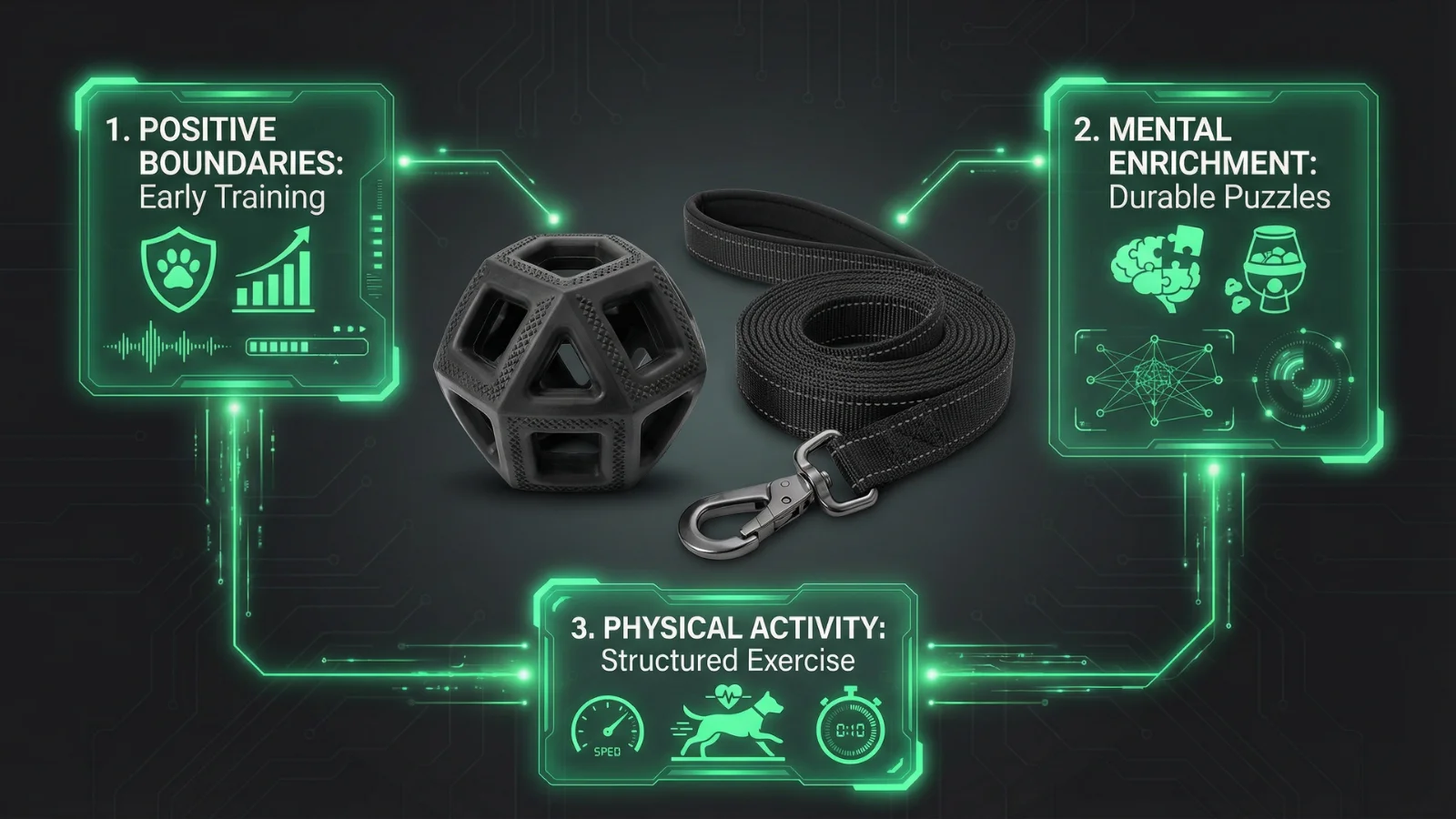
- Bite Inhibition: Teach your dog the “off” command from puppyhood.
- Mental Stimulation: Use heavy-duty dog enrichment toys to satisfy their urge to chew and prevent boredom-based destructive behaviour.
- Physical Outlet: Ensure they have a way to burn off energy so they don’t become frustrated.
Final Thoughts on the Pitbull Bite Force PSI Debate
When you strip away the sensationalised headlines and urban legends, the truth about the pitbull bite force psi is grounded in pure biology. At approximately 235 to 242 PSI, the American Pit Bull Terrier possesses a strong and capable bite, but it is far from the unnatural, bone-crushing anomaly that myths make it out to be. They do not have locking jaws, and they do not bite with thousands of pounds of pressure.
At FlexK9, our goal is to empower dog owners with the facts. Understanding your dog’s physical capabilities is a crucial part of responsible ownership. The American Pit Bull Terrier is a deeply loyal, athletic, and tenacious breed. When provided with the right training, robust chew toys, and a loving environment, their strength becomes a testament to their working heritage rather than a cause for fear.
If you’re raising a powerful breed and want to ensure they channel their energy positively, be sure to explore our guides on durable gear and enrichment to keep their minds and jaws happily occupied.
Frequently Asked Questions
What is the bite force of a Pitbull in 2026?
Scientific studies consistently place the American Pit Bull Terrier’s bite force between 235 and 242 PSI. While formidable, it is lower than that of a Rottweiler (328 PSI) or a Kangal (743 PSI).
Is it true that Pitbulls can bite with 2000 PSI?
No. This is a common myth. There is no recorded evidence of any domestic dog reaching 2000 PSI. For context, even a Great White Shark’s bite is estimated at around 4,000 PSI; a 60lb dog reaching half of that is biologically impossible.
Which dog has the strongest bite force?
The Kangal, a Turkish livestock guardian, currently holds the record for the highest measured bite force at approximately 743 PSI.
Can a Pitbull’s bite break bone?
Yes. While they don’t have the highest PSI, 240 pounds of pressure per square inch is more than enough to break small bones in the hand or foot and cause significant soft tissue damage.
Why do Pitbulls refuse to let go when they bite?
This is due to a trait called “tenacity” or “gameness.” It is not a physical lock but a psychological drive to hold onto their “prey” or toy. This behaviour can be managed with proper training and socialisation.
How does a Pitbull’s bite force compare to a human’s?
An average human bites with a force of about 120–160 PSI. A Pit Bull Terrier’s bite is roughly twice as powerful as a human’s.
Does a Pitbull Terrier have a stronger bite than a German Shepherd?
Actually, they are nearly identical. A German Shepherd typically measures around 238 PSI, while a Pit Bull is around 235-242 PSI. The difference is statistically negligible.
