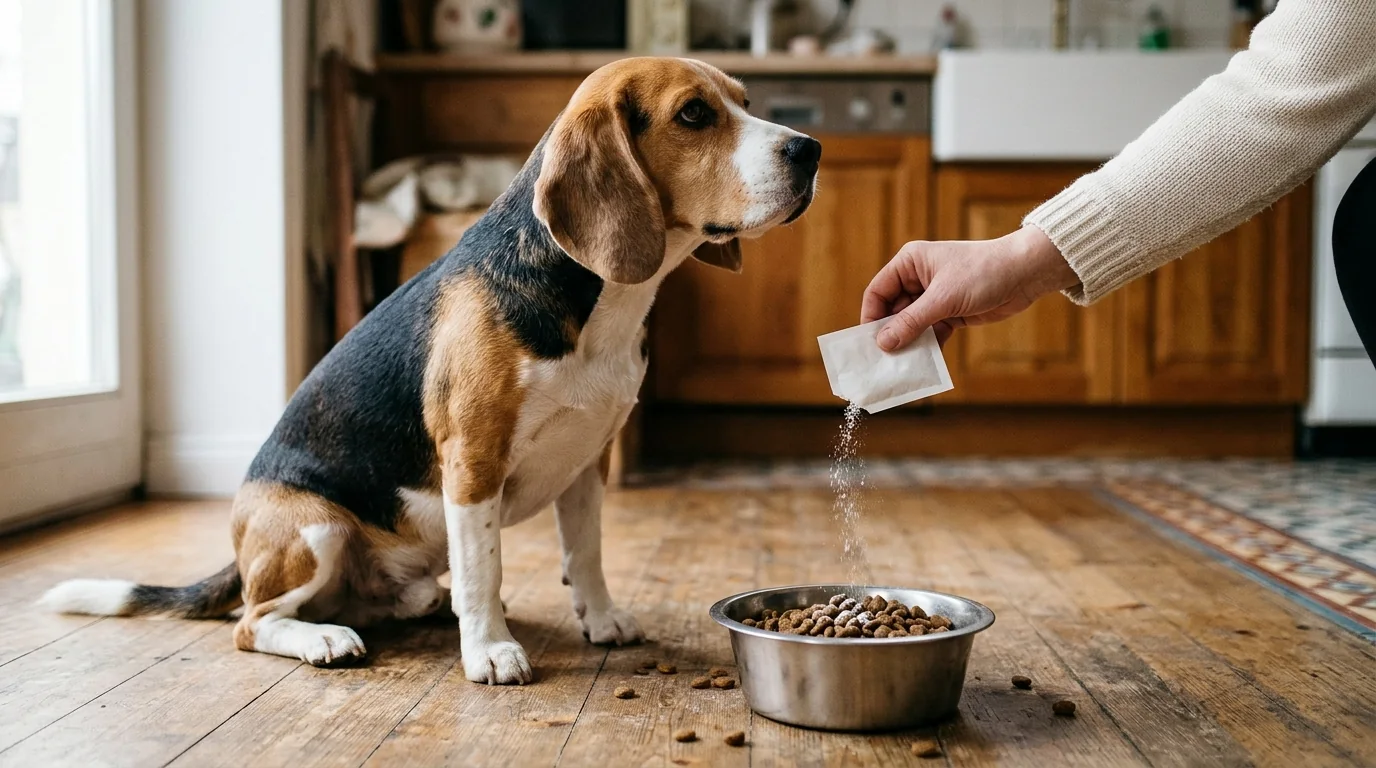
What are the best probiotics for dogs? For most dogs, the right probiotic is one your vet suggests for a few days after a tummy upset, not a supplement for life. Protexin’s Pro-Kolin Advanced paste is my overall pick, the original Pro-Kolin paste is the budget choice, and Purina’s FortiFlora is the powder to try if your dog won’t take a syringe.
This guide draws on PDSA’s vet-written advice on probiotics and tummy upsets, on each maker’s own description of its product (labelled as theirs), and on Amazon UK prices and reviews as I found them on 18 November 2026. Where UK sources say nothing, I’ve said so.
Quick Picks:
Best overall: Protexin Pro-Kolin Advanced: a probiotic paste with binders, dosed from a wheel on the syringe
Best budget paste: Protexin Pro-Kolin: the same maker’s simpler paste for less
Best powder: Purina Pro Plan FortiFlora: one sachet a day, sprinkled on food
Best short-course sachets: YuMOVE Digestive Care PLUS: a six-sachet box for a sudden upset
Best daily tablets: YuMOVE Digestive Care: a dose set by your dog’s weight
Best chews: Zesty Paws Probiotic Bites: a soft chew for dogs that refuse tablets and powders
TABLE OF CONTENTS
What are probiotics for dogs?
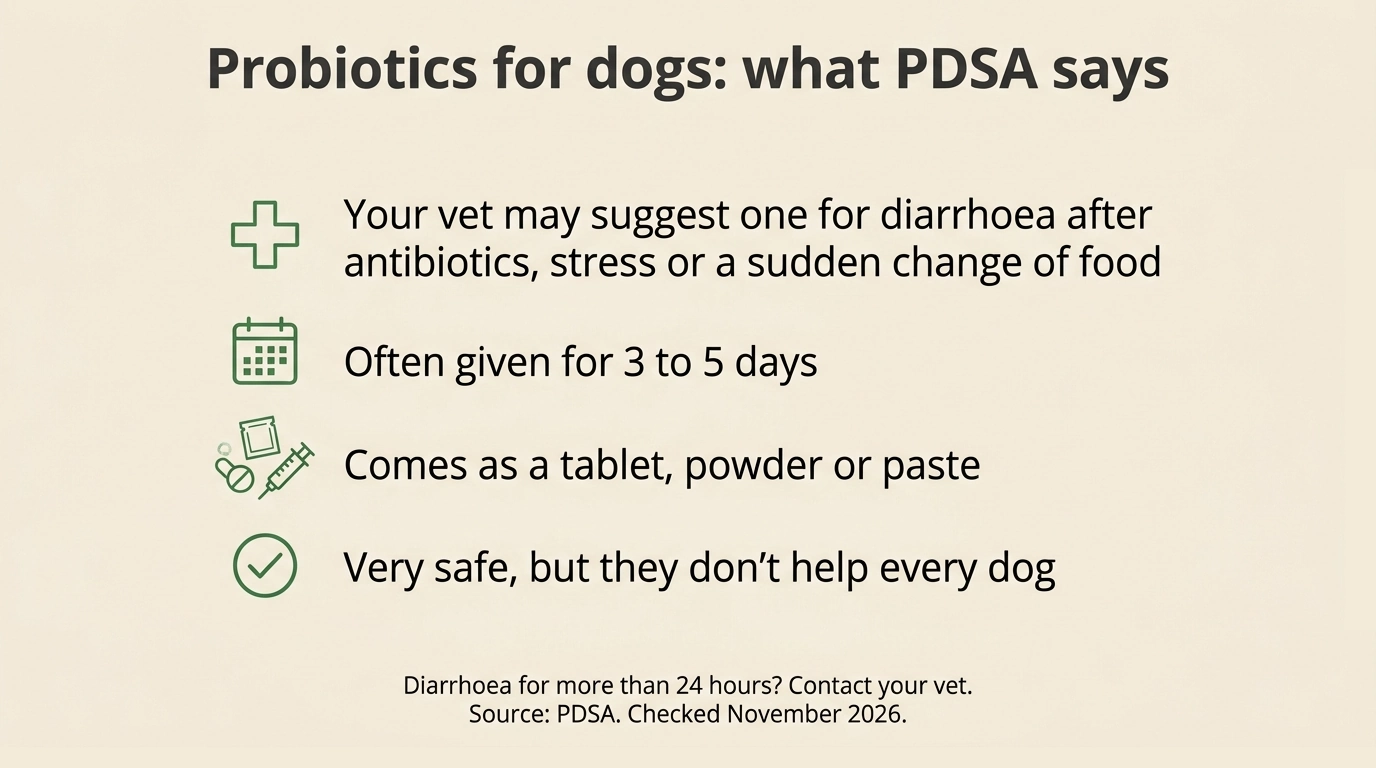
Probiotics are friendly bacteria. PDSA describes them as a way to “top up” the bacteria in a dog’s gut when illness or medication has disrupted them, and they come as a tablet, powder or paste. Some products also contain ingredients that bind diarrhoea and soothe the gut, according to PDSA’s guide to probiotics.
We found no UK vet charity, the Royal Kennel Club or VetCompass saying which bacteria a dog’s probiotic should contain, how many it needs or which brand works best. Every strain and amount on the cards below is the maker’s own figure, labelled as theirs.
FlexK9 Health Disclaimer: This guide doesn’t replace your vet. PDSA advises contacting your vet if your dog’s diarrhoea lasts more than 24 hours, has blood or mucus in it, or comes with vomiting, a poor appetite or tiredness, and sooner if your dog is very young, old, already unwell or on medication. Don’t wait for a probiotic to work first.
When might a dog need a probiotic?
Your vet may recommend a course of probiotics if your dog has diarrhoea after antibiotics, diarrhoea caused by stress, or diarrhoea after a sudden change of food, PDSA says. Its vets are clear that probiotics help some dogs but not all, and that they don’t work in every situation.
Probiotics can be bought at your vet’s or online, and where possible it’s best to use one your vet recommends, the charity’s guide to stomach upsets adds. Every pick below is sold without a prescription, so you can ask your vet which one suits your dog before you buy.
From our home: When Dexter, my Cane Corso, swallowed something he shouldn’t have, he had bad diarrhoea for about four days. His vet gave him a probiotic paste in a syringe, and it helped a lot. I don’t know which brand it was, so none of the picks below is marked as one he’s used.
If your dog’s stomach is unsettled more often than not, a probiotic isn’t the whole answer. Our guide to the best dog food for sensitive stomachs covers changing food slowly and what to feed after an upset.
How long should you give a dog probiotics?
Probiotics are often given for three to five days, and PDSA describes them as very safe and extremely unlikely to cause side effects.
The makers’ own guidance varies, so read the pack. Any dog with a digestive upset lasting more than two to three days should be checked by a vet, Protexin says, and YuMOVE advises seeking veterinary advice if there’s no improvement in three to five days. The directions for FortiFlora run longer: one sachet a day until at least a week after your dog’s poo is back to normal, according to Purina.
Those time limits are the makers’. The charity’s own advice is to contact your vet if diarrhoea lasts more than 24 hours, so don’t wait for a paste or a box of sachets to run out before you call. Our guide to diarrhoea and vomiting in dogs lists the other signs that mean it’s time to call.
We found no UK source that says a healthy dog benefits from a probiotic every day. The daily tablets and chews further down are sold that way by their makers, so if you’re thinking of one for a dog with no tummy trouble, ask your vet whether it’s worth it.
How we chose
I looked at more than 20 probiotics for dogs on Amazon UK, from pastes and powders to tablets and chews, and kept seven, using four checks:
- Sold without a prescription. Probiotics can be bought at your vet’s or online, and nothing here needs a prescription.
- The maker names the probiotic and how much is in it. Each card gives the strain and amount from the maker’s own label.
- In stock on Amazon UK. Every pick was in stock when I checked on 18 November 2026.
- The right form for the job. A paste for a sudden upset, sachets for a short course, and tablets or chews for owners whose vet suggests a daily product.
I can’t confirm Dexter has used any of these: the paste his vet gave him had no name I can trace. Everything here comes from each maker’s description, PDSA’s advice and verified UK buyer reviews.
Probiotic pastes for dogs with a sudden upset
A paste comes in a syringe and goes straight into your dog’s mouth or onto their food, which helps when a dog with an upset stomach is off their food. Both pastes here pair a probiotic with binders, according to their maker.
Best Probiotic Paste for Dogs
1. Protexin Pro-Kolin Advanced

- What it is: A probiotic paste in a 30ml syringe with a dosing wheel on the plunger.
- Inside: Enterococcus faecium with prebiotics, psyllium and the binders kaolin and montmorillonite, Protexin says.
- Flavour: Liver-flavoured, with no meat, according to its maker.
- How often: Up to three times a day, from eight weeks old, Protexin says.
Why it’s a top pick:
Pro-Kolin Advanced combines a probiotic with the kind of ingredients PDSA describes as binding diarrhoea and soothing the gut. Protexin lists the probiotic Enterococcus faecium, the prebiotics Preplex and pectin, psyllium fibre, and the binding clays kaolin and montmorillonite. It’s a liver-flavoured paste that Protexin says contains no meat, and a wheel on the plunger sets the dose by your dog’s weight. Protexin says it can be given up to three times a day, from eight weeks old.
Specifications:
- Type: Oral paste in a syringe
- Pack size: 30ml (also sold in 15ml and 60ml)
- Probiotic (maker): Enterococcus faecium
- Other ingredients (maker): Prebiotics (Preplex, pectin), psyllium, kaolin, montmorillonite, beta-glucans
- Suitable from (maker): 8 weeks
- Best for: A sudden upset in a small or medium dog
✅ Reasons to Buy:
- Binders as well as bacteria: kaolin and montmorillonite sit alongside the probiotic, Protexin says.
- Easy to dose: a wheel on the plunger sets the amount by weight.
- Meat-free flavour: liver-flavoured without meat, according to its maker.
❌ Reasons to Avoid:
- Small syringe for a big dog: at Protexin’s dose of 7ml twice a day for a dog over 30kg, a 30ml syringe lasts about two days; Protexin suggests the 60ml syringe for larger dogs.
- May contain soy: the listing’s allergen information says so.
📝 Mini Verdict:
Buy it to keep in the cupboard for a sudden upset, once your vet has agreed it suits your dog. For a big dog, choose the 60ml syringe, which lasts longer.
Best Budget Probiotic Paste for Dogs
2. Protexin Pro-Kolin
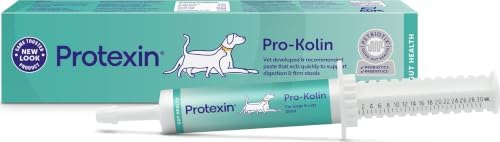
- What it is: A probiotic paste in a 30ml syringe for dogs and cats.
- Inside: Enterococcus faecium with kaolin, pectin and the prebiotic Preplex, its label says.
- How long: Twice a day for two to three days, or as your vet advises, Protexin says.
- Flavour: A meat-free beef flavour.
Why it’s a top pick:
The original Pro-Kolin is the simpler, cheaper paste from the same maker. Its label lists the same probiotic, Enterococcus faecium, with kaolin as a binder, pectin and the prebiotic Preplex, in a meat-free beef flavour. Protexin’s directions are to give it twice a day by your dog’s weight for two to three days, or as your vet advises, and to see a vet if symptoms carry on. It’s sold for dogs and cats.
Specifications:
- Type: Oral paste in a syringe
- Pack size: 30ml (also sold in 60ml)
- Probiotic (maker): Enterococcus faecium
- Other ingredients (maker): Kaolin, pectin, prebiotic (Preplex), soya oil, dextrose
- Suitable from (maker): Not stated on the listing
- Best for: A cheaper paste for a small or medium dog
✅ Reasons to Buy:
- Lower price: costs less than the Advanced version for the same 30ml syringe.
- A short course: two to three days, Protexin’s directions say.
- Dogs and cats: one syringe covers both.
❌ Reasons to Avoid:
- Fewer ingredients than Advanced: no montmorillonite or psyllium on its label.
- Contains soya oil: it’s listed in the composition.
- Small syringe for a big dog: at 6ml twice a day for a 25–35kg dog, a 30ml syringe lasts two and a half days.
📝 Mini Verdict:
Buy it if you want a well-known paste for a short course at a lower price. Skip it if you’d rather have the extra binders in Pro-Kolin Advanced.
Probiotic powders and sachets for dogs
Powders are sprinkled on food, so they suit a dog who is still eating. Both picks here come in single-dose sachets.
Best Probiotic Powder for Dogs
3. Purina Pro Plan FortiFlora

- What it is: 30 one-gram probiotic sachets to sprinkle on food once a day.
- Inside: Purina’s own strain, Enterococcus faecium SF68, with vitamins C and E.
- With antibiotics: Give at least two hours apart from any antibiotic, Purina says.
- Fussy eaters: Its maker describes it as a palatability enhancer.
Why it’s a top pick:
FortiFlora is a probiotic powder in one-gram sachets that you sprinkle over your dog’s food once a day. Purina says each sachet contains its own strain of Enterococcus faecium, SF68, coated to help it reach the gut alive, and that the powder can tempt a dog with a poor appetite. Its directions cover giving it during a course of antibiotics and for a week afterwards, at least two hours apart from the antibiotic. It sits in Purina’s Pro Plan Veterinary Diets range but is sold without a prescription.
Specifications:
- Type: Powder sachets
- Pack size: 30 × 1g sachets
- Probiotic (maker): Enterococcus faecium SF68
- Other ingredients (maker): Meat and animal derivatives, minerals, vitamins C and E
- Suitable from (maker): Puppies at weaning
- Best for: A dog on antibiotics, or one that’s off its food
✅ Reasons to Buy:
- One sachet a day: no measuring, Purina says.
- Antibiotic guidance: Purina says to give it at least two hours apart from any antibiotic.
- Made to tempt fussy eaters: its maker describes it as a palatability enhancer.
❌ Reasons to Avoid:
- Made with meat: the first ingredient is meat and animal derivatives, so check with your vet if your dog is on a vet-recommended diet.
- Price: 30 sachets last a month at one a day.
📝 Mini Verdict:
Buy it if your vet suggests a probiotic during or after antibiotics, or your dog is off their food. Skip it if your dog must avoid meat other than their usual protein.
Best Probiotic Sachets for a Short Course
4. YuMOVE Digestive Care PLUS
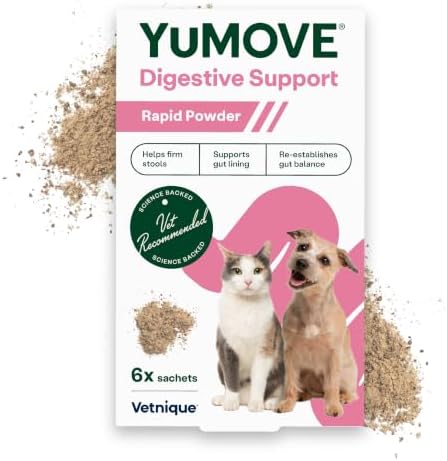
- What it is: Six probiotic sachets for a short course, for dogs and cats.
- Inside: One billion Enterococcus faecium per sachet with three prebiotics, the label says.
- Binder: Bentonite clay, which YuMOVE says helps firm loose stools.
- Dose: Two sachets a day for a 16 to 35kg dog, YuMOVE’s guide says.
Why it’s a top pick:
Digestive Care PLUS is YuMOVE’s stronger sachet for a sudden upset, sold for dogs and cats. Its label lists one billion Enterococcus faecium per sachet, the prebiotics FOS, MOS and beta-glucans, and bentonite clay, which YuMOVE says helps firm loose stools. A six-sachet box is a short course: YuMOVE’s guide is two sachets a day for a 16–35kg dog, and it advises seeking veterinary advice if there’s no improvement in three to five days.
Specifications:
- Type: Powder sachets
- Pack size: 6 sachets
- Probiotic (maker): Enterococcus faecium, 1 billion per sachet
- Other ingredients (maker): Linseed meal, prebiotics (FOS, MOS, beta-glucans), bentonite clay
- Suitable from (maker): All ages
- Best for: A short course for a medium or large dog
✅ Reasons to Buy:
- Low price per box: six sachets, one of the lowest-priced packs on this page.
- A binder included: bentonite clay, according to YuMOVE.
- Sprinkle and go: each sachet goes on food.
❌ Reasons to Avoid:
- Runs out fast for a big dog: six sachets last three days at two a day, or two days at three a day for a dog over 35kg.
- Price per day: high, because a box of six lasts three days at two sachets a day.
📝 Mini Verdict:
Buy it if you want a short course in single sachets with a binder included. Skip it for a giant dog over several days: the box empties quickly.
Daily probiotics for dogs: tablets and chews
These three are sold for daily use. No UK source says a healthy dog needs a daily probiotic, so treat the makers’ daily directions as theirs and check with your vet.
Best Daily Probiotic Tablets for Dogs
5. YuMOVE Digestive Care

- What it is: 120 daily probiotic tablets for dogs.
- Inside: 200 million Enterococcus faecium per tablet with scFOS, MOS and beta-glucans, the label says.
- Dose: One to four tablets a day by weight, YuMOVE says.
- Age: For dogs and puppies eating solids, according to its maker.
Why it’s a top pick:
YuMOVE Digestive Care is a daily tablet for dogs with sensitive digestion, according to its maker. Each tablet contains 200 million Enterococcus faecium plus a prebiotic blend of scFOS, MOS and beta-glucans, the label says. YuMOVE’s dose goes by weight, from one tablet a day for a dog up to 10kg to four for a dog over 40kg, so a pack of 120 lasts a month even for the biggest dogs.
Specifications:
- Type: Tablet
- Pack size: 120 tablets
- Probiotic (maker): Enterococcus faecium, 200 million per tablet
- Other ingredients (maker): Prebiotics (scFOS, MOS, beta-glucans)
- Suitable from (maker): Puppies eating solids
- Best for: Daily use, if your vet suggests it
✅ Reasons to Buy:
- Dose by weight: one to four tablets a day, YuMOVE says.
- A month’s supply for a big dog: 120 tablets at four a day.
- Prebiotics included: three named on the label.
❌ Reasons to Avoid:
- Lower amount per dose: 200 million bacteria per tablet, against one billion per PLUS sachet.
- Several tablets for a large dog: three a day at 26–40kg and four over 40kg.
📝 Mini Verdict:
Buy it if your vet thinks a daily probiotic is worth trying for your dog. Skip it for a sudden upset: a paste or sachet suits that better.
Best Probiotic Chews for Dogs
6. Zesty Paws Probiotic Bites

- What it is: 90 soft pumpkin-based chews, given once a day.
- Inside: Bacillus subtilis (Calsporin), FOS and an inactivated yeast, the UK label says.
- How long: At least four weeks, Zesty Paws says.
- Age: Not for puppies under four months.
Why it’s a top pick:
Zesty Paws Probiotic Bites are soft, pumpkin-based chews for dogs that won’t take a tablet or powder. The UK label lists the probiotic Bacillus subtilis (sold as Calsporin), the prebiotic FOS and an inactivated yeast it calls a postbiotic, with dried pumpkin as the first ingredient. Zesty Paws says to feed them once a day for at least four weeks, and they aren’t suitable for puppies under four months.
Specifications:
- Type: Soft chew
- Pack size: 90 chews
- Probiotic (maker): Bacillus subtilis (Calsporin)
- Other ingredients (maker): Dried pumpkin, FOS, inactivated yeast (EpiCor), linseed
- Suitable from (maker): 4 months
- Best for: Dogs that refuse tablets and powders
✅ Reasons to Buy:
- A chew, not a pill: given like a treat.
- Lasts 45 days for a 15–30kg dog: at two chews a day, Zesty Paws’ guide for that weight.
❌ Reasons to Avoid:
- Most expensive here: the highest-priced pack on this page (90 chews).
- One probiotic: the UK label lists Bacillus subtilis only.
- Claims we couldn’t check: its listing also mentions itchy skin and seasonal allergies; we found no UK source behind those.
📝 Mini Verdict:
Buy it if your dog won’t take a tablet or powder and your vet is happy with a daily chew. Skip it if price matters or you’re after a short course for an upset.
Best Budget Daily Probiotic for Dogs
7. Pooch & Mutt Bionic Biotic

- What it is: A 200g tub of powder to sprinkle on food once a day.
- Inside: Bacillus velezensis, chicory root as a source of FOS, and fish oil, the label says.
- Age: For dogs from 12 weeks, according to Pooch & Mutt.
- Chicken-free: Its maker says it contains no chicken.
Why it’s a top pick:
Bionic Biotic is the cheapest product here: a 200g tub of powder you sprinkle on food once a day. Pooch & Mutt’s label lists the probiotic Bacillus velezensis, chicory root as a source of the prebiotic FOS, fish oil, vitamins and minerals. It’s sold as a complementary feed for dogs from 12 weeks old, and its maker says it’s chicken-free.
Specifications:
- Type: Powder
- Pack size: 200g tub
- Probiotic (maker): Bacillus velezensis
- Other ingredients (maker): Maize, maize gluten meal, chicory root (FOS), yeast, fish oil, vitamins and minerals
- Suitable from (maker): 12 weeks
- Best for: A low-cost daily powder
✅ Reasons to Buy:
- Lowest price: the lowest-priced pack on this page.
- Chicken-free: according to Pooch & Mutt.
- Sprinkled on food: once a day.
❌ Reasons to Avoid:
- Mostly maize: maize and maize gluten meal are the first two ingredients.
- Skin and coat claims are the maker’s: we found no UK source behind them.
- Large doses for big dogs: three to four teaspoons a day for a 25–50kg dog, its feeding guide says.
📝 Mini Verdict:
Buy it if you want a cheap daily powder and your vet is happy for your dog to try one. Skip it if you’d rather have a product with no maize base.
How much do probiotics for dogs cost?
Price per pack says little on its own, because the amount each maker suggests depends on your dog’s weight, so the table shows each maker’s dose for a 30kg dog beside each price band. The bands compare the packs in this table with each other: £ is the lower-priced end, ££ the middle and £££ the higher end.
| Product | Pack | Price band | Maker’s dose for a 30kg dog |
|---|---|---|---|
| Protexin Pro-Kolin Advanced | 30ml syringe | ££ | 5ml twice a day |
| Protexin Pro-Kolin Advanced | 60ml syringe | £££ | 6ml twice a day |
| Protexin Pro-Kolin | 30ml syringe | ££ | 6ml twice a day |
| Purina Pro Plan FortiFlora | 30 sachets | £££ | 1 sachet a day |
| YuMOVE Digestive Care PLUS | 6 sachets | £ | 2 sachets a day |
| YuMOVE Digestive Care | 120 tablets | £££ | 3 tablets a day |
| Zesty Paws Probiotic Bites | 90 chews | £££ | 2 chews a day |
| Pooch & Mutt Bionic Biotic | 200g tub | £ | 3 to 4 teaspoons a day |
Amazon prices change often, so check the current price before you buy.
Final Thoughts: Which Probiotic Should You Buy for Your Dog?
- If your vet suggests a probiotic for a sudden upset, Pro-Kolin Advanced is the paste to keep in the cupboard, in the 60ml size for a big dog.
- If you want a paste for less, the original Pro-Kolin is the cheaper option.
- If your dog is on antibiotics, ask your vet about FortiFlora, which Purina says to give at least two hours apart from the medicine.
- If you’d rather sprinkle a short course on food, YuMOVE Digestive Care PLUS comes in single sachets.
- If your vet thinks a daily product is worth trying, YuMOVE Digestive Care tablets or Zesty Paws chews are the options here, with Pooch & Mutt as the budget powder.
Whichever of these probiotics for dogs you choose, contact your vet if diarrhoea lasts more than 24 hours or your dog seems unwell.
Frequently Asked Questions About Probiotics for Dogs
Can I give my dog human probiotics?
It’s best not to. We found no UK vet charity advice on giving dogs probiotics made for people, and PDSA’s advice is to use a probiotic your vet recommends. If a human product is ever suggested, check its label for xylitol, a sweetener PDSA lists as poisonous to dogs, and ask your vet first.
How long do probiotics take to work in a dog?
No UK source gives a timescale. PDSA says probiotics are often given for three to five days, and that they help some dogs but not all. Contact your vet if diarrhoea lasts more than 24 hours, or sooner if your dog seems unwell, rather than waiting to see whether a probiotic works.
Do probiotics have side effects in dogs?
Rarely. PDSA describes probiotics as very safe and says they’re extremely unlikely to cause side effects. If your dog seems worse after starting one, or their upset doesn’t settle, stop giving it and speak to your vet, who can check for a cause a probiotic won’t treat.
Can my dog have probiotics while taking antibiotics?
Yes, if your vet agrees. Diarrhoea after antibiotics is one of the reasons PDSA says a vet may recommend probiotics. Purina says its FortiFlora powder should be given at least two hours apart from any antibiotic; for other products, ask your vet how to time the doses.
Can puppies have probiotics?
Some products are sold for puppies, from different ages. Protexin says Pro-Kolin Advanced can be used from eight weeks, Pooch & Mutt sells Bionic Biotic from 12 weeks, and Zesty Paws says its chews aren’t for puppies under four months. A very young puppy with diarrhoea should see a vet, PDSA advises.
Is yoghurt or kefir a good probiotic for dogs?
We found no UK vet charity advice recommending yoghurt or kefir as a probiotic for dogs. PDSA’s advice is to use a probiotic your vet recommends, so a product made for dogs is the safer choice. If you’re thinking of adding a new food to your dog’s diet, ask your vet first.
