
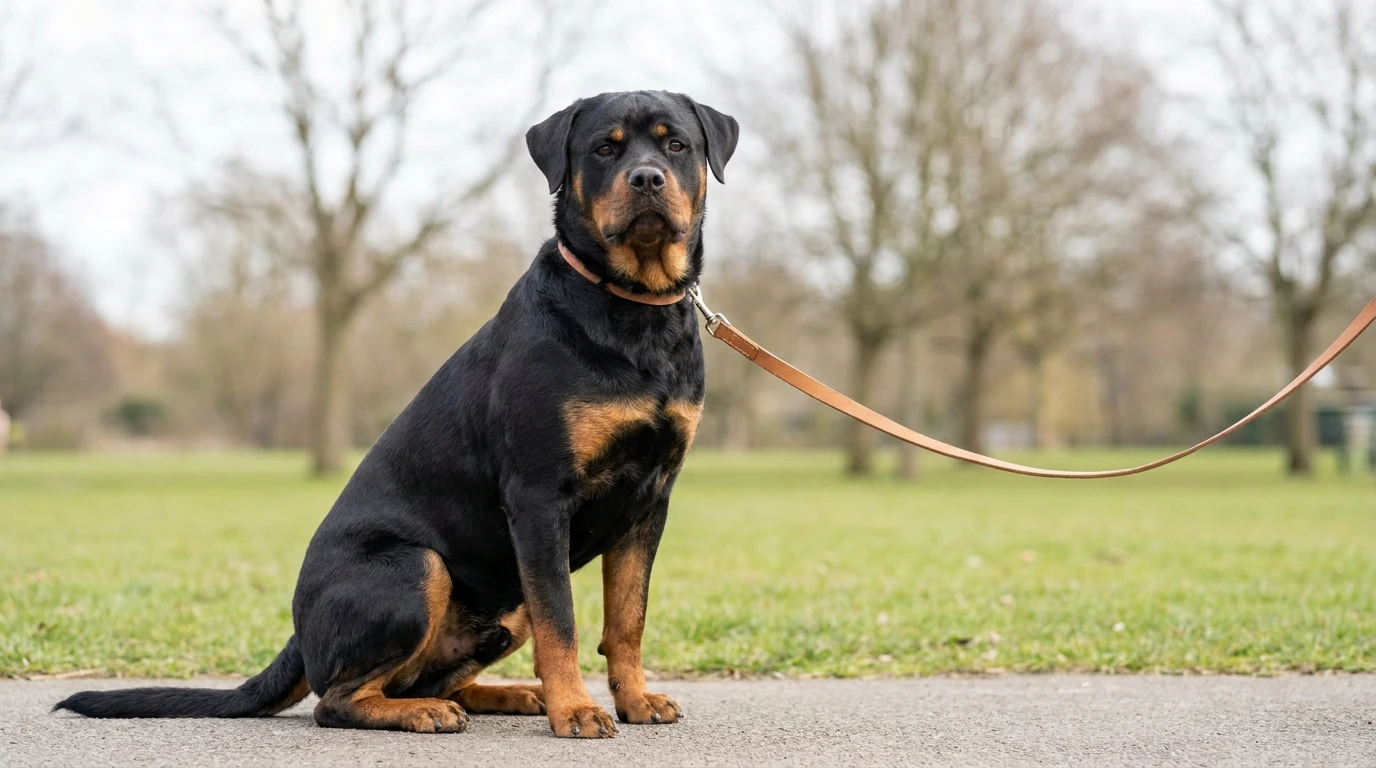
Are Rottweilers banned in the UK? No. The Rottweiler is not one of the banned types of dog named by GOV.UK, and you do not need a court order or any special permission to own one. GOV.UK judges whether a dog is a banned type by what it looks like, rather than its breed or name. The law that applies to a Rottweiler is the law that applies to every dog.
This guide draws on GOV.UK, mygov.scot, nidirect and the Royal Kennel Club. It’s general information, not legal advice: if your own dog is affected, start with GOV.UK or speak to a solicitor.
TABLE OF CONTENTS
Rottweilers and the UK’s banned types
GOV.UK sets out the types of dog it’s against the law to own in the UK. The Rottweiler is not one of them. Our guide to the list of banned dog breeds in the UK covers which types are on that list and what the rules are for them.
Because the Rottweiler is not a banned type, there’s no exemption certificate to apply for, no court decision to wait on and no registration scheme to join. The Royal Kennel Club lists the Rottweiler on Breeds A to Z in its Working group, and it can be registered, shown and bred like any other recognised breed.
How GOV.UK decides whether a dog is a banned type
GOV.UK is clear that this is not a question of paperwork: “Whether your dog is a banned type depends on what it looks like, rather than its breed or name.” A police or council dog expert judges what type a dog is, and whether it is, or could be, a danger to the public.
If a dog is suspected of being a banned type, it’s the owner’s responsibility to prove that it is not. That’s why a pedigree, a microchip record or a DNA result doesn’t settle the question on its own. Our guide to how the law on banned types works sets out that process in full.
The law that applies to every dog
The main rule a Rottweiler owner needs to know isn’t about breed at all. GOV.UK says it’s against the law to let a dog be dangerously out of control anywhere: in a public place, in a private place such as a neighbour’s house or garden, and in the owner’s own home. In its words, “the law applies to all dogs”.
A dog is considered dangerously out of control if it injures someone, or makes someone worried that it might injure them. A court could also decide a dog is dangerously out of control if it attacks someone’s animal, or if the owner of that animal thinks they could be injured trying to stop the attack.
What the penalties are
GOV.UK sets out what a court can do. For a dog that’s dangerously out of control, you can get an unlimited fine or be sent to prison for up to 6 months, or both. You may not be allowed to own a dog in future, and your dog may be destroyed.
The sentences rise with the harm done. If you let your dog injure someone, you can be sent to prison for up to 5 years or fined, or both. If you allow your dog to kill someone, that rises to up to 14 years or an unlimited fine, or both. Injuring an assistance dog, such as a guide dog, carries up to 3 years.
Important: GOV.UK says the dangerously out of control offence applies anywhere, including in the owner’s own home. It applies to every dog, whatever the breed.
You can read more about the Act these offences sit under in our guide to the Dangerous Dogs Act 1991, and about how to report a dangerous dog if you need to.
What the law asks of every Rottweiler owner
Microchipping, collar and tag
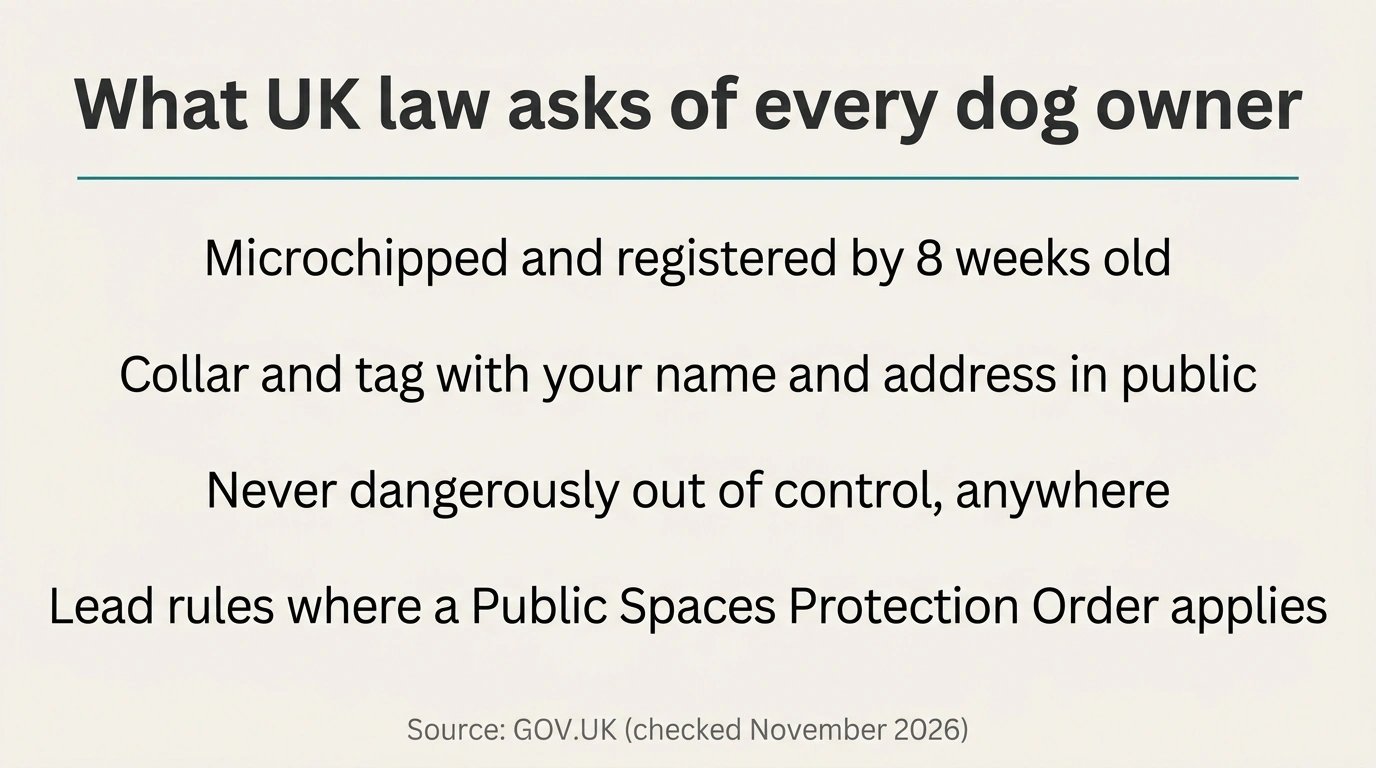
GOV.UK says all dogs in the UK must be microchipped and registered on an approved database by the time they’re 8 weeks old. You can be fined up to £500 if your dog isn’t microchipped or isn’t registered on one of those databases.
A microchip doesn’t replace a collar. GOV.UK adds that a dog must still wear a collar and tag with your name and address on it when it’s in a public place. Keeping the database details up to date is the owner’s job, so it’s worth checking them after a house move.
Leads and Public Spaces Protection Orders
There’s no national law that keeps a Rottweiler on a lead. In England and Wales, lead rules come from Public Spaces Protection Orders, which councils apply to particular places such as a park or a town centre.
In an area covered by one, GOV.UK says you may have to keep your dog on a lead, put it on a lead if a police officer, PCSO or someone from the council tells you to, stay out of certain places such as farmland or part of a park, limit how many dogs you have with you, and clear up after your dog. Ignoring an order can mean a £100 fixed penalty on the spot, or up to £1,000 if it goes to court. Councils have to make clear where these orders apply.
Other lead rules apply on designated roads, on open access land and around livestock: our guide to dog lead laws in the UK covers them nation by nation.
When extra rules can be added for one dog
A muzzle is not a breed rule in the UK. Where a muzzle is required, it comes from an order made about one particular dog’s behaviour.
In England, Defra’s guidance explains that a community protection notice can require the person responsible for a dog to do specified things, including muzzling the dog, keeping it on a lead, neutering it or attending training classes. A notice can only be issued where the behaviour is persistent, unreasonable and has a negative effect on other people’s quality of life, and a written warning has to come first.
A notice can be issued by a police officer, an authorised PCSO, a council officer or an approved registered social landlord. Breaking one can mean a £100 fixed penalty, or a fine of up to £2,500 at a magistrates’ court. There are 21 days to appeal against measures the owner believes are unreasonable.
Good to know: A muzzle order applies to one named dog after a written warning. GOV.UK sets no breed rule that makes a Rottweiler wear a muzzle in public.
Rottweiler law in Scotland and Northern Ireland
In Scotland, the equivalent is a Dog Control Notice. mygov.scot says a council may give one if a dog’s behaviour makes someone feel worried or scared and their concern is reasonable, and the owner isn’t keeping the dog under effective and consistent control. A notice can require a lead in public, a muzzle or training classes, and mygov.scot notes there are no standard rules: the dog warden decides what’s needed.
Not doing what a Dog Control Notice says can lead to a court fine of up to £1,000, a ban on owning a dog, or the dog being taken away. There are 21 days to appeal to the sheriff court.
Northern Ireland has one rule the rest of the UK doesn’t: a licence. nidirect says it’s an offence to own an unlicensed dog, with a small number of exemptions, and a dog licence costs £12.50 and lasts 12 months. All dogs in Northern Ireland must be microchipped at eight weeks old, and must be microchipped before an owner applies for a licence. Dogs must wear a collar with the owner’s name and address, and keeping a dog without a valid licence can mean a fine of up to £1,000.
A council dog warden in Northern Ireland can also impose control conditions on an individual dog, which can include being muzzled in a public place, kept on a lead held by someone strong enough to restrain it, or securely confined when not under control.
Rottweiler law across the UK at a glance
| England and Wales | Scotland | Northern Ireland | |
|---|---|---|---|
| Rottweiler a banned type | No | No | No |
| Licence needed for a pet dog | No | No | Yes, £12.50 a year |
| Microchipped by 8 weeks | Yes | Yes | Yes |
| Rules for one dog’s behaviour | Community protection notice | Dog Control Notice | Council control conditions |
Sources: GOV.UK; mygov.scot; nidirect (checked November 2026).
Why this guide doesn’t rate the breed’s temperament
This page answers the legal question only, from UK government sources. What a Rottweiler is actually like to live with is a separate question, and we’ve covered it elsewhere: see our guide to whether Rottweilers make good family dogs, and the Rottweiler weight chart in kg for size. You’ll find the rest of our breed writing in our breed guides.
Frequently Asked Questions
Do Rottweilers have to be muzzled in public in the UK?
No. There’s no UK law that makes a Rottweiler wear a muzzle because of its breed. A muzzle can be required for one named dog, through a community protection notice in England, a Dog Control Notice in Scotland or a council control condition in Northern Ireland, after a problem with that dog’s behaviour.
Can a Rottweiler be seized under UK dog law?
Yes, like any dog. GOV.UK says it’s against the law to let any dog be dangerously out of control, and a court can order that a dog is destroyed. In Northern Ireland, nidirect says a council officer can seize a dog without a warrant where it appears to be attacking a person.
Does UK law class the Rottweiler as a dangerous breed?
No. GOV.UK’s banned list covers types of dog, judged on what a dog looks like, and the Rottweiler isn’t on it. Everything else in the law is about one dog’s behaviour: whether it has been dangerously out of control, not what breed it is.
Do Rottweiler owners need third party insurance?
Not by law. GOV.UK sets no insurance requirement for owning a dog, and its guidance says you do not need third party public liability insurance even for banned dogs. Insurance is a personal decision, and many owners take out pet cover for vet fees and liability.
Are the rules different in Scotland or Northern Ireland?
The Rottweiler isn’t a banned type anywhere in the UK. Scotland uses Dog Control Notices for individual dogs, and in Northern Ireland every dog needs a licence costing £12.50 a year, must be microchipped at eight weeks, and must wear a collar with the owner’s name and address.
