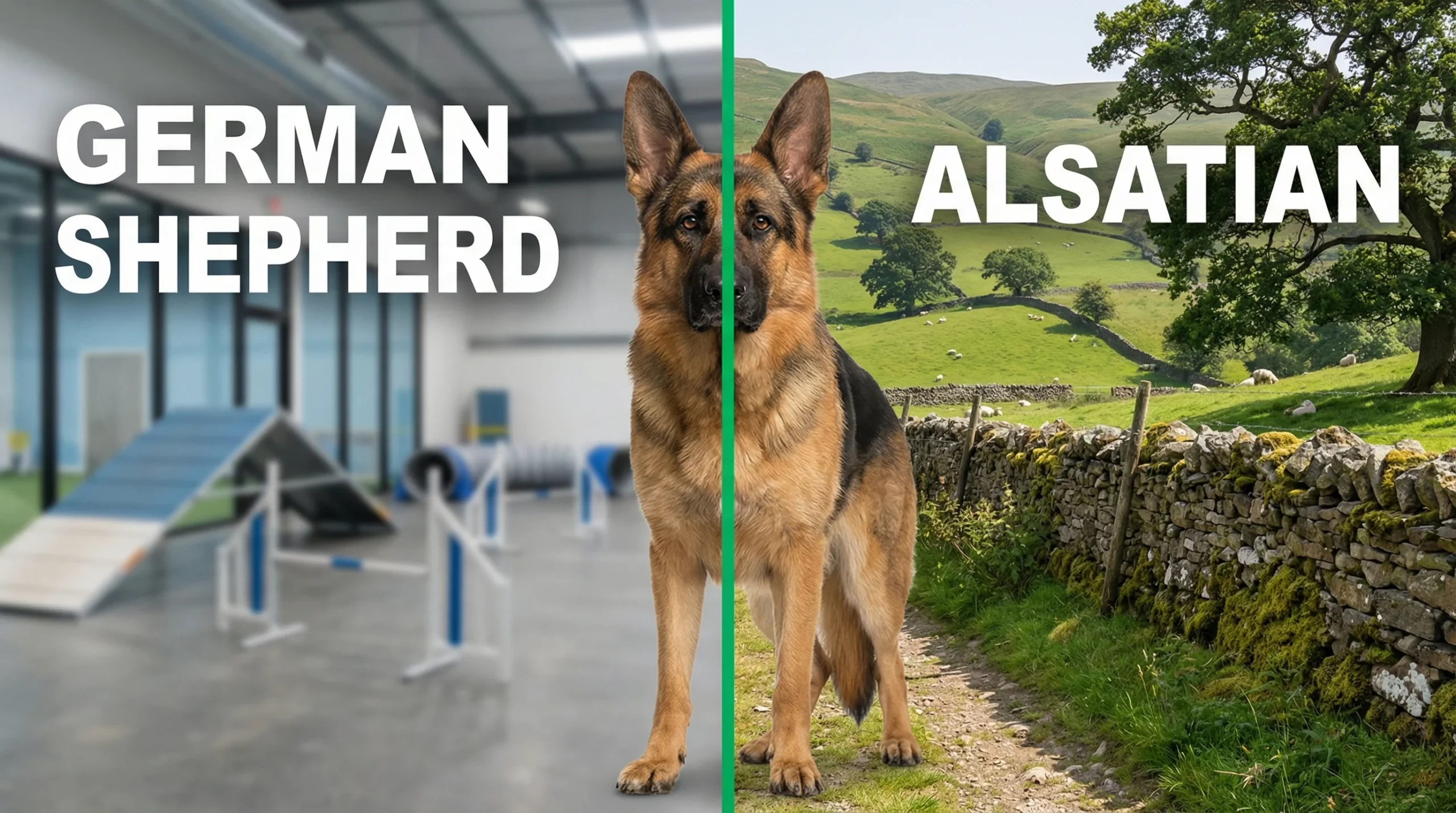
The Alsatian vs German Shepherd dog debate is a common one in UK dog parks. If you have ever found yourself arguing about whether that majestic, pointed-eared dog sprinting after a ball is one or the other, you aren’t alone. In Britain, these two names have been used interchangeably for decades, often leading to the misconception that they represent two distinct lineages or physical ‘types’ of the same dog.
The short answer is simple: They are the exact same breed. However, the story of how one dog ended up with two identities is a fascinating journey through British history, wartime politics, and a slow climb back to its original heritage. At FlexK9, we believe that understanding the history of your dog is the first step toward providing the elite care and training they deserve.
Quick Comparison: Alsatian vs German Shepherd
| Feature | Alsatian | German Shepherd |
|---|---|---|
| Breed Status | Not a separate breed | Official breed name recognised worldwide |
| Origin | Same German origin | Developed in Germany (1899) |
| Kennel Club Name (UK) | Historically used name | Official name: German Shepherd Dog |
| Physical Differences | None | None |
| Temperament | Intelligent, loyal, protective | Intelligent, loyal, protective |
| Health Profile | Same genetic risks | Hip/elbow dysplasia, GDV, DM |
| Modern Usage | Informal UK term | Correct international breed name |
| Are They Different Dogs? | ❌ No | ❌ No |
TABLE OF CONTENTS
The Great British Rebrand: Understanding the Alsatian vs German Shepherd History
To understand why the UK remains one of the few places where the term “Alsatian” is still commonly used, we have to look back to the early 20th century. Before the First World War, the breed was known worldwide as the German Shepherd Dog (GSD).
The Post-WWI Anti-German Sentiment in the UK
The confusion behind the alsatian vs german shepherd dog name began strictly due to anti-German sentiment in Britain after World War I, not because of any biological difference. Following the end of World War I in 1918, anti-German sentiment in the United Kingdom was at an all-time high. Anything associated with Germany was viewed with suspicion or outright hostility. The British Kennel Club feared that the breed’s popularity—which was soaring due to their incredible intelligence and loyalty—would plummet if they kept “German” in the title. To protect the breed’s future in the UK, a rebrand was necessary.
The French Connection: Alsace-Lorraine and the “Alsatian”
The name “Alsatian” wasn’t chosen at random. It was borrowed from the Alsace-Lorraine region on the border of France and Germany. Because the breed shared a “wolf-like” appearance, the name was initially expanded to “Alsatian Wolf Dog”. This name stuck for years, though the “Wolf Dog” suffix was eventually dropped because it made the breed sound too aggressive for suburban family life.
The 1977 Kennel Club Reversion
It took nearly 60 years for the official name to be restored. In 1977, after years of campaigning by breed enthusiasts seeking to align with the rest of the world, the Kennel Club in the UK officially reverted to the name German Shepherd Dog. However, “Alsatian” had become so ingrained in the British lexicon that many owners and even some veteran breeders still use it today. To see exactly how the UK governing body defines the modern dog’s structure and temperament today, view the current Kennel Club German Shepherd Breed Standard.
Breed Profiles: Physical Characteristics and Standards
While the names are identical in terms of DNA, the breed itself has evolved into different “lines”. Whether you are looking at the Alsatian vs German Shepherd in terms of working ability or show standard, the physical requirements for a healthy, agile dog remain the same.
The “Wolf Dog” Aesthetic: Coat Colours and Patterns
The classic look is the “Black and Tan” saddle pattern, made famous by TV icons like Rin Tin Tin. However, the breed exhibits significant variety. You will find Sables (which often look more “wolf-like” with banded hairs), solid Blacks, and even the rarer Bi-colours. In the UK, the Kennel Club recognises most of these, though “White” is considered a disqualifying fault in the show ring, despite having a dedicated following among pet owners.
Size, Weight, and Build: What to Expect
This is a large, powerful breed. In the UK, a male German Shepherd typically stands between 60cm and 65cm at the wither, weighing anywhere from 30kg to 40kg. Females are slightly smaller, usually 55cm to 60cm and weigh between 22kg and 32kg. They should appear “longer than they are tall,” with a deep chest that allows for the lung capacity needed for endurance work.
Understanding the “Straight Back” vs. “Sloping Back” Debate
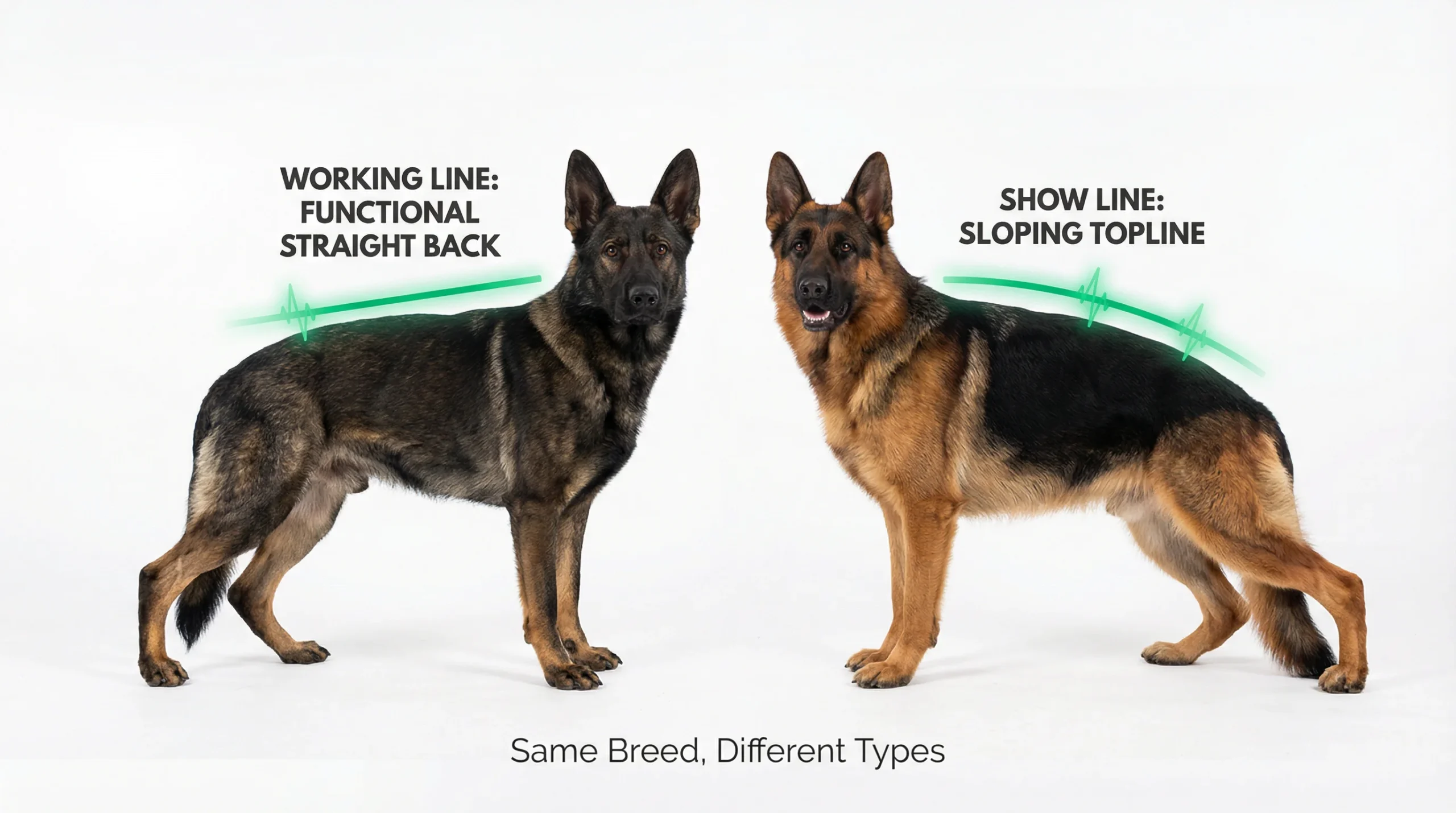
One of the most contentious issues in the UK GSD community is the “topline” or the shape of the back. Show lines (often seen at Crufts) tend to have a more pronounced slope, which can sometimes lead to an extreme “roach” back. Working lines (often used by UK Police or Search and Rescue) usually maintain a straighter, more traditional back. At FlexK9, we advocate for functional health over aesthetic trends; a dog’s build should always support its ability to move freely and without pain.
Temperament and Personality: Is an Alsatian Right for You?
Owning a German Shepherd is less like having a “pet” and more like having a “partner.” They are highly sentient animals that require a high level of engagement from their owners.
Intelligence and Trainability: The Top 3 Ranking
According to Dr. Stanley Coren’s The Intelligence of Dogs, the German Shepherd is the third smartest breed in the world, surpassed only by the Border Collie and the Poodle. They are capable of learning a new command in fewer than five repetitions. This makes them a dream to train, but it also means they can “outsmart” an owner who is inconsistent with their rules.
Whether you call them one or the other, the alsatian vs german shepherd training needs are identical, requiring high mental stimulation and consistent discipline.
Protective Instincts vs. Aggression
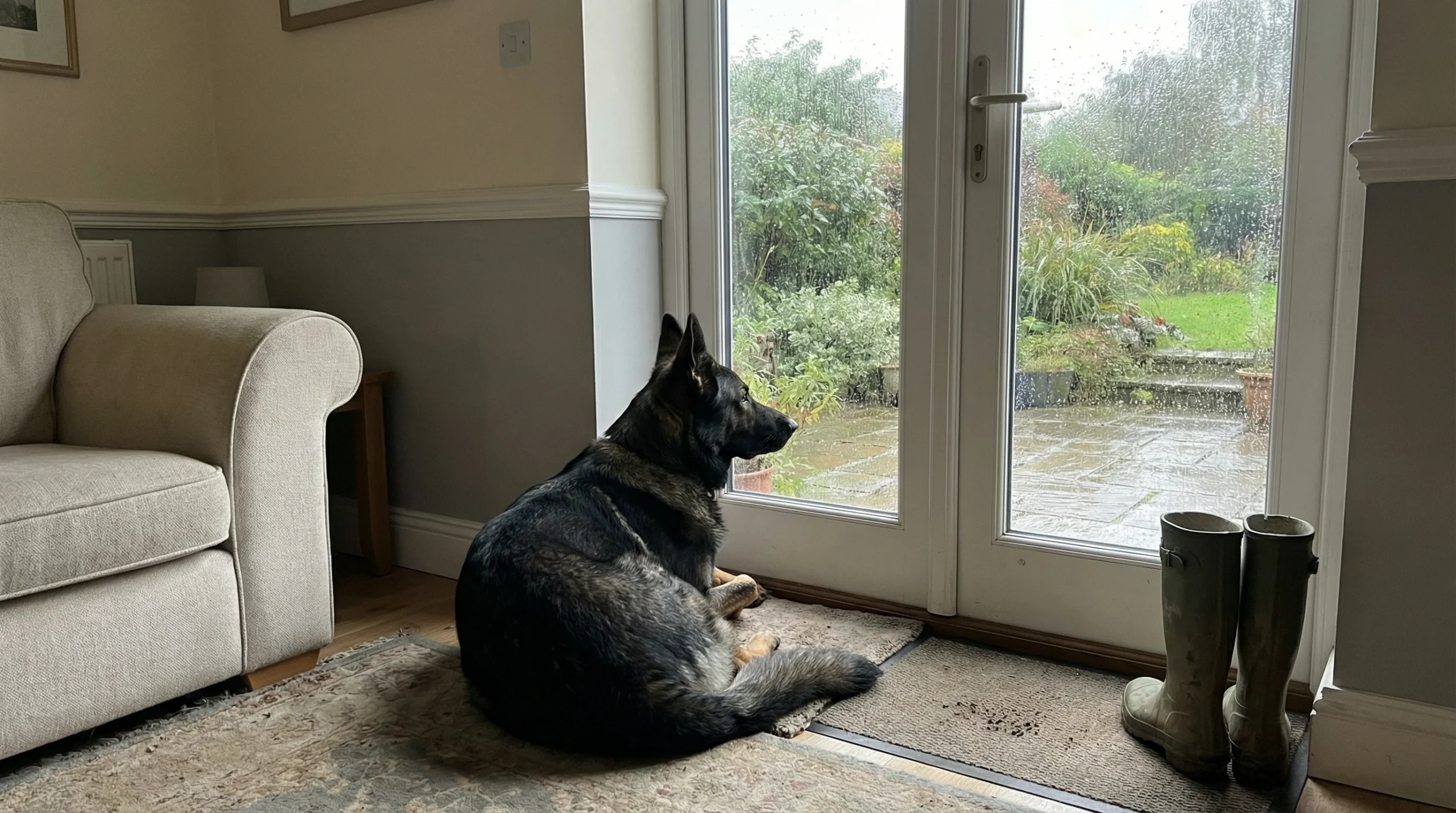
A well-bred Alsatian is naturally aloof with strangers but should never be nervous or aggressive without cause. Their “guarding” instinct is deeply baked into their DNA. They are vocal dogs—often referred to as “land sharks” during their puppy biting phase—and will use their voice to alert you to anyone approaching the home. Proper socialisation is non-negotiable to ensure this protective nature doesn’t turn into reactive fear.
If you are weighing up different family guardians, see how this breed stacks up against another powerhouse in our Rottweiler vs German Shepherd analysis.
Family Life: Living with a High-Energy Power Breed
Despite their fearsome reputation in some circles, GSDs are legendary for their devotion to children—often acting as “nanny dogs” who keep a watchful eye on the youngest members of the pack. However, they are “velcro dogs.” If you don’t want a 35kg shadow following you into the bathroom, this might not be the breed for you. They thrive on proximity to their “alpha.”
Health and Longevity: Looking After Your GSD
Because of their popularity, the breed has unfortunately suffered from some overbreeding issues in the UK. Being an informed owner is the best way to ensure your dog lives a long, happy life (typically 10–13 years).
Common Genetic Conditions: Hip and Elbow Dysplasia
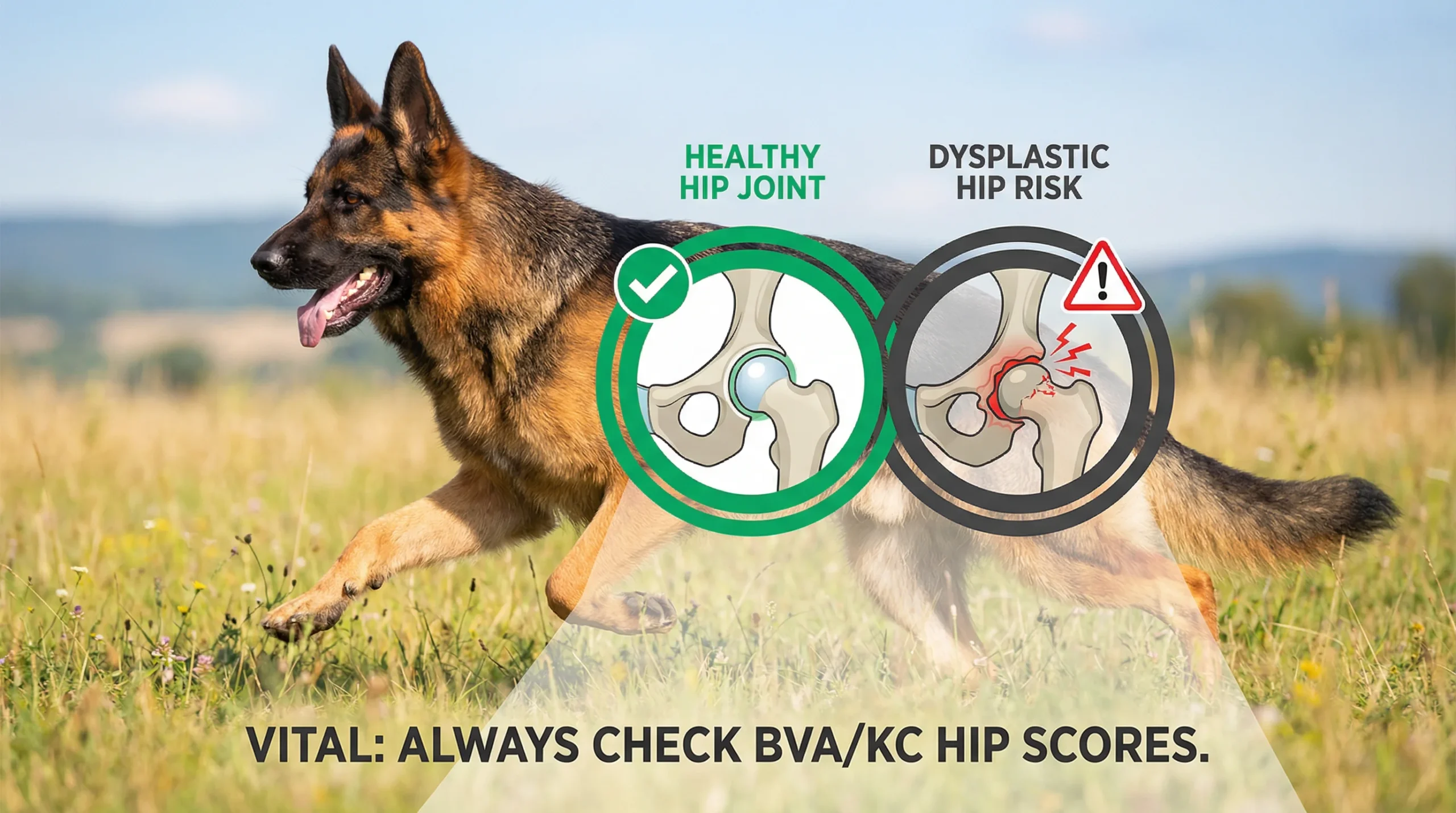
This is the “big one” for large breeds. Hip dysplasia occurs when the ball and socket joint of the hip does not fit together properly. In the UK, the British Veterinary Association (BVA) and the Kennel Club run a “Hip Scoring” scheme. When searching for a breeder, don’t let the alsatian vs german shepherd terminology distract you; focus instead on health testing and the temperament of the parents.
Before buying a puppy, you must insist on seeing the parents’ hip and elbow scores. Lower scores are better, indicating a lower risk of hereditary joint issues. For authoritative guidance on how this testing works and what the scores mean for your dog’s future, we recommend reviewing the official British Veterinary Association (BVA) Hip Scheme guide.
Understanding GDV (Bloat) in Deep-Chested Breeds
Gastric Dilatation-Volvulus (GDV), or Bloat, is a life-threatening emergency where the stomach twists. It is more common in deep-chested breeds like the GSD. To mitigate this, UK owners are advised to feed smaller, frequent meals rather than one large one, and to avoid vigorous exercise for at least an hour after eating.
Providing the right nutrition is critical to preventing growth issues; read our guide on large breed dog food to ensure you are filling their bowl with quality ingredients that support slow, steady growth.
Degenerative Myelopathy (DM) and Spinal Health
DM is a progressive disease of the spinal cord in older German Shepherds, similar to ALS in humans. It starts with a loss of coordination in the hind legs. While there is currently no cure, genetic testing of the parents can identify carriers, further highlighting why choosing the right source for your dog is vital.
We strongly recommend seeking out Kennel Club Assured Breeders, as they are held to higher standards for health screening, responsible breeding practices, and puppy welfare. Avoid “bargain” puppies advertised on generic classified sites — the initial savings can quickly be outweighed by thousands of pounds in veterinary costs later in your dog’s life.
Practical Ownership: Exercise, Grooming, and Training
If you are looking for a “low maintenance” dog, the Alsatian is not it. They require a commitment to both physical and mental upkeep.
The “German Shedder”: Managing the Double Coat
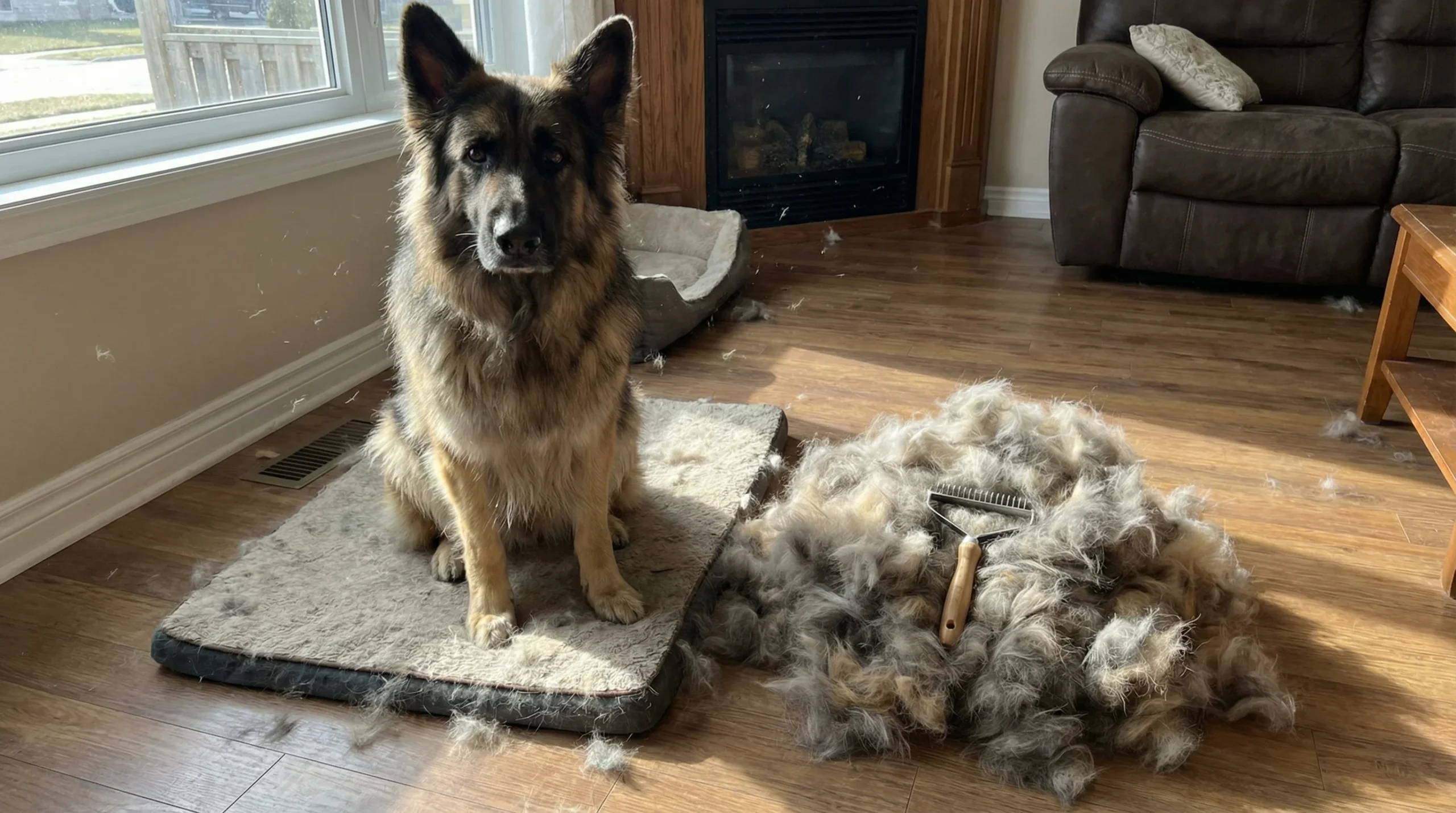
Owners affectionately call them “German Shedders” for a reason. They possess a thick double coat: a wiry outer layer and a soft, insulating undercoat. They shed moderately year-round but will “blow” their coat twice a year (spring and autumn). During these times, you will find clumps of fur in every corner of your home. Daily brushing with an undercoat rake is essential during these peak periods.
For a specific breakdown of the tools that actually work on this heavy double coat, check out our guide to the best dog brush for German Shepherds.
Advanced Training: Canicross, Agility, and Protection Work
A bored German Shepherd is a destructive German Shepherd. In the UK, many owners are turning to Canicross (cross-country running with your dog) or Agility to burn off their dog’s incredible energy. Because they are working dogs, they need a “job.” Even simple scent-work games in the garden can provide the mental exhaustion they crave.
If you are interested in high-drive working dogs but want something lighter on its feet, read our comparison of the Belgian Malinois vs German Shepherd to see how they differ.
Dietary Requirements for Large Working Breeds
Nutrition is the foundation of health. These dogs need high-quality protein to maintain muscle mass and added joint supplements (like Glucosamine and Chondroitin) from an early age to support their skeletal structure. Avoid “filler” heavy foods that can contribute to obesity, as every extra kilogram puts unnecessary strain on their hips.
To support their skeletal structure and reduce the risk of dysplasia, we recommend reviewing our top picks for the best dog joint supplements.
Summary: One Breed, Two Names, Infinite Loyalty
Ultimately, the Alsatian vs German Shepherd distinction is purely historical, but the dog beneath the name is the same noble “Deutsche Schäferhund” envisioned by Max von Stephanitz in 1899. Whether you use the post-war British name or the original German title, you are talking about one of the most versatile creatures in the canine kingdom.
Owning one is a significant responsibility, but the reward is a bond unlike any other. They are protectors, workers, and, above all, family.
Frequently Asked Questions (FAQ)
What is the difference between an Alsatian and a German Shepherd?
There is no difference between an Alsatian and a German Shepherd; they are the exact same dog breed. The different names are purely historical. In the UK, the breed was renamed “Alsatian” during World War I to distance it from Germany due to anti-German sentiment. The British Kennel Club officially reverted the name to “German Shepherd Dog” in 1977, though “Alsatian” is still widely used by the British public.
Why was the German Shepherd’s name changed to Alsatian?
The name was changed to protect the breed’s popularity in Britain during the anti-German wave of WWI. The British Kennel Club feared the public would reject a dog with “German” in its title. They rebranded it the “Alsatian Wolf Dog” (named after the French-German border region of Alsace-Lorraine). The “Wolf Dog” suffix was later dropped to avoid making the breed sound dangerous, leaving us with the “Alsatian” we know today.
Do Alsatians have straighter backs than German Shepherds?
No, the shape of the back depends on the “line” (Working vs. Show), not the name. Dogs bred for the show ring (often called German Shepherds in modern contexts) may have a more pronounced sloping topline. Dogs bred for police or military work (often traditionally referred to as Alsatians by older generations) tend to have a straighter, more functional back. However, both body types are registered as the same breed.
Are Alsatians good family dogs?
Yes, Alsatians make excellent family pets for active households, provided they are well-socialised. They are ranked as the third most intelligent breed, known for their extreme loyalty and natural protective instincts over children (“nanny dog” behaviour). However, they are high-energy working dogs; without at least 2 hours of daily exercise and mental stimulation, they can become bored and destructive.
What are the most common health problems for Alsatians?
The most common health issues for Alsatians in the UK are Hip Dysplasia, Elbow Dysplasia, and CDRM (Chronic Degenerative Radiculomyelopathy). Because of their size and deep chest, they are also at risk of Bloat (GDV), a life-threatening twisted stomach. We strongly advise buying only from breeders who hip score their dogs to minimise genetic risks.
