
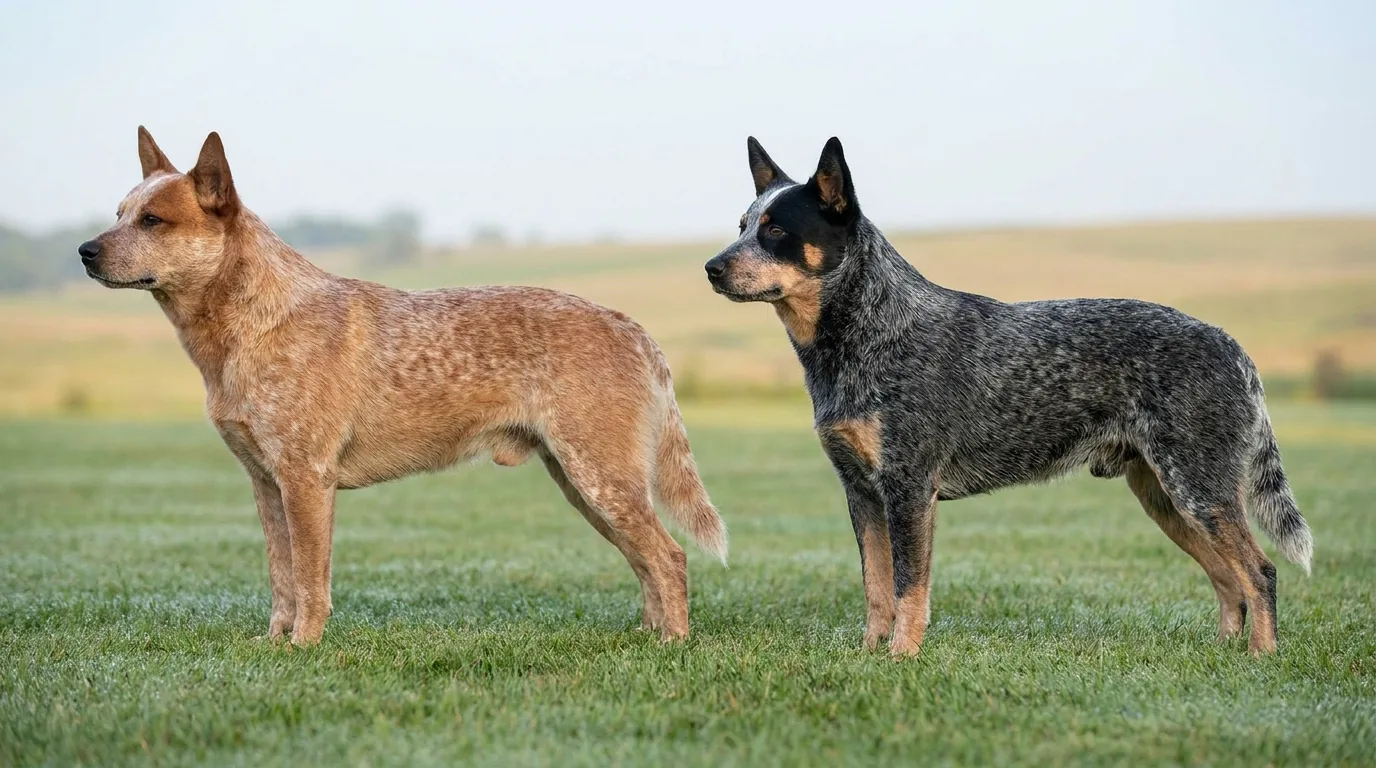
Australian Cattle Dog vs Blue Heeler isn’t a choice between two breeds: they’re the same dog. “Blue Heeler” and “Red Heeler” describe the breed’s two coat colours, blue and red speckle. The Royal Kennel Club notes the breed has also been known as the Queensland Heeler.
We haven’t owned an Australian Cattle Dog, so this guide draws on the Royal Kennel Club’s breed page and breed standard, PDSA’s breed guide and Dogs Trust’s UK longevity study.
TABLE OF CONTENTS
Australian Cattle Dog vs Blue Heeler: what the names mean
In the UK, the breed’s registered name is the Australian Cattle Dog. It sits in the Royal Kennel Club’s Pastoral group, alongside other herding breeds. The other names you’ll hear for it are nicknames or older working names.
Blue Heeler and Red Heeler
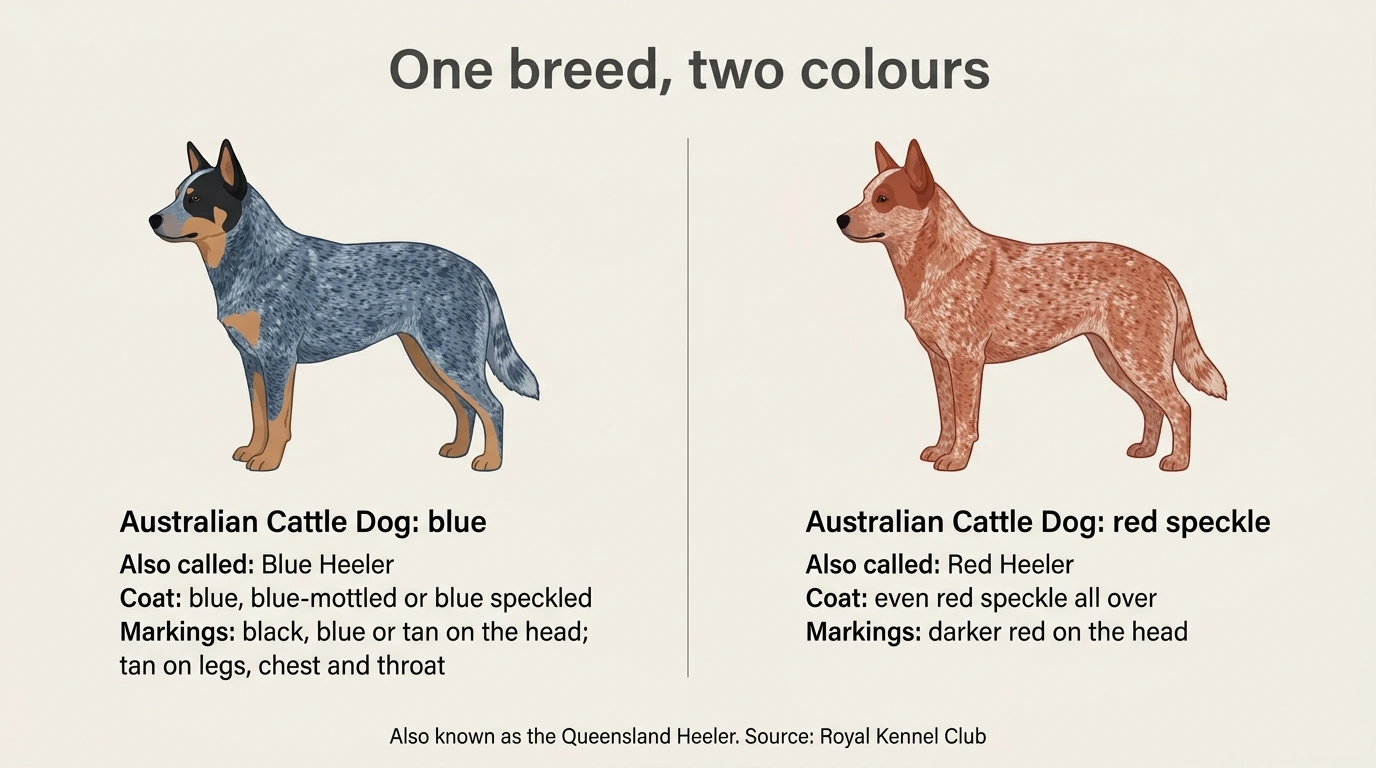
The two nicknames follow the coat. An Australian Cattle Dog with a blue coat is often called a Blue Heeler, and one with a red speckle coat a Red Heeler. They aren’t separate breeds or separate types: the Royal Kennel Club’s breed standard describes both colours under the one breed.
Queensland Heeler, and why “heeler”?
The Royal Kennel Club explains that the breed was sometimes known as the Blue or Red Heeler, or the Queensland Heeler, because of the way it works: it crouches low and nips at the heels of cattle to drive them on. That’s where “heeler” comes from.
The name also reaches back to the breed’s roots. According to the Royal Kennel Club, the Australian Cattle Dog is descended from Hall’s Heelers, which came from crossing the Australian Dingo with early colonial dogs, probably drovers’ dogs of various collie types. The breed’s exact ancestry is unknown.
Is the Lancashire Heeler the same?
No. The Lancashire Heeler is a separate Royal Kennel Club breed with a different story. It’s a small Pastoral breed thought to come from a cross between the Welsh Corgi and the Manchester Terrier, and it was once known as the Ormskirk Heeler. It shares the word “heeler”, but it isn’t another name for the Australian Cattle Dog.
The Australian Stumpy Tail Cattle Dog is a different breed again, with a naturally short tail. Our Stumpy Tail Cattle Dog vs Australian Cattle Dog guide explains how to tell them apart. For other herding comparisons, see Australian Cattle Dog vs Kelpie and Australian Shepherd vs Cattle Dog.
Blue or red: the two colours in the breed standard
The Royal Kennel Club breed standard allows two colours, and the nicknames map straight onto them.
Blue. The coat is blue, blue-mottled or blue speckled. Black, blue or tan markings on the head are permitted. The standard also describes tan partway up the forelegs, running up the front to the chest and throat, tan on the jaws, and tan on the inside of the hindlegs. Black markings on the body are undesirable.
Red speckle. The coat is an even red speckle all over, including the undercoat, with or without darker red markings on the head. Red markings on the body are tolerated.
Any other colour or combination of colours is unacceptable under the standard. So a Blue Heeler and a Red Heeler are simply the breed’s two permitted colours. The standard sets one description of build and temperament for both.
The Australian Cattle Dog at a glance
| Australian Cattle Dog | |
|---|---|
| Royal Kennel Club group | Pastoral |
| Breed Watch | Category 1 |
| Height (breed standard) | Males 46–51cm, females 43–48cm |
| Weight | Not given in the breed standard; PDSA gives an average of 16–20kg |
| Coat | Smooth, short double coat; blue or red speckle |
| Exercise | More than 2 hours a day |
| Grooming | Brush once a week |
| UK median lifespan | 14.0 years (Dogs Trust; from a small group of dogs) |
| UK legal status | Not a banned type |
Sources: Royal Kennel Club breed page and breed standard; PDSA; Dogs Trust. A breed standard describes the ideal, so individual dogs can be larger or smaller.
Temperament, exercise and grooming: what UK sources say
Temperament
The Royal Kennel Club breed standard describes the Australian Cattle Dog as “alert, intelligent, watchful, courageous, trustworthy, devoted to its work”. It adds that the breed is loyal and protective, a guardian of the stockman, herd and property, and naturally suspicious of strangers while still amenable to handling.
The breed page puts it more plainly: Australian Cattle Dogs are distrustful of strangers and very protective of their owner and territory, which is why they were often used as guard dogs on Australian cattle stations.
PDSA flags one thing families should know. Because of their strong herding instinct, Australian Cattle Dogs may nip at the heels of running children. PDSA says socialisation with children and training at a young age can help.
No UK study compares the breed’s trainability or barking with other breeds, so we haven’t ranked it on either.
Exercise
The Royal Kennel Club and PDSA both put the breed’s exercise needs at more than two hours a day. PDSA describes Australian Cattle Dogs as high-energy and highly intelligent, needing plenty of mental activity as well as physical exercise, and suggests activities such as agility and flyball. The Royal Kennel Club’s breed panel lists the breed as better suited to the country than to town, though it rates a small house and a small to medium garden as enough space.
Grooming
The coat is short and weather-resistant: a smooth double coat, with a short, dense undercoat beneath a close, hard, straight top coat. The Royal Kennel Club and PDSA both suggest brushing once a week, and the Royal Kennel Club notes that the breed sheds. Our guide to the best brush for double-coated dogs covers brushes for this kind of coat.
Lifespan and health
Australian Cattle Dog lifespan in the UK
Dogs Trust’s 2024 study of UK dog longevity, which drew on records from over half a million UK dogs, gives the Australian Cattle Dog a median lifespan of 14.0 years. That figure comes from a small group of dogs, so treat it as a guide rather than a promise. The Royal Kennel Club’s breed panel puts the breed’s lifespan at over 10 years.
Health conditions to know about
PDSA lists these among the health problems Australian Cattle Dogs can be prone to:
- Deafness
- Eczema, a skin condition that leaves the skin inflamed and itchy
- Hip dysplasia
- Elbow dysplasia
- Portosystemic shunt, where blood bypasses the liver
- Luxating patellas (kneecaps that slip out of place)
- Urolithiasis (stones forming in the urine)
Before you buy: Ask the breeder whether the puppy’s parents have been screened under the BVA/Kennel Club Canine Health Schemes. PDSA recommends this for Australian Cattle Dogs, along with talking through the health history of the parents and grandparents, because the breed can be prone to inherited conditions including deafness and hip and elbow dysplasia.
There’s no UK VetCompass study focused on the Australian Cattle Dog alone, so PDSA’s list is the best UK guide available. For a wider look at health problems across breeds, see our guide to common health problems in dog breeds.
Comparing other breeds? Browse all our breed guides.
Frequently asked questions
Is a Blue Heeler the same as an Australian Cattle Dog?
Yes. “Blue Heeler” is a nickname for an Australian Cattle Dog with a blue coat. In the UK, the Royal Kennel Club recognises the breed as the Australian Cattle Dog, and its standard allows two colours, blue and red speckle. A Blue Heeler is simply a blue-coated dog of that one breed.
What is the difference between a Blue Heeler and a Red Heeler?
Only the coat colour. Both are Australian Cattle Dogs. Under the Royal Kennel Club standard, a blue dog is blue, blue-mottled or blue speckled, often with tan on the head and legs, while a red dog has an even red speckle all over. The standard sets the same build and temperament for both.
Why is the Australian Cattle Dog called a heeler?
Because of the way it works cattle. The Royal Kennel Club explains that the breed crouches low and nips at the heels of cattle to drive them on, which is why it was sometimes known as the Blue Heeler, Red Heeler or Queensland Heeler. It is descended from dogs known as Hall’s Heelers.
Is the Lancashire Heeler the same as a Blue Heeler?
No. The Lancashire Heeler is a separate Royal Kennel Club breed: a small Pastoral dog thought to come from crossing the Welsh Corgi and the Manchester Terrier, once known as the Ormskirk Heeler. “Blue Heeler” is a nickname for the Australian Cattle Dog, a medium-sized breed descended from crosses with the Australian Dingo.
How long do Australian Cattle Dogs live in the UK?
About 14 years is the typical figure in UK data, but treat it as a rough guide. Dogs Trust’s UK longevity study gives the Australian Cattle Dog a median lifespan of 14.0 years, from a small group of dogs. The Royal Kennel Club puts the breed’s lifespan at over 10 years.
Are Blue Heelers banned in the UK?
No. The Australian Cattle Dog, including dogs called Blue or Red Heelers, is not a banned type in the UK. The banned types are the Pit Bull Terrier, Japanese Tosa, Dogo Argentino and Fila Brasileiro, plus the XL Bully in England and Wales. The law against letting a dog be dangerously out of control applies to every dog.
