
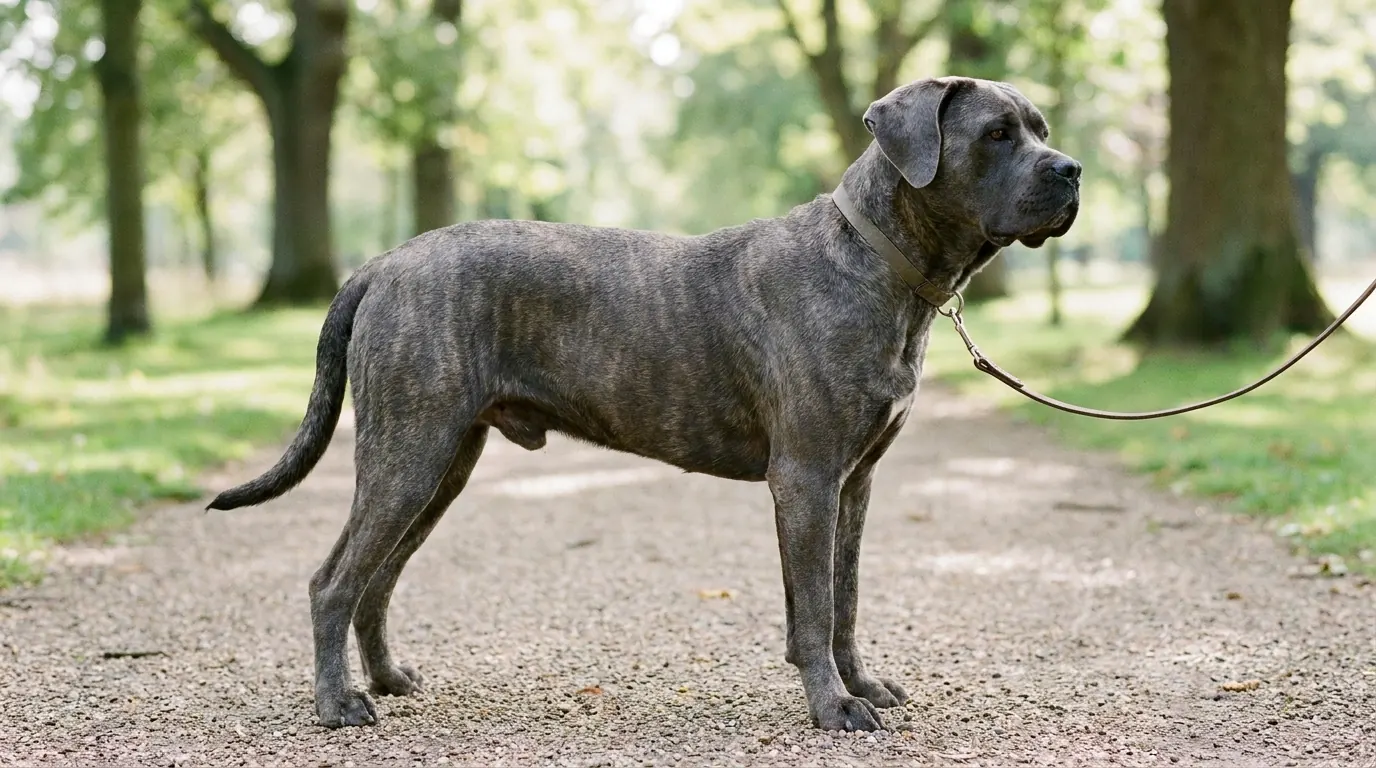
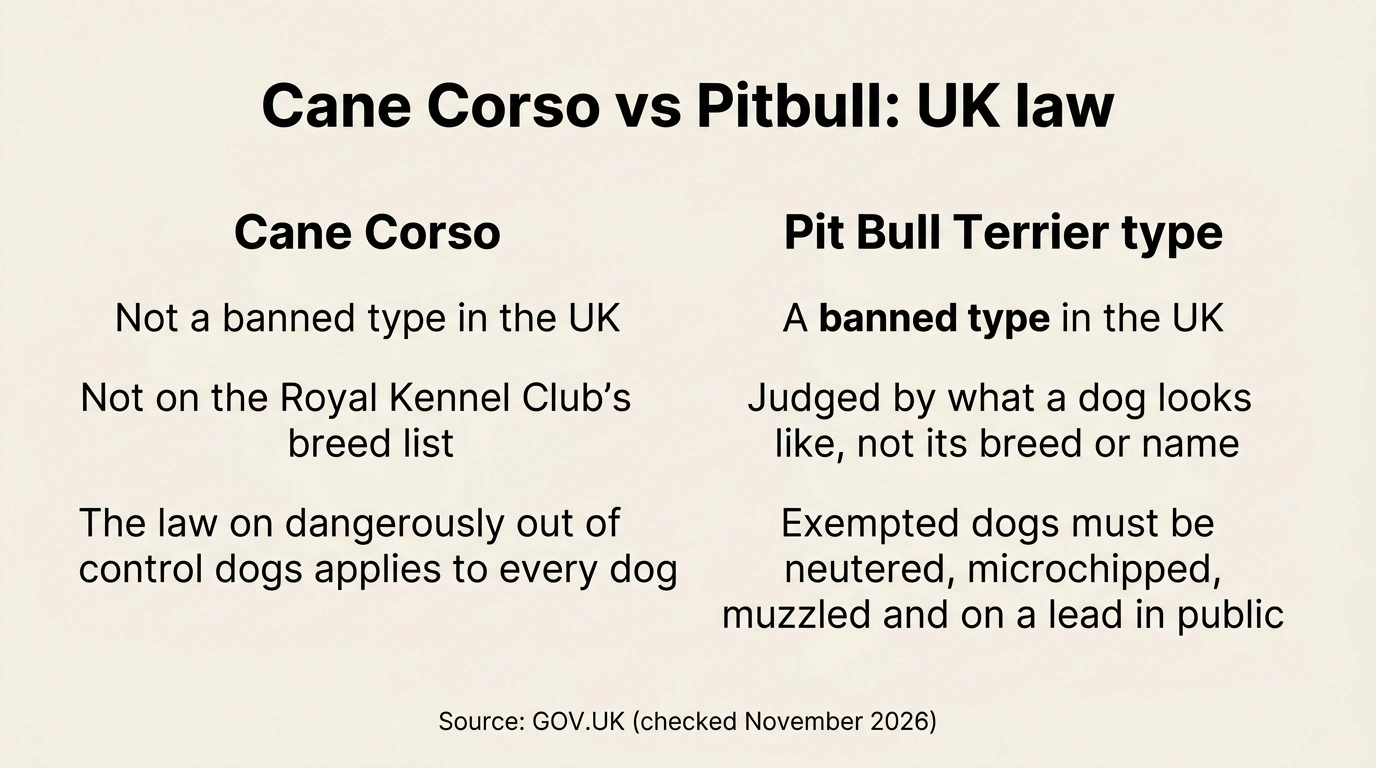
Cane Corso vs Pitbull comes down to UK law before anything else. GOV.UK lists the Pit Bull Terrier as one of five banned dog types, judged by what a dog looks like rather than its breed or name. The Cane Corso isn’t a banned type, but like every dog it must never be dangerously out of control.
This guide draws on GOV.UK, the Royal Kennel Club’s breed list, Dogs Trust’s UK longevity study and Cane Corso breed guide, and PDSA’s Cane Corso guide.
TABLE OF CONTENTS
What UK law says about Pit Bull Terrier types
GOV.UK’s guidance on banned dogs says it’s against the law in the UK to own certain types of dog: the Pit Bull Terrier, Japanese Tosa, Dogo Argentino, Fila Brasileiro and XL Bully. It’s also illegal to sell, abandon or give away a banned dog, or to breed from one.
The key word is “type”. GOV.UK says whether a dog is banned “depends on what it looks like, rather than its breed or name”, and uses the Pit Bull Terrier as its example: a dog that matches many of its characteristics may be a banned type.
How seizure and court work
If the police or a council dog warden think a dog is a banned type, they can take it away and keep it, even if it isn’t behaving dangerously and nobody has complained. In a public place the police don’t need a warrant; in a private place they do. A police or council dog expert then judges what type of dog it is and whether it is, or could be, a danger to the public. The dog is released or kept in kennels while a court decides, and the owner can’t visit it in the meantime.
In court, it’s the owner’s job to prove the dog isn’t a banned type. If they can’t, they’re convicted and face an unlimited fine, up to six months in prison, or both, and the dog is destroyed. If the court thinks a banned dog isn’t a danger to the public, it can issue a Contingent Destruction Order, which lets the owner apply for a Certificate of Exemption.
What a Certificate of Exemption requires
A Certificate of Exemption lets someone keep a banned dog for the rest of its life, as long as the dog doesn’t behave dangerously and the rules are followed. GOV.UK says the dog must be:
- neutered
- fitted with a microchip
- kept on a lead and muzzled at all times in public
- kept somewhere secure so it can’t escape
The owner must be over 16, must show the certificate to a police officer or council dog warden when asked (at the time or within five days), and must tell the Index of Exempted Dogs if they move or the dog dies.
Children under 12 and banned dogs
From 1 November 2026, a child under 12 must not be left in close contact with a banned dog in a private place, such as a home or garden, without adult supervision. Defra’s guidance, Keeping children safe around banned breed dogs in the home, sets out how owners can meet this child safety condition.
This guide doesn’t cover getting, importing or breeding a banned dog. For all five types in one place, see our list of banned dog breeds in the UK.
Why ‘pitbull’ isn’t a breed name in the UK
“Pitbull” is a common name, not a UK breed. The Royal Kennel Club’s list of 230 breeds has no Pit Bull Terrier, American Pit Bull Terrier, American Staffordshire Terrier or American Bully. Because the law looks at what a dog looks like, the name a dog is sold or registered under doesn’t settle whether it’s a banned type.
GOV.UK lists the XL Bully as a separate banned type. The Staffordshire Bull Terrier is a different breed again: it’s on the Royal Kennel Club’s list and isn’t one of the five banned types, as our Pitbull vs Staffy guide explains. Our guide to whether pitbulls are banned in the UK covers the law on pit bull types in more depth.
Where the Cane Corso stands in UK law
The Cane Corso isn’t on GOV.UK’s list of banned types, so owning one is legal in the UK. That doesn’t put it outside the law: GOV.UK says it’s against the law to let any dog be dangerously out of control anywhere, including in its owner’s home.
A dog counts as dangerously out of control if it injures someone or makes someone worried that it might. A court can also decide a dog is dangerously out of control if it attacks someone’s animal, or if the animal’s owner thinks they could be hurt trying to stop it. The penalty is an unlimited fine, up to six months in prison, or both. If you’re worried about a dog, here’s how to report a dangerous dog.
Ear cropping is illegal in every part of the UK, so a Cane Corso here should have its natural ears.
Good to know: PDSA advises reporting a Cane Corso with cropped ears or a docked tail to the RSPCA, as both procedures are illegal in the UK.
The Dogo Argentino, another banned type often compared with the Corso, is covered in our Cane Corso vs Dogo Argentino guide.
Cane Corso vs Pitbull at a glance
Neither has a UK breed standard, so this table sticks to what UK sources actually say and marks the gaps.
| Feature | Cane Corso | Pitbull (Pit Bull Terrier type) |
|---|---|---|
| UK legal status | Not a banned type | Banned type |
| Royal Kennel Club | Not on its breeds list | Not on its breeds list |
| UK breed standard | No UK breed standard | No UK breed standard |
| Size | Very large and muscular (Dogs Trust) | No UK guidance |
| Exercise | Around 2 hours a day (PDSA) | No UK guidance |
| Grooming | A weekly brush (PDSA) | No UK guidance |
| UK median lifespan | 8.1 years | No UK data |
Sources: GOV.UK banned dogs list; Royal Kennel Club Breeds A to Z; Dogs Trust 2024 UK longevity study and Cane Corso breed guide; PDSA Cane Corso guide.
The Cane Corso in UK charity guides
Dogs Trust describes the Cane Corso as a very large, muscular, high-energy dog with a short coat, and notes a higher risk of heat stroke. PDSA suggests around two hours’ exercise a day and reward-based training from a young age, and says the breed’s size makes it better suited to experienced owners. A weekly brush is usually enough, though PDSA warns that Corsos drool. Our guide to the best brush for a Cane Corso covers grooming tools.
Dogs Trust’s 2024 study of UK dogs gives the Cane Corso a median lifespan of 8.1 years. In plain terms, a typical Corso in the study reached about eight years old, the third-shortest median of the 155 breeds studied. The figure comes from a smaller group of dogs, so read it as a rough guide, not a forecast for your own dog. PDSA places the breed in its “under 10 years” band.
PDSA says the Cane Corso is too uncommon in the UK to be sure which health problems are most common in the breed. It lists some evidence of concern for hip and elbow dysplasia (with x-ray screening under the BVA/Kennel Club schemes before breeding), bloat (GDV), which is an emergency, and eye problems including entropion, ectropion and cherry eye.
Why we don’t describe the Pit Bull Terrier type
No UK breed source covers the Pit Bull Terrier type: there’s no Royal Kennel Club standard, no Dogs Trust or PDSA breed guide and no VetCompass study. GOV.UK is the only UK source, and under its rules a police or council dog expert decides whether a dog is a banned type by how it looks. Nothing on this page is meant to help you identify a dog.
If you’re unsure about a particular dog, the GOV.UK guidance linked above explains how the process works. For other breed comparisons, browse our breed guides.
Frequently Asked Questions
Is a pitbull banned in the UK?
Yes. The Pit Bull Terrier is one of five banned dog types in the UK, and GOV.UK judges a dog by what it looks like rather than its breed or name. A banned dog can only be kept with a Certificate of Exemption, which comes with strict rules such as neutering, a microchip, and a lead and muzzle in public.
Can you own a Cane Corso in the UK?
Yes. The Cane Corso isn’t a banned type, so you don’t need an exemption to own one. The law on dangerously out of control dogs still applies, as it does to every dog, and ear cropping is illegal in the UK, so a Corso here should have its natural ears.
What happens if police think a dog is a Pit Bull Terrier type?
The police or a council dog warden can take the dog, even if it hasn’t behaved dangerously, and an expert judges its type. In court, the owner has to prove the dog isn’t a banned type. If they can’t, they face a fine, prison or both, and the dog is destroyed unless the court allows an exemption.
Is the American Pit Bull Terrier a recognised breed in the UK?
No. The American Pit Bull Terrier isn’t on the Royal Kennel Club’s list of breeds, and nor is the American Staffordshire Terrier. In UK law the name doesn’t decide anything: GOV.UK says a dog is judged on what it looks like, so a dog sold under any name can still be a banned type.
Does the new rule on children under 12 apply to Cane Corsos?
No. The rule that started on 1 November 2026 covers banned dogs only, and the Cane Corso isn’t one. Separately, PDSA doesn’t recommend a Cane Corso for homes with small children, who could be knocked over, and says the breed suits adult-only homes or families with older children.
