
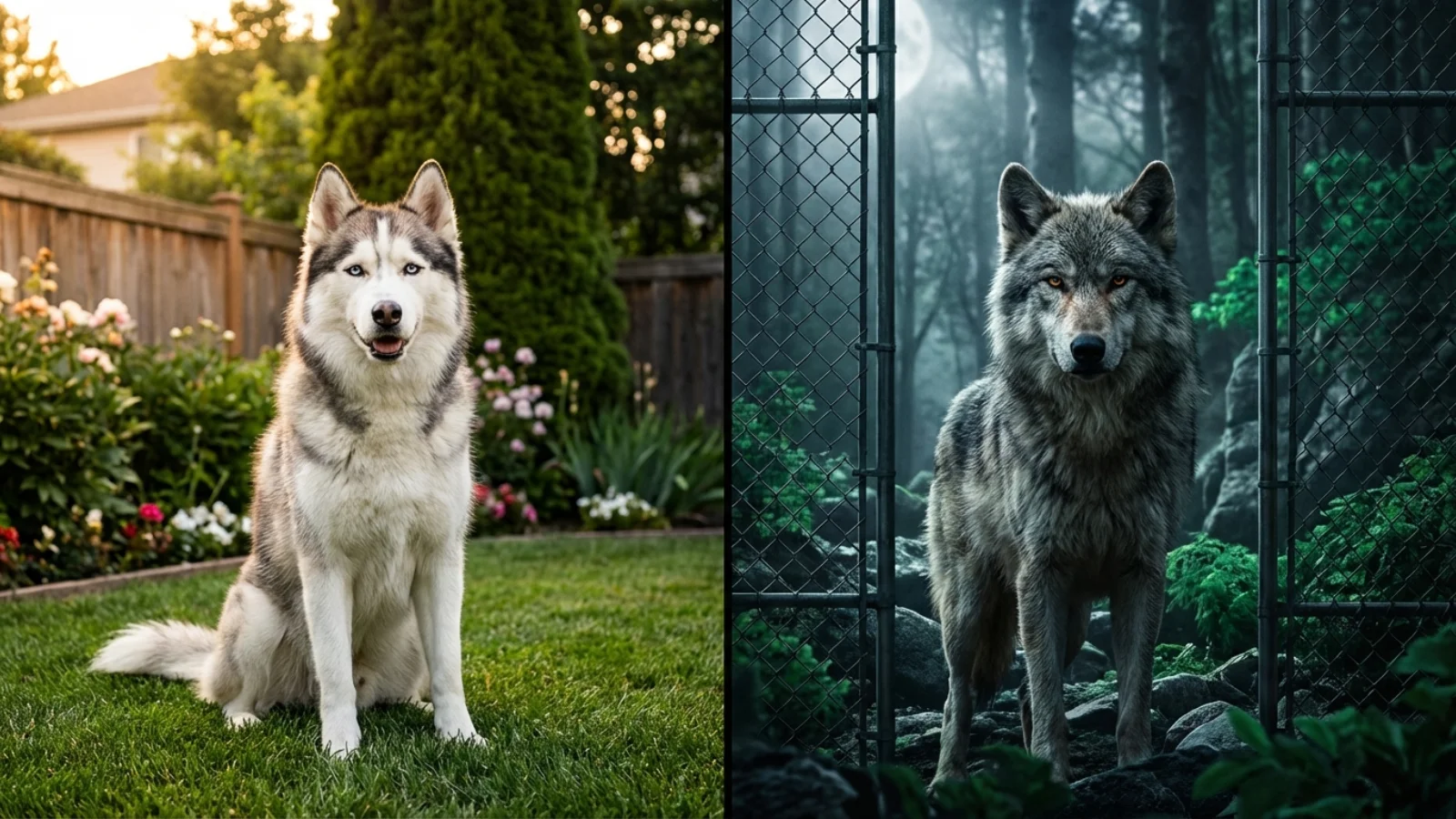
When comparing a Husky vs Wolf Dog, it is easy to get caught up in their striking, wild aesthetics. Both possess piercing eyes, thick double coats, and a formidable presence. However, assuming these animals are similar beneath the surface is a dangerous misconception.
While the Siberian Husky is a high-energy domestic companion, a Wolf Dog is a complex hybrid governed by primitive survival instincts. In the UK, the difference between the two is not just about behaviour—it is about strict legislation, public safety, and ethical ownership.
If you are trying to decide which of these majestic canines is right for you, or if you simply want to understand the reality behind the “wild dog” aesthetic, here are the 7 critical differences you must know.
Quick Comparison – Husky vs Wolf Dog
| Factor | Husky | Wolf Dog |
|---|---|---|
| Legal in UK | Yes | F1/F2 need licence; F3+ classed domestic |
| Temperament | Social, energetic | Reserved, instinct-driven |
| Trainability | Moderate | Low reliability |
| Insurance | Standard | Often excluded |
| Suitability for families | Possible | Rarely appropriate |
TABLE OF CONTENTS
7 Critical Differences Between Huskies and Wolf Dogs
1. Genetic Foundation & Domestication
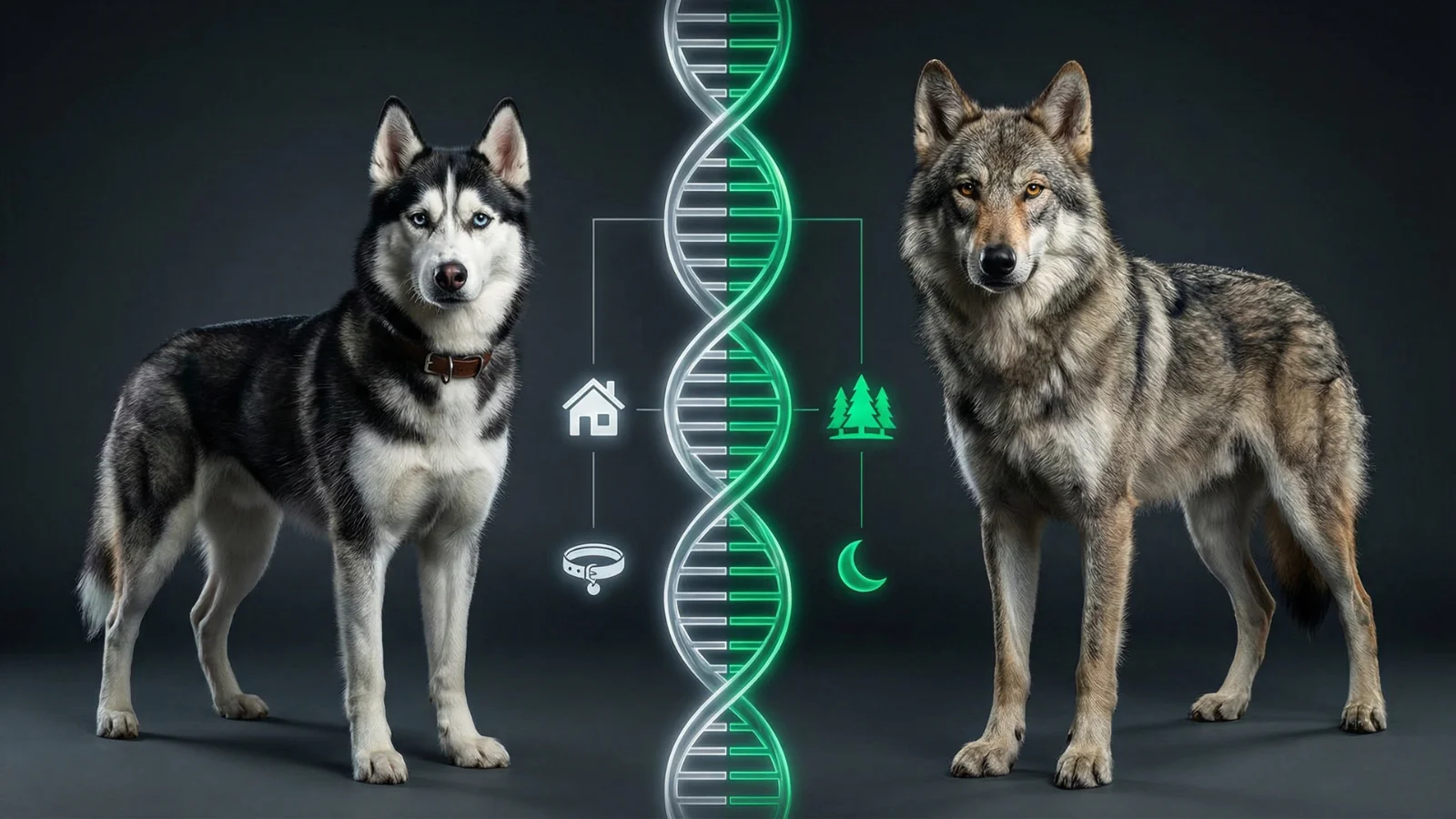
The most profound difference lies in their DNA.
Recognised by The Kennel Club UK as a working breed, the Siberian Husky is a 100% domesticated dog. They were selectively bred over thousands of years by the Chukchi people of Siberia to be social, hardworking sledge dogs that lived closely with families. While they share ancient DNA with wolves (like all domestic dogs), their wild instincts have been bred out.
A Wolf Dog, on the other hand, is a direct cross between a domestic dog (often a German Shepherd or a heavy northern breed—see our comparison of the Malamute dog vs Husky for visual differences) and a wild wolf. Depending on the generation (F1, F2, F3, etc.) and the “content” level, their genetic makeup is heavily influenced by recent wild ancestry. This dictates everything from their fear thresholds to their maturity cycles.
2. UK Legal Status (The Dangerous Wild Animals Act)
In the UK, the law treats these two animals very differently.
- Huskies are standard domestic pets. You do not need any special permissions to own one, and standard pet insurance policies cover them (though their escape-artist tendencies might raise premiums).
- Wolf Dogs are strictly regulated. Under the Dangerous Wild Animals Act 1976, first-generation (F1) and second-generation (F2) wolf hybrids are classified as wild animals. While they are not technically on the list of banned dog breeds in the UK, to own an F1 or F2 hybrid, you must obtain a specific Dangerous Wild Animals licence from your local council, which involves rigorous enclosure inspections and heavy public liability insurance.
3. Predictability & Trainability
Because Huskies are domesticated, their behaviour is generally predictable. They are notoriously stubborn and independent, but they are biddable—meaning they understand human communication and can be trained using positive reinforcement. A Husky wants to interact with you, even if they decide to ignore your “sit” command.
Wolf Dogs lack this innate desire to please humans. They are driven by primitive instincts. Training a high-content Wolf Dog is less about obedience and more about mutual respect and negotiation. They do not respond well to repetition, and their response to stress can be far less predictable than that of a domestic dog, often presenting as extreme shyness, panic, or defensive behaviour.
4. Containment & Fencing Requirements
Both animals are notorious escape artists, but the stakes and solutions are vastly different.
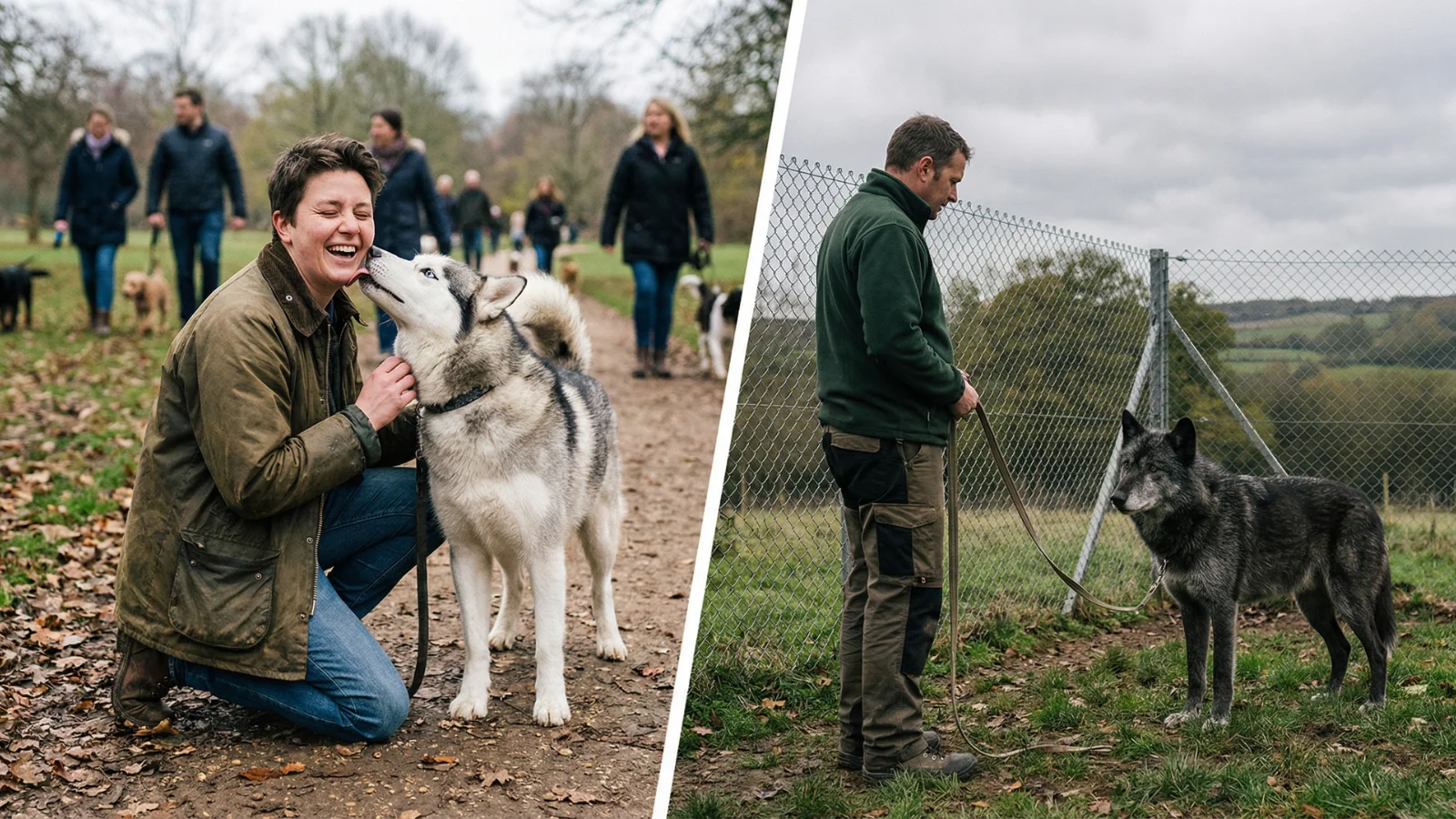
A Husky requires a secure garden with a minimum 6-foot fence. They will dig under or climb over if bored, but standard heavy-duty domestic fencing is usually sufficient to keep them safe.
A Wolf Dog requires specialist reinforced containment far beyond standard domestic fencing. Their jumping ability and jaw strength far exceed that of a domestic dog. High-content hybrids often require 8-to-10-foot reinforced fencing with “lean-ins” at the top and deeply buried concrete perimeters to prevent digging. In practice, local authorities may require reinforced enclosure standards as part of the Dangerous Wild Animals licensing process.
According to guidance from the International Wolf Center, early-generation wolf hybrids often show behavioural traits closer to wild wolves than domestic dogs. Even when outside the garden, securing a Wolf Dog requires heavy-duty, specialised escape-proof gear that goes far beyond the standard dog harness vs collar debate.
5. Prey Drive & Family Suitability
Huskies have a notoriously high prey drive. They are often unsafe around cats, rabbits, or livestock. However, they are highly sociable with humans and are famously good-natured around children, making them excellent (albeit energetic) options for active households looking for the best family dogs in the UK.
Because of their unpredictable behavioural traits and specialist containment needs, wolf dogs are generally not recommended as family pets by most wolf-hybrid rescue organisations and wildlife experts. Organisations such as the International Wolf Center and wolf-hybrid sanctuaries consistently warn that these animals require specialist environments and experienced handlers.
Wolf Dogs also retain a much stronger predatory drive than most domestic breeds. Their predatory sequence — stalking, chasing, and gripping- remains far closer to wild wolf behaviour than to that of domesticated dogs. Behaviour guidance from wolf-hybrid organisations and conservation groups suggests that early-generation wolf hybrids often display stronger prey drive, heightened fear responses, and lower trainability than domestic breeds.
While a Husky might chase a squirrel, a Wolf Dog’s prey drive can be triggered by sudden movements, high-pitched noises, or even a running child. Their pack dynamics are complex, and they frequently challenge for hierarchy as they reach sexual maturity (around 1 to 3 years old).
6. Vocalisation: Barking vs. Howling
If an animal is barking aggressively at the postman, it is almost certainly not a Wolf Dog.
Huskies are incredibly vocal. They “talk,” woo, whine, and throw famous vocal tantrums when they don’t get their way. They do howl, but they also bark frequently during play or when excited.
Wolves and high-content Wolf Dogs rarely bark. Their vocalisation is limited to low-frequency huffs, warning growls, whimpers, and deep, mournful pack howls meant for long-distance communication.
7. Diet & Nutritional Needs
While Huskies can thrive on a high-quality, large-breed dog food or a standard domestic raw diet, their digestive systems are fully adapted to domestic living.
Many owners of high-content Wolf Dogs prefer raw or whole-prey style feeding because it more closely resembles a wild canid diet. However, any feeding plan must still be nutritionally balanced and managed carefully. Feeding a Wolf Dog requires a significant financial commitment to proper, species-appropriate nutrition.
In the Husky vs Wolf dog comparison, the critical distinction is not appearance — it is domestication. A Husky, while demanding, fits within established UK pet ownership frameworks. A wolf dog exists at the edge of legality, manageability, and predictability.
For most UK owners, the Husky already represents a high-energy, escape-prone commitment requiring secure fencing and structured training. Adding wolf genetics magnifies complexity significantly.
If your interest is driven by the allure of owning something “wild,” it is worth reconsidering whether that appeal aligns with responsible ownership. Wolf hybrids are not lifestyle accessories. They are specialised animals requiring extraordinary containment, knowledge, and legal compliance.
In short: Huskies are challenging domestic companions. Wolf dogs are a regulated hybrid with risks that extend beyond standard pet ownership. Understanding that difference is essential before making any decision.
Because of the legal restrictions and the allure of the “wolf” look, the UK market is flooded with fake Wolf Dog breeders who often skirt standard UK dog breeding regulations. These individuals often breed large Alaskan Malamutes with German Shepherds or Siberian Huskies, falsely advertising the puppies as “low-content Wolf Dogs” to inflate the price.
Red Flags to watch for:- 🚩 They claim to sell F1 or F2 hybrids but do not ask to see your Dangerous Wild Animals (DWA) licence.
- 🚩 They promise the puppy will make a “perfect, protective family pet.”
- 🚩 The parents have distinct domestic traits: blue eyes (wolves do not have blue eyes), compact paws, or a typical domestic bark.
Frequently Asked Questions
Is a Husky part wolf?
No. The Siberian Husky is a 100% domesticated dog breed. While all dogs share a distant ancestor with the grey wolf, Huskies have been selectively bred by humans for thousands of years. They are not a recent hybrid.
Can a Wolf Dog be a guard dog?
No. Contrary to popular belief, wolves and Wolf Dogs are naturally neophobic (deeply afraid of new things). When faced with an intruder, a Wolf Dog is much more likely to flee and hide than to stand its ground and protect a property.
Are Wolf Dogs legal to own in the UK?
Yes, but with strict conditions. First (F1) and second (F2) generation hybrids require a Dangerous Wild Animals licence from your local council. Third-generation (F3) and beyond are legally classed as domestic dogs, but still require highly experienced handling.
What is the main physical difference between a Husky and a Wolf Dog?
The most reliable physical markers are the eyes, paws, and head shape. Huskies often have blue or bi-coloured eyes, a distinct “stop” (the angle where the muzzle meets the forehead), and compact snowshoe paws. Wolf Dogs have amber or yellow eyes, a sloped forehead with no distinct stop, massive elongated paws, and generally present a much larger, leggier frame (check out our guide on wolf vs dog size for exact measurements).
Can you train a Wolf Dog like a Husky?
No. Huskies can be trained using standard positive reinforcement techniques. Wolf Dogs operate on survival instincts; they do not possess the domestic dog’s inherent desire to please humans, making them highly unreliable in standard obedience scenarios.
