
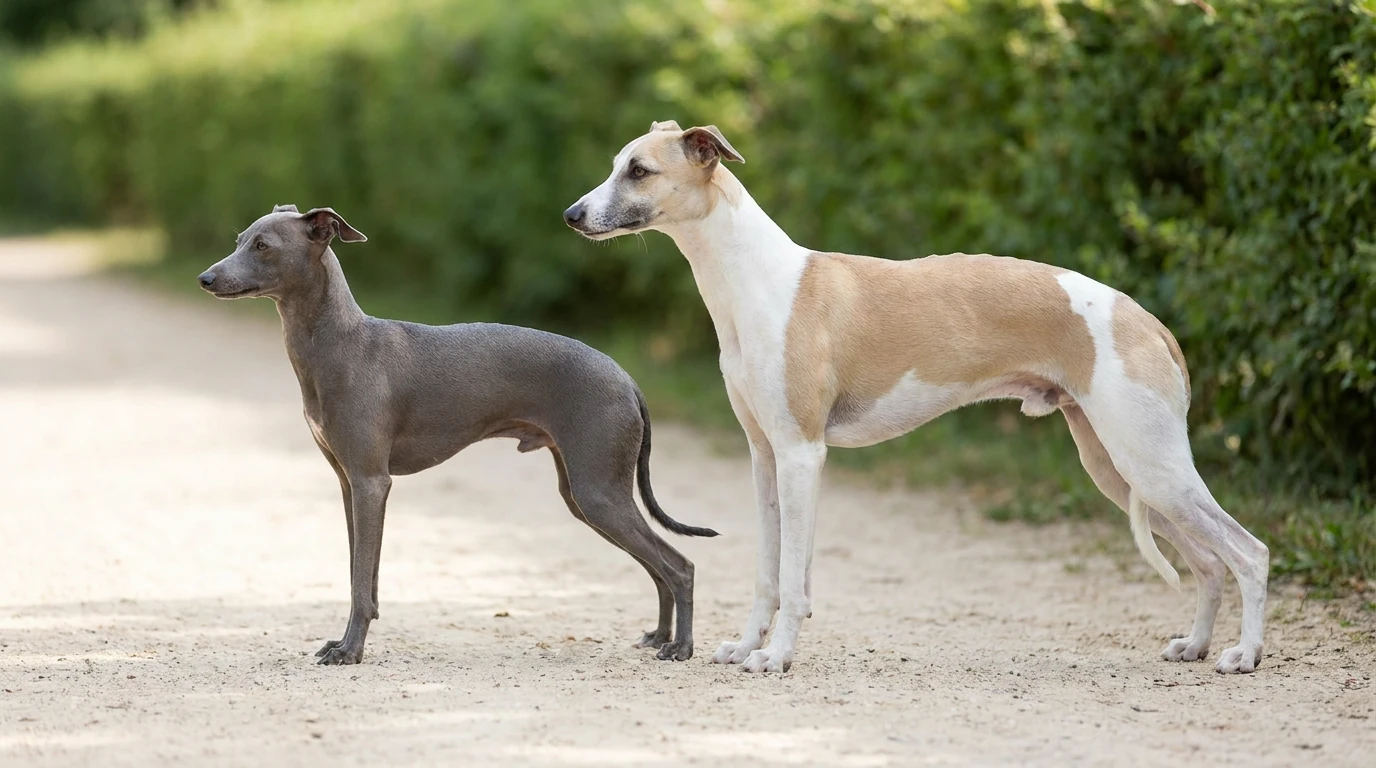
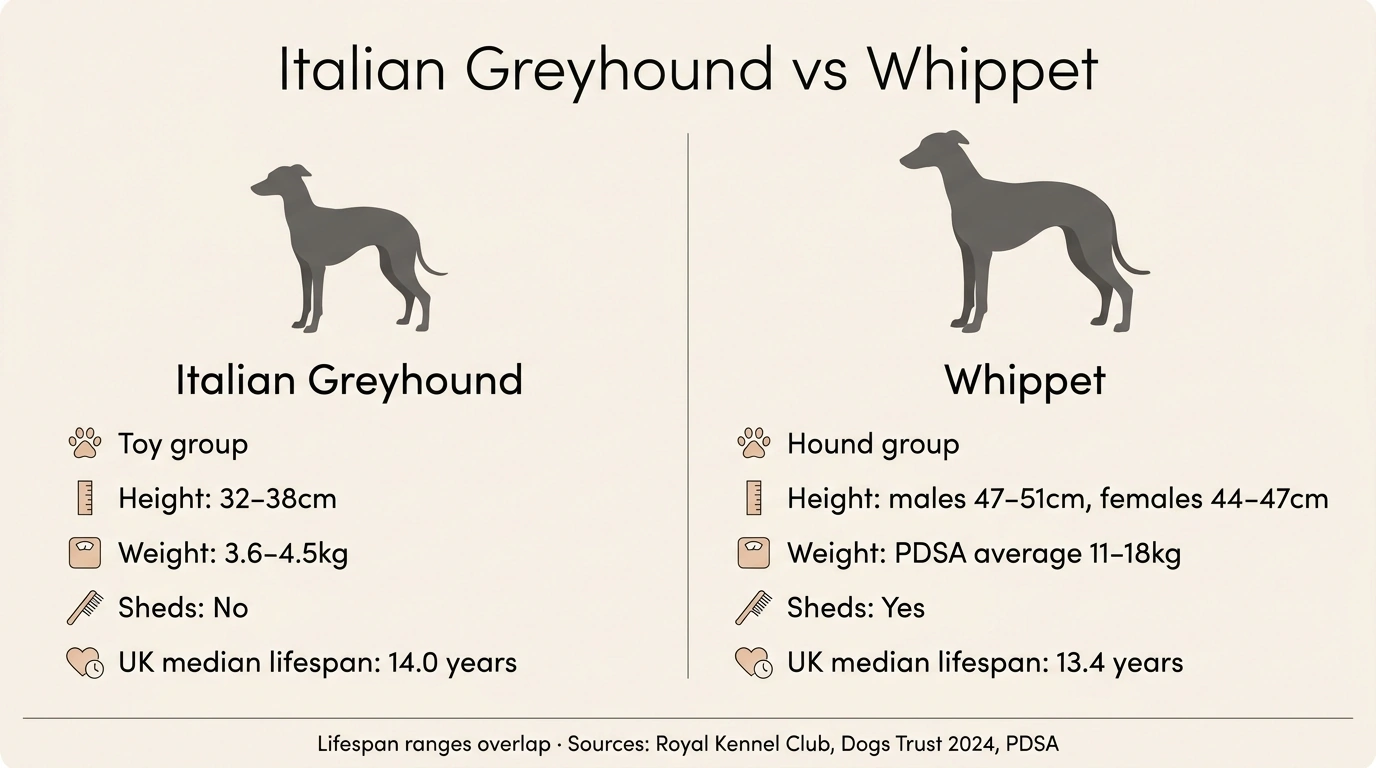
Italian Greyhound vs Whippet comes down to size and household fit. The Royal Kennel Club places the Italian Greyhound in the Toy group at 32–38cm, while Whippet males stand 47–51cm. The RKC gives both up to an hour’s exercise a day, but only the Whippet sheds. PDSA suggests the Whippet for families with slightly older children.
We haven’t owned either breed, so this comparison draws on the Royal Kennel Club breed standards, Dogs Trust’s UK longevity study and PDSA’s breed guides.
TABLE OF CONTENTS
Italian Greyhound vs Whippet at a glance
| Italian Greyhound | Whippet | |
|---|---|---|
| Royal Kennel Club group | Toy | Hound |
| RKC size category | Small | Small |
| Height | 32–38cm (one range for males and females) | Males 47–51cm, females 44–47cm |
| Weight | 3.6–4.5kg (breed standard) | Not given in the breed standard; PDSA gives an average of 11–18kg |
| Coat | Short, fine and glossy | Fine, short and close |
| Colours | Black, blue, cream, fawn, red or white, or any of these broken with white | Any colour or mixture of colours except merle |
| Sheds (RKC) | No | Yes |
| Grooming | Once a week | Once a week |
| Exercise (RKC) | Up to 1 hour a day | Up to 1 hour a day |
| Home and garden | Small house; small or medium garden | Small house; small or medium garden |
| UK median lifespan | 14.0 years (from a smaller group of dogs) | 13.4 years |
| Breed Watch | Category 1 | Category 1 |
| UK legal status | Not a banned type | Not a banned type |
Sources: Royal Kennel Club breed standards and breed pages; lifespans from Dogs Trust’s 2024 UK longevity study; the Whippet’s average weight from PDSA. Breed standard sizes describe the ideal, so an individual dog can be larger or smaller.
A Toy breed and a hound: where each comes from
The Italian Greyhound
The Royal Kennel Club places the Italian Greyhound in its Toy group, the group for small companion breeds. Its breed page says dogs of Italian Greyhound type can be seen on tombs from ancient Egypt and the Roman Empire, and describes a miniature sighthound that keeps the curving outline of the hounds in its ancestry.
The breed standard sums up its character as “elegant, graceful and quick moving”, with a high-stepping action.
The Whippet
The Whippet sits in the Hound group, alongside the other sighthounds. The Royal Kennel Club says dogs of Whippet type were common in the Middle Ages, and that genetic studies have traced the breed back to the Greyhound.
By the 19th century the Whippet was a recognisable breed, used for hunting small game and controlling vermin. Whippet racing later became popular in the mining areas of the North and Wales, as well as London and the Midlands. Today the RKC describes it as a gentle, affectionate family companion.
How to tell an Italian Greyhound from a Whippet
Size and build
Height is the clearest difference. The Royal Kennel Club standard gives the Italian Greyhound an ideal height of 32–38cm at the withers, with one range for males and females, and an ideal weight of 3.6–4.5kg. The Whippet standard gives males 47–51cm and females 44–47cm, and no weight.
Build differs too. The Italian Greyhound standard describes a dog “more slender in all proportions” than a Greyhound, fine-boned with a deep, narrow chest. The Whippet standard asks for a balance of muscular power and strength with elegance, built for speed and work.
Ears, tail and coat
Both breeds have rose-shaped ears that fold back. The Italian Greyhound’s are soft and fine, placed well back and never pricked; the Whippet’s are small and fine in texture.
Tails differ in set and length. The Italian Greyhound’s tail is low-set, long and fine, and carried low. The Whippet’s is long and tapering with no feathering, reaching at least to the hock, and carried in a gentle curve no higher than the back when moving.
Both coats are short. The Italian Greyhound’s is fine and glossy, and its standard allows black, blue, cream, fawn, red or white, or any of these broken with white; merle, brindle, and black or blue with tan markings are unacceptable. The Whippet standard accepts any colour or mixture of colours except merle.
“A greyhound in miniature”?
The Italian Greyhound breed standard opens with the words “A greyhound in miniature”. The Royal Kennel Club’s Whippet page notes that early standards for both the Whippet and the Italian Greyhound used the same phrase.
Since then the three breeds have developed along different paths. The Greyhound is a separate, larger breed in the Hound group, and neither the Italian Greyhound nor the Whippet is simply a scaled-down version of it.
Temperament: what the breed standards and PDSA say
The breed standards use different words. The Italian Greyhound is “intelligent, affectionate and vivacious; may appear aloof”, while the Whippet has a “gentle, affectionate, even disposition” and is described as an ideal companion, adaptable at home and in sport.
PDSA describes Italian Greyhounds as intelligent dogs that often prefer to do their own thing and can be difficult to train. It adds that they can be quite timid, so early socialisation is essential, and that they can be slow to form a bond, though they make a fantastic companion once it is established.
For the Whippet, PDSA notes that it can be a little shy with new people and has a reputation for being slow to learn new things. It still calls the breed a good choice for first-time owners who are patient and consistent, and recommends starting positive, reward-based training early.
PDSA also warns that Whippets dislike being left alone and can suffer from separation anxiety, and only recommends one if someone will be around all day. It says the breed is not known for barking a lot.
No UK study compares the behaviour of the two breeds directly, so these are breed-guide descriptions rather than measured differences.
Exercise, home and grooming
On paper, the two breeds need the same set-up. The Royal Kennel Club gives both up to an hour’s exercise a day, and lists both as suited to a small house with a small or medium garden, in town or country.
Both are sighthounds, so the bigger question is where they run. PDSA says the Whippet has a very high prey drive: keep a tight hold of the lead outside secure areas, and treat a secure garden as a must. For the Italian Greyhound, PDSA notes that once it catches sight of potential prey it can be hard to get back, so exercise in a confined area is recommended.
Grooming is once a week for both, according to the RKC. The difference is shedding: the RKC lists the Italian Greyhound as a breed that doesn’t shed and the Whippet as one that does. PDSA describes the Whippet’s shedding as fairly minimal, with more in spring and autumn.
PDSA has a few more Whippet-specific tips. Its sensitive skin is better suited to a soft brush, it may need a coat in winter because it has so little body fat, and its prominent elbows, shoulders and hips mean it prefers thick, soft bedding. For walks, our dog harness vs collar guide covers the options for narrow-headed breeds.
Lifespan and health: what UK data shows
Italian Greyhound vs Whippet lifespan in the UK
Dogs Trust’s 2024 study gives the Italian Greyhound a median lifespan of 14.0 years and the Whippet 13.4 years.
The gap is too small for the data to say that either breed lives longer. The Italian Greyhound’s figure also comes from a much smaller group of dogs, so it’s less certain. The Royal Kennel Club gives “over 12 years” for both breeds.
Italian Greyhound health
PDSA lists periodontal disease (infection and inflammation of the tissues supporting the teeth), epilepsy, luxating patellas (kneecaps slipping out of place) and progressive retinal atrophy, which causes gradual loss of sight. For help with dental care at home, see our guide to cleaning dog teeth without brushing.
PDSA also notes the breed’s “bone fragility during growth”, which is why it may not be the ideal breed to live with other pets or young children. We found no single-breed UK VetCompass study for the Italian Greyhound.
Whippet health
PDSA lists eye problems, including progressive retinal atrophy, mitral valve disease (a heart condition where a weakened valve lets blood flow back into the heart) and immune-mediated problems, where the body reacts against its own cells.
PDSA also warns that Whippets can cut their skin on thorns, twigs or other sharp objects, can damage their bones running on uneven ground, and can be bruised or cut in boisterous play because their skin is thin. We found no single-breed UK VetCompass study for the Whippet.
Both breeds are in the Royal Kennel Club’s Breed Watch Category 1, which means the RKC currently lists no points of concern specific to either breed.
Before you buy: Ask to see both parents’ health screening results. PDSA recommends checking that an Italian Greyhound puppy’s parents have been screened under the BVA/Kennel Club Canine Health Schemes, and advises screening a Whippet’s parents for progressive retinal atrophy. The Royal Kennel Club also notes a breed club health scheme for the Whippet. Ask your vet to talk you through what the results mean.
Which breed suits which owner
The Italian Greyhound may suit an adult household with no young children or other pets. That is where PDSA’s note on bone fragility during growth points, and its timid streak means it needs patience while it builds a bond. At 32–38cm and 3.6–4.5kg by the breed standard, it is the smaller of the two.
The Whippet suits families with slightly older children who understand when to give a dog space, which is PDSA’s recommendation. It needs someone at home for most of the day and shouldn’t live with smaller pets, given its prey drive.
Both breeds need a safe, enclosed place to run, a lead outside it, and owners who are patient with training. Neither is the better dog; they suit different homes. For other pairs, see our Lhasa Apso vs Shih Tzu comparison or browse all our breed guides.
Frequently Asked Questions
Is an Italian Greyhound smaller than a Whippet?
Yes. The Royal Kennel Club standard gives the Italian Greyhound an ideal height of 32–38cm and an ideal weight of 3.6–4.5kg. Whippet males stand 47–51cm and females 44–47cm; the standard gives no weight, but PDSA gives an average of 11–18kg.
Are Whippets and Italian Greyhounds just small Greyhounds?
No. The Italian Greyhound, the Whippet and the Greyhound are three separate Royal Kennel Club breeds. Early standards for the Italian Greyhound and the Whippet described each as a Greyhound in miniature, but the RKC says all three have since developed along different paths.
Do Italian Greyhounds or Whippets live longer?
Neither, as far as UK data can tell. Dogs Trust’s 2024 UK study gives the Italian Greyhound a median of 14.0 years and the Whippet 13.4 years, but the gap is too small to show a real difference, and the Italian Greyhound figure comes from a smaller group of dogs. The Royal Kennel Club gives over 12 years for both.
Do Italian Greyhounds and Whippets shed?
The Royal Kennel Club lists the Italian Greyhound as a breed that doesn’t shed and the Whippet as one that does. PDSA describes the Whippet’s shedding as fairly minimal, with more in spring and autumn. Both short coats need grooming about once a week.
Are Italian Greyhounds or Whippets better with children?
PDSA recommends the Whippet for homes with slightly older children who understand when to give a dog space. For the Italian Greyhound, PDSA says bone fragility during growth means it may not be the ideal breed for homes with young children. Always supervise dogs with children.
Can Italian Greyhounds and Whippets live with cats?
PDSA says a Whippet may get along with a cat it has grown up with, under supervision, but advises against keeping one with smaller pets because of its high prey drive. For the Italian Greyhound, PDSA says it may not be the ideal breed to live with other pets.
