What’s the best antifungal shampoo for dogs? If your dog has a skin infection, it’s the one your vet prescribes. Blue Cross says to use medicated shampoos only if your vet prescribes them. For keeping skin clean when your vet suggests an over-the-counter wash, a 3% chlorhexidine shampoo such as DOUXO S3 PYO is our pick, with a 4% option, two antiseptic shampoos and wipes for paws below.
This guide uses PDSA and Blue Cross advice, the makers’ own descriptions and directions, and our own experience with Dexter, our Cane Corso: DOUXO S3 PYO is the shampoo his vet suggested for his paws. Every pick is sold without a prescription. Where UK sources say nothing, we’ve said so.
Quick Picks:
Best overall: DOUXO S3 PYO Shampoo: 3% chlorhexidine with a pump, and the shampoo Dexter’s vet suggested.
Best higher-strength pick: Clorexyderm 4% Shampoo: 4% chlorhexidine with lanolin and glycerin.
Best for smelly dogs: Aqueos Antibacterial Dog Shampoo: a 1 litre antiseptic shampoo that its maker says tackles fox and badger smells.
Best budget: Safe4 Vet Care Animal Shampoo: an antimicrobial shampoo in the lowest price band.
Best for paws between baths: DOUXO S3 PYO Pads: no-rinse 3% chlorhexidine pads for paws and skin folds.
TABLE OF CONTENTS
What antifungal shampoo for dogs can and can’t do
Bacteria and yeasts live on every dog’s skin without causing problems. If the skin is damaged, an infection can take hold, and PDSA says a yeast infection may give your dog a greasy coat and a sour smell. Antifungal and antibacterial shampoos are made to clean that skin with an antiseptic, most often chlorhexidine.
What they can’t do is tell you what’s wrong. Itching, a smell or flaky skin can come from fleas, an allergy, an infection or something else, and each needs something different. Blue Cross’s advice is clear: only use medicated shampoos if your vet prescribes them. None of the UK charities we checked names an over-the-counter antifungal shampoo, and we found no Dogs Trust advice on medicated shampoos.
FlexK9 Health Disclaimer: This guide is general information, not veterinary advice. If your dog has sore, smelly, itchy, flaky or broken skin, hair loss or any other skin problem, see your vet before using any shampoo, and follow their advice on which product to use and how often.
For a plain guide to what different skin problems look like, see PDSA’s overview of skin problems in dogs.
Shampoos your vet prescribes
Some medicated shampoos are licensed veterinary medicines. Malaseb, which contains miconazole and chlorhexidine, is one of them, and the Veterinary Medicines Directorate lists it as prescription-only. In the UK, a prescription-only veterinary medicine can only be supplied once a vet has prescribed it. That’s why it isn’t one of our picks. If you think your dog needs it, book a vet appointment rather than buying an over-the-counter alternative.
When to see your vet before using an antifungal shampoo for dogs
Book a vet appointment first if your dog:
- has a skin problem that hasn’t cleared up in a few days
- has blood or pus coming from their skin (see a vet as soon as possible)
- has red, wet, weeping patches that appeared quickly, known as hot spots
- has circular patches of hair loss with red, crusty skin
- is scratching more than usual
PDSA says skin conditions can be very uncomfortable and often painful, and that waiting can lead to more serious problems.
Ringworm
Ringworm isn’t a worm. It’s a fungal skin infection that can spread to people and other animals. It usually needs a vet’s treatment: often clipping the coat, a medicated shampoo and antifungal medicine. PDSA’s ringworm guide says the anti-fungal bath is given once or twice a week until the infection clears, which often takes a few weeks.
Blue Cross recommends wearing gloves and an apron when treating a dog with ringworm, keeping children from touching your dog, and cleaning your home thoroughly, because the spores can live in the environment for a long time. Don’t treat ringworm with any of the shampoos below unless your vet tells you to.
Itching, dandruff and fleas
If the main problem is itchy, dry or flaky skin, see our guide to the best shampoo for dogs with itchy skin. For fleas, see our guide to flea shampoo for dogs. For a healthy dog that just needs a wash, our best dog shampoo guide covers everyday picks. Ear problems are a separate job for your vet; our guide to dog ear infections explains why.
How to use a chlorhexidine shampoo safely
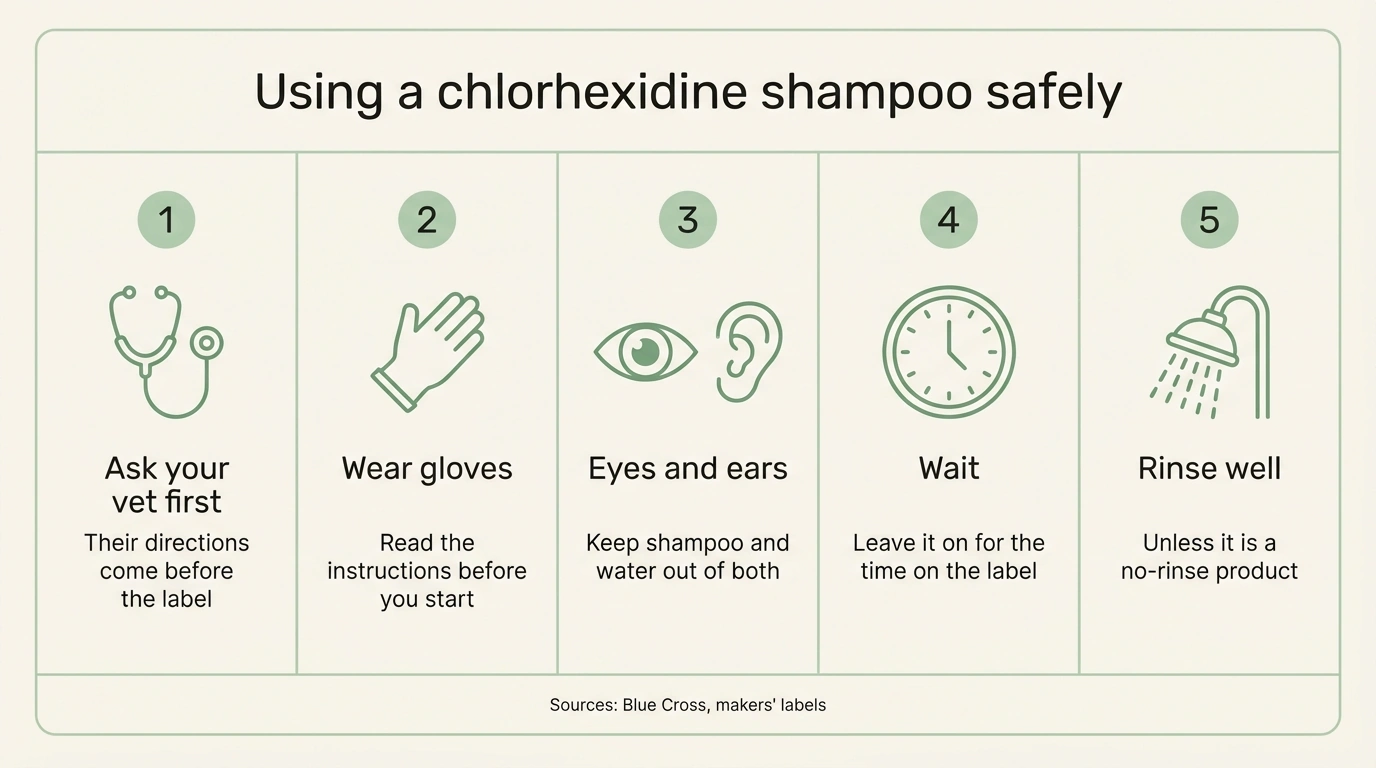
Chlorhexidine is an antiseptic, and every pick below except Aqueos lists it as an active ingredient. Each maker gives its own directions, and they differ, so read the label on your bottle. These steps come from Blue Cross and the makers:
- Ask your vet first if your dog has a skin problem, and follow their directions over the label’s.
- Wear gloves, and read the instructions carefully before you start.
- Wet the coat, apply the shampoo and work it into the skin.
- Keep it out of your dog’s eyes and ears.
- Leave it on for the contact time on the label: DOUXO says 5 to 10 minutes, and Clorexyderm’s UK distributor says 5 to 7 minutes.
- Rinse thoroughly, unless it’s a no-rinse product such as the pads.
Keep it out of the ears: Wash around your dog’s ears, not inside them. Don’t let water or shampoo run into the ear canal. If your dog’s ears are red, smelly or itchy, that’s one for your vet.
How we chose these antifungal shampoos for dogs
We checked every antifungal shampoo for dogs on our shortlist against four things:
- Sold without a prescription. No licensed veterinary medicine is listed here.
- The active ingredient and its strength, as each maker states it.
- The maker’s own directions, including how long to leave it on.
- In stock on Amazon UK from a reliable seller when we checked.
DOUXO S3 PYO Shampoo is the only product here we’ve used on Dexter. The rest were chosen on their makers’ specifications, ingredients and directions, not on buyer reviews or star ratings. The price bands compare the picks on this page.
Chlorhexidine shampoos
Best overall antifungal shampoo for dogs
1. DOUXO S3 PYO Shampoo

- Antiseptic: 3% chlorhexidine digluconate with Ophytrium, according to Ceva.
- Contact time: Leave on for 5 to 10 minutes before rinsing, as the maker directs.
- Easy dosing: A pump and a visibility line on the 200ml bottle.
- Free from: Soaps, sulphates, parabens and colourings, its maker says.
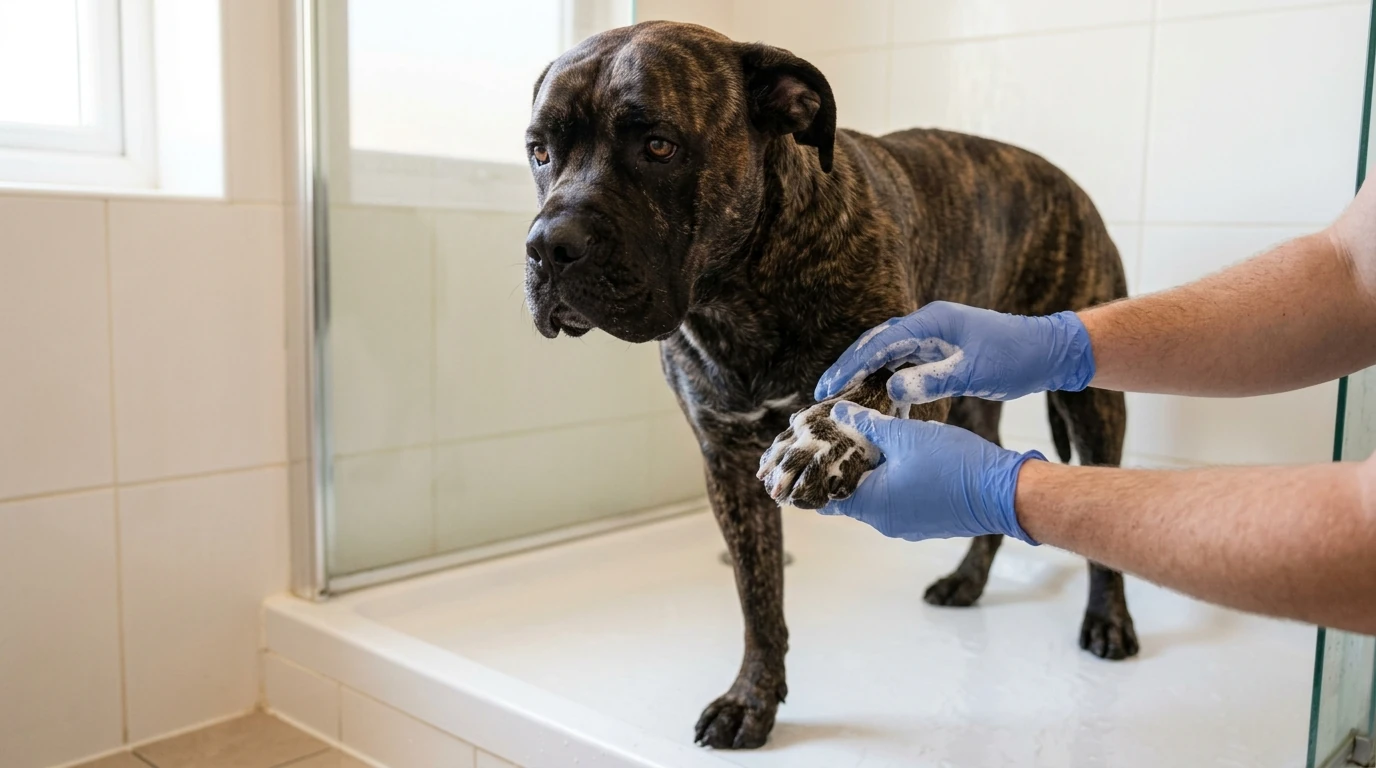
🐾 Used on Dexter: When Dexter was licking his paws, our vet suggested a gentle wash with DOUXO S3 PYO, or the foam from the same range. We went with the shampoo, and I still use it at bath time on his paws and the outside of his ears. I never wash inside his ears, and I keep water and shampoo out of them.
Why it’s a top pick:
DOUXO S3 PYO is an antiseptic shampoo with 3% chlorhexidine digluconate, plus Ophytrium, which its maker Ceva says supports the skin’s barrier. It comes with a dosing pump and a visibility line, so you can see how much is left. Ceva’s UK page says to seek veterinary advice if your pet shows signs of a skin problem, which fits the way we’d use it: alongside your vet, not instead of them. It’s also the one Dexter’s vet suggested for his paws.
Specifications:
- Type: Shampoo (rinse off)
- Size: 200ml
- Active ingredient (maker): 3% chlorhexidine digluconate, Ophytrium
- Contact time (maker): 5 to 10 minutes
- Pets (maker): Dogs and cats
- Best for: An over-the-counter antiseptic wash your vet has suggested
✅ Reasons to Buy:
- Clear strength: 3% chlorhexidine, printed on the listing.
- Easy to measure: a dosing pump and a visibility line on the bottle.
- Free of the usual extras: Ceva says it’s free from soaps, sulphates, parabens and colourings.
- Part of a range: the same formula comes as a mousse and as pads for spot cleaning.
💡 Good to know before you buy:
- Leave it on: Ceva’s directions say to wait 5 to 10 minutes before rinsing, so plan a longer bath.
- There’s a no-rinse version: if your vet suggests the foam instead, it’s sold as DOUXO S3 PYO Mousse.
❌ Reasons to Avoid:
- Small bottle for a big dog: 200ml won’t go far on a large, long-coated dog.
- It has a scent: a light coco-vanilla fragrance, which won’t suit owners who want an unscented product.
📝 Mini Verdict:
The pick for most owners whose vet has suggested a chlorhexidine wash. If your dog hasn’t seen a vet about their skin yet, start there instead.
Best higher-strength pick
2. Clorexyderm 4% Shampoo

- Higher strength: 4% chlorhexidine digluconate, according to its maker.
- Moisturisers: Lanolin and glycerin in the formula.
- Contact time: 5 to 7 minutes, according to its UK distributor Nextmune.
- Puppies: The label says to ask your vet before using it on puppies.
Why it’s a top pick:
Clorexyderm has the highest chlorhexidine level on this page: 4% chlorhexidine digluconate, with lanolin and glycerin, which its UK distributor Nextmune says help moisturise the skin. The distributor gives a shorter contact time than most, at 5 to 7 minutes, which makes a long bath easier on a dog that won’t stand still. It’s sold for dogs, cats and horses, and says it can be used two to three times a week.
Specifications:
- Type: Shampoo (rinse off)
- Size: 200ml
- Active ingredient (maker): 4% chlorhexidine digluconate, lanolin, glycerin
- Contact time (maker): 5 to 7 minutes
- Pets (maker): Dogs, cats and horses
- Best for: Owners whose vet has suggested a 4% chlorhexidine wash
✅ Reasons to Buy:
- Highest strength here: 4% chlorhexidine, according to its maker.
- Shorter wait: a 5 to 7 minute contact time, according to the distributor.
- Moisturisers added: lanolin and glycerin in the formula.
- Bigger size available: a 1 litre bottle of the same shampoo is also sold.
💡 Good to know before you buy:
- Check with your vet for puppies: the label’s warnings say to consult a vet before using it on puppies, pregnant or nursing dogs, or dogs that are unwell.
- Directions vary between listings: the Amazon listing gives 5 to 10 minutes and Nextmune gives 5 to 7, so follow the bottle in your hand.
❌ Reasons to Avoid:
- Highest price band here: for a 200ml bottle.
- Small bottle for the price: 200ml, and the 1 litre size costs a lot more.
📝 Mini Verdict:
A good choice if your vet has suggested a 4% chlorhexidine shampoo. Skip it for a young puppy unless your vet says it’s fine.
Antiseptic shampoos for everyday hygiene
Best antiseptic shampoo for smelly dogs
3. Aqueos Antibacterial Dog Shampoo

- Tested: To EN1276, EN1650 and EN14476 disinfectant standards, according to Aqueos.
- Gentle base: Alcohol-free, paraben-free and pH-neutral, its maker says.
- Contact time: Leave on for 2 minutes before rinsing.
- Size: A 1 litre bottle for dogs of all ages.
Why it’s a top pick:
Aqueos is an antiseptic shampoo rather than a chlorhexidine one. Its maker says it has been tested to the European disinfectant standards for bacteria (EN1276), fungi (EN1650) and viruses (EN14476), with less than 1% active ingredient. It’s alcohol-free and paraben-free, and it comes in a 1 litre bottle that the maker says works on fox and badger smells. It’s the pick for a dog that comes home smelling of something it rolled in.
Specifications:
- Type: Shampoo (rinse off)
- Size: 1 litre
- Active ingredient (maker): Not named on the listing (less than 1% active ingredient)
- Contact time (maker): 2 minutes
- Pets (maker): Dogs of all ages, including puppies
- Best for: Antiseptic washing and smells on a healthy dog
✅ Reasons to Buy:
- Tested to disinfectant standards: EN1276, EN1650 and EN14476, according to its maker.
- Big bottle: 1 litre, in the middle price band.
- Gentle base: alcohol-free and paraben-free, its maker says, and pH-neutral.
- Short contact time: 2 minutes, in the maker’s directions.
💡 Good to know before you buy:
- Patch test first: the maker suggests trying it on a small area the first time you use it.
- For itchy skin, see your vet: if your dog is scratching, that’s a vet question first, and our itchy skin shampoo guide covers that job.
❌ Reasons to Avoid:
- Active ingredient not named: the listing doesn’t say what the antiseptic is.
- Not a chlorhexidine shampoo: if your vet has suggested chlorhexidine, choose card 1 or 2.
📝 Mini Verdict:
A large antiseptic shampoo for smelly or muddy dogs with healthy skin. It isn’t a substitute for a shampoo your vet prescribes.
Best budget pick
4. Safe4 Vet Care Animal Shampoo

- Antimicrobial: Contains chlorhexidine digluconate and PHMB, according to Safe4.
- Contact time: Leave the lather on for 2 to 3 minutes, then rinse.
- pH-neutral: Made in the UK, according to the listing.
- Refill: A 5 litre refill with a pump is also sold.
Why it’s a top pick:
Safe4’s Vet Care shampoo is made in the UK and sold as a professional antimicrobial shampoo. It carries antimicrobial ingredients including chlorhexidine digluconate and PHMB, according to its Blackberry version’s listing (Safe4 says the Peach and Blackberry versions are the same formula). It’s pH-neutral, the maker says, and it’s in the lowest price band here for a 500ml bottle, with a 5 litre refill sold separately. The contact time is short, at 2 to 3 minutes.
Specifications:
- Type: Shampoo (rinse off)
- Size: 500ml
- Active ingredient (maker): Chlorhexidine digluconate, PHMB, chlorocresol (strengths not stated)
- Contact time (maker): 2 to 3 minutes
- Pets (maker): Animals (sold as a dog shampoo)
- Best for: A budget antiseptic wash for healthy skin
✅ Reasons to Buy:
- Lowest price band: the cheapest pick on this page.
- Short contact time: 2 to 3 minutes, in the maker’s directions.
- Refill size: a 5 litre bottle with a pump is sold for topping up.
- Made in the UK: according to the listing.
💡 Good to know before you buy:
- Two scents, one formula: it’s sold in Peach and Blackberry, and the maker says they’re the same shampoo.
❌ Reasons to Avoid:
- Strengths not stated: the listing names the antiseptics but not how much of each.
- Contains SLES: a sulphate-based cleanser, unlike DOUXO, which its maker says is sulphate-free.
📝 Mini Verdict:
The budget pick for an antiseptic wash on a healthy dog. If your vet has suggested a set chlorhexidine strength, choose DOUXO or Clorexyderm instead.
No-rinse wipes for paws and folds
Best for paws between baths
5. DOUXO S3 PYO Pads

- No rinse: 30 pads with 3% chlorhexidine digluconate and Ophytrium.
- Targeted: Made for paws, skin folds and hard-to-reach areas.
- Directions: Wipe once a day for 2 to 3 weeks, keeping it away from the eyes.
- Ages: For dogs and cats of any age, according to the pack.
Why it’s a top pick:
These are the DOUXO S3 PYO formula on 30 pads: 3% chlorhexidine digluconate with Ophytrium, made for paws, skin folds and other hard-to-reach areas, and you don’t rinse them off. That suits a big dog whose paws need attention more often than the rest of them needs a bath. The pack’s directions on Boots say to wipe the areas once a day for 2 to 3 weeks, and that they’re suitable for dogs and cats of any age.
Specifications:
- Type: Pads (no rinse)
- Size: 30 pads
- Active ingredient (maker): 3% chlorhexidine digluconate, Ophytrium
- Contact time (maker): No rinse; wipe once a day for 2 to 3 weeks
- Pets (maker): Dogs and cats of any age
- Best for: Paws and skin folds between baths
✅ Reasons to Buy:
- No bath needed: wipe and leave, with no rinsing.
- Same strength as the shampoo: 3% chlorhexidine, according to Ceva.
- Sized for small areas: paws and skin folds.
- Any age: suitable for dogs of any age, according to the pack’s directions.
💡 Good to know before you buy:
- Keep away from the eyes: the directions say not to get the solution in the eyes.
- Pair with the shampoo: it’s the same formula as card 1, so it fits alongside a DOUXO bath routine your vet has suggested.
❌ Reasons to Avoid:
- 30 pads only: a big dog’s four paws can use several pads a day.
- Not for the whole body: for a full wash, you’ll need a shampoo.
📝 Mini Verdict:
Handy for paws and folds between baths, especially on a large dog. For anything wider than a few patches, use a shampoo and see your vet.
Antifungal Shampoo for Dogs Prices Compared
| Pick | Size | Active ingredient (maker) | Price band |
|---|---|---|---|
| DOUXO S3 PYO Shampoo | 200ml | 3% chlorhexidine | ££ |
| Clorexyderm 4% Shampoo | 200ml | 4% chlorhexidine | £££ |
| Aqueos Antibacterial Dog Shampoo | 1 litre | Not named (under 1%) | ££ |
| Safe4 Vet Care Animal Shampoo | 500ml | Chlorhexidine, PHMB, chlorocresol | £ |
| DOUXO S3 PYO Pads | 30 pads | 3% chlorhexidine | £££ |
Final Thoughts: Which Antifungal Shampoo for Dogs Should You Buy?
- If your vet has suggested a chlorhexidine wash, start with DOUXO S3 PYO Shampoo.
- If your vet wants a 4% chlorhexidine shampoo, choose Clorexyderm 4% Shampoo.
- If your healthy dog comes home smelling of fox, try Aqueos Antibacterial Dog Shampoo.
- If you want the lowest-priced antiseptic wash, choose Safe4 Vet Care Animal Shampoo.
- If you need to clean paws or skin folds between baths, use DOUXO S3 PYO Pads.
- If your dog has sore, broken or weeping skin, or you think it’s ringworm, see your vet before buying anything.
For everyday washing once your dog’s skin is healthy, see our guide to the best dog shampoo.
Frequently Asked Questions About Antifungal Shampoo for Dogs
Can I buy Malaseb without a prescription?
No. The Veterinary Medicines Directorate lists Malaseb as a prescription-only veterinary medicine, so in the UK it can only be supplied once a vet has prescribed it. If you think your dog needs it, book a vet appointment. Your vet can tell you whether it’s the right shampoo and how often to use it.
Can I use Hibiscrub on my dog?
Ask your vet first. Hibiscrub is an antiseptic wash made for people, and none of the UK animal charities we checked gives advice on using it on dogs. PDSA recommends a dog-specific shampoo, and there are chlorhexidine shampoos made for dogs, like the picks on this page.
Can I use a human antifungal shampoo on my dog?
No, use a shampoo made for dogs. PDSA says human shampoos can irritate a dog’s skin and recommends a dog-specific shampoo. If your dog has a skin problem, ask your vet which product to use rather than borrowing one from the bathroom cabinet.
How often should I use an antifungal shampoo on my dog?
Follow your vet’s advice, or the label if your vet hasn’t given you a plan. No UK charity gives a schedule for over-the-counter antifungal shampoos. Makers’ directions vary: Clorexyderm’s UK distributor says two to three times a week, and DOUXO S3 PYO Pads are wiped on once a day for two to three weeks. For ringworm, PDSA says vets usually prescribe a bath once or twice a week until it clears.
Is chlorhexidine shampoo safe for dogs?
Chlorhexidine shampoos made for dogs are sold for use on dogs, as long as you follow the label. Keep the shampoo out of your dog’s eyes and ears, and wear gloves, as Blue Cross advises for medicated products. Clorexyderm’s label says to ask your vet before using it on puppies, pregnant or nursing dogs, or a dog that’s unwell. If the skin looks worse, stop and call your vet.
Can people catch ringworm from a dog?
Yes. PDSA says ringworm is a fungal infection that can spread from dogs to people and other animals. Blue Cross recommends wearing gloves and an apron when you treat your dog, keeping children from touching them, and cleaning your home thoroughly. If you think you’ve caught it, see your doctor.
Can I use antifungal shampoo on a puppy?
Only if the label says it’s suitable for puppies, and ideally after asking your vet. Labels differ: DOUXO S3 PYO Pads are for any age and Aqueos says all ages, but Clorexyderm’s label says to ask your vet before using it on puppies. A puppy with sore or patchy skin should see a vet, as PDSA says puppies are among the dogs most at risk of serious ringworm.
